


Updated:July 8th, 2026

SEO for Dentists: How It Works, What It Costs & Who to Hire

Written by

Reviewed by

Why Does SEO for Dentists Work Differently Than Other Industries?

Search engine optimization for dentists is the process of optimizing a dental practice’s online presence so it appears when local patients search for the services you offer – from routine cleanings to emergency extractions to cosmetic work.

Most practices lose potential patients every week not because of poor care, but because a competing practice shows up first on Google and gets the call.

What makes dental different?

Google holds dental health content to elevated YMYL (Your Money or Your Life) quality standards, which means visibility here is earned through demonstrated credibility (not just optimization tricks).

SEO for Dentists How It Works What It Costs and Who to Hire

At Growth Saloon, we’ve run SEO campaigns across some of the most competitive search terms and verticals on the internet, and dental is no exception.

Patient searches are high-intent, locally concentrated, and conversion-ready – meaning the person typing “dentist near me” is not doing research, they’re choosing a provider right now.

The practices that invest in organic search build a compounding pipeline of web traffic and new patient appointments that grows month over month, without paying per click every time someone searches.

This guide covers how dental SEO works, which strategies drive results, what a monthly retainer realistically costs, how to hire a legitimate partner, and how to spot scams before signing.

Growth Saloon helps dental practices build the kind of digital presence that consistently generates qualified new patient inquiries – not just clicks.

Contact our team today to find out how our dental marketing services can lower your cost per new patient and grow your practice.

What Is SEO for Dentists?

SEO for dentists is the practice of optimizing a dental website and Google Business Profile to rank higher in local search engine results and attract new patients.

It’s not a single tactic – it’s a coordinated system of signals that tells Google your practice is the most relevant, trustworthy result for a patient searching in your area.

According to Google’s Search Quality Evaluator Guidelines, health pages should be written by people with appropriate medical expertise and updated regularly.

Dental content meets that threshold – which means dental SEO isn’t just about visibility.

It’s about demonstrating credibility.

What Does Dental SEO Include?
Google’s Business Profile lets you manage how your local business appears across Google Search and Maps – it’s the first thing most patients see before visiting your website.

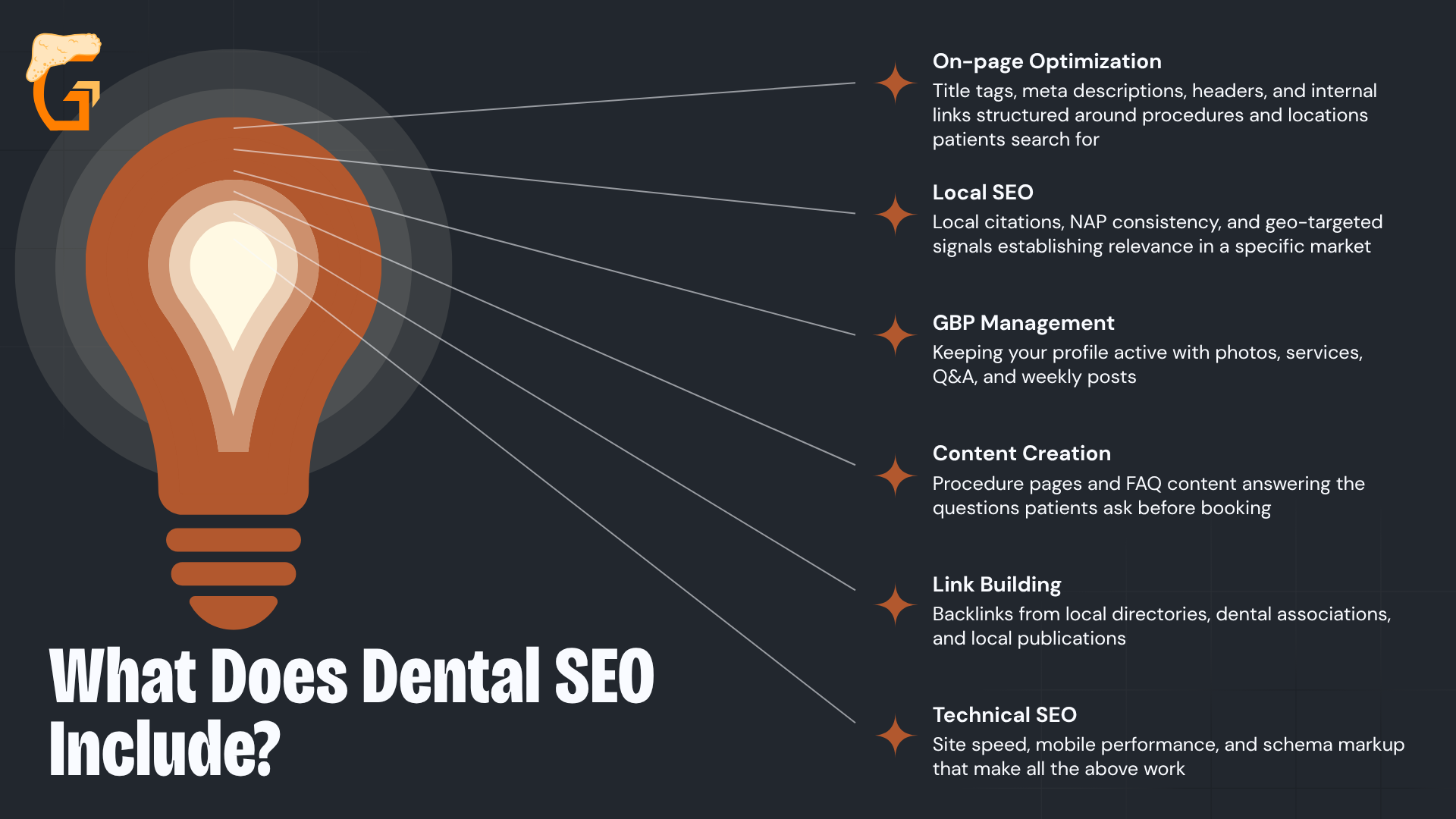
Dental SEO builds on that foundation with six integrated service components:

  • On-page optimization: Title tags, meta descriptions, headers, and internal links structured around procedures and locations patients search for
  • Local SEO: Local citations, NAP consistency, and geo-targeted signals establishing relevance in a specific market
  • GBP management: Keeping your profile active with photos, services, Q&A, and weekly posts
  • Content creation: Procedure pages and FAQ content answering the questions patients ask before booking
  • Link building: Backlinks from local directories, dental associations, and local publications
  • Technical SEO: Site speed, mobile performance, and schema markup that make all the above work

These components function as a system, not a checklist.

Poor technical SEO undermines strong content and search rankings, and content without local signals won’t convert search intent into appointments.

How Is Dental SEO Different from General SEO?

Google’s guidance on helpful content makes clear that E-E-A-T carries extra weight for YMYL topics – and dental content qualifies.

Four distinctions define dental SEO:

  • Hyper-local targeting: Patients search “dentist near me,” “emergency dentist,” or “dentist [city]” – not national terms
  • YMYL/E-E-A-T requirements: Dentist credentials, reviewed content, and author transparency are baseline expectations, not extras
  • Procedure-specific intent: High-value patients searching for a cosmetic dentist, Invisalign, implants, or emergency dental care need dedicated pages, not generic “services” copy
  • Practice-side ownership: SEO is typically managed by the owner, office manager, or a marketing coordinator; onboarding should reflect that

Because Google scrutinizes dental content more rigorously than general niches, credential display is table stakes for online visibility.

A practice page that doesn’t identify who wrote or reviewed its content starts the evaluation behind competitors who do.

Dentists fielding pitches from every marketing channel face a real resource question: where does the budget go first? This section answers the one that comes up most – is SEO worth it, or should the practice just run ads?

Growth Saloon helps dental practices build the kind of digital presence that consistently generates qualified new patient inquiries – not just clicks.

Contact our team today to find out how our dental marketing services can lower your cost per new patient and grow your practice.
Do Dentists Need SEO? How Does It Compare to Google Ads and Other Channels?

Dentists benefit from SEO because most patients search online before booking, and unlike Google Ads, SEO drives compounding organic patient acquisition that doesn’t stop when ad spend does.

Which channel deserves priority depends on where the practice is in its growth cycle.

Why Is Local SEO Especially Valuable for Dental Practices?

Patients actively searching “dentist near me” are not browsing – they’re at the bottom of the decision funnel, ready to book.

That makes local search the highest-intent acquisition channel available to most dental practices.

Local SEO delivers measurable advantages that other channels struggle to match:

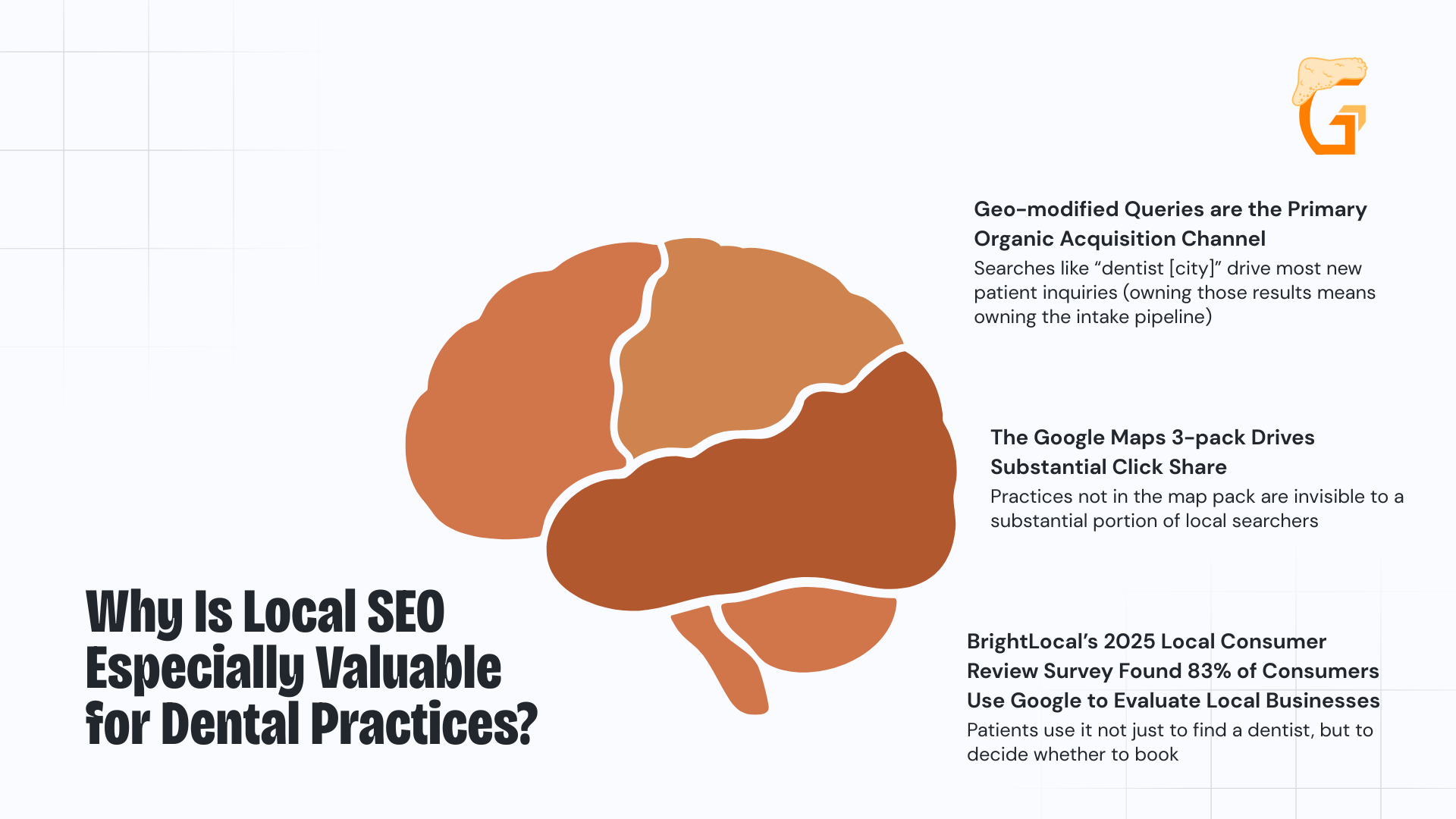
  • Geo-modified queries are the primary organic acquisition channel: searches like “dentist [city]” drive most new patient inquiries; owning those results means owning the intake pipeline
  • The Google Maps 3-pack drives substantial click share: practices not in the map pack are invisible to a substantial portion of local searchers
  • BrightLocal’s 2025 Local Consumer Review Survey found 83% of consumers use Google to evaluate local businesses: patients use it not just to find a dentist, but to decide whether to book

When the audience is already ready to act, priority goes to search visibility at the moment of decision – making GBP and local SEO the highest-leverage starting point.

How Does SEO Compare to Google Ads for Dental Patient Acquisition?

This isn’t a binary choice.

Both channels serve dental practices at different stages.

A side-by-side look:

  • Cost-per-acquisition: WordStream’s 2025 Google Ads Benchmarks put average dental CPC at $7.85 with a cost-per-lead of $83.93; SEO has no cost-per-click and produces a lower cost-per-patient over a 12–24 month horizon for established practices
  • Longevity: Organic rankings persist after investment slows; ads stop producing the moment spend stops
  • Lead quality: Organic searchers on a specific procedure page show higher booking intent than broad-match ad audiences
  • Time-to-results: Ads deliver in days; SEO takes 6–12 months to compound into measurable organic patient inquiry volume

SEO works best as the long-term foundation of the acquisition mix.

Paid search, referrals, and direct mail fill short-term gaps while organic builds.

Practices that outperform in local rankings at year three started investing in year one.

When Is SEO the Wrong Choice for a Dental Practice?

SEO is not the right primary channel in every situation.

A brand-new practice needing immediate chair fills should pair dental SEO services with Google Ads in year one – organic takes 6–12 months, which is too long on an empty schedule.

A hyper-saturated metro competing against incumbents with decade-long SEO investments requires realistic milestone planning.

Most practices see meaningful ranking movement in 4–6 months and measurable patient inquiry growth between 6–12 months.

If the practice isn’t positioned to think 12 months out, that’s useful information – and the right partner will say so.

Effective dental SEO in 2026 requires layering multiple strategies simultaneously – single-tactic approaches plateau.

GBP without technical health stalls.

Great content without online reviews loses the 3-pack to a leaner competitor with more stars.

Growth Saloon helps dental practices build the kind of digital presence that consistently generates qualified new patient inquiries – not just clicks.

Contact our team today to find out how our dental marketing services can lower your cost per new patient and grow your practice.
What Dental SEO Strategies Actually Work in 2026?

Effective dental SEO in 2026 combines Google Business Profile optimization, on-page content for high-intent procedures, technical site health, and consistent patient review acquisition.

No single layer is sufficient.

How Should Dentists Optimize Their Google Business Profile?

Your GBP is the first thing most patients in your local area see – before your website, before anything else.

It’s the highest-leverage local SEO asset a dental practice controls.

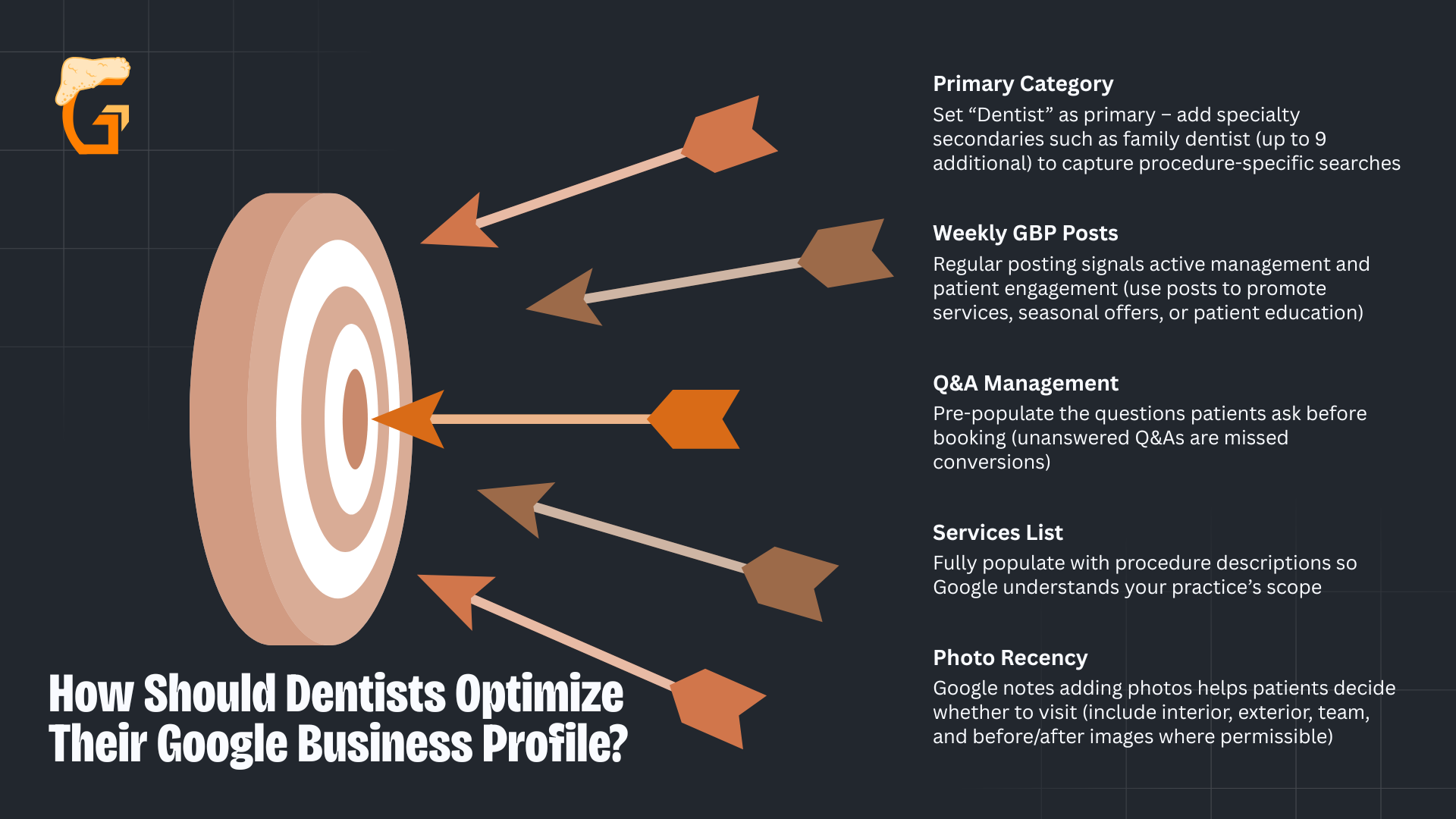
Prioritize these five areas when building out your GBP:

  • Primary category: Set “Dentist” as primary; add specialty secondaries such as family dentist (up to 9 additional) to capture procedure-specific searches
  • Weekly GBP posts: Regular posting signals active management and patient engagement; use posts to promote services, seasonal offers, or patient education
  • Q&A management: Pre-populate the questions patients ask before booking; unanswered Q&As are missed conversions
  • Services list: Fully populate with procedure descriptions so Google understands your practice’s scope
  • Photo recency: Google notes adding photos helps patients decide whether to visit; include interior, exterior, team, and before/after images where permissible

GBP management is ongoing, not a one-time setup.

Google rewards active, complete profiles – a stale one loses ground to competitors posting weekly.

What On-Page and Content SEO Should Dental Websites Prioritize?

Generic “we offer dental services” pages don’t rank for high-value procedure queries.

Content must map directly to the search queries patients enter.

Because Google rewards specificity over generality, dental websites need these content assets:

  • Dedicated procedure pages: Individual pages for Invisalign, implants, veneers, emergency dental, cosmetic dentistry, and pediatric dentist services; each targeting a specific keyword at 1,500+ words
  • City or neighborhood landing pages: Multi-location or geo-expanding practices need locally relevant location pages, not duplicated copy with a city name swapped in
  • FAQ schema markup: Structured data on procedure pages positions content for People Also Ask and AI Overview placement; table stakes for 2026
  • Author bios with dentist credentials: The E-E-A-T signal Google’s quality raters look for; a page without author attribution starts behind

These pages work as a system: homepage and GBP point to procedure pages, which cross-link to related services.

Isolated pages consistently underperform interconnected content clusters.

How Do Technical SEO and Patient Reviews Affect Dental Rankings?

Well-optimized content doesn’t rank on a slow site with no reviews.

Technical health and review velocity determine whether everything else works.

From page speed to patient feedback, these elements form the technical foundation:

  • Core Web Vitals: LCP ≤ 2.5s, INP ≤ 200ms, CLS ≤ 0.1 at the 75th percentile of real-user data; vital on mobile devices, where most dental searches happen
  • Mobile-first indexing: Google indexes the mobile version first; poor mobile optimization is penalized
  • Dental schema markup: LocalBusiness, Dentist, and MedicalOrganization schema types give Google explicit practice signals
  • HTTPS: Non-negotiable; an unsecured dental site triggers browser warnings that kill conversions before SEO matters
  • Review velocity: Ask at checkout and via follow-up text or email; consistent, ethical requesting compounds over time
  • Review response: Respond to every review to protect your online reputation; Google’s local algorithm weighs recency, volume, and response rate

A practice with 200 reviews and active responses consistently outranks one with better content but stale, unresponded reviews.

What Does 2026-Specific SEO Mean for Dental Practices?

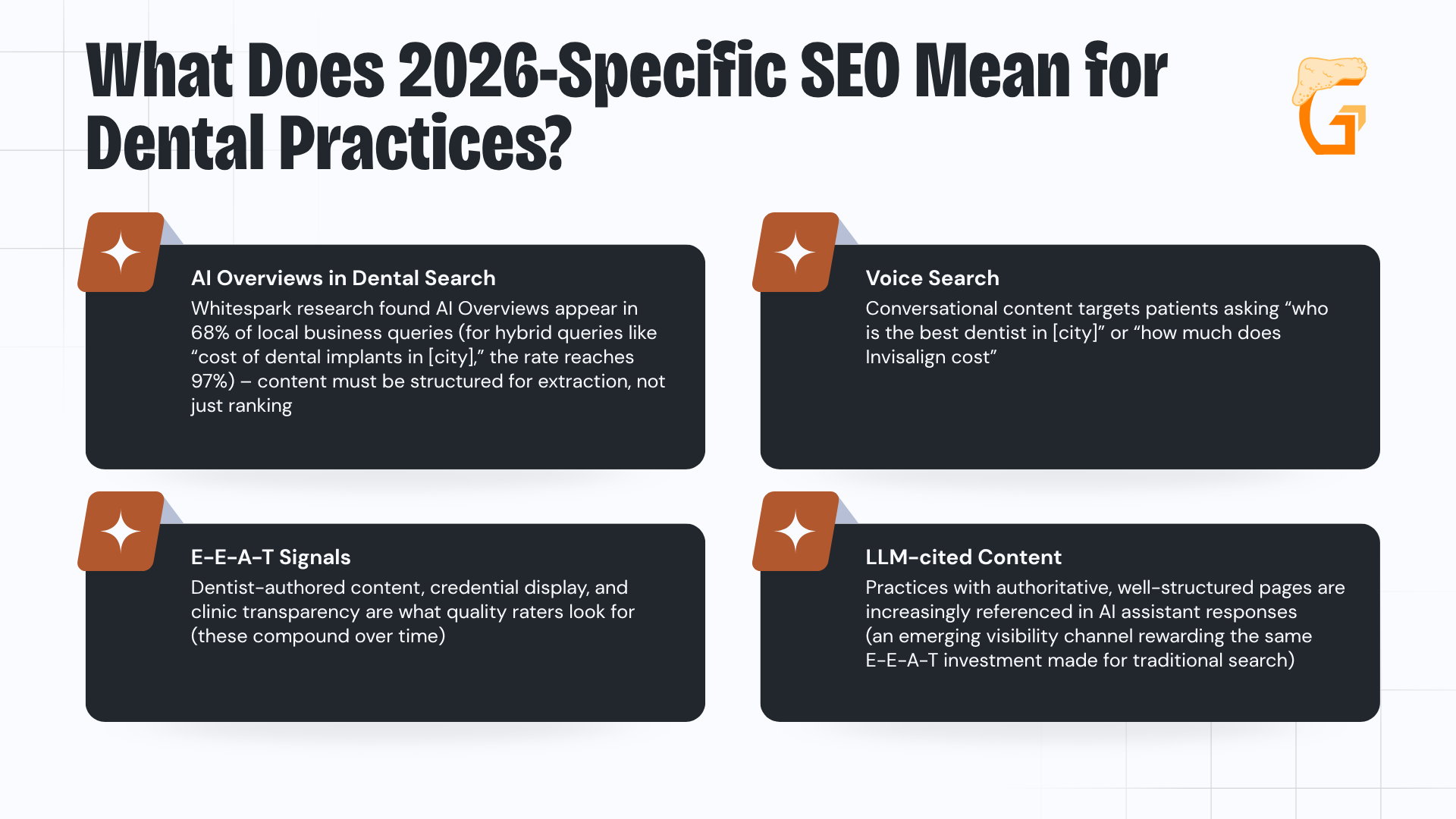
Dental SEO now runs on two tracks: traditional local SEO for booking-intent queries, and Answer Engine Optimization (AEO) for procedure and cost queries that increasingly trigger AI Overviews and Google’s Search Generative Experience.

Where 2026 dental SEO diverges from prior years is in these emerging factors:

  • AI Overviews in dental search: Whitespark research found AI Overviews appear in 68% of local business queries; for hybrid queries like “cost of dental implants in [city],” the rate reaches 97% – content must be structured for extraction, not just ranking
  • E-E-A-T signals: Dentist-authored content, credential display, and clinic transparency are what quality raters look for; these compound over time
  • Voice search: Conversational content targets patients asking “who is the best dentist in [city]” or “how much does Invisalign cost”
  • LLM-cited content: Practices with authoritative, well-structured pages are increasingly referenced in AI assistant responses – an emerging visibility channel rewarding the same E-E-A-T investment made for traditional search

The practices building these signals today hold the compounding SEO success advantage as AI-driven search continues to evolve.

Pricing is the most common question dental practices ask before starting SEO – and the range is wide for a reason.

What a solo practice in a mid-size market needs in terms of location specific keywords looks nothing like what a multi-location DSO requires.

The variation reflects practice size and competitive scope, not arbitrary pricing.

Growth Saloon helps dental practices build the kind of digital presence that consistently generates qualified new patient inquiries – not just clicks.

Contact our team today to find out how our dental marketing services can lower your cost per new patient and grow your practice.
How’s your SEO going?

Enter your website URL below to get a free comprehensive SEO audit.

The audit includes:

How Much Does SEO Cost for a Dental Practice?

Dental SEO typically costs $2,500 to $10,000+ per month on retainer, with single-location practices in the $2,500–$5,000 range and multi-location DSO campaigns running $10,000+ monthly.

Knowing what each tier includes is the starting point for evaluating whether your dental SEO efforts are priced correctly.

What Are the Typical Monthly Retainer Ranges for Dental SEO?

Dental SEO pricing follows a clear tier structure based on practice size, market competitiveness, and deliverable scope – not arbitrary discretion.

Most dental practices fall into one of three pricing tiers:

  • Tier 1 – Solo or entry-level practice ($2,500–$5,000/month): GBP optimization, citation building, review-generation workflow, 1–2 content pieces per month, and monthly performance reporting. Entry tier for single-location practices.
  • Tier 2 – Established single-location / core retainer ($5,000–$10,000/month): Full on-page optimization, expanded content production, review strategy, local link building, dental schema implementation, and monthly reporting. Right range for established single-location practices in competitive markets.
  • Tier 3 – DSO or practice with multiple locations ($10,000+/month): Location-level strategies, expanded content volume, and enterprise reporting across multiple markets.

One-time costs are separate from ongoing retainers: an initial technical audit, website rebuild, or schema implementation are line items that don’t fold neatly into a monthly figure.

Ask for them to be itemized.

How Do You Evaluate Whether a Dental SEO Package Is Worth the Price?

The right benchmark isn’t the monthly spend – it’s cost per new patient acquired relative to average case value.

Assess any dental SEO package against these three benchmarks:

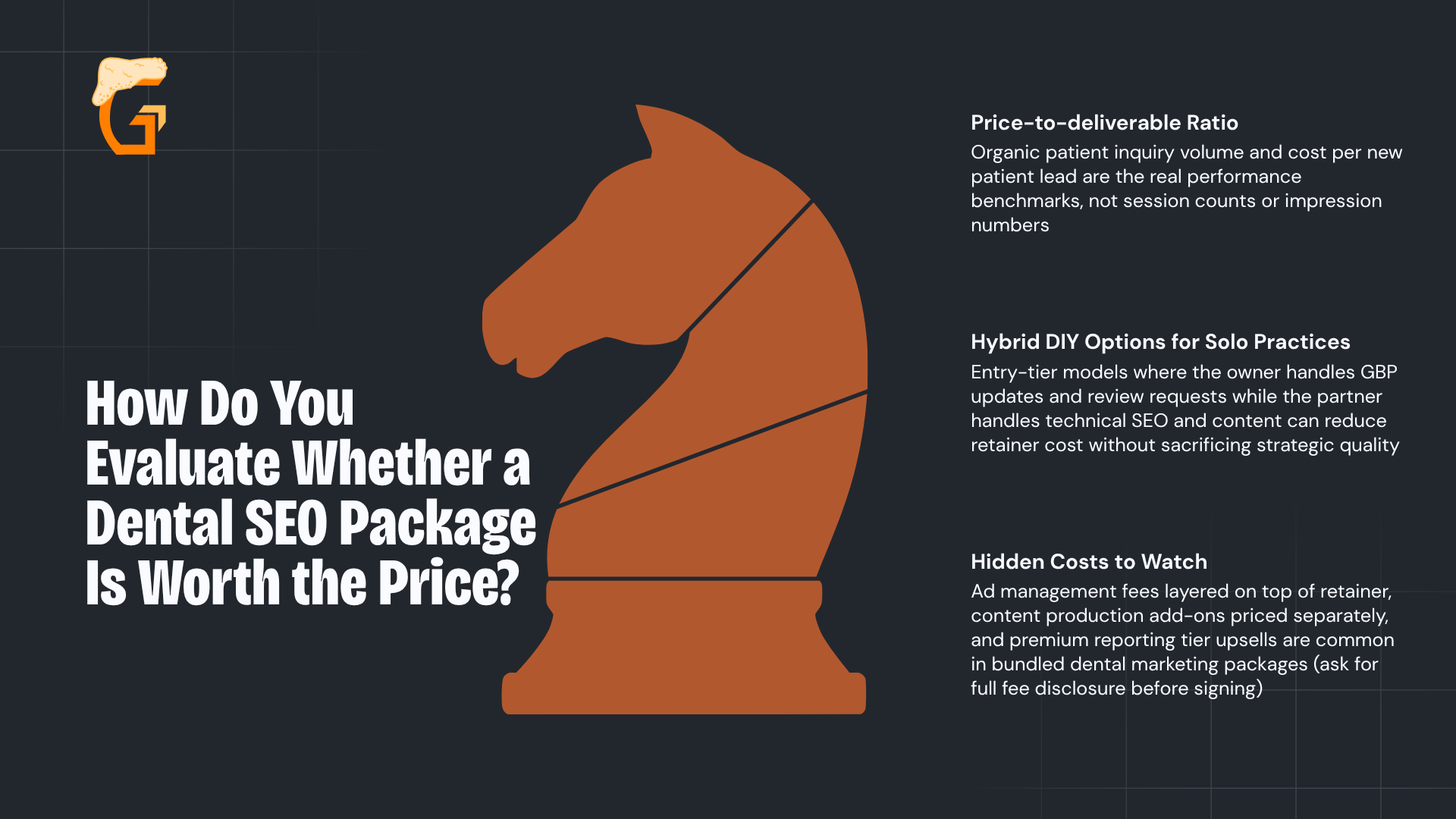
  • Price-to-deliverable ratio: Organic patient inquiry volume and cost per new patient lead are the real performance benchmarks, not session counts or impression numbers
  • Hybrid DIY options for solo practices: Entry-tier models where the owner handles GBP updates and review requests while the partner handles technical SEO and content can reduce retainer cost without sacrificing strategic quality
  • Hidden costs to watch: Ad management fees layered on top of retainer, content production add-ons priced separately, and premium reporting tier upsells are common in bundled dental marketing packages; ask for full fee disclosure before signing

A $5,000/month retainer that produces 8 new implant patients at $4,000 each through search engine visibility outperforms a $2,500/month package that produces 2 hygiene cleanings.

If a prospective partner can’t speak to cost-per-patient-acquired, that’s a signal worth taking seriously.

Most dental SEO agency websites look identical – polished case study headers, stock photos of smiling patients, promises of more new patients.

The difference shows up in the specifics: who actually does the work, what they report on, and whether they can produce a client you can call.

Growth Saloon helps dental practices build the kind of digital presence that consistently generates qualified new patient inquiries – not just clicks.

Contact our team today to find out how our dental marketing services can lower your cost per new patient and grow your practice.
How Do You Choose the Best Dental SEO Company?

The best dental SEO company has verifiable dental case studies, transparent monthly reporting, no lock-in contracts without performance benchmarks, and proven familiarity with local search, off page SEO, and dental practice marketing.

Here’s how to evaluate the field before signing.

What Should You Look for When Evaluating a Dental SEO Partner?

The evaluation process comes down to four verifiable criteria – not website copy or sales promises.

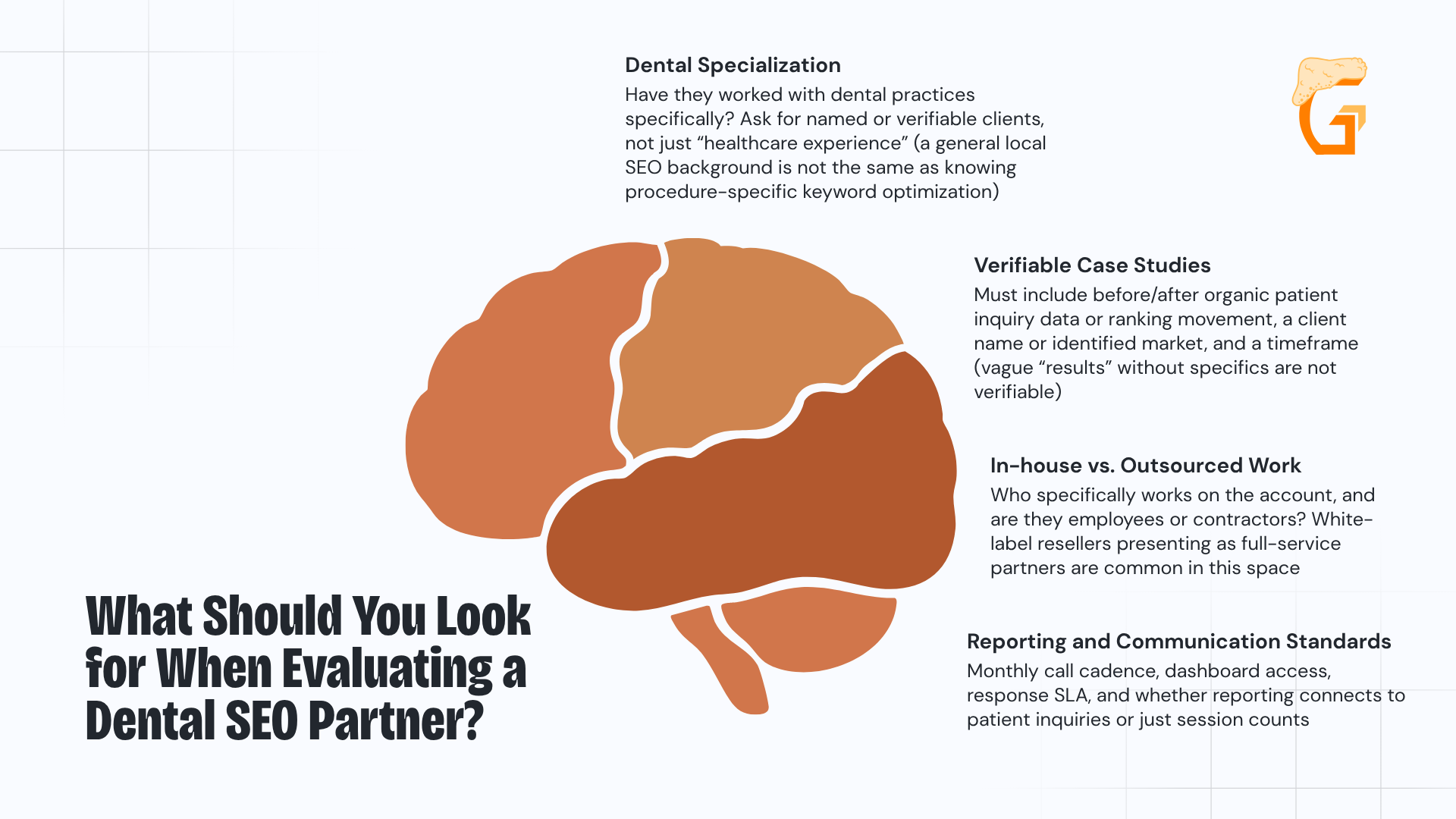
Vet every prospective partner against these four criteria:

  • Dental specialization: Have they worked with dental practices specifically? Ask for named or verifiable clients, not just “healthcare experience”; a general local SEO background is not the same as knowing procedure-specific keyword optimization
  • Verifiable case studies: Must include before/after organic patient inquiry data or ranking movement, a client name or identified market, and a timeframe; vague “results” without specifics are not verifiable
  • In-house vs. outsourced work: Who specifically works on the account, and are they employees or contractors? White-label resellers presenting as full-service partners are common in this space
  • Reporting and communication standards: Monthly call cadence, dashboard access, response SLA, and whether reporting connects to patient inquiries or just session counts

On the local vs. national question: a local partner offers relationship depth and market familiarity; a remote specialist may bring deeper dental SEO expertise and stronger tooling.

Fit depends on practice size and how involved the owner wants to be in strategy.

What Questions Should You Ask Before Signing?

The discovery call is the highest-signal moment in vendor evaluation.

The quality of the questions a partner asks you reveals as much as the answers they give.

Questions to ask: Who specifically works on my account? What is the reporting cadence and format? What KPIs do you track beyond session counts? How do you handle algorithm updates mid-contract?

Green flags at the proposal stage: a custom strategy tailored to this practice and market, realistic timelines with milestone checkpoints, a transparent deliverable list with no vague line items.

Red flags: guaranteed #1 rankings (Google explicitly states no one can guarantee rankings), a cookie-cutter pitch with no customization, aggressive pressure to sign quickly, or refusal to provide references.

Knowing how to choose a good partner is only half the job.

The other half is knowing how to spot a bad one – which the next section covers directly.

Dentists get pitched by SEO vendors constantly – and many have been burned.

The skepticism is earned.

This section is practical protection: the patterns that identify bad vendors before a contract is signed.

What Are the Warning Signs of a Dental SEO Scam?

Common dental SEO scam red flags include guaranteed #1 rankings, long lock-in contracts with no performance benchmarks, vague reporting, and pressure tactics demanding immediate signature.

Recognizing the pattern is faster than recovering from a bad engagement.

What Scam Tactics Are Common in Dental SEO?

Dental SEO scams follow predictable patterns – and identifying the category is the fastest way to disqualify a bad vendor.

Because these tactics recur across the industry, recognizing each pattern protects your practice:

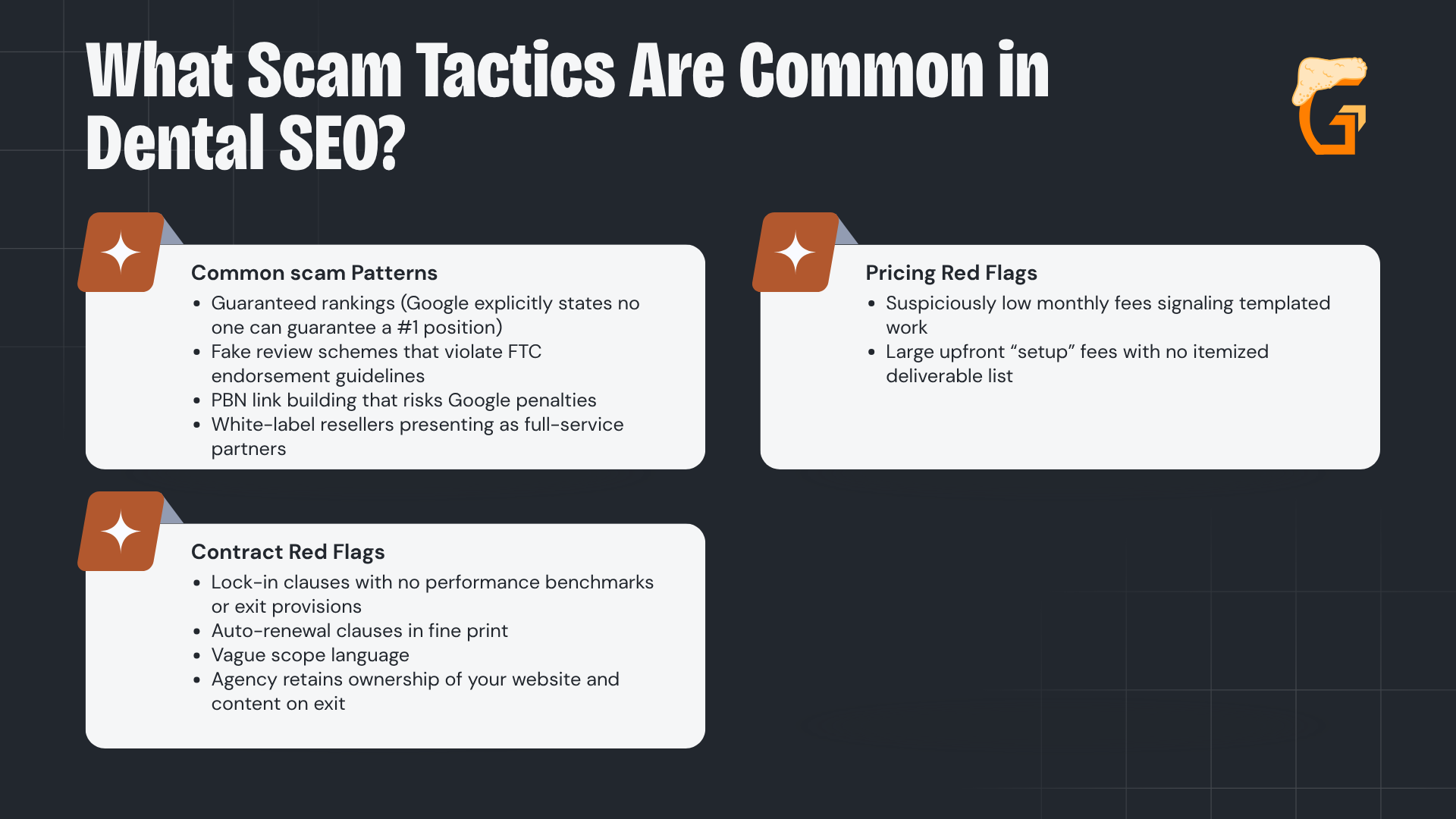
  • Common scam patterns: Guaranteed rankings (Google explicitly states no one can guarantee a #1 position); fake review schemes that violate FTC endorsement guidelines; PBN link building that risks Google penalties; white-label resellers presenting as full-service partners
  • Contract red flags: Lock-in clauses with no performance benchmarks or exit provisions; auto-renewal clauses in fine print; vague scope language; agency retains ownership of your website and content on exit
  • Pricing red flags: Suspiciously low monthly fees signaling templated work; large upfront “setup” fees with no itemized deliverable list

The most damaging scams are subtle: partners who look legitimate but report only on vanity metrics (impressions and sessions) while never connecting the work to patient inquiry volume.

How Do You Verify a Dental SEO Partner’s Claims Before Signing?

Verification is two-part: independently check the partner’s track record, and confirm they’ll give your practice full data access from day one.

Work through these three verification steps before signing any agreement:

  • Reporting red flags: Vanity metrics only, no keyword ranking detail, refusal to share Google Analytics / Google Search Console access (Google Search Console access is standard – partners who won’t provide it are a warning sign)
  • Independently verify: Check their Google reviews and third-party profiles, request references you can call, and audit their own website’s SEO; a partner who can’t rank their own site is telling you something
  • If already scammed: Document everything, request full data exports, consult an attorney about exit provisions, and file a complaint with the FTC or your state attorney general

The best protection against a dental SEO scam is knowing exactly what legitimate dental SEO looks like – the strategies, costs, and hiring criteria this guide has covered throughout.

Growth Saloon helps dental practices build the kind of digital presence that consistently generates qualified new patient inquiries – not just clicks.

Contact our team today to find out how our dental marketing services can lower your cost per new patient and grow your practice.
How Can Growth Saloon Help Your Dental Practice Grow?

Growth Saloon is a Chicago-based digital marketing agency built to help dental practices attract more patients and grow their practice through performance-driven digital marketing.

Mike Lowe and the Growth Saloon team specialize in SEO, web design, conversion rate optimization, and marketing attribution – working alongside your practice to build a measurable digital presence that generates qualified patient inquiries, not just website traffic.

From ranking for high-intent local search terms to converting site visitors into booked appointments, Growth Saloon focuses on results at every stage of the patient acquisition funnel.

Practice owners and marketing managers get clear visibility into exactly which channels are driving new patient growth.

We know that every open appointment slot has a real cost.

Every decision we make is built around one outcome – helping your practice fill more of them.

Meet the Founder of Growth Saloon

Meet the founder and lead strategist at Growth Saloon – Mike Lowe:

  • As founder and CEO of Growth Saloon, Mike brings years of hands-on experience in SEO strategy, CRO, web design, and marketing attribution for service-based businesses competing in local and regional markets.
  • Based in Chicago and working with practices across the country, Mike has built and managed digital growth campaigns for businesses competing in some of the most contested search markets in the country.
  • Growth Saloon’s data-driven approach to local SEO and patient acquisition helps dental practices turn their websites into their highest-performing new patient channel.

What Does Working With Growth Saloon Look Like?

Growth Saloon operates as a dedicated extension of your marketing team – not a vendor that disappears after onboarding.

Every engagement includes direct access to Mike and the team, transparent reporting tied to actual patient acquisition outcomes, and strategies tailored to your specific services and local market.

Whether you’re looking to rank for high-value procedures, build location specific pages, improve your site’s appointment conversion rate, or finally get clarity on where your new patients are actually coming from – Growth Saloon builds the strategy and does the work.

Growth Saloon helps dental practices build the kind of digital presence that consistently generates qualified new patient inquiries – not just clicks.

Contact our team today to find out how our dental marketing services can lower your cost per new patient and grow your practice.

FAQ
Author

Who is Mike Lowe?

Mike Lowe is a digital marketing strategist and the founder of Growth Saloon, where he specializes in helping businesses cut through the noise with high-converting email strategies and SEO.

With a focus on “organic storytelling,” Mike combines over a decade of agency experience with a passion for helping brands build genuine trust with their audience.

When he’s not optimizing subject lines or scaling SaaS companies, he’s likely sharing insights on how to transform cluttered inboxes into meaningful connection points for online marketers.

Related links

Ready to turn your website traffic into real growth?

You’ve read the strategy now let Growth Saloon help you put it into action.

Get a free SEO audit and see what’s holding your website back from ranking, converting, and growing. 

Let's Chat

Let’s discuss your online marketing goals! We’re quick to respond, so we’ll be in touch shortly to set up a time to chat.