

Let’s talk

Updated:October 28th, 2026

SEO for Plastic Surgeons: What to Know in 2026

Mike Lowe

Written by

Reviewed by

Taylor Coteus

Key takeaways

  • SEO for plastic surgeons in 2026 is a coordinated patient acquisition system (not just keyword placement) that connects Google Business Profile optimization, procedure-focused content, E-E-A-T trust signals, technical site health, and local search visibility to capture both informational and consultation-intent searches that fill consultation calendars.
  • High-converting procedure pages should combine title tags, meta descriptions, H1/H2 structure, candidacy details, recovery information, cost factors, FAQs, surgeon credentials, compliant before-and-after photos, and a consultation CTA, with internal links connecting each page to related procedures, surgeon bios, location pages, and financing information.
  • When evaluating a plastic surgeon SEO company, practices should ask who writes and medically reviews content, what deliverables are completed monthly, and how reporting ties to patient acquisition outcomes like booked consultations and call volume, while treating guaranteed rankings or fixed results by a specific date as the clearest red flag to walk away from.

Why Does SEO for Plastic Surgeons Deserve Its Own Strategy?

A plastic surgery practice online operates in one of the most competitive medical search environments, where prospective patients are researching procedures, comparing surgeons, reading reviews, and studying before-and-after galleries – all before they ever pick up the phone.

If your practice isn’t appearing for those high-intent, procedure-specific searches, other plastic surgeons nearby are capturing every one of those consultation requests.

This guide covers each component of a plastic surgery SEO strategy built around what actually fills consultation calendars: Google Business Profile optimization, E-E-A-T trust signals, procedure-focused content architecture, technical site health, and how to evaluate the right SEO partner.

SEO for Plastic Surgeons

The Growth Saloon team put this resource together from real campaign experience, so every recommendation ties back to the metric that matters – qualified patients requesting consultations, not vanity metrics.

Growth Saloon helps plastic surgery practices build the kind of digital presence that consistently generates qualified consultation inquiries – not just clicks.

Contact our team today to find out how our plastic surgery marketing services can lower your cost per new patient and grow your practice.

What Is SEO for Plastic Surgeons in 2026?

SEO for plastic surgeons is the process of optimizing a plastic surgery practice’s website, Google Business Profile, content, reputation, technical health, and trust signals so it appears for procedure-related and location-based searches in organic results, Google Maps, and AI search experiences.

It is not only keyword placement – it is a coordinated patient acquisition system across website quality, local presence, trust, and measurement.

SEO supports the broader marketing mix without replacing paid media, referrals, or conversion optimization.

Why Does Plastic Surgery SEO Matter for Patient Acquisition?

Prospective patients search for the best plastic surgeon, procedure names, locations, recovery timelines, candidacy questions, cost factors, before-and-after examples, reviews, and consultation options before they ever pick up the phone.

That research happens long before a patient is ready to book.

Organic search visibility connects directly to qualified consultations, especially for long tail keywords like “[procedure] plus city” or “[procedure] near me.”

A surgeon who shows up for those searches is competing for cosmetic surgery patients who already know what they want and are evaluating who to trust with it.

Two intent types drive the patient journey, and both matter:

  • Informational searches: recovery timelines, candidacy, risks, and procedure basics, where patients are still deciding if a procedure is right for them
  • Consultation-intent searches: procedure plus location, “best [procedure] surgeon,” or pricing questions, where patients are close to booking

Over time, organic visibility can reduce a practice’s dependence on paid clicks for the same search terms.

It should never be described as free, instant, or a substitute for a sound marketing budget – it compounds, but it takes sustained work to get there.

What Is the Core SEO System of a Website?
What Is the Core SEO System of a Website

Plastic surgery SEO runs on a recurring set of components – keyword research, local SEO, Google Business Profile optimization, procedure-page content, reviews and reputation, technical SEO, internal linking, and authority building.

None of these work in isolation.

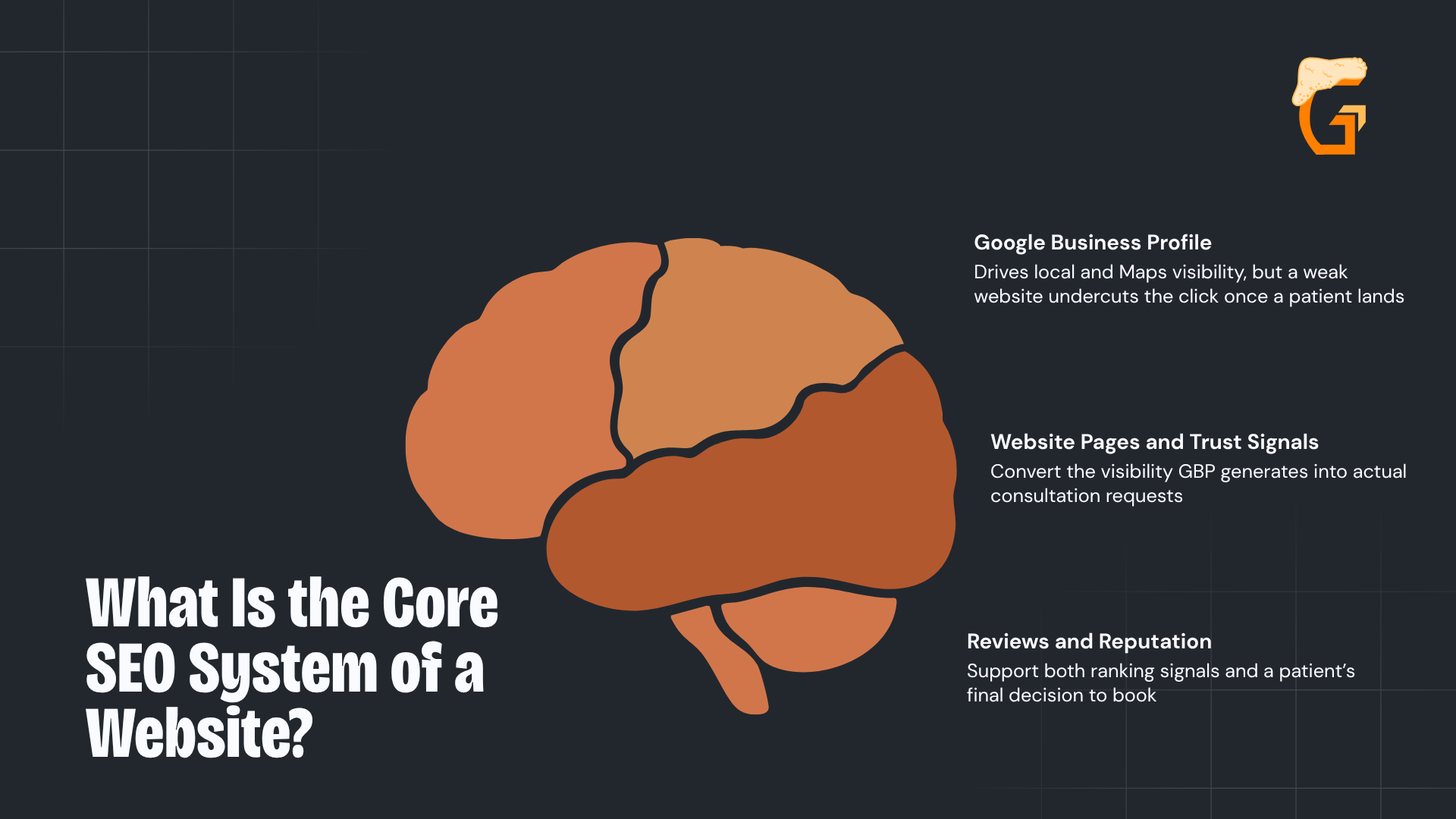
Each piece reinforces the others:

  • Google Business Profile: drives local and Maps visibility, but a weak website undercuts the click once a patient lands
  • Website pages and trust signals: convert the visibility GBP generates into actual consultation requests
  • Reviews and reputation: support both ranking signals and a patient’s final decision to book

High quality content for a plastic surgery practice should be accurate, medically reviewed where appropriate, written in plain language a layperson can follow, and specific to the procedures and locations the practice actually serves.

High quality backlinks and local prominence work as authority signals built over time – they are not shortcut tactics, and treating them as one tends to create more risk than visibility.

How Do AI Overviews and Generative Engine Optimization Affect Search in 2026?

AI Overviews, AI Mode, and other answer-engine experiences have raised the bar for clear, well-structured, authoritative content.

Google’s guidance on AI features in Search explains that these experiences surface relevant links and rely on the same Search fundamentals practices already need to get right.

Generative engine optimization, or GEO, is not a separate replacement for search engine optimization.

Think of it as an extension of the fundamentals – crawlable pages, expert-reviewed content, citations, and clearly defined entities.

The practical move is building entity-rich pages that identify the surgeon, practice, locations, procedures, credentials, policies, and contact pathways without ambiguity.

Online visibility inside AI search experiences is not guaranteed, and it should be monitored alongside – not instead of – traditional organic and local search performance.

Many plastic surgery patients search with local intent even when they start with a broad procedure question, which is where Google Business Profile and local SEO take over.

Growth Saloon helps plastic surgery practices build a digital presence that turns procedure searches into qualified consultations – not just clicks.

See how our plastic surgery SEO services can lower your cost per new patient and bring in the high-intent patients already searching for the procedures you perform.
How Do Local SEO and Google Business Profile Optimization Work for Plastic Surgeons?

Local SEO for plastic surgery clinics improves Maps and local-pack visibility by aligning Google Business Profile completeness, reviews, photos, citations, NAP consistency, and city/procedure pages with Google’s relevance, distance, and prominence signals.

Local search is central to this vertical because most patients evaluate cosmetic surgeons by geography, convenience, reputation, and perceived trust before anything else.

Google Business Profile work should be handled with accuracy, freshness, privacy awareness, and consistency across the rest of the web.

How Do You Optimize Google Business Profile for Relevance, Distance, and Prominence?

How Do You Optimize Google Business Profile for Relevance, Distance, and Prominence

Google’s local ranking documentation describes relevance, distance, and prominence as the core factors behind local ranking.

Relevance measures how well a profile matches what someone is searching for; distance reflects how far each potential result is from the searcher; prominence reflects how well-known and well-reviewed a business is.

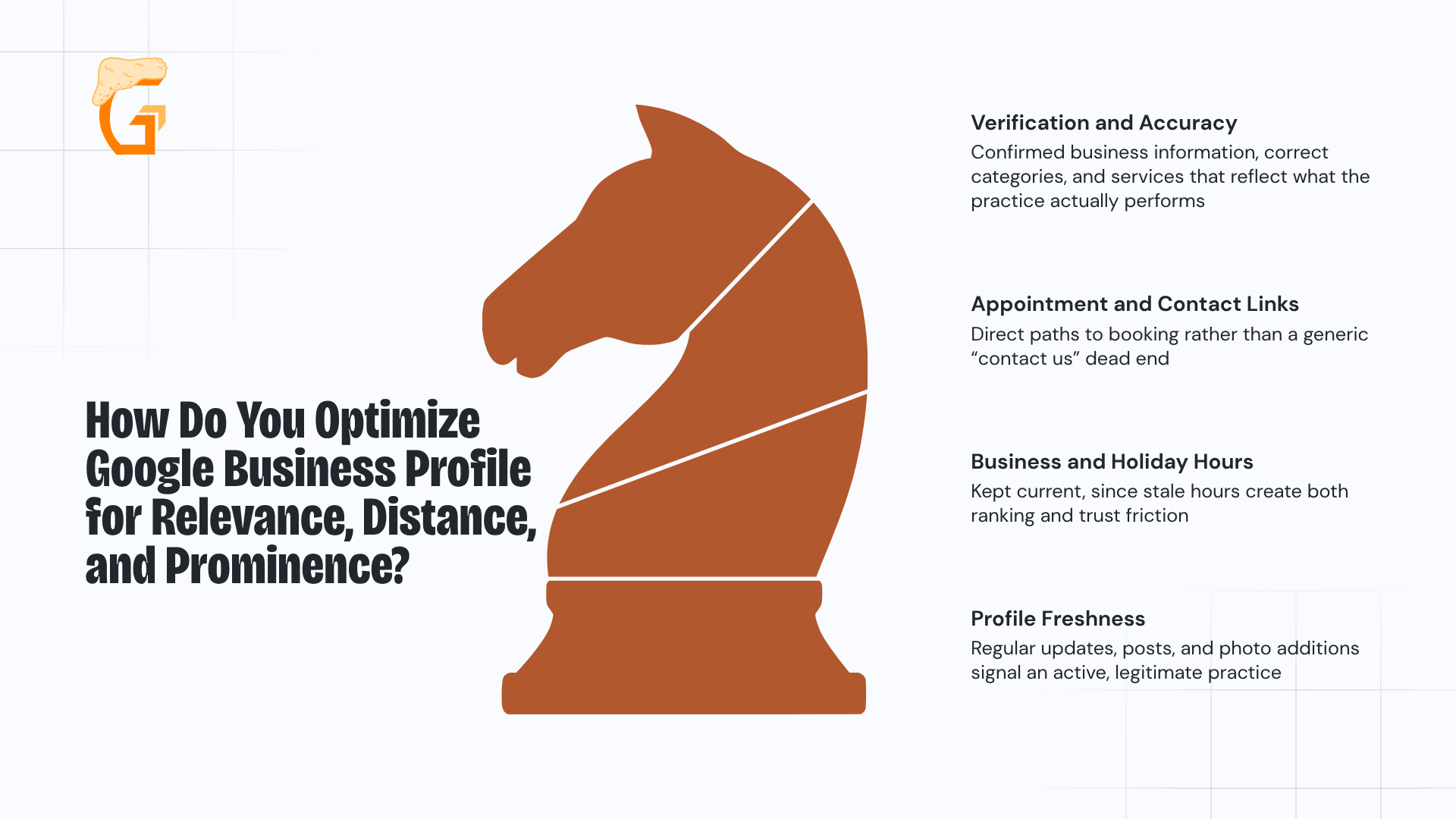
A complete, accurate profile feeds all three signals:

  • Verification and accuracy: confirmed business information, correct categories, and services that reflect what the practice actually performs
  • Appointment and contact links: direct paths to booking rather than a generic “contact us” dead end
  • Business and holiday hours: kept current, since stale hours create both ranking and trust friction
  • Profile freshness: regular updates, posts, and photo additions signal an active, legitimate practice

Service information for relevant plastic surgery procedures should be added without exaggerating outcomes.

Consistency between the GBP, website, citations, and how the practice actually operates matters for trust – mismatches between what a profile claims and what a patient experiences create the kind of friction that costs a booked consultation.

How Do Reviews, Photos, Citations, and NAP Consistency Affect Local SEO?

Ethical review acquisition means asking patients consistently, never pressuring them, and avoiding incentives that violate platform rules.

Replies to reviews should stay privacy-conscious – a response should never confirm, deny, or otherwise reveal that a commenter is a patient, since that crosses into protected health information territory.

Photo strategy should reflect the practice as it actually is:

  • Exterior and interior shots that help patients recognize the location
  • Surgeon and team photos that build familiarity before a consultation
  • Before-and-after assets only where consent and platform rules allow, never assumed

Citations and NAP (name, address, phone number) consistency across directories, healthcare profiles, local listings, and professional associations reinforce the same trust signal from a different angle.

Inconsistent business names, addresses, or phone numbers across the web weaken local trust and can genuinely confuse a patient trying to find the right office.

When Should You Build Procedure and City Pages for Local Search Intent?

Procedure-plus-location pages – rhinoplasty in a specific city, breast augmentation near a metro area, tummy tuck pages for each served location – earn their place when a practice serves multiple cities or regions with real local intent behind the searches.

They lose their purpose fast when they become thin, duplicate pages that only swap a location name.

A useful local page needs unique value – surgeon availability at that location, location-specific consultation details, directions, nearby areas served, relevant reviews from patients in that market, procedure education, and internal links to related pages.

Done well, city and procedure pages support local relevance while staying genuinely useful to the patient reading them – not just another page built to catch a keyword variant.

How Can Plastic Surgeons Prove Medical Trust and Authority Through E-E-A-T?

Because plastic surgery content can affect health and safety, its SEO should demonstrate trust through surgeon credentials, board certification, medical review, professional affiliations, citations, transparent contact information, patient reviews, and privacy-conscious proof.

Plastic surgery businesses operate in a higher-trust healthcare environment where credibility affects both search performance and patient decisions.

The practical question is what trust signals to add to a page, and how to verify each one before it goes live.

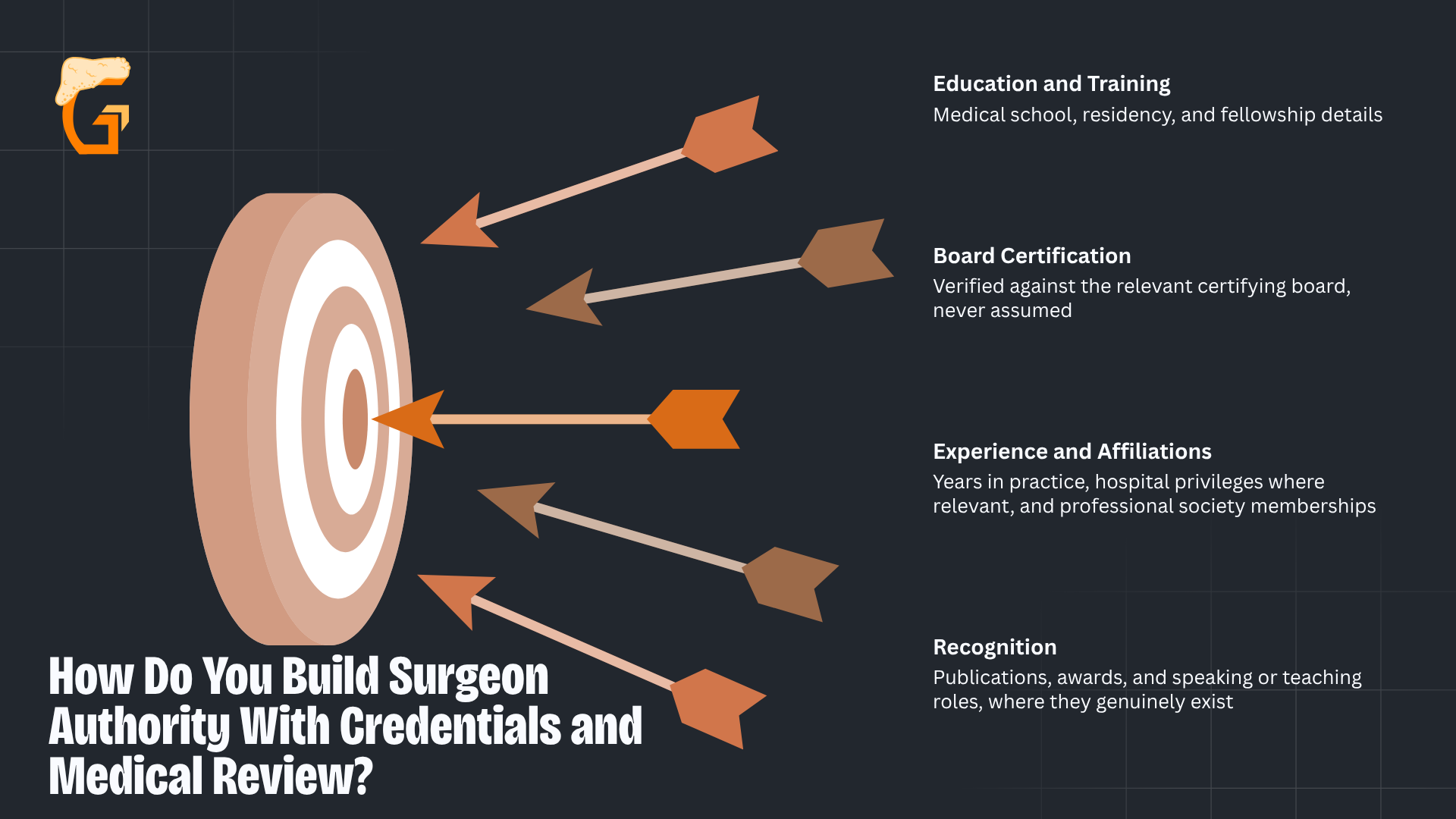
How Do You Build Surgeon Authority With Credentials and Medical Review?

How Do You Build Surgeon Authority With Credentials and Medical Review

Plastic surgery sits firmly in YMYL (Your Money or Your Life) territory because the content can influence a patient’s health decisions.

Google’s own E-E-A-T guidance treats trust as the most important of the four signals, and the Search Quality Rater Guidelines apply extra scrutiny to YMYL pages for exactly this reason.

A robust surgeon bio should include:

  • Education and training: medical school, residency, and fellowship details
  • Board certification: verified against the relevant certifying board, never assumed
  • Experience and affiliations: years in practice, hospital privileges where relevant, and professional society memberships
  • Recognition: publications, awards, and speaking or teaching roles, where they genuinely exist

Every credential, affiliation, award, and years-of-experience claim must be verified before publication – an unverifiable claim is a liability, not a trust signal.

Author and reviewer bylines, review dates, and update dates, paired with a real medical review workflow for educational content, all reinforce the same point – a real, qualified person stands behind what the page says.

What Trust Signals Can Patients and Search Engines Verify?

Transparent contact details, a physical location, clear consultation pathways, financing information where appropriate, policies, accessibility details, and privacy links all do double duty – they help search engines understand the practice, and they help a patient feel confident enough to book.

Claims about plastic surgery services, safety considerations, recovery expectations, and candidacy should cite reputable sources such as the American Society of Plastic Surgeons or other recognized medical and professional bodies.

Consistent identity signals across surgeon bios, location pages, the Google Business Profile, professional directories, and structured data all tell Google and other search engines the same coherent story about who is behind the practice.

How Do You Handle Reviews, Testimonials, and Before-and-After Proof Compliantly?

How Do You Handle Reviews, Testimonials, and Before-and-After Proof Compliantly

Reviews, testimonials, patient stories, and before-and-after photos can support trust and conversion, but they are compliance-sensitive by nature.

Patient authorization, privacy review, and platform-policy review should happen before anything is published or promoted – not after.

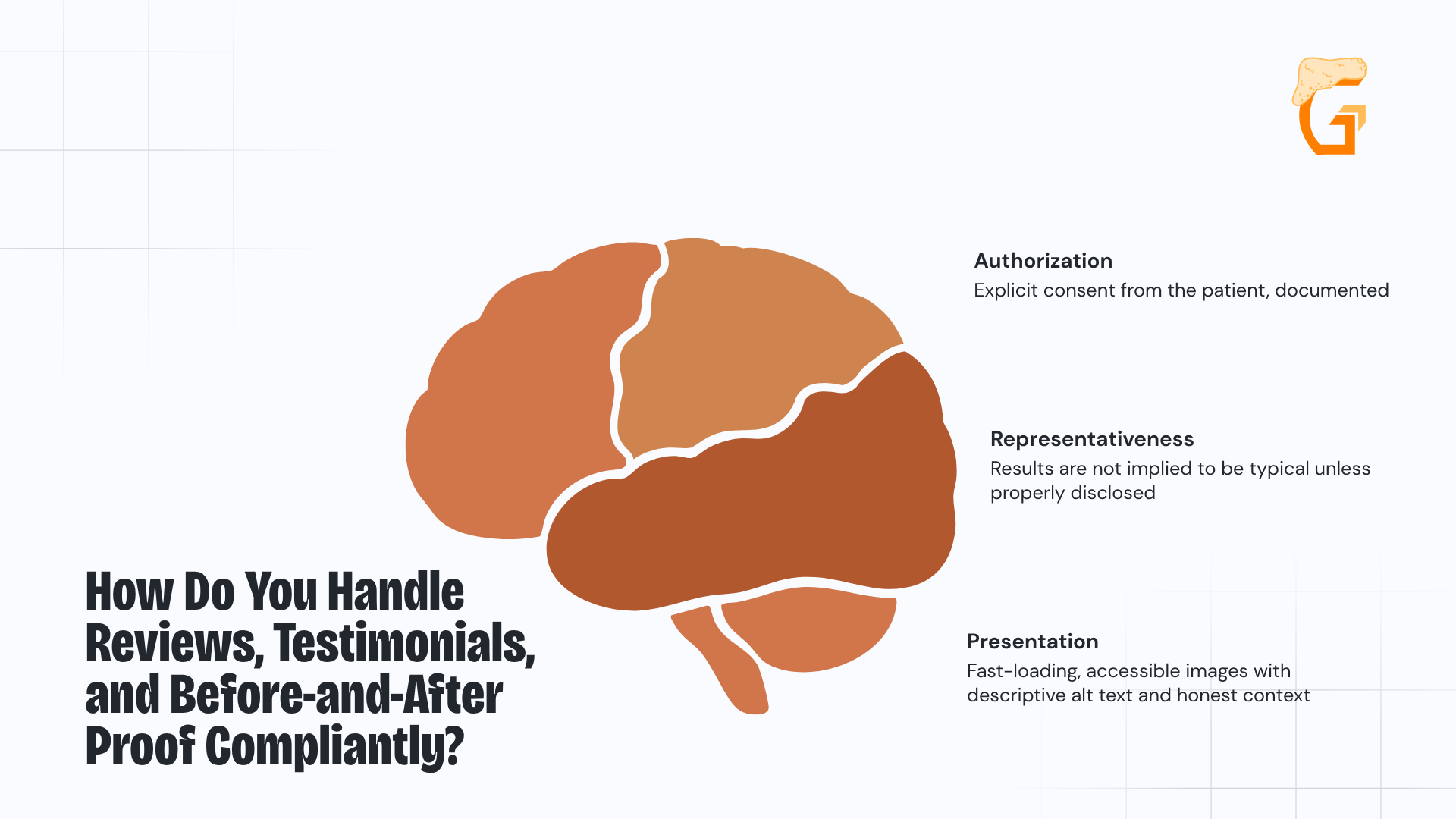
Before using any form of patient proof, confirm:

  • Authorization: explicit consent from the patient, documented
  • Representativeness: results are not implied to be typical unless properly disclosed
  • Presentation: fast-loading, accessible images with descriptive alt text and honest context

None of this is legal advice, and a practice should verify the applicable rules with qualified counsel or compliance professionals rather than relying on generic marketing guidance.

Trust signals work best when they are built directly into procedure pages rather than isolated on a standalone About page, since that is where a hesitant patient is actually deciding whether to book.

Growth Saloon helps surgeons turn verified credentials and medical trust signals into the kind of visibility that earns qualified new patient inquiries – not just clicks.

Find out how our SEO for plastic surgery practices builds the authority that patients and search engines reward, so your practice becomes the obvious choice.

How’s your SEO going?

Enter your website URL below to get a free comprehensive SEO audit.

The audit includes:

What Does a Plastic Surgery SEO Strategy Include?

Solid SEO strategies start with procedure and location keyword research, build dedicated treatment pages, strengthen technical foundations and internal links, add schema and review signals, and measure rankings, leads, and Search Console performance.

This is where concepts turn into execution – the website and content system that actually captures procedure, location, and consultation intent.

The same approach is useful whether a practice handles SEO in-house or is evaluating outside support.

How Do You Approach Keyword Research and Procedure Page Architecture?

How Do You Approach Keyword Research and Procedure Page Architecture

Keyword research for this vertical segments naturally by procedure, location, cost, recovery, candidacy, risks, benefits, before-and-after, FAQs, comparison terms, and consultation intent.

Dedicated pages make sense for high-value procedures the practice actually offers – breast augmentation, rhinoplasty, tummy tuck, facelift, liposuction, and any other core service.

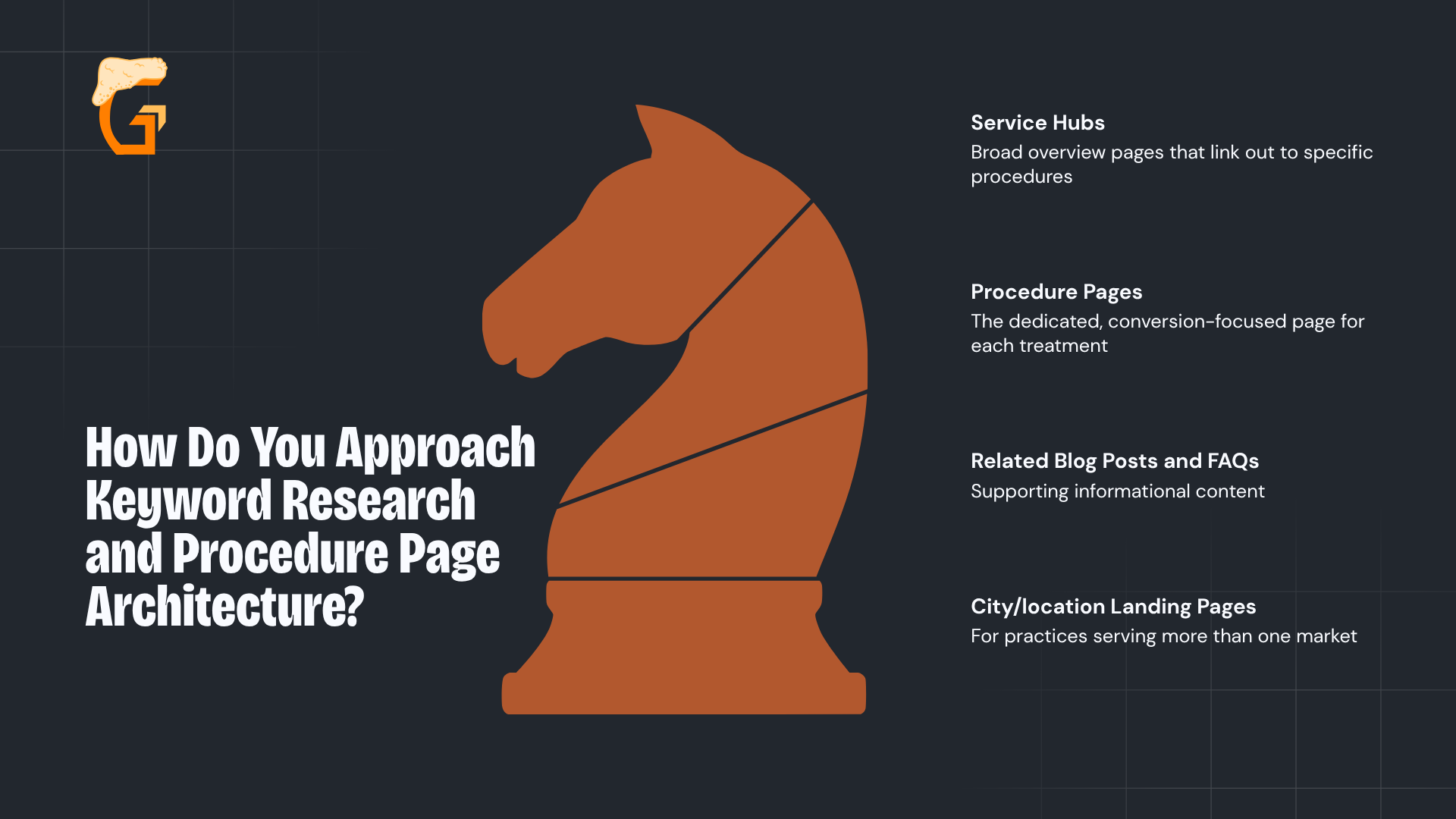
A clear page hierarchy keeps everything organized:

  • Service hubs: broad overview pages that link out to specific procedures
  • Procedure pages: the dedicated, conversion-focused page for each treatment
  • Related blog posts and FAQs: supporting informational content
  • City/location landing pages: for practices serving more than one market

Descriptive URLs and a logical hierarchy help both crawlers and patients understand where they are on the site at any given point.

Cannibalization becomes a real risk when multiple pages target the same procedure and location without a distinct purpose – each page needs its own clear reason to exist.

What Should High-Converting Procedure Pages Include?

A strong procedure page combines title tags, meta descriptions, clear H1/H2 structure, a procedure overview, candidacy details, benefits, risks, recovery information, cost factors, FAQs, surgeon credentials, and a consultation CTA.

Before-and-after content belongs here where it is appropriate and compliant – descriptive file names, alt text, compression, and documented patient authorization all matter.

Internal links should connect each procedure page to related procedures, surgeon bios, service pages, location pages, financing information, before-and-after galleries, and consultation pages.

The balance to strike is patient education against conversion – realistic expectations, clear next steps, and an easy path to book, without unsupported clinical claims.

Patient-education sections should be backed by medical review and credible citations.

How Do Technical SEO, Internal Linking, Structured Data, and Measurement Work Together?

Technical health covers crawlability, indexation, mobile performance, site speed, image optimization, XML sitemaps, internal linking, and clean redirects.

Structured data should only be added where it matches the page’s visible content and current eligibility requirements – Google’s structured data guidelines cover physicians, organizations, locations, services, reviews, breadcrumbs, and FAQs where applicable, but schema never guarantees a rich result.

Measurement should track patient acquisition, not vanity metrics:

  • Rankings by procedure and location, tracked over time rather than as a single snapshot
  • Search Console impressions, clicks, and indexed pages
  • GBP calls and direction requests
  • Form fills, phone calls, and booked consultations

Pairing Search Console and analytics data with call tracking, CRM or intake data, and revenue by procedure turns measurement from a publishing checklist into an accountable patient acquisition program that the whole practice can actually trust.

Growth Saloon helps practices put every piece of the SEO system to work together so it consistently produces booked consultations – not just clicks.

Talk to us about a plastic surgeon SEO strategy built around your procedures, your market, and the patients who will actually grow your practice.

How Much Does Plastic Surgery SEO Cost Compared to PPC?

Plastic surgery SEO costs vary widely by market competition, location count, scope, content needs, technical fixes, link building, and integration with PPC, GEO, and CRO, while SEO builds compounding organic visibility and PPC provides faster paid demand capture.

Specific price ranges aren’t useful without current market research for a given practice, so the goal here is understanding cost drivers, channel tradeoffs, and how to evaluate return without financial guarantees.

What Drives Plastic Surgery SEO Cost?

What Drives Plastic Surgery SEO Cost

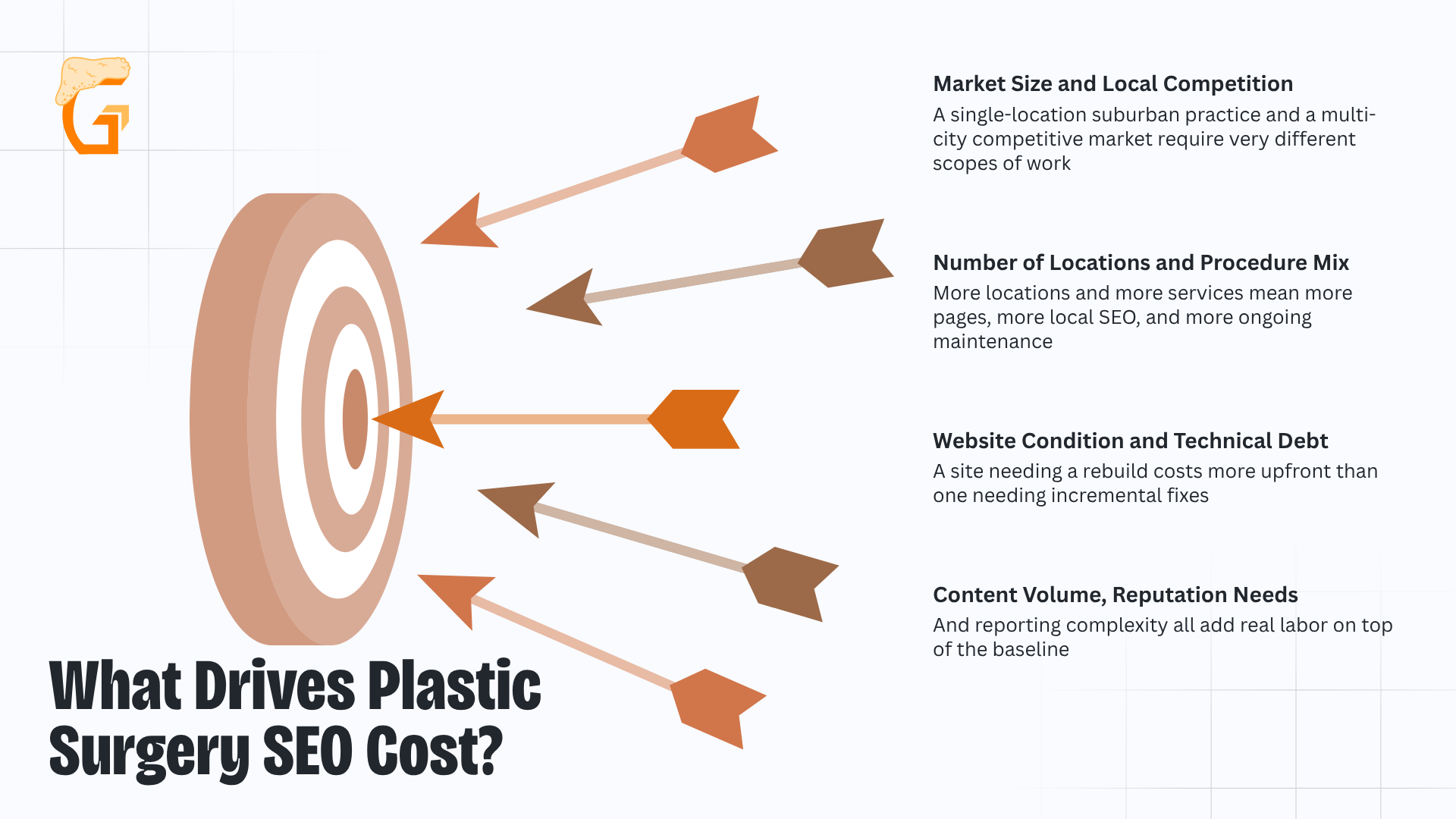
Cost moves with a handful of real variables, not a flat rate:

  • Market size and local competition: a single-location suburban practice and a multi-city competitive market require very different scopes of work
  • Number of locations and procedure mix: more locations and more services mean more pages, more local SEO, and more ongoing maintenance
  • Website condition and technical debt: a site needing a rebuild costs more upfront than one needing incremental fixes
  • Content volume, reputation needs, and reporting complexity: all add real labor on top of the baseline

Common service scopes range from local basics, to full-service competitive SEO, to dedicated content programs, technical remediation, plastic surgery link building or digital PR, and integrated SEO/GEO/CRO programs.

Investment should be framed around competitiveness, procedure value, growth goals, and the practice’s current digital baseline – not around a discount or a guaranteed return.

Practices comparing quotes should expect this kind of variation and treat a suspiciously low flat rate as a question, not a deal.

How Does SEO Compare to PPC for Patient Acquisition?

SEO is slower to show results but can compound through durable rankings, content assets, GBP visibility, and reputation signals that keep working long after the initial investment.

PPC is faster and more controllable, but it depends on continued ad spend and compliant ad management to keep performing.

For most practices, the two work best together – PPC captures immediate demand while SEO builds the long-term organic visibility that eventually reduces reliance on paid clicks for the same terms.

Both channels still depend on strong landing pages, real trust signals, conversion tracking, and claims that hold up to scrutiny – neither one fixes a weak website on its own.

What ROI Metrics Matter Across the Cosmetic Surgery Marketing Mix?

SEO sits inside a broader marketing mix that can include PPC, reputation management, social proof, content marketing, conversion rate optimization, email or nurture sequences, referral development, and offline events.

No single channel should be evaluated in isolation.

The signals that actually matter for ROI:

  • Organic leads and consultation form fills, tracked back to source
  • Phone calls and booked consultations, paired with call tracking
  • Procedure revenue and cost per qualified lead
  • Local-pack visibility and non-branded procedure search growth

Organic traffic or average ranking position are incomplete metrics without lead quality and intake outcomes attached to them.

Useful reporting connects SEO deliverables directly to patient acquisition indicators, while being upfront about the real limits of attribution across a multi-channel marketing mix.

A practice that only sees a traffic chart and never sees a call-volume chart is not getting the full picture.

Growth Saloon helps plastic surgeons earn durable organic visibility that lowers cost per new patient over time – not just clicks today.

Ask how our cosmetic surgery SEO compounds month over month, so your practice depends less on paid clicks and more on patients who find you on their own.

How Do You Choose Plastic Surgery SEO Services or the Best SEO Company?

The best plastic surgery SEO partner should show healthcare SEO experience, transparent deliverables, ethical content and review practices, technical and local SEO capability, clear reporting on leads, and no guarantees or shortcut tactics.

This section is written for a practice comparing plastic surgery SEO services, a plastic surgeon SEO company, freelancers, and general SEO partners – with concrete questions, deliverables, and red flags to use in that comparison.

What Do Credible Plastic Surgery SEO Services Include?

Expect a defined set of deliverables, not a vague monthly retainer:

  • An SEO audit and keyword strategy specific to the practice’s procedures and markets
  • GBP and local SEO management, not a one-time setup and silence
  • Procedure-page content, technical SEO, and image optimization
  • Structured data, reviews and reputation support, and ethical link building or digital PR
  • Analytics and reporting tied to patient acquisition outcomes

Healthcare SEO experience matters specifically because this is YMYL territory – compliance-sensitive content, patient privacy considerations, and reputation management all carry real risk if handled carelessly.

Content quality control – expert input, medical review, and citations for educational claims – should be table stakes, not an upsell.

In a competitive plastic surgery market, local SEO and technical optimization are non-negotiable rather than optional add-ons.

What Questions Should You Ask a Plastic Surgeon SEO Company?

A short list of questions tends to separate credible partners from the rest quickly:

  • Who writes the content, and who medically reviews it?
  • What deliverables are completed each month, and how are priorities set?
  • How is GBP optimization, reviews, local citations, link building, technical fixes, structured data, and before-and-after image optimization handled?
  • What metrics get reported – Search Console data, local visibility, rankings, GBP actions, calls, forms, booked consultations, and lead quality?
  • Who owns the website content, analytics properties, call tracking numbers, Search Console, GBP access, and reporting dashboards?
  • What is a realistic timeline, and what early indicators will be tracked before rankings and consultations grow?

A partner with good answers to all of these will usually offer them before being asked.

What Are the Red Flags When Evaluating SEO Agencies?

What Are the Red Flags When Evaluating SEO Agencies

Guaranteed rankings, guaranteed patient volume, guaranteed ROI, or fixed results by a specific date are the clearest warning sign in this industry – no legitimate plastic surgery SEO agencies control Google’s algorithm closely enough to promise any of it.

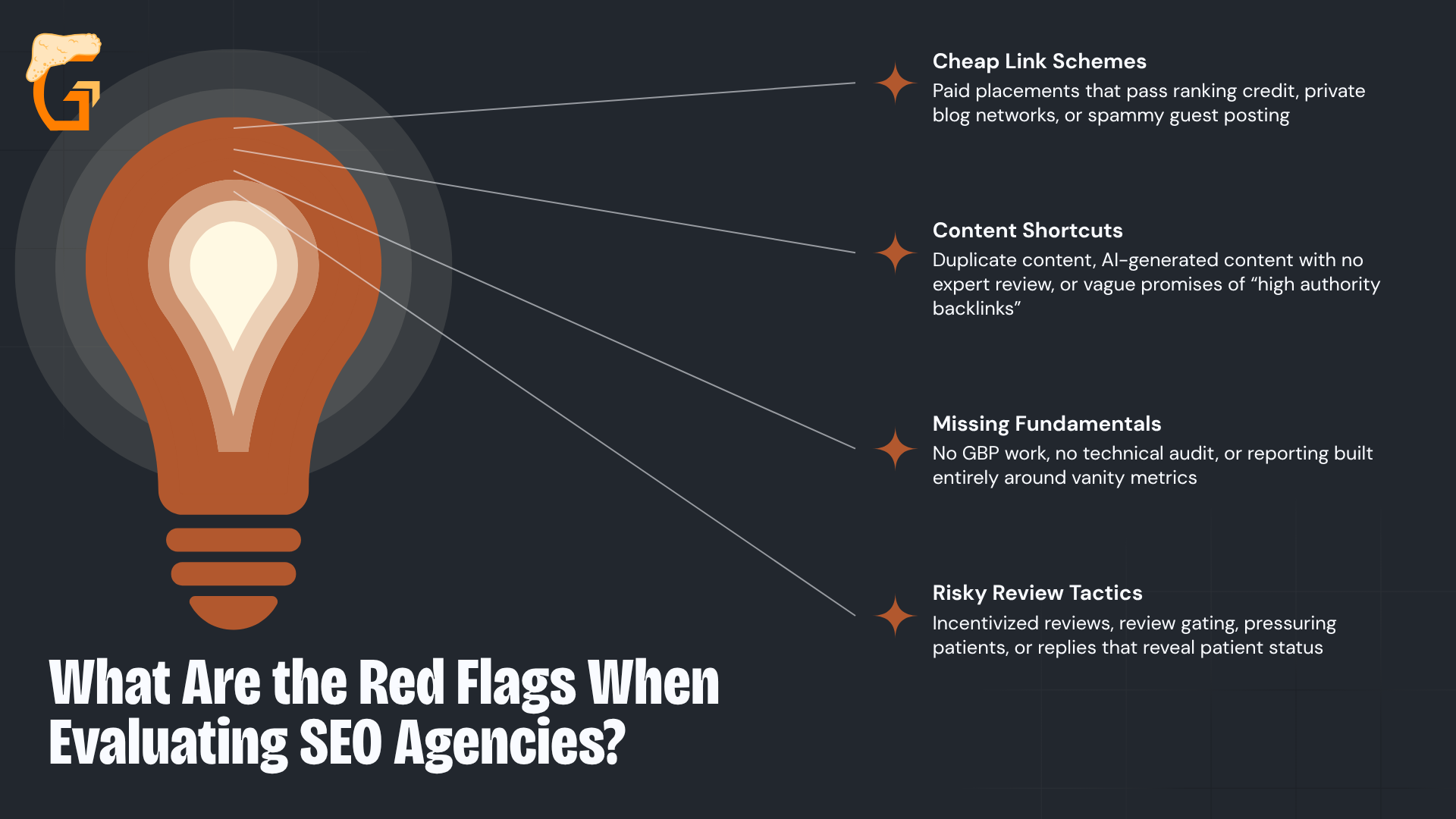
Other red flags worth walking away from:

  • Cheap link schemes: paid placements that pass ranking credit, private blog networks, or spammy guest posting
  • Content shortcuts: duplicate content, AI-generated content with no expert review, or vague promises of “high authority backlinks”
  • Missing fundamentals: no GBP work, no technical audit, or reporting built entirely around vanity metrics
  • Risky review tactics: incentivized reviews, review gating, pressuring patients, or replies that reveal patient status

Choose a partner that explains tradeoffs honestly, documents deliverables clearly, and reports on qualified consultations and booked appointments instead of clicks.

Many underperforming plastic surgeon SEO campaigns fail for a simpler reason than any of this – foundational crawl, indexation, content, or measurement issues were never fixed in the first place.

Why Is a Plastic Surgery Website Not Ranking on Google?

A plastic surgery website may fail to rank when Google cannot efficiently crawl, index, understand, or trust key pages, so an audit should check Search Console, site architecture, page speed, image-heavy galleries, mobile UX, metadata, canonicals, schema, and content quality.

This section works as a diagnostic checklist rather than a promise that any single fix will move rankings on its own.

Priority order matters – indexation blockers first, then crawlability and architecture, then speed and mobile UX, then schema and content quality, then local signals and conversion friction.

How Do You Diagnose Crawling, Indexing, and Search Rankings in Search Console?

How Do You Diagnose Crawling, Indexing, and Search Rankings in Search Console

Google Search Console is the source of truth for how Google actually crawls, indexes, and serves a site.

Diagnosis should start with indexing status, crawl errors, sitemap coverage, URL Inspection, manual actions, security issues, Core Web Vitals, and the queries, pages, clicks, and impressions in the Performance report.

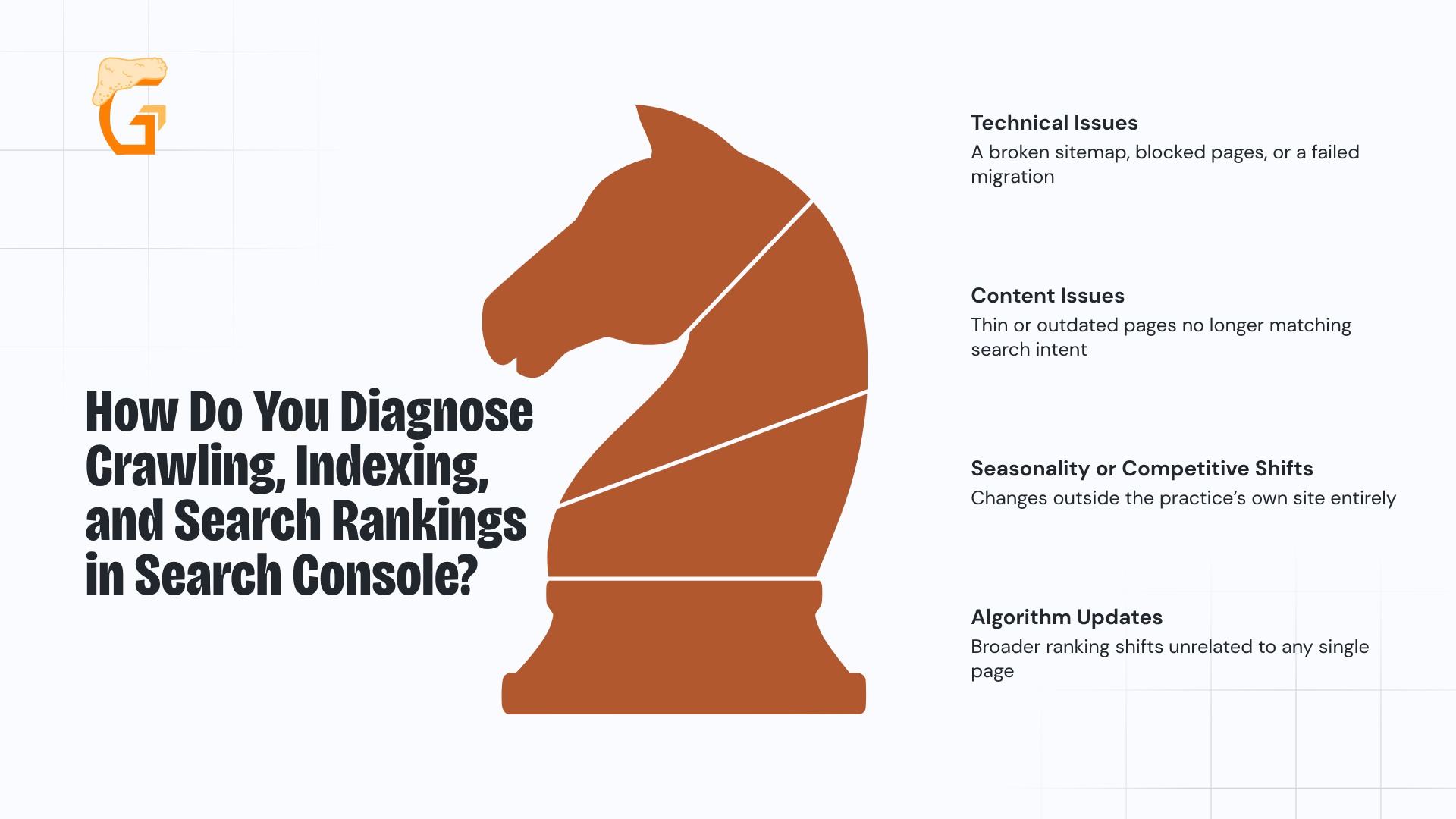
A drop in any of these can point in several directions:

  • Technical issues: a broken sitemap, blocked pages, or a failed migration
  • Content issues: thin or outdated pages no longer matching search intent
  • Seasonality or competitive shifts: changes outside the practice’s own site entirely
  • Algorithm updates: broader ranking shifts unrelated to any single page

The first practical check is whether important procedure pages are indexed at all and receiving impressions for non-branded procedure or location queries.

Diagnosing an exact cause without real Search Console, crawl, speed, and analytics data is guesswork, not an audit.

How Do Site Architecture, URL Structure, Metadata, and Internal Links Affect Rankings?

A structural review should check:

  • Robots.txt, noindex tags, and canonical tags for accidental blocking
  • XML sitemaps, redirects, duplicate pages, and orphan pages
  • Broken internal links that strand both search engine crawlers and patients

The site should have a clear procedure hierarchy – service hubs, procedure pages, related articles, surgeon bios, location pages, and consultation pages – each with its own distinct target and purpose.

Title links, meta descriptions, headings, and page copy should be optimized so no two web pages compete for the same intent.

Thin, duplicate, outdated, or cannibalized pages tend to confuse search engines and patients in equal measure.

Internal links should help patients move naturally from informational content toward the relevant procedure page and consultation path.

How Do You Prioritize Speed, Mobile UX, Images, and Schema Fixes?

Image-heavy before-and-after galleries and media-rich procedure pages are common culprits behind slow page speed and weak performance on mobile devices.

Image compression, responsive sizing, lazy loading where appropriate, descriptive file names, and accessible alt text address most of this at the source.

Structured data needs validation too – errors here can prevent search engines from correctly understanding the organization, physicians, locations, breadcrumbs, services, reviews, and FAQs where eligible.

Schema should always match what is actually visible on the page and follow Google’s current structured data guidelines.

The fix order that tends to produce results fastest: indexation blockers first, then page speed and mobile performance, then content quality, then schema, then local signals and form or CTA friction.

Working in any other order usually means polishing pages that were never going to be found in the first place.

Growth Saloon helps practices diagnose what is holding a site back and rebuild it into a steady source of qualified consultations – not just clicks.

Let our plastic surgery SEO partner team audit your site, fix what is keeping you off page one, and grow your practice with the patients searching right now.

How Can Growth Saloon Help Your Plastic Surgery Practice Grow?

Growth Saloon is a Chicago-based digital marketing agency built to help plastic surgery practices attract high value patients and grow through performance-driven digital marketing.

Mike Lowe and the Growth Saloon team specialize in SEO, web design, conversion rate optimization, and marketing attribution – working alongside your practice to build a measurable digital presence that generates qualified patient inquiries, not just website traffic.

From ranking in search engine results pages for high-intent procedure-specific search terms to converting site visitors into booked consultations, Growth Saloon focuses on results at every stage of the patient acquisition funnel.

Practice owners and marketing managers get clear visibility into exactly which channels are driving new patient growth.

We know that every unfilled consultation slot represents real revenue.

Every decision we make is built around one outcome – helping your practice book more of them.

Meet the Founder of Growth Saloon

Meet the founder and lead strategist at Growth Saloon – Mike Lowe:

  • As founder and CEO of Growth Saloon, Mike brings years of hands-on experience in SEO strategy, CRO, web design, and marketing attribution for service-based businesses competing in local and regional markets.
  • Based in Chicago and working with practices across the country, Mike has built and managed digital growth campaigns for businesses competing in some of the most contested search markets in the country.
  • Growth Saloon’s data-driven approach to local SEO and patient acquisition helps plastic surgery practices turn their websites into their highest-performing new patient channel.

What Does Working With Growth Saloon Look Like?

Growth Saloon operates as a dedicated extension of your marketing team – not a vendor that disappears after onboarding.

Every engagement includes direct access to Mike and the team, transparent reporting tied to actual patient acquisition outcomes, and strategies tailored to your specific procedures and local market.

Whether you’re looking to rank for high-value procedures, improve your site’s consultation conversion rate, or finally get clarity on where your new patients are actually coming from, Growth Saloon builds the strategy and does the work.

Growth Saloon helps plastic surgery practices build the kind of digital presence that consistently generates qualified new patient inquiries – not just clicks.

Contact our team today to find out how our plastic surgery marketing services can lower your cost per new patient and grow your practice.

FAQ
Author
Mike Lowe

Who is Mike Lowe?

Mike Lowe is a digital marketing strategist and the founder of Growth Saloon, where he specializes in helping businesses cut through the noise with high-converting email strategies and SEO.

With a focus on “organic storytelling,” Mike combines over a decade of agency experience with a passion for helping brands build genuine trust with their audience.

When he’s not optimizing subject lines or scaling SaaS companies, he’s likely sharing insights on how to transform cluttered inboxes into meaningful connection points for online marketers.

Related content
Resources for Plastic Surgeons

Every resource we’ve published for Plastic Surgeons, in one place:

Ready to turn your website traffic into real growth?

You’ve read the strategy now let Growth Saloon help you put it into action.

Get a free SEO audit and see what’s holding your website back from ranking, converting, and growing.