
Key takeaways
- If ChatGPT shows your practice on its map, it already has a profile built from your website, reviews and other sites. Claim it to correct it.
- It picks favorites out loud ("My first choice to interview"), then narrows by case type or procedure.
- Plastic surgeons were judged on board certification, Healthgrades, RealSelf and the ASPS directory, not a profile card.
- Claiming won't move you up by itself. ChatGPT still builds its answer from your site, reviews and other profiles.
On November 10, OpenAI started letting businesses claim the profile ChatGPT shows when it recommends them. Law firms, dental practices and plastic surgery practices can now claim their business on ChatGPT, correct what it says, and see how often it mentions them. Setup is a short form; approval can take longer.
On November 14 we asked ChatGPT the three questions a new client or patient would ask. Below: what it said, and a 7-step checklist for this week.
What is Businesses in ChatGPT?
OpenAI calls it Businesses in ChatGPT. In its words: “We’re introducing Businesses in ChatGPT in beta, giving businesses a new way to connect with the 1.2 billion people who use ChatGPT each week.”
Through the new Business Hub, a verified owner can:
– Claim the business and update its name, description, contact details, hours and products (per LocaliQ, a marketing vendor).
– See insights: mentions in ChatGPT, website clicks from ChatGPT, and “discovery topics”, the themes of conversations where your site is cited.
Business Agents, chat assistants for a business, launched too, but only for “eligible ecommerce and online service businesses in the U.S.” for now.
Two limits matter. OpenAI shows insights only once there are enough conversations to meet its privacy thresholds, so a single-location practice may see nothing at first. And clicks carry OpenAI’s own warning, as Search Engine Roundtable reported: “Clicks don’t confirm website visits or conversions.”
What does ChatGPT say when a client or patient asks for a recommendation?
We asked three questions on November 14, around 11am Eastern (and the lawyer one again at 2pm), logged out, the way a stranger would. We wanted a personal injury lawyer in Chicago, a dentist in Dallas and a plastic surgeon in Phoenix. One moment, one city each: a look, not a study.
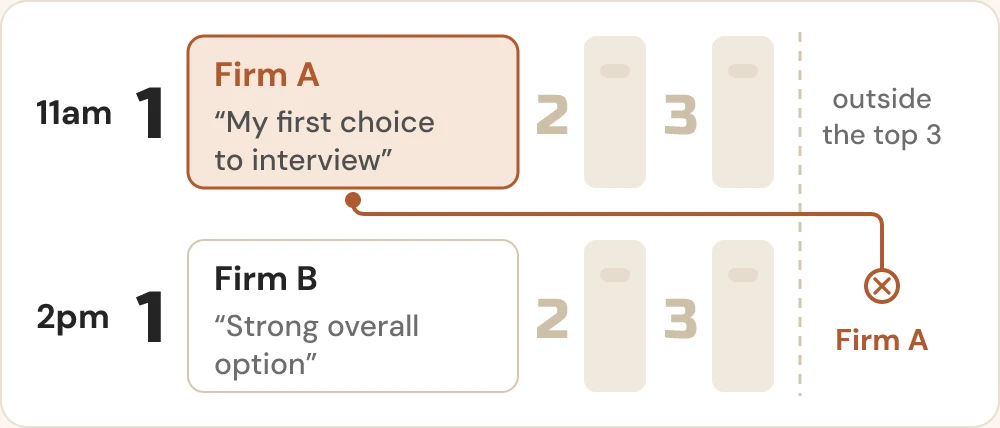
It picks a favorite out loud. For the lawyer, ChatGPT listed five firms rated 4.4 to 5.0, with photos, phones and addresses. It labeled one “My first choice to interview” and named three to “start by interviewing”. For the dentist, it listed five practices rated 4.7 to 5.0, one with 1,875 reviews, and marked one “My first pick”.
Its favorite changes. Asked the same lawyer question three hours later, ChatGPT put a different firm first, labeled “Strong overall option”. A spot on its list is a likelihood, not a fixed rank.
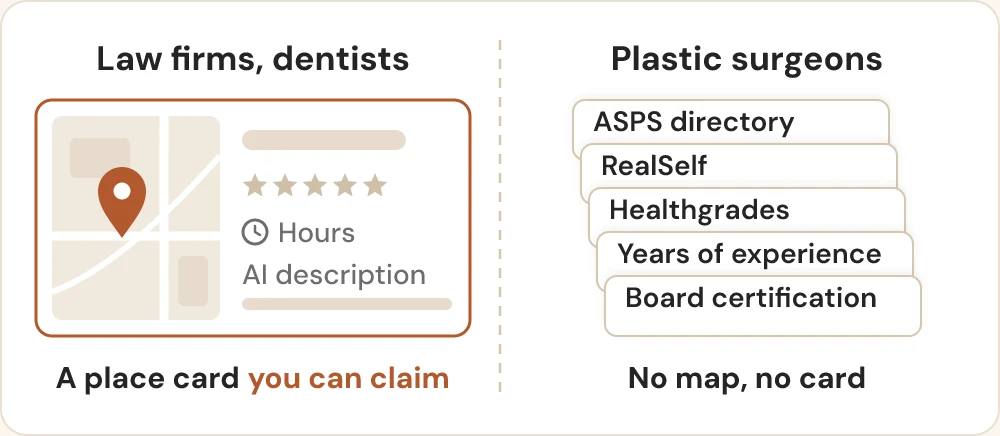
Law firms and dentists get place cards: a photo, a rating and hours on a map. The first law firm’s card opened a full profile with photos, hours, an AI-written description citing its sources, and “What people say” from reviews. That’s the profile you can claim.
Your reviews become its sales pitch. One Dallas practice made the list partly because “patients highlight honest, non-salesy recommendations”. Whatever your patients and clients repeat in reviews, ChatGPT repeats too.
Plastic surgeons were judged differently. No map, no cards. ChatGPT named four surgeons, citing board certification, years of experience, and Healthgrades and RealSelf ratings. It also pointed us to the American Society of Plastic Surgeons directory.
Every answer narrowed. It asked about the case (car, truck, slip and fall, malpractice), the dental need (cleanings, cosmetic, implants) or the procedure, and promised a better pick once it knew.
Nobody can see who claimed. A logged-out searcher sees no “claimed” or “verified” badge on a profile.
What it means for law firms, dentists and plastic surgeons
| What ChatGPT showed | What it leaned on | Fix first | |
|---|---|---|---|
| Law firms | 5 firms with place cards, one named “first choice to interview” | Ratings, practice areas, address and phone | Your profile details and one page per main case type |
| Dental practices | 5 practices with place cards, one “first pick” | Review themes, emergency care, evening and Saturday hours, Medicaid | Hours, services and insurance accepted, on your profile and your site |
| Plastic surgery | 4 surgeons, no cards | Board certification, years of experience, Healthgrades, RealSelf, ASPS | Your Healthgrades, RealSelf and ASPS profiles |
Left off the list, a law firm loses the call: ChatGPT hands the reader three names. For dental practices, details decide the “first pick” for a patient’s specific need. For plastic surgery, the profiles ChatGPT already trusts matter more than the claim.
How to claim your business on ChatGPT this week
Time estimates are ours, not from a timed test.
- Ask ChatGPT about yourself (about 5 minutes). In a logged-out window, ask “Who is a good [your specialty] in [your city]?” and “What do you know about [your practice name]?” Write down what it gets wrong.
- Claim your business on ChatGPT (about 20 minutes, plus approval). Go to chatgpt.com/business-hub, search for your business and start the claim. Not sure if someone already claimed it, like an office manager or a past agency? Ask them first. Only an owner or authorized person should claim, and the listing belongs in an account the practice owns. Reports so far describe a code by phone, text or email, or a website (DNS) check. An identity check may ask for a government ID and business registration (Search Engine Roundtable, LocaliQ). New listings may land on a waitlist.
- Fix the details (about 10 minutes). Hours, phone, address, and a description that names your main case types or procedures in plain words. Law firms: don’t call yourself a “specialist” or “expert” in the description unless your state bar allows it.
- Make your website say it first (an afternoon). ChatGPT matches its follow-up questions (“truck accident?”, “implants?”) against what your site covers. One page per main case type or procedure beats one page listing everything. Our guide to AI SEO for dentists goes deeper.
- Get honest reviews from everyone (ongoing). Ask every client or patient, not just the ones you expect to be happy, and let them write what they want. Never buy reviews or reward positive ones: the FTC’s 2024 rule bans fake reviews and rewards tied to a positive review. Dental and plastic surgery practices: never confirm someone is a patient in a public reply. A dental practice paid HHS to settle over exactly that.
- Plastic surgeons: update your outside profiles (about 30 minutes). Healthgrades, RealSelf and your ASPS listing, with your board certification front and center. See SEO for plastic surgeons for the rest.
- Check your insights once a month. When they appear, the discovery topics tell you what people ask before ChatGPT names you. Keep your Google Business Profile matching: same hours, phone and address.
Agencies managing listings for clients: claim only with the client’s written authorization, inside an account the client owns.
My take: claim it now, but don't expect a jump
I’d claim it this week. It’s quick and puts you in control of what ChatGPT says about you. Once you have enough conversations, the insights show how often an AI recommends you and what people asked first.
But don’t expect claiming to move you up. LocaliQ reports that OpenAI says claiming doesn’t guarantee better placement. What we saw fits: every reason ChatGPT gave was a review theme, a credential or a service from the practice’s own site. So don’t buy anything new because of this launch. What gets you named by ChatGPT is what gets you found on Google: clear pages for what you do, honest reviews, and accurate information everywhere.
What I’m watching: OpenAI plans to expand Business Agents “to more markets and business categories”, and businesses can already sponsor their agent through ChatGPT Ads. My bet: when agents reach practices, they’ll start from the profile you claim now.
We’re running the bigger version of this test next: 30 cities, all three fields. Follow Growth Saloon on LinkedIn to see the results first.
Published November 17, 2026. Our ChatGPT test was run on November 14, 2026, logged out, with three questions (one repeated); answers vary by user, by day and even by hour.
How's your SEO going?
Get your free comprehensive SEO audit.
- Scan entire website for technical issues
- Get a list of your top opportunities
- See your highest priority fixes to make
 Mike Lowe