

Key takeaways
- Most practices see initial ranking movement in 3 to 6 months and consistent new-patient growth in months 6 to 12, with the local pack often lifting in just 60 to 120 days.
- Each stage has verifiable deliverables, with Month 1 covering technical fixes and GBP setup, months 2 to 4 bringing indexing and first keyword movement, and months 4 to 12 driving ranking and patient-volume growth.
- Timeline depends heavily on market competition, so major metros like New York or Los Angeles often need 9 to 12 months or more while lower-competition markets can see results in 3 to 5 months.
How Long Does Dental SEO Take to Work (and Why Do Most Practices Give Up Too Early)?
How long does dental SEO take to work?
It’s the first question every practice owner asks – and the one that determines whether a campaign ever reaches the point where it pays off.
Unlike paid ads (where results arrive the day a campaign goes live), dental SEO takes time to build patient-acquisition momentum over months.
Most dental practices begin to see initial ranking movement in 3–6 months, with consistent new-patient volume arriving closer to the 12-month mark.
That timeline isn’t a hedge – it’s the structural reality of how Google’s search engine algorithms evaluate trust signals for local businesses.
The practices that build a stronger online presence aren’t the ones with the biggest budgets – they’re the ones that stayed long enough for the foundational work to compound.
The ones that didn’t usually stopped at month four, right before the growth phase began.
This guide breaks down what to expect from a comprehensive SEO strategy at each stage, which factors shorten or extend the timeline for your specific market, and how to tell the difference between slow results and a provider that simply isn’t doing the work.
Growth Saloon helps dental practices build the kind of digital presence that consistently generates qualified new patient inquiries – not just clicks.
Contact our team today to find out how our dental marketing services can lower your cost per new patient and grow your practice.
How Long Does Dental SEO Take? The Realistic Timeline
Dental SEO takes 3–6 months for initial ranking movement and 6–12 months for consistent new-patient growth, with local pack results often arriving faster than organic rankings.
Those numbers are not aspirational – they are the typical range reported across the dental industry in a variety of markets.
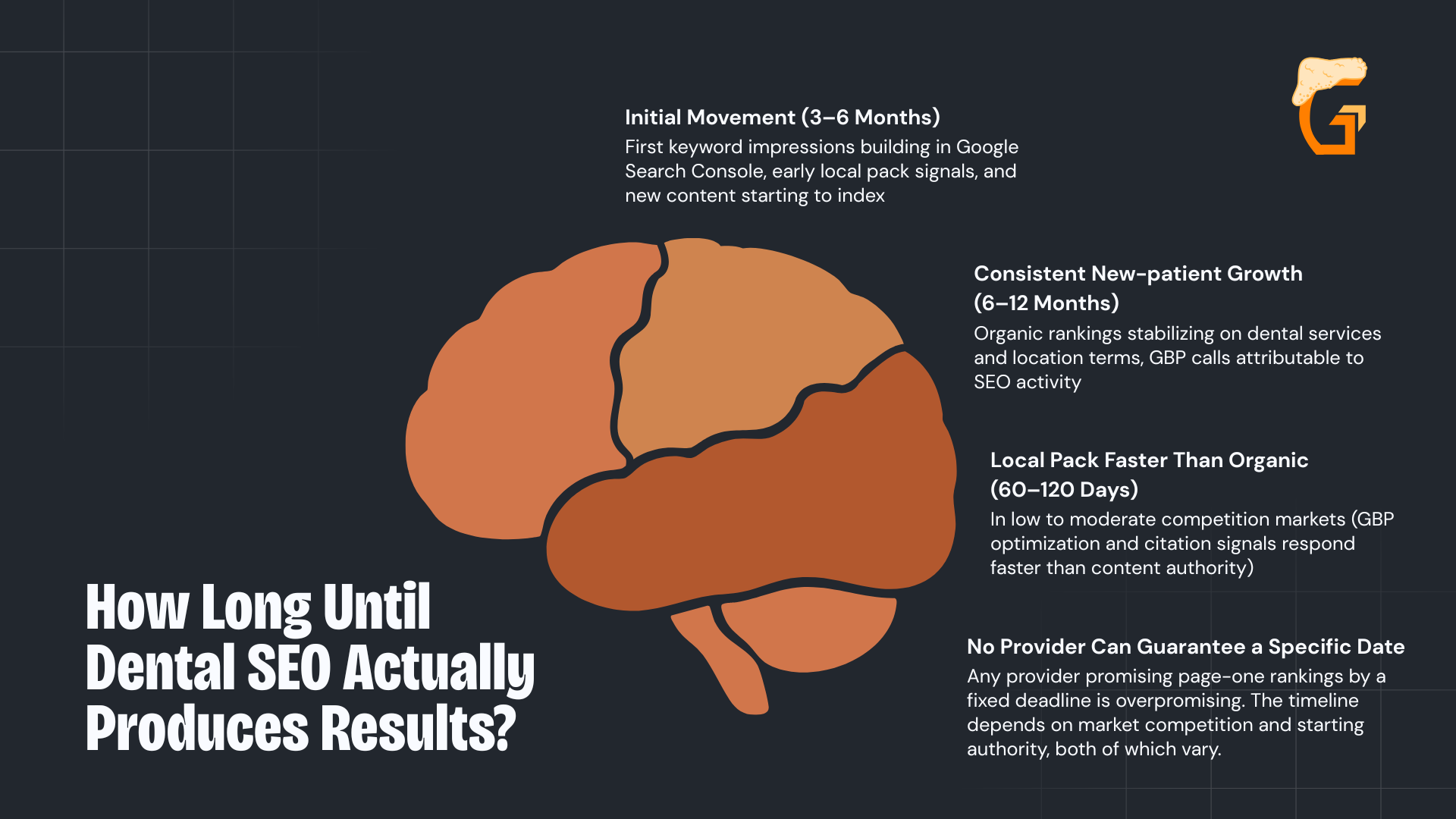
How Long Until Dental SEO Actually Produces Results?
The timeline breaks into two tracks:
- Initial movement (3–6 months): first keyword impressions building in Google Search Console, early local pack signals, and new content starting to index
- Consistent new-patient growth (6–12 months): organic rankings stabilizing on dental services and location terms, GBP calls attributable to SEO activity
- Local pack faster than organic (60–120 days): in low to moderate competition markets (GBP optimization and citation signals respond faster than content authority)
- No provider can guarantee a specific date: any provider promising page-one rankings by a fixed deadline is overpromising. The timeline depends on market competition and starting authority, both of which vary.
These benchmarks describe typical patterns for a dental SEO strategy, not guaranteed outcomes.
A practice in a low-competition mid-sized city may see local search traffic from the map pack within six weeks.
A new practice in a major metro competing against 40 established sites may not gain search visibility on page one for 12 months.
Why Does the Starting Point Change the Timeline, and How Does SEO Compare to Ads?
Paid advertising through Google Ads produces calls in days.
SEO compounds over months.
They serve different roles:
- New domain:
- Starts with no trust signals
- Requires the full 12-month investment to reach meaningful patient volume
- No shortcut exists for domain authority
- Established domain with existing content:
- Compounds faster
- Prior indexing history, existing backlinks, and content already in Google’s index give the new work a head start
The implication for budget: practices that need patients now should run Google Ads while dental SEO services build authority.
Practices that build SEO for 12 months create a patient-acquisition asset that fuels long-term business growth and continues generating calls without ongoing spend per click.
What Happens at Each Stage of Dental SEO? Month-by-Month Milestones
Each stage of dental SEO has verifiable deliverables.
Month 1 covers technical fixes like site speed and GBP setup, months 2–4 bring indexing and first keyword movement, and months 4–12 are when rankings climb and patient volume grows.
A practice owner can check every one of these successful SEO milestones without expertise (they are observable facts, not black-box activity).
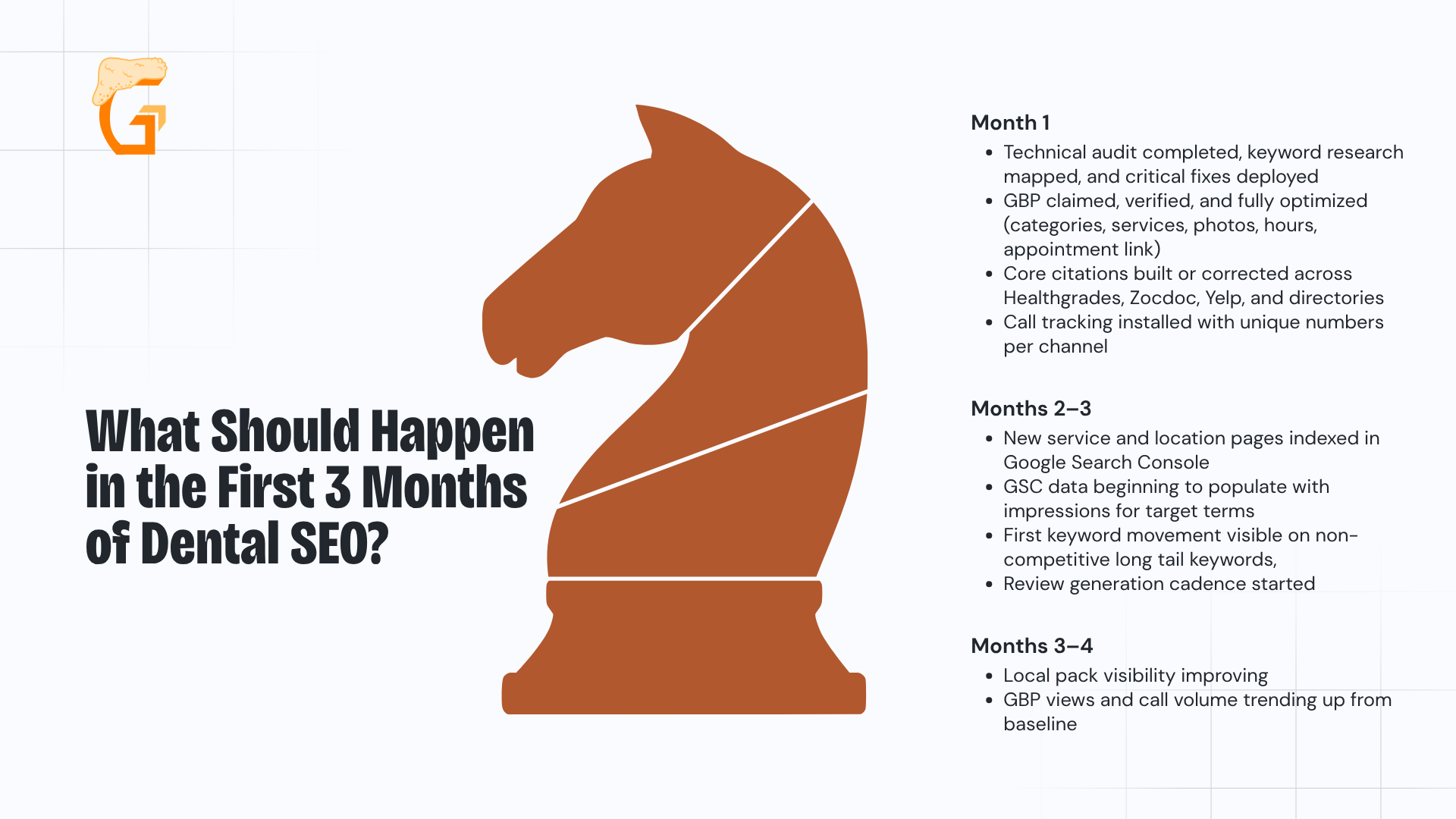
What Should Happen in the First 3 Months of Dental SEO?
Months 1–3 are the foundation phase.
The quality of execution here determines the 12-month outcome.
Technical fixes, on page optimization, and GBP optimization done correctly in the first 30 days create the base every later month builds on.
The phase-by-phase milestone structure looks like this:
- Month 1:
- Technical audit completed, keyword research mapped, and critical fixes deployed
- GBP claimed, verified, and fully optimized (categories, services, photos, hours, appointment link)
- Core citations built or corrected across Healthgrades, Zocdoc, Yelp, and directories
- Call tracking installed with unique numbers per channel
- Months 2–3:
- New service and location pages indexed in Google Search Console
- GSC data beginning to populate with impressions for target terms
- First keyword movement visible on non-competitive long tail keywords,
- Review generation cadence started
- Months 3–4:
- Local pack visibility improving
- GBP views and call volume trending up from baseline
If none of these milestones have occurred by the end of month 3, the question is not whether search engine optimization takes time – it is whether the execution happened.
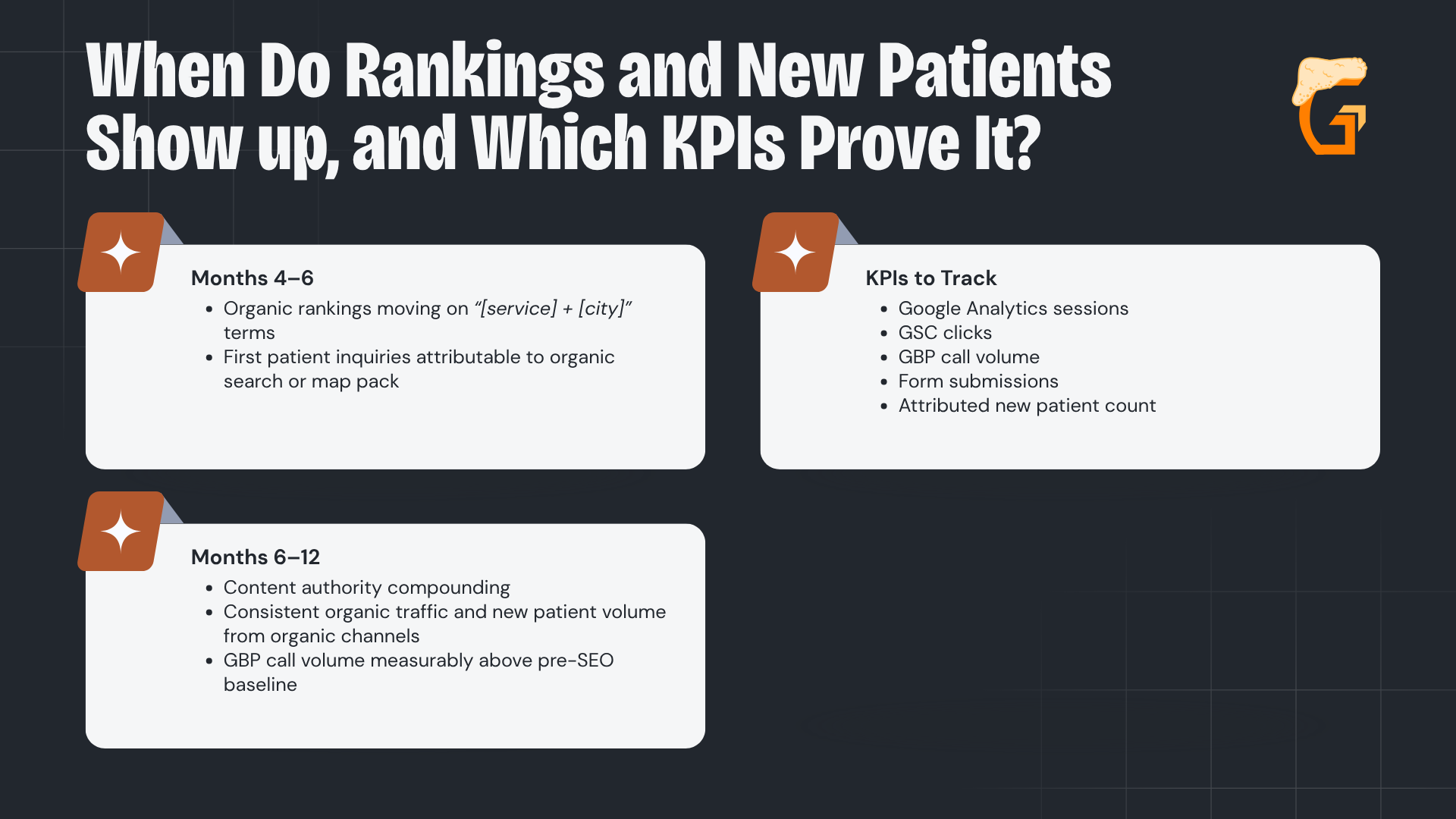
When Do Rankings and New Patients Show up, and Which KPIs Prove It?
Months 4–12 are the growth phase.
Organic rankings climb on service and location terms as content authority compounds into consistent patient volume:
- Months 4–6:
- Organic rankings moving on “[service] + [city]” terms
- First patient inquiries attributable to organic search or map pack
- Months 6–12:
- Content authority compounding
- Consistent organic traffic and new patient volume from organic channels
- GBP call volume measurably above pre-SEO baseline
- KPIs to track:
- Google Analytics sessions
- GSC clicks
- GBP call volume
- Form submissions
- Attributed new patient count
One important note: GSC impression data had reporting anomalies in 2025–2026, making raw impression counts less reliable as a standalone metric.
To measure SEO success, GBP calls and form submissions are the more dependable patient-growth signals to anchor reporting on.
Growth Saloon executes each stage of the dental SEO timeline so the months of work compound into qualified new patient inquiries – not just clicks.
Contact our team today to find out how our dental marketing services can lower your cost per new patient and grow your practice.
What Factors Make Dental SEO Take Longer?
Dental SEO takes longer when competition is high, the domain is new with little authority, the site has technical problems, or content is published too slowly to build authority.
Search engines accumulate these trust signals over months.
Several factors here are outside a practice owner’s control.
Others are not.
How Much Do Competition and Domain Age Slow Dental SEO Down?
Competition and domain age are the two delay factors a practice cannot directly control – but they are the ones that determine the baseline timeline:
- Market competition:
- Decisions in Dentistry notes that practices with lower domain authority and thinner content face a longer road in competitive markets.
- Major metro markets (New York, Los Angeles, Chicago) typically require 9–12 months or more.
- Smaller, lower-competition markets can see meaningful results in 3–5 months.
- Domain age and existing authority:
- A new domain starts with no trust history.
- Google’s systems evaluate new content over a period of weeks to months before rewarding it with rankings.
- An established domain with existing indexed content and incoming links from reputable sites compounds faster because the trust evaluation has already begun.
Budget and content investment need to match the competitive environment.
A practice in a major metro expecting three-month results from a minimal content budget is working against two structural disadvantages at once.
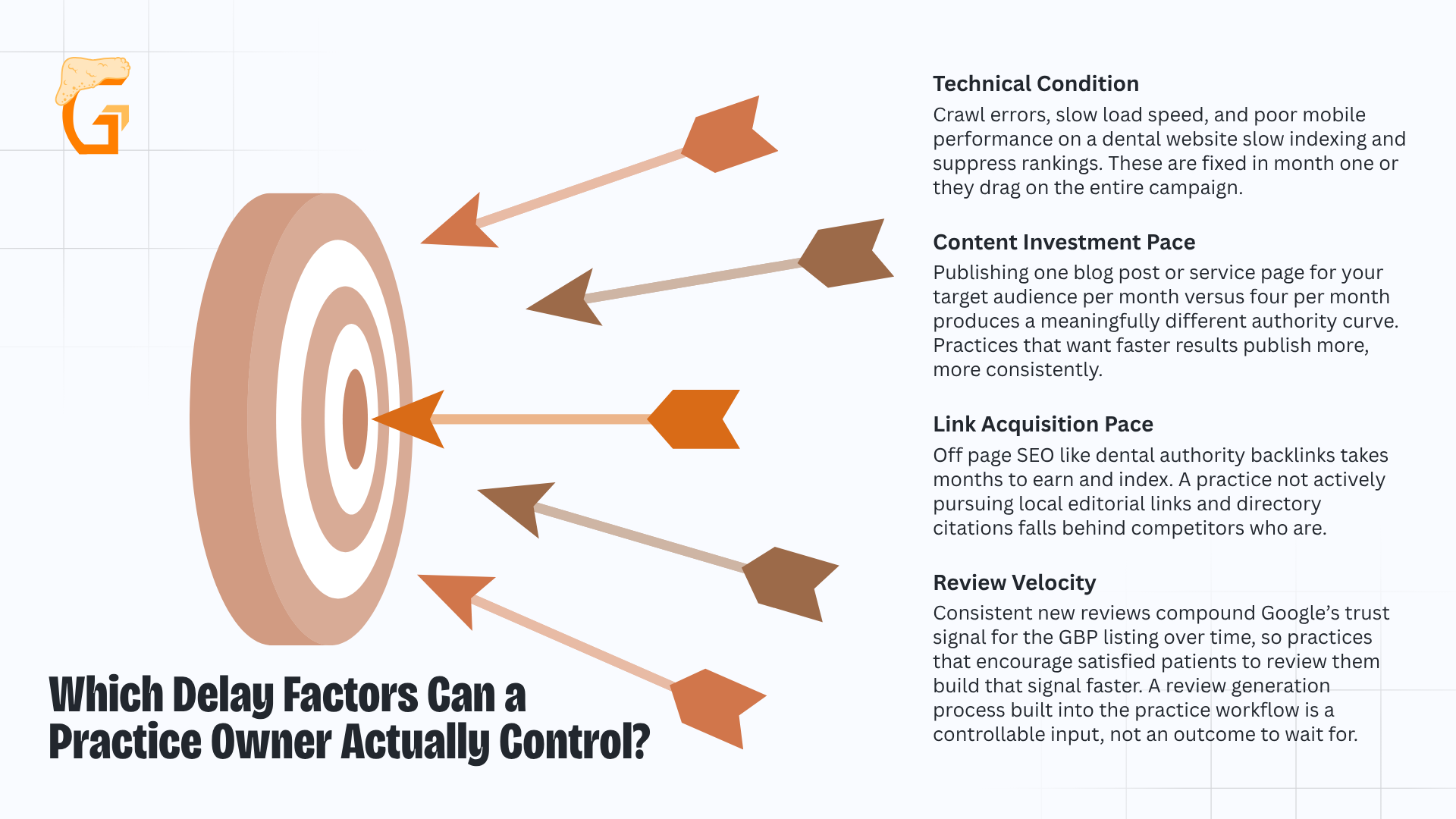
Which Delay Factors Can a Practice Owner Actually Control?
Four delay factors are directly controllable:
- Technical condition: crawl errors, slow load speed, and poor mobile performance on a dental website slow indexing and suppress rankings. These are fixed in month one or they drag on the entire campaign.
- Content investment pace: publishing one blog post or service page for your target audience per month versus four per month produces a meaningfully different authority curve. Practices that want faster results publish more, more consistently.
- Link acquisition pace: off page SEO like dental authority backlinks takes months to earn and index. A practice not actively pursuing local editorial links and directory citations falls behind competitors who are.
- Review velocity: consistent new reviews compound Google’s trust signal for the GBP listing over time, so practices that encourage satisfied patients to review them build that signal faster. A review generation process built into the practice workflow is a controllable input, not an outcome to wait for.
Fix what you can control.
Technical cleanup and content cadence are the two levers in your dental SEO efforts that most directly shorten the path to organic rankings.
Growth Saloon pulls the technical and content levers that shorten the path to qualified new patient inquiries – not just clicks.
Contact our team today to find out how our dental marketing services can lower your cost per new patient and grow your practice.
How’s your SEO going?
Enter your website URL below to get a free comprehensive SEO audit.
The audit includes:
- A scan of your entire website for technical issues
- A list of your top opportunities to target immediately
- Your highest priority fixes to make
How Does Dental SEO Timeline Differ for Local Pack vs Organic Results?
The local pack drives local traffic faster than organic results because it responds to GBP signals, citations, and reviews, which can be optimized immediately (often producing map pack lift in 30–60 days in low-competition markets).
As an ongoing process, organic rankings respond to different signals and take longer to compound.
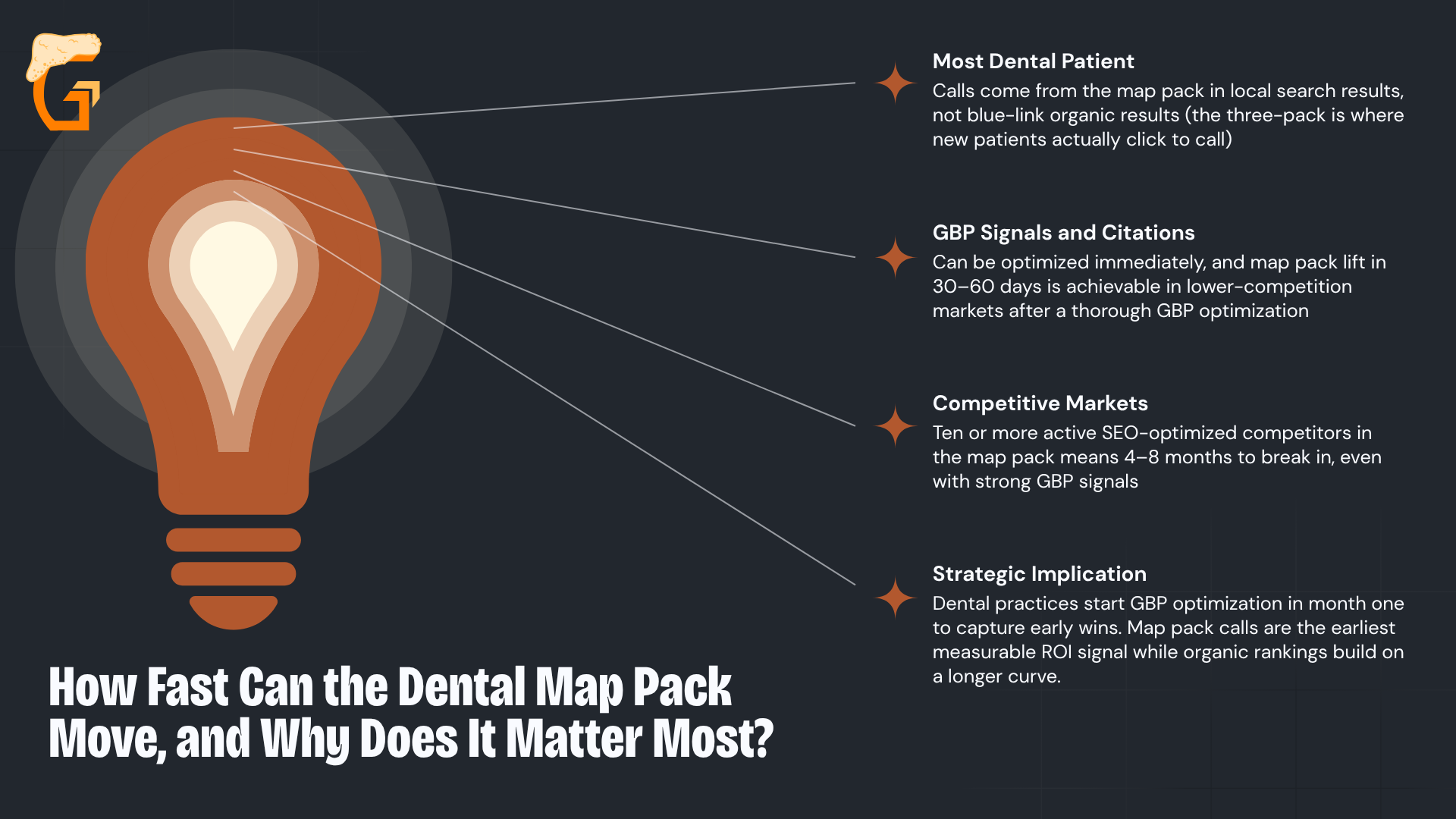
How Fast Can the Dental Map Pack Move, and Why Does It Matter Most?
The local map pack is the highest-priority outcome for most dental practices:
- Most dental patient calls come from the map pack in local search results, not blue-link organic results (the three-pack is where new patients actually click to call)
- GBP signals and citations can be optimized immediately, and map pack lift in 30–60 days is achievable in lower-competition markets after a thorough GBP optimization
- Competitive markets: ten or more active SEO-optimized competitors in the map pack means 4–8 months to break in, even with strong GBP signals
- Strategic implication: dental practices start GBP optimization in month one to capture early wins. Map pack calls are the earliest measurable ROI signal while organic rankings build on a longer curve.
Why Do Organic Rankings Take Longer than the Local Pack?
Organic rankings are driven by content authority, backlinks, and topical depth (signals that compound slowly rather than responding to a single profile update):
- Competitive service terms like “cosmetic dentistry [city],” “dental implants [city],” or “Invisalign [city]” typically take 4–9 months to rank in the top five
- Content authority builds as Google evaluates each page over weeks to months before awarding search engine rankings
- High quality backlinks (which amplify content authority) take time to earn, get indexed, and pass ranking value
Run both tracks in parallel with ongoing optimization:
- Map pack optimization in month one; and
- Website optimization, content and link building throughout the campaign.
Report on them separately (local pack calls and organic clicks are different signals that move at different speeds).
Growth Saloon tracks local pack and organic signals separately so a dental practice sees exactly where its qualified new patient inquiries are coming from.
Contact our team today to find out how our dental marketing services can lower your cost per new patient and grow your practice.
When Should You Be Concerned That Dental SEO Isn't Working?
No patient growth in the first 3 months is normal, but flat GBP calls, flat form fills, and no new citations by month 4 signal an execution problem – not that the strategy needs more time.
The question to ask at month four is not “is SEO working?” – it is “is my provider executing?”
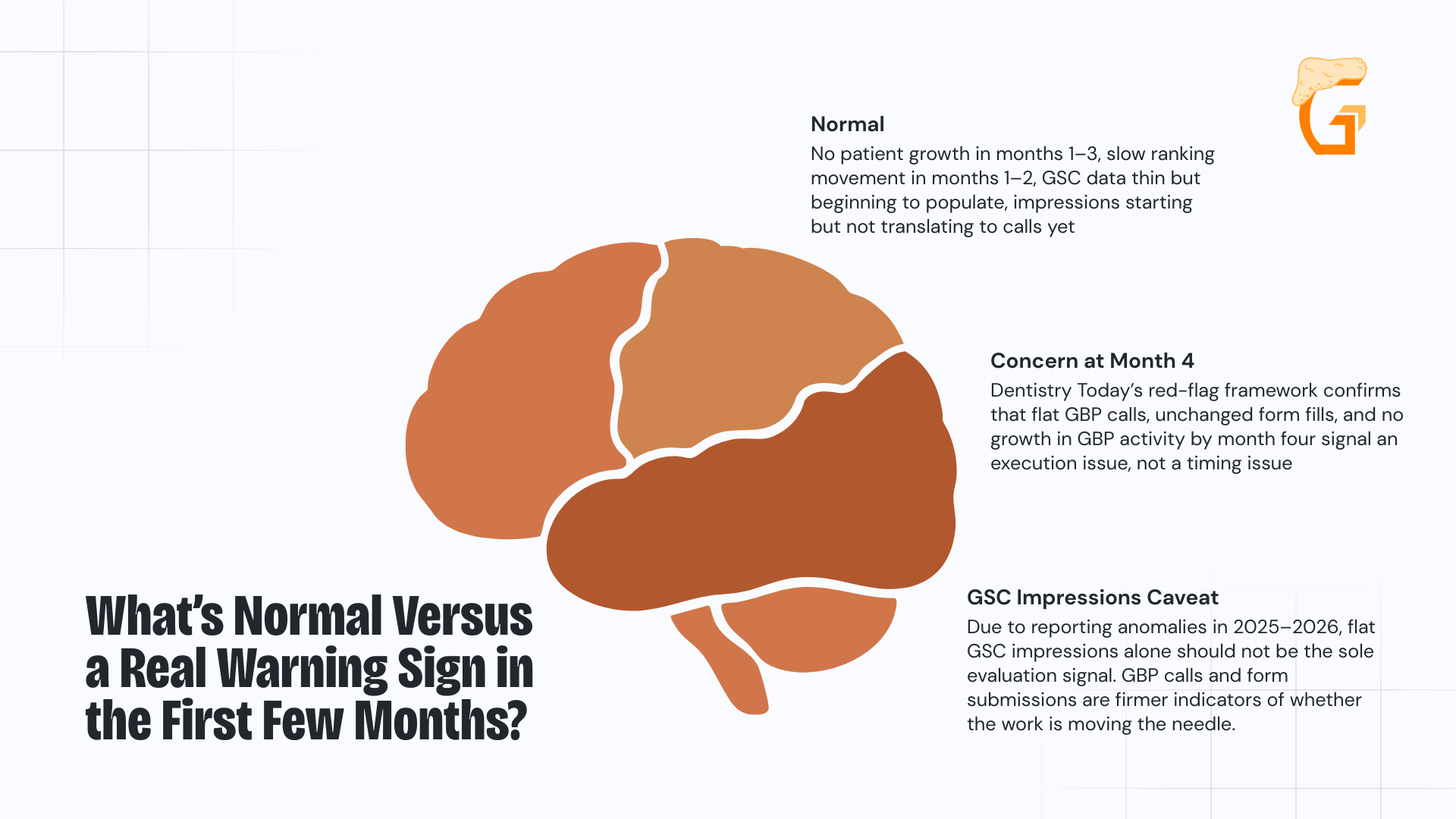
What’s Normal Versus a Real Warning Sign in the First Few Months?
Draw the line clearly:
- Normal: no patient growth in months 1–3, slow ranking movement in months 1–2, GSC data thin but beginning to populate, impressions starting but not translating to calls yet
- Concern at month 4: Dentistry Today’s red-flag framework confirms that flat GBP calls, unchanged form fills, and no growth in GBP activity by month four signal an execution issue, not a timing issue
- GSC impressions caveat: due to reporting anomalies in 2025–2026, flat GSC impressions alone should not be the sole evaluation signal. GBP calls and form submissions are firmer indicators of whether the work is moving the needle.
By month three, a practice owner should be able to verify – new content indexed in GSC, citations built and live, Google reviews accumulating, and GBP views improving from baseline.
These are observable.
No dental SEO agency should be reporting only on abstract keyword positions while these verifiable deliverables are absent.
What Provider Red Flags and Self-Audit Should You Check?
The #1 reason dental SEO fails is abandoning before the compounding effect takes hold – but the right response to slow progress is diagnosis, not quitting:
- Provider red flags: reporting only on keyword rankings with no other deliverables, call tracking not installed after 30 days, no new content published in two months or more
- Owner audit checklist: Is the site indexed? Are NAP details consistent across local listings and directories? Is the GBP fully optimized with recent posts and photos? Is content being published on schedule?
A practice that checks those four items and finds them all in order has a timing problem.
A practice that finds uncorrected technical errors, no new local citations, and no new content has an execution problem (and changing providers may be warranted).
Growth Saloon helps dental practices build the kind of digital presence that consistently generates qualified new patient inquiries – not just clicks.
Contact our team today to find out how our dental marketing services can lower your cost per new patient and grow your practice.
How Can Growth Saloon Help Your Dental Practice Grow?
Growth Saloon is a Chicago-based digital marketing agency built to help dental practices attract more patients and grow their practice through performance-driven digital marketing.
Mike Lowe and the Growth Saloon team specialize in SEO, web design, conversion rate optimization, and marketing attribution (working alongside your practice to build a measurable digital presence that generates qualified patient inquiries, not just website traffic).
From ranking for high-intent local search terms to converting site visitors into booked appointments, Growth Saloon focuses on results at every stage of the patient acquisition funnel.
Practice owners and marketing managers get clear visibility into exactly which channels are driving new patient growth.
We know that every open appointment slot has a real cost.
Every decision we make is built around one outcome – helping your practice fill more of them.
Meet the Founder of Growth Saloon
Meet the founder and lead strategist at Growth Saloon – Mike Lowe:
- As founder and CEO of Growth Saloon, Mike brings years of hands-on experience in SEO strategy, CRO, web design, and marketing attribution for service-based businesses competing in local and regional markets.
- Based in Chicago and working with practices across the country, Mike has built and managed digital growth campaigns for businesses competing in some of the most contested search markets in the country.
- Growth Saloon’s data-driven approach to local SEO and patient acquisition helps dental practices turn their websites into their highest-performing new patient channel.
What Does Working With Growth Saloon Look Like?
Growth Saloon operates as a dedicated extension of your marketing team – not a vendor that disappears after onboarding.
Every engagement includes direct access to Mike and the team, transparent reporting tied to actual patient acquisition outcomes, and strategies tailored to your specific services and local market.
Whether you’re looking to rank for high-value procedures, improve your site’s appointment conversion rate, or finally get clarity on where your new patients are actually coming from, Growth Saloon builds the strategy and does the work.
Growth Saloon helps dental practices build the kind of digital presence that consistently generates qualified new patient inquiries – not just clicks.
Contact our team today to find out how our dental marketing services can lower your cost per new patient and grow your practice.
How's your SEO going?
Get your free comprehensive SEO audit.
Enter your website URL below to get a free comprehensive SEO audit.
- Scan entire website for technical issues
- Get a list of your top opportunities
- See your highest priority fixes to make
-
In a highly competitive market (major metros like New York, Los Angeles, or Chicago) expect 9–12 months before consistent organic ranking gains materialize, and 4–8 months before meaningful local pack movement.
Many dental practices find the same strategies that work in a low-competition market in 3–5 months take roughly twice as long in markets where dozens of well-resourced competitors are actively doing SEO.
Budget and content investment need to match the competitive environment.
-
Call volume from SEO typically begins to move between months 4 and 6 for practices in moderate-competition markets.
Local pack calls (from the Google Maps section) often appear before organic calls, sometimes as early as 60–90 days after Google Business Profile optimization and citation work.
Organic calls from service page rankings take longer, usually 4–9 months.
Call tracking software installed from day one is required to distinguish SEO-sourced phone calls from other channels.
-
Three months is too short to evaluate patient growth from dental SEO, but it is enough time to evaluate execution quality.
By month 3, you should see – Google Search Console impressions trending upward, GBP views and clicks improving, new citations built and verified, and new content indexed.
If none of these leading indicators are moving at 90 days, there is likely an execution problem – not insufficient time for the strategy to work.
-
The earliest reliable signals that dental SEO is working are:
- Increasing Google Search Console impressions for target keywords (weeks 4–8);
- More views and direction requests in GBP Insights (weeks 4–8);
- New pages appearing in Google’s index (weeks 2–4); and
- Online reviews increasing if a review cadence has been built in.
Dental practices experience ranking and call volume improvements that typically follow these leading indicators by 4–8 weeks.
-
The most common reasons dental SEO stalls are:
- Insufficient content production (one post per month vs four);
- No link acquisition strategy;
- Technical issues blocking proper crawling or indexing;
- New or low-authority domain; and
- Intense market competition.
Google also evaluates new high quality content over time before rewarding it with rankings (this evaluation period alone accounts for 1–3 months of apparent inactivity).
Review the execution, not just the strategy.
-
Yes. Running Google Ads during the first 6–12 months of dental SEO is a common and effective way to reach potential patients.
Ads produce calls immediately while SEO builds online visibility and authority over time.
Once organic visibility generates consistent leads from local patients, ad spend can be reduced or redirected toward higher-value procedures.
The two channels are not mutually exclusive (ads handle short-term patient leads while SEO builds the long-term compounding asset).
Most agencies sell traffic. We sell actual growth. That’s the Growth Saloon difference.
Are you looking to grow?
Recent blogs
Enter your website URL below to get free comprehensive SEO audit.
- Scan entire website for technical issues
- Get a list of your top opportunities
- See your highest priority fixes to make