

Updated:August 13th, 2026

YMYL SEO for Dentists: Trust Signals [2026 Guide]

Written by

Mike Lowe

Reviewed by

Taylor Coteus

Key takeaways

  • Content for dentistry falls under YMYL (Your Money or Your Life) and is held to Google's highest scrutiny on every page, not just the homepage, because patients use it to make health and financial decisions.
  • The highest-ROI fix is E-E-A-T compliance, starting with complete dentist bios and named DDS bylines on clinical pages, since low E-E-A-T signals get sites downgraded in core algorithm updates.
  • Make service pages clinically complete with candidacy, risks, recovery, cost, and cited authoritative sources like the ADA, then add schema and technical trust signals such as HTTPS and consistent NAP.

Why Does YMYL SEO for Dentists Operate by Different Rules Than General SEO?

YMYL SEO for dentists means your website is held to Google’s highest content quality standard (not because your practice is doing anything wrong, but because dental patients use your pages to make real health and financial decisions).

When someone reads your implant page or your oral surgery FAQ, Google treats that content the same way it treats medical sites like WebMD: a credibility problem isn’t just a ranking problem, it’s a patient safety problem.

That distinction matters because the SEO playbook that works for a restaurant or a retail brand will fall short for a dental practice.

Keyword density, backlink counts, and page speed all still matter (but they sit below a more demanding threshold that dental sites have to clear first).

YMYL SEO for Dentists Trust Signals

If your content can’t demonstrate that a qualified professional stands behind it, search engines have a documented reason to deprioritize it, regardless of how well everything else is optimized.

The Growth Saloon team put this guide together specifically for dental practices trying to close that gap.

The sections below cover every layer of YMYL compliance that moves the needle for dental websites (from E-E-A-T signals and service page structure to schema markup, local SEO, and a practical audit checklist you can run on your own site).

Growth Saloon helps dental practices build the kind of digital presence that consistently generates qualified new patient inquiries – not just clicks.

Contact our team today to find out how our dental marketing services can lower your cost per new patient and grow your practice.

What YMYL Means for Dental Websites and Why Google Holds Them to a Higher Standard

YMYL (Your Money or Your Life) is Google’s classification for content, including dental care information, that can directly affect a person’s health, safety, or finances.

All dental websites fall into this category because patients use them to make decisions about dental procedures, treatment costs, and their physical wellbeing.

Google applies its strictest quality evaluation to YMYL sites, meaning a dental practice website (whether for a family practice, a cosmetic dentist, or an emergency dentist) must demonstrate expertise, accuracy, and trustworthiness at a level that a restaurant or retail site never needs to match.

The classification isn’t limited to one page type.

It covers the entire dental website (from general care to emergency dentistry), and every page that influences patient health or financial decisions faces the same evaluation standard.

Which Dental Website Pages Fall Under YMYL Classification?
Which Dental Website Pages Fall Under YMYL Classification

YMYL classification is not limited to the homepage.

It applies to every page of a dental website because patients searching for a dentist near them use it to make decisions about clinical procedures, treatment costs, and their physical health.

Here is what that classification means in practice:

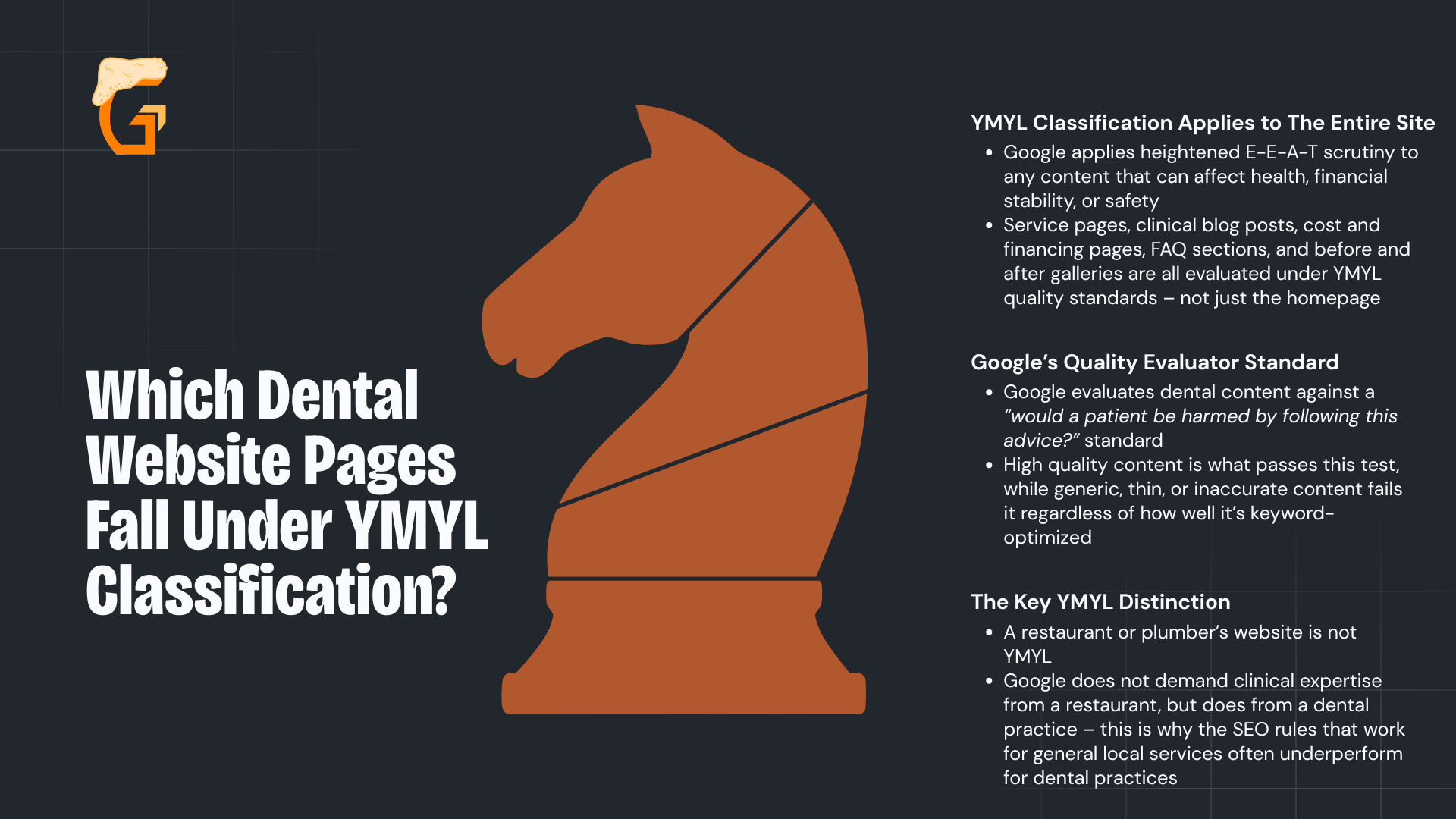
  • YMYL classification applies to the entire site: Google applies heightened E-E-A-T scrutiny to any content that can affect health, financial stability, or safety, so service pages, clinical blog posts, cost and financing pages, FAQ sections, and before and after galleries are all evaluated under YMYL quality standards (not just the homepage)
  • Google’s quality evaluator standard: Google evaluates dental content against a “would a patient be harmed by following this advice?” standard (high quality content is what passes this test, while generic, thin, or inaccurate content fails it regardless of how well it’s keyword-optimized)
  • The key YMYL distinction: a restaurant or plumber’s website is not YMYL (Google does not demand clinical expertise from a restaurant, but does from a dental practice – this is why the SEO rules that work for general local services often underperform for dental practices)

The Medic update (2018) and Helpful Content updates specifically penalized dental sites with thin, uncredentialed content because they failed YMYL quality standards (recovery required substantive content improvements, not technical fixes).

What Is the Ranking Consequence of YMYL Non-Compliance for Dental Websites?

YMYL sites with low E-E-A-T signals are downgraded in core algorithm updates, not just temporarily filtered (recovery requires substantive content improvements, not technical fixes).

The consequence cuts both ways:

  • Ranking penalty mechanism: YMYL sites with low E-E-A-T signals are downgraded in core algorithm updates (recovery requires improving bios, authorship attribution, and clinical citations – not adding keywords or tweaking meta tags)
  • The positive compliance case: dental sites that clearly demonstrate expertise, accurate clinical information, and professional accountability consistently rank above competitors with better keyword optimization but weaker E-E-A-T (compliance is a durable competitive advantage)

The implication is that investing in YMYL compliance (complete dentist bios, better service page structure, clinical citations) is the highest-ROI investment a dental practice can make to protect its SEO rankings in a competitive market.
E-E-A-T Signals That Matter Most for Dental Practice Websites

E-E-A-T (Experience, Expertise, Authoritativeness, and Trustworthiness) is the framework Google’s quality evaluators use to assess whether dental content is safe to rank.

For dental practices, the highest-impact E-E-A-T signals are credentialed dentist bios with degrees and specializations, author bylines and medical review disclosures on clinical content, documented case experience with before/after results, and memberships in recognized dental associations like the ADA.

Most dental websites fail on the Expertise pillar alone (service pages with no named author and no credential attribution are the most common YMYL compliance gap).

How Should Dentist Bio Pages and Author Bylines Be Structured for E-E-A-T?

How Should Dentist Bio Pages and Author Bylines Be Structured for E-E-A-T

A complete dentist bio demonstrates the Expertise pillar in a format Google’s quality evaluators can assess directly (and most dentists either lack a bio page entirely or have a headshot and a generic paragraph).

Structure the bio and bylines around these requirements:

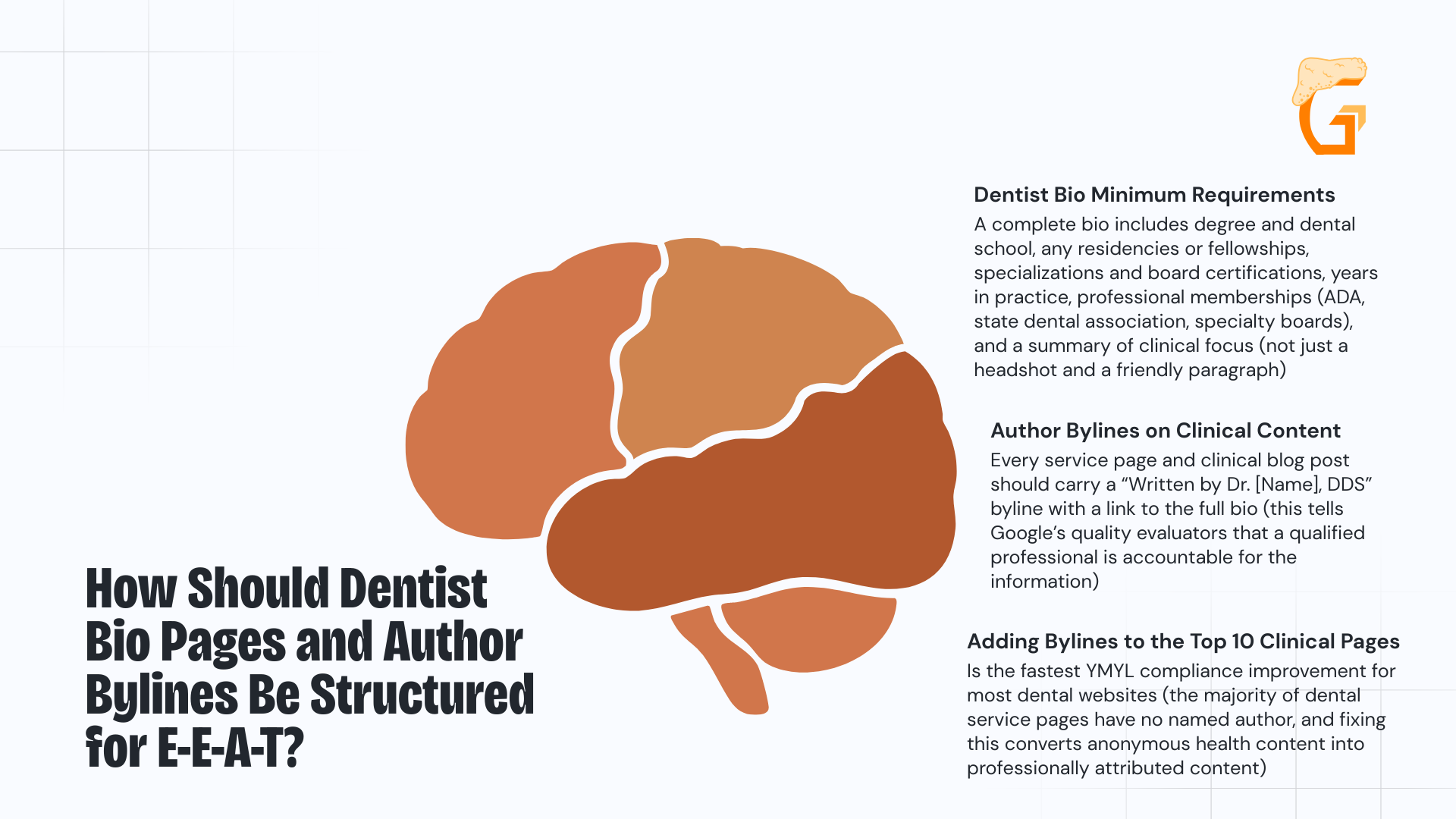
  • Dentist bio minimum requirements: a complete bio includes degree and dental school, any residencies or fellowships, specializations and board certifications, years in practice, professional memberships (ADA, state dental association, specialty boards), and a summary of clinical focus (not just a headshot and a friendly paragraph)
  • Author bylines on clinical content: every service page and clinical blog post should carry a “Written by Dr. [Name], DDS” byline with a link to the full bio (this tells Google’s quality evaluators that a qualified professional is accountable for the information)
  • Adding bylines to the top 10 clinical pages is the fastest YMYL compliance improvement for most dental websites (the majority of dental service pages have no named author, and fixing this converts anonymous health content into professionally attributed content)

Author bylines are the single fastest YMYL compliance improvement for most dental websites (adding a credentialed dentist byline to the top 10 clinical pages produces an immediate E-E-A-T improvement that keyword optimization cannot replicate).

How Do Medical Review Disclosures, Case Documentation, and Association Memberships Build Dental E-E-A-T?

Medical review disclosures, patient stories, and professional memberships cover the Experience and Authoritativeness pillars that bio pages and bylines alone cannot fully establish.

Each covers ground the bio and bylines cannot:

  • Medical review disclosures:
    • For blog posts, FAQs, and educational content, a “Reviewed by Dr. [Name], DDS, [Specialty]” disclosure with a last-reviewed date is the dental equivalent of the medical review label used by WebMD and Healthline.
    • It signals clinical accountability and content freshness.
  • Case documentation as Experience signals:
    • Before-and-after photo galleries with procedure context
    • Brief case summaries describing what was done and why
    • Documented outcomes demonstrate real-world Experience (the first E in E-E-A-T).
    • Credentials alone cannot prove a dentist has performed a procedure, but cases can.
  • Professional memberships:
    • ADA, state dental board, and specialty association listings (AAPD, AAO, AACD, AAID) are Authoritativeness signals.
    • They confirm the practice is a professionally accountable healthcare provider, not just a business with a dental license.

The four E-E-A-T signals (bios, bylines, review disclosures, and case documentation) work as a system – a dental website with all four is demonstrably more compliant than one with only one or two.

Growth Saloon builds the E-E-A-T signals that make a dental site YMYL-compliant and convert that patient trust into qualified new patient inquiries – not just clicks.

Contact our team today to find out how our dental marketing services can lower your cost per new patient and grow your practice.

How to Write Dental Service Pages That Satisfy YMYL Content Requirements

A YMYL-compliant dental service page covers the full patient decision journey:

  • What the procedure is;
  • Who is a good candidate;
  • What happens during treatment;
  • Realistic risks and recovery;
  • Dental implants cost range and insurance considerations; and
  • Why this practice is qualified to perform it.

Clinical claims should be supported by citations to the ADA, specialty associations, or peer-reviewed sources.

High-competition service categories like dental implants and cosmetic dentistry face the most scrutiny because they involve both health risk and significant financial commitment.

The standard is not “good enough for a local business” – it is “good enough to inform a patient making a healthcare decision.”

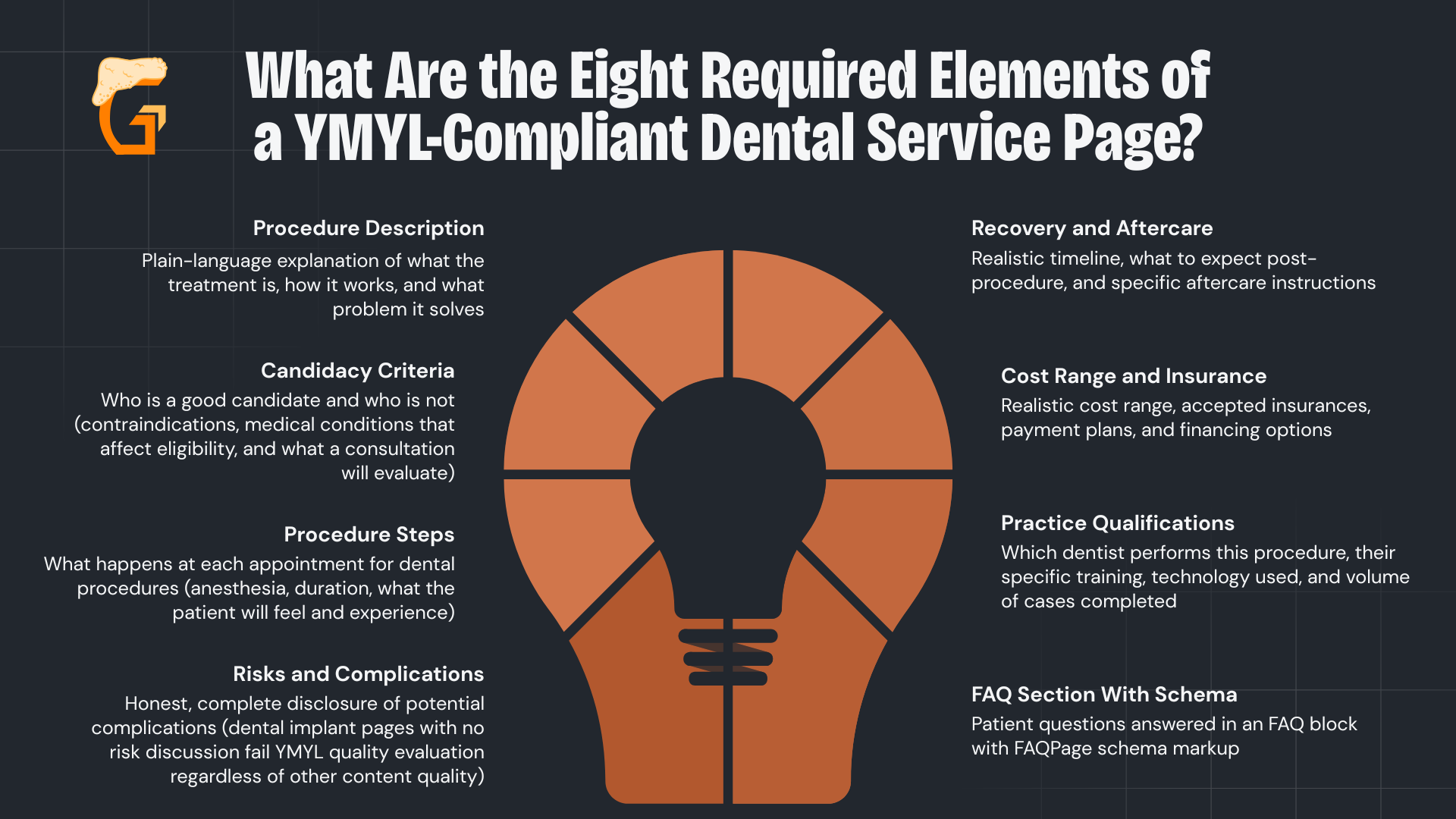
What Are the Eight Required Elements of a YMYL-Compliant Dental Service Page?

What Are the Eight Required Elements of a YMYL-Compliant Dental Service Page

A YMYL-compliant dental service page is a structured answer to every question a patient might have before booking (each element serves both the patient’s decision-making needs and Google’s quality evaluator’s review criteria simultaneously).

A compliant page works through each of these elements:

  • Procedure description: plain-language explanation of what the treatment is, how it works, and what problem it solves
  • Candidacy criteria: who is a good candidate and who is not (contraindications, medical conditions that affect eligibility, and what a consultation will evaluate)
  • Procedure steps: what happens at each appointment for dental procedures (anesthesia, duration, what the patient will feel and experience)
  • Risks and complications: honest, complete disclosure of potential complications (dental implant pages with no risk discussion fail YMYL quality evaluation regardless of other content quality)
  • Recovery and aftercare: realistic timeline, what to expect post-procedure, and specific aftercare instructions
  • Cost range and insurance: realistic cost range, accepted insurances, payment plans, and financing options
  • Practice qualifications: which dentist performs this procedure, their specific training, technology used, and volume of cases completed
  • FAQ section with schema: patient questions answered in an FAQ block with FAQPage schema markup

Omitting candidacy contraindications and risks are the two most common YMYL failures on dental service pages (a page that only presents ideal outcomes is promotional copy, not the clinically honest content that Google’s quality evaluators require).

How Long Should a YMYL Dental Service Page Be, and Which Associations Should It Cite?

Every specific clinical claim on a dental service page should be traceable to an authoritative source (ADA, AAPD, AAO, peer-reviewed journal) – a page with no external references is a YMYL red flag.

Citations and length both follow clear rules:

  • ADA citation requirement:
    • Every specific clinical claim should be traceable to an authoritative source (ADA, AAPD, AAO, peer-reviewed journals (JADA, Journal of Periodontology, Journal of Dental Research)).
    • A claim like “dental implants have a 95% success rate” needs a citation to a recognized source, not just a confident sentence.
  • Content length:
    • YMYL-compliant dental service pages typically run 800–1,500 words for standard procedures and 1,200–2,000 for complex or high-cost procedures like dental implants.
    • There is no fixed word minimum, but covering all eight elements thoroughly produces appropriate length naturally.

A page that tries to hit a word count without covering the eight required elements does not satisfy YMYL standards (length is a byproduct of clinical completeness, not a target to optimize toward).

Growth Saloon writes clinically complete, YMYL-compliant dental service pages that earn qualified new patient inquiries – not just clicks.

Contact our team today to find out how our dental marketing services can lower your cost per new patient and grow your practice.

How’s your SEO going?

Enter your website URL below to get a free comprehensive SEO audit.

The audit includes:

Schema Markup and Technical Trust Signals for YMYL Dental Sites

Technical trust signals reinforce YMYL compliance at the infrastructure level.

The four schema types that matter most for dental sites are LocalBusiness/Dentist (homepage), MedicalProcedure (treatment pages), FAQPage (question-and-answer sections), and Review (genuine patient testimonials).

Beyond schema, YMYL trust requires HTTPS on every page, consistent NAP across the website and all directories, a visible privacy policy, and secure forms for any patient health information submission.

Schema makes existing credentials machine-readable (a credentialed, YMYL-compliant site without schema loses the algorithmic advantage that structured data provides).

Which Schema Types Does a YMYL-Compliant Dental Website Need?

Which Schema Types Does a YMYL-Compliant Dental Website Need

Schema markup tells Google’s crawlers what type of healthcare entity the practice is (whether general dentistry or a specialty), what procedures it offers, and how its content is organized.

Without schema, the crawler must infer these things, which introduces ambiguity into the trust evaluation.

A dental YMYL site needs the following schema types:

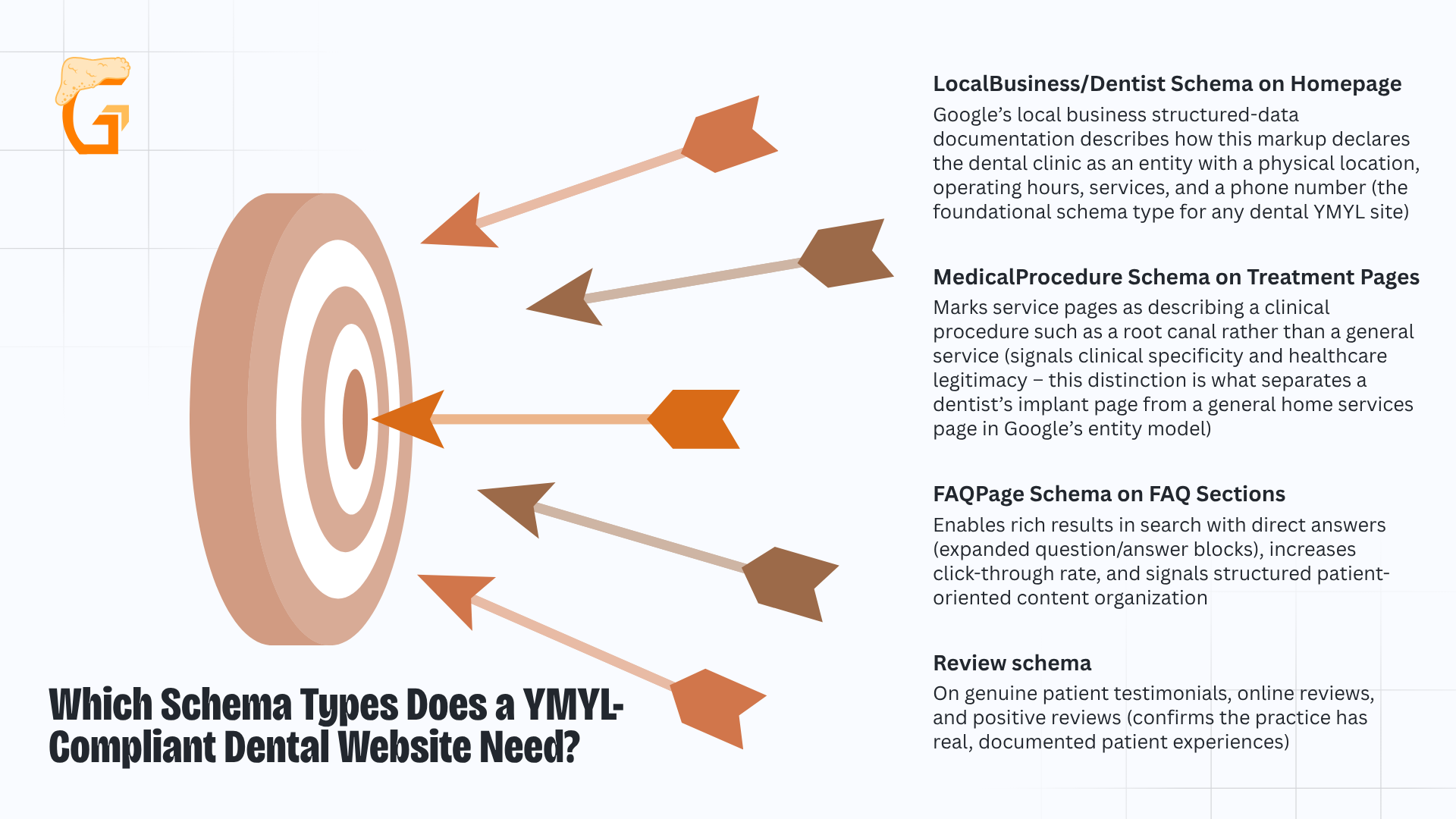
  • LocalBusiness/Dentist schema on the homepage: Google’s local business structured-data documentation describes how this markup declares the dental clinic as an entity with a physical location, operating hours, services, and a phone number (the foundational schema type for any dental YMYL site)
  • MedicalProcedure schema on treatment pages: marks service pages as describing a clinical procedure such as a root canal rather than a general service (signals clinical specificity and healthcare legitimacy – this distinction is what separates a dentist’s implant page from a general home services page in Google’s entity model)
  • FAQPage schema on FAQ sections: enables rich results in search with direct answers (expanded question/answer blocks), increases click-through rate, and signals structured patient-oriented content organization
  • Review schema: on genuine patient testimonials, online reviews, and positive reviews (confirms the practice has real, documented patient experiences)

Use Google’s Rich Results Test to verify that schema is correctly implemented (a schema block with errors is worse than no schema, because it signals a technical inconsistency to the crawler).

What Technical Trust Signals Does a YMYL Dental Site Need Beyond Schema?

HTTPS, NAP consistency, and secure patient forms are the baseline technical trust signals that a dental YMYL site needs regardless of how good its content is.

Confirm each of these baseline signals:

  • HTTPS sitewide and secure patient forms:
    • Every page must be served over HTTPS (not just contact forms and other important pages)
    • An HTTP dental page is a baseline trust failure for a YMYL site
    • Secure patient intake forms are a HIPAA-adjacent signal Google evaluates for healthcare sites
  • NAP (name, address, phone) consistency:
    • Practice name, address, and phone must be identical across the dental website, Google Business Profile, Yelp, Healthgrades, Zocdoc, and all citation directories
    • Inconsistency (“Smith Family Dentistry” vs “Smith Dentistry” vs “Dr. Smith DDS”) signals an untrustworthy entity to Google’s local trust evaluation

NAP cleanup is fast, free, and directly addresses a structural trust deficiency that no amount of schema markup can compensate for (and it’s one of the most commonly missed YMYL trust fixes).

Growth Saloon implements the schema and technical trust signals that make a dental site machine-readable and drive qualified new patient inquiries – not just clicks.

Contact our team today to find out how our dental marketing services can lower your cost per new patient and grow your practice.

YMYL, Local SEO, and the Dental Practice Compliance Audit Checklist

YMYL compliance affects local SEO indirectly but materially (Google’s quality evaluation of a dental website’s content and trust signals influences overall domain authority, which in turn shapes map pack eligibility).

Practices with thin, uncredentialed content lose patient confidence and are at a structural disadvantage even if their GBP is well-optimized.

A practical YMYL compliance audit covers the five areas that separate the best dentist websites from the rest:

  • Content quality and clinical accuracy;
  • E-E-A-T signals (bios, authorship, credentials);
  • Schema implementation;
  • Technical trust infrastructure; and
  • GBP and citation consistency.

A polished GBP alone is not sufficient for map pack eligibility in a competitive market (the underlying website quality evaluation matters).

What Does a Dental Practice YMYL Compliance Audit Check in Each of the Five Categories?

What Does a Dental Practice YMYL Compliance Audit Check in Each of the Five Categories

Treating YMYL compliance as five distinct audit categories prevents the most common pattern (fixing the most visible problem first while missing structural gaps in other areas).

Work through the audit category by category:

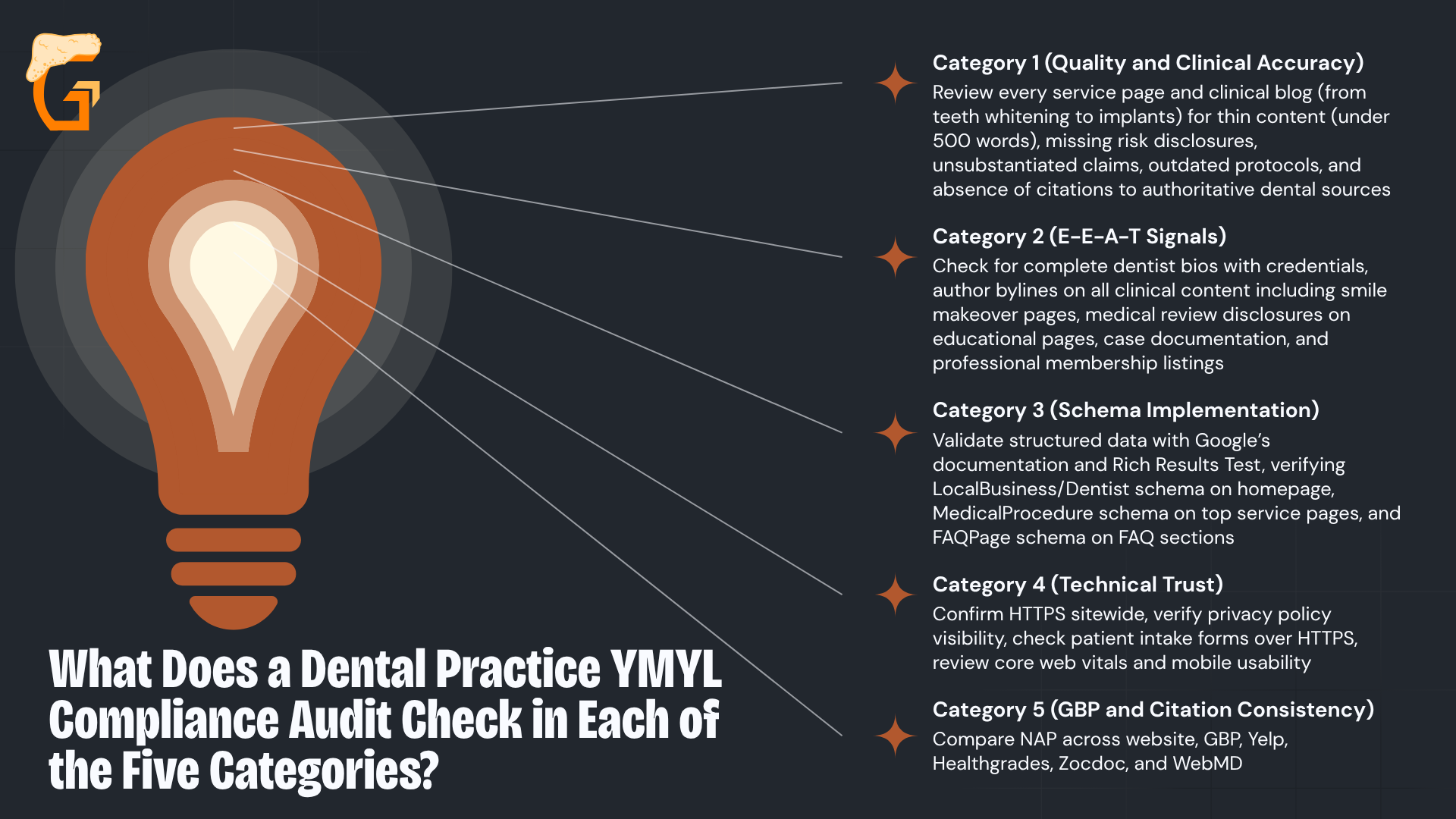
  • Category 1 (Content quality and clinical accuracy): review every service page and clinical blog, from teeth whitening to implants, for thin content (under 500 words), missing risk disclosures, unsubstantiated claims, outdated protocols, and absence of citations to authoritative dental sources
  • Category 2 (E-E-A-T signals): check for complete dentist bios with credentials, author bylines on all clinical content including smile makeover pages, medical review disclosures on educational pages, case documentation, and professional membership listings
  • Category 3 (Schema implementation): validate structured data with Google’s documentation and Rich Results Test, verifying LocalBusiness/Dentist schema on homepage, MedicalProcedure schema on top service pages, and FAQPage schema on FAQ sections
  • Category 4 (Technical trust): confirm HTTPS sitewide, verify privacy policy visibility, check patient intake forms over HTTPS, review core web vitals and mobile usability
  • Category 5 (GBP and citation consistency): compare NAP across website, GBP, Yelp, Healthgrades, Zocdoc, and WebMD

The audit should be run as a checklist rather than a general review (each category has specific binary pass/fail checks that produce a concrete remediation list, not a qualitative score).

What Is the Correct Remediation Priority Order After a YMYL Dental Compliance Audit?

E-E-A-T content improvements come first because Google’s quality evaluation weighs them most heavily (fixing schema before fixing thin, unattributed content produces minimal improvement).

Tackle remediation in this order:

  • E-E-A-T content first (Google’s highest-scrutiny area): dentist bios, author bylines, risk disclosures, medical review labels (these are what quality evaluators assess most heavily – fixing schema without these is optimizing the infrastructure before fixing the foundation)
  • YMYL-compliant service page structure second: add the missing elements (candidacy criteria, risks, citations) to the top five service pages (these are the pages most likely to be under quality review)
  • Schema implementation third: add LocalBusiness/Dentist, MedicalProcedure, and FAQPage schema as part of your technical SEO (now that the underlying content is YMYL-compliant, schema amplifies those signals)
  • Technical trust and citation cleanup last: HTTPS audit, NAP normalization (these are fast to execute and should be done in parallel with content work, but they produce minimal ranking impact if the content above them is still thin)

YMYL compliance is not a one-time optimization.

It is the baseline standard for any dental website that expects to rank for competitive, high-intent service terms through core algorithm updates (non-compliant dental sites cycle between temporary ranking gains and quality-update losses).

Growth Saloon helps dental practices build the kind of digital presence that consistently generates qualified new patient inquiries – not just clicks.

Contact our team today to find out how our dental marketing services can lower your cost per new patient and grow your practice.

How Can Growth Saloon Help Your Dental Practice Grow?

Growth Saloon is a Chicago-based digital marketing and SEO agency built to help dental practices attract more patients and grow their practice through performance-driven digital marketing.

As a dental SEO agency, Mike Lowe and the Growth Saloon team specialize in SEO, Google Ads, web design, conversion rate optimization, and marketing attribution – working alongside your practice to build a measurable digital presence that generates qualified patient inquiries, not just website traffic.

From ranking for the high-intent terms patients search to converting site visitors into booked appointments, Growth Saloon focuses on results at every stage of the patient acquisition funnel.

Practice owners and marketing managers get clear visibility into exactly which channels are driving new patient growth.

We know that every missed patient call and open appointment slot has a real cost.

Every decision we make is built around one outcome – helping your practice fill more of them.

Meet the Founder of Growth Saloon

Meet the founder and lead strategist at Growth Saloon – Mike Lowe:

  • As founder and CEO of Growth Saloon, Mike brings years of hands-on experience in SEO strategy, CRO, web design, and marketing attribution for service-based businesses competing in local and regional markets.
  • Based in Chicago and working with practices across the country, Mike has built and managed digital growth campaigns for businesses competing in some of the most contested search markets in the country.
  • Growth Saloon’s data-driven approach to dental SEO success and patient acquisition helps dental practices turn their websites into their highest-performing new patient channel.

What Does Working With Growth Saloon Look Like?

Growth Saloon operates as a dedicated extension of your marketing team for dental clients – not a vendor that disappears after onboarding.

Every engagement includes direct access to Mike and the team, transparent Google Analytics reporting tied to actual patient acquisition outcomes, and strategies tailored to your specific services and local market.

Whether you’re looking to rank for high-value procedures, improve your site’s appointment conversion rate, or finally get clarity on where your new patients are actually coming from, Growth Saloon builds the strategy and does the work.

Growth Saloon helps dental practices build the kind of online presence that consistently generates qualified new patient inquiries – not just clicks.

Contact our team today to find out how our dental marketing services can lower your cost per new patient and grow your practice.

FAQ
Author

Who is Mike Lowe?

Mike Lowe is a digital marketing strategist and the founder of Growth Saloon, where he specializes in helping businesses cut through the noise with high-converting email strategies and SEO.

With a focus on “organic storytelling,” Mike combines over a decade of agency experience with a passion for helping brands build genuine trust with their audience.

When he’s not optimizing subject lines or scaling SaaS companies, he’s likely sharing insights on how to transform cluttered inboxes into meaningful connection points for online marketers.

Related content
Resources for Dentists

Every resource we’ve published for Dentists, in one place:

Ready to turn your website traffic into real growth?

You’ve read the strategy now let Growth Saloon help you put it into action.

Get a free SEO audit and see what’s holding your website back from ranking, converting, and growing. 

Let's Chat

Let’s discuss your online marketing goals! We’re quick to respond, so we’ll be in touch shortly to set up a time to chat.