

Updated:August 3rd, 2026

SEO for Cosmetic Dentists in 2026

Written by

Mike Lowe

Reviewed by

Taylor Coteus

Key takeaways

  • Cosmetic patients research for weeks before booking, and a single veneer case worth $10,000 to $20,000 justifies far more SEO investment per keyword than a $150 cleaning.
  • Win the high-value searches with procedure hub pages that rank and convert, plus before and after photos that double as E-E-A-T trust signals proving real clinical results.
  • Publish content for every stage of the patient journey rather than decision-stage pages alone, since most cosmetic sites miss the patients who are 3 to 6 months from booking but actively researching.

Why Does SEO for Cosmetic Dentists Require Its Own Strategy?

Search engine optimization for cosmetic dentists operates in a different competitive environment than general dental SEO.

One where patients research for weeks or months before booking, case values run into the thousands, and a single well-ranked procedure page can generate more revenue than a dozen general dentistry searches combined.

Your practice may be delivering exceptional smile transformations, but if those high-intent potential patients can’t find you when they search “veneers [city]” or “cosmetic dentist near me,” they’re booking with a competitor whose website answers the questions yours does not.

The cosmetic patient journey rarely starts with “book an appointment.”

It starts with curiosity – a patient wondering whether veneers can fix a gap, comparing Invisalign to braces, or researching what a smile makeover actually costs.

SEO for Cosmetic Dentists

The practice that shows up across all three stages of that journey (inspiration, evaluation, and decision) builds a pipeline of future patients, not just a handful of same-day bookings.

Growth Saloon helps dental practices build the kind of digital presence that consistently generates qualified new patient inquiries – not just clicks.

Contact our team today to find out how our dental marketing services can lower your cost per new patient and grow your practice.

What Makes Cosmetic Dentist SEO Different from General Dental SEO

Cosmetic dentist SEO targets elective, high-value procedures with a longer patient decision journey (veneers, smile makeovers, Invisalign, and whitening) rather than the urgency-driven searches of general dental care.

Reaching this target audience means content must serve three stages (awareness, evaluation, and decision) because patients researching cosmetic procedures spend weeks comparing options and providers before booking.

A general dental patient has a problem and books an appointment.

A cosmetic patient has a desire and researches for months.

That distinction reshapes everything about cosmetic dentistry SEO, from keyword strategy to page structure.

How Is Cosmetic Dental Search Intent Different from General Dental Search?
General dental searches start with a problem that often sends people to an emergency dentist – a toothache, a chipped filling, a missed cleaning.

Cosmetic searches start with a desire and evolve over time.

The two intent types require completely different content:

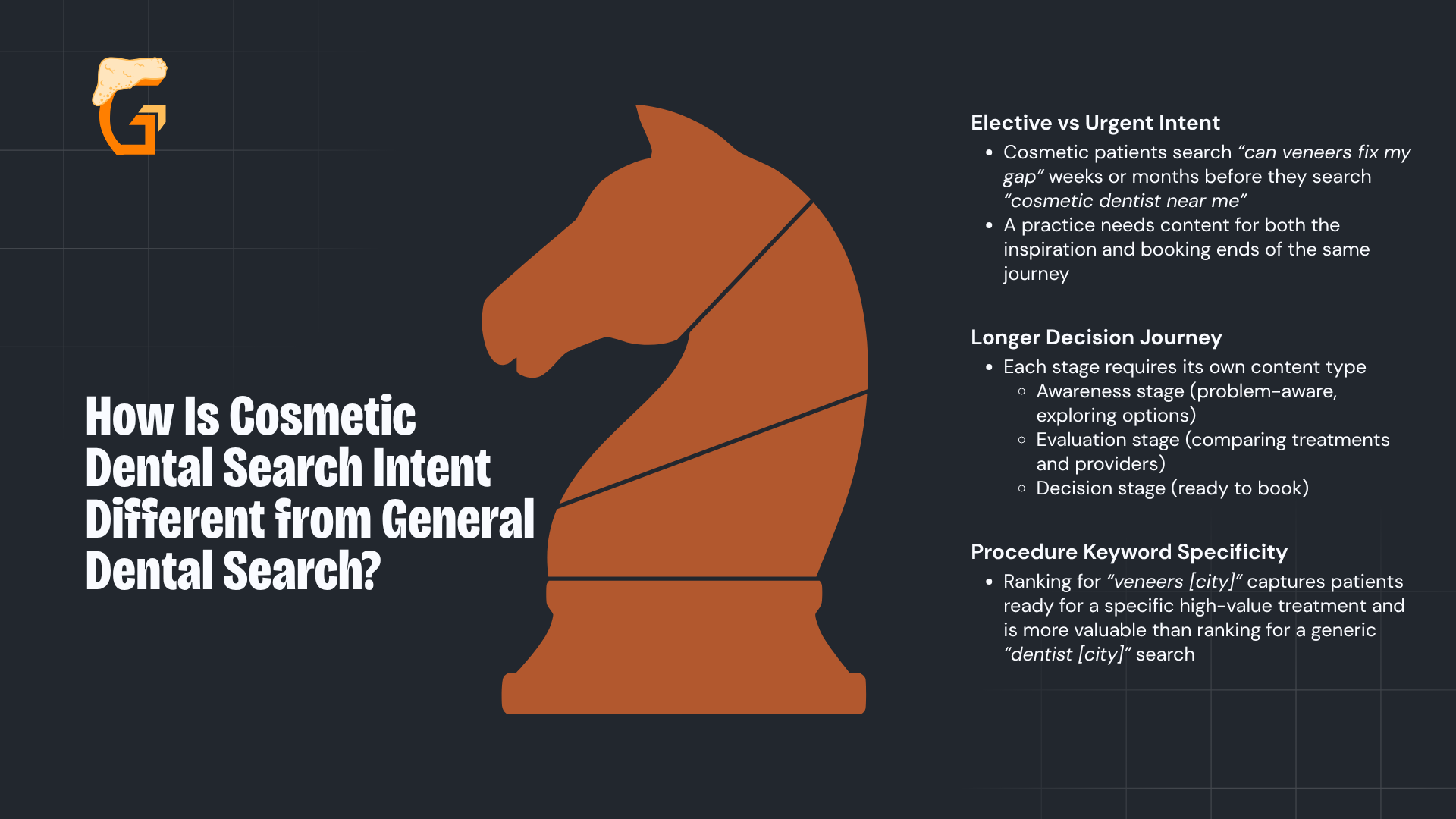
  • Elective vs urgent intent: cosmetic patients search “can veneers fix my gap” weeks or months before they search “cosmetic dentist near me” (a practice needs content for both the inspiration and booking ends of the same journey)
  • Longer decision journey: awareness stage (problem-aware, exploring options), evaluation stage (comparing treatments and providers), decision stage (ready to book) (each stage requires its own content type)
  • Procedure keyword specificity: ranking for “veneers [city]” captures patients ready for a specific high-value treatment and is more valuable than ranking for a generic “dentist [city]” search

A single “cosmetic services” page, even one backed by Google Ads, cannot serve a months-long patient decision journey.

The practice that maps relevant keywords to journey stages (awareness content, evaluation comparisons, decision-ready service pages) outperforms the one that publishes only a service overview and a contact form.

Why Does Higher Case Value Change the SEO Investment?

A veneer case worth $8,000–$20,000 justifies far more spending on SEO services per keyword than a $150 cleaning.

That math drives competition up, which raises the bar on content depth and credentialing:

  • More competitive search engine results pages: higher case value means more marketing budget chasing the same keywords (every practice targeting “veneers [city]” knows what a booked case is worth)
  • Higher E-E-A-T bar: artistry and aesthetic credentials matter alongside clinical ones (before/after galleries and AAACD accreditation are cosmetic-specific trust signals general dentists cannot claim)
  • Deeper content required: a general dental competitor can rank with a 400-word service page (a cosmetic dentistry services page competing for high-value terms needs to answer every candidacy, process, cost, and comparison question a researching patient has)

Because the prize is larger, ranking pages have to be deeper and more credentialed than a general-dental equivalent – which is what the hub-page and E-E-A-T sections ahead address directly.
Local SEO for Cosmetic Dentists: GBP, Reviews, and Map Pack Visibility

For cosmetic dentists, local SEO strategies mean ranking in the map pack for searches like ‘cosmetic dentist near me’, ‘veneers [city]’, and ‘Invisalign provider [city]’.

The Google Business Profile drives the majority of high-intent local clicks. The U.S. Small Business Administration lists managing search-engine listings as the first of its recommended local marketing strategies for small businesses.

Setting the secondary category to ‘Cosmetic Dentist’, adding cosmetic services to the GBP business account, and systematically acquiring reviews that mention specific procedures are the three highest-ROI local SEO actions.

For “veneers near me” and “cosmetic dentist near me” searches built on location based keywords, the map pack listings appear above any organic website result.

In local search results, the GBP is not a supplement to the website – it is the first thing most patients see.

How Should a Cosmetic Dentist Set up the Google Business Profile?

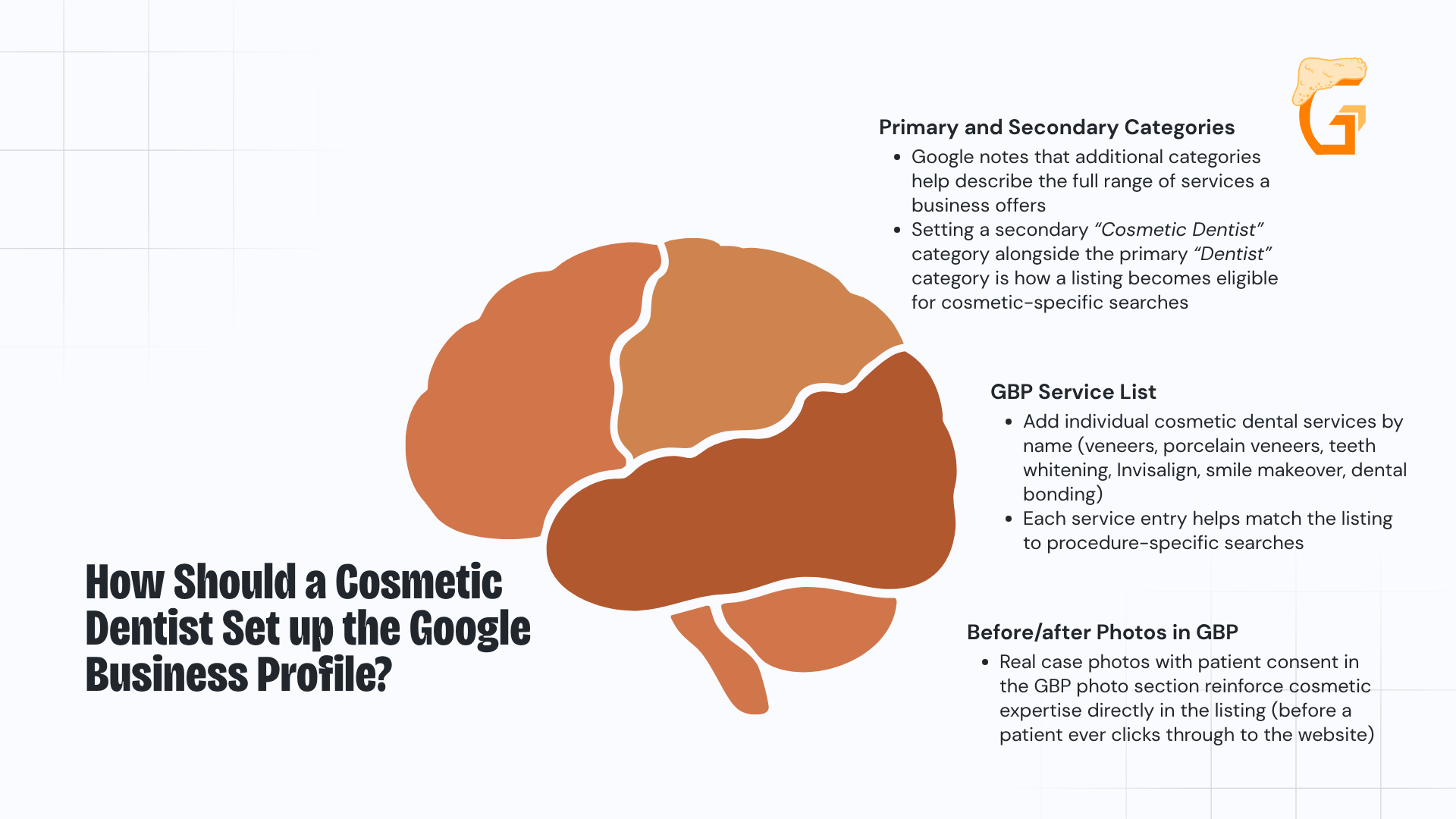
For patients searching cosmetic procedures locally, the map pack appears before any organic result, which makes the GBP the highest-priority local SEO asset:

  • Primary and secondary categories: Google notes that additional categories help describe the full range of services a business offers, so setting a secondary “Cosmetic Dentist” category alongside the primary “Dentist” category is how a listing becomes eligible for cosmetic-specific searches
  • GBP service list: add individual cosmetic dental services by name (veneers, porcelain veneers, teeth whitening, Invisalign, smile makeover, dental bonding) each service entry helps match the listing to procedure-specific searches
  • Before/after photos in GBP: real case photos with patient consent in the GBP photo section reinforce cosmetic expertise directly in the listing, before a patient ever clicks through to the website

A practice appears for “cosmetic dentist near me” and “veneers [city]” even when general dentists target those terms without the “Cosmetic Dentist” secondary category.

That distinction, combined with a complete service list, is what makes the listing eligible to appear in cosmetic-specific searches where a generic dentist listing does not.

How Do Reviews and NAP Consistency Boost Cosmetic Map Pack Rankings?

Patient reviews that name the procedure carry more local SEO signal than a generic five-star rating – Google reads procedure mentions as relevance signals:

  • Procedure-specific review acquisition: request reviews immediately post-treatment and encourage patients to mention the procedure by name (“my porcelain veneers” is more useful than “great dentist”)
  • NAP consistency: identical practice name, address, and phone across local directories like Yelp, Healthgrades, and ADA/cosmetic dental listings keeps the entity trusted across the local footprint

A review mentioning “porcelain veneers” or “smile makeover” feeds procedure-level relevance that a five-star rating without context cannot provide.

Consistent NAP across all directories is the prerequisite for citations and online reputation to add up rather than conflict.

Growth Saloon optimizes a cosmetic practice’s GBP and reviews to win the map pack searches that become qualified new patient inquiries – not just clicks.

Contact our team today to find out how our dental marketing services can lower your cost per new patient and grow your practice.

Cosmetic Dental Procedure Hub Pages That Rank and Convert

Each high-value cosmetic procedure (veneers, Invisalign, teeth whitening, and smile makeovers) deserves its own procedure specific landing page that goes beyond a promotional overview.

A hub page that positions the practice as the best cosmetic dentist covers candidacy, process, cost ranges, comparison with alternatives, before/after results, and FAQ.

Cost pages for cosmetic procedures are among the highest-converting pages on a dental website because patients searching treatment costs are close to booking.

A 250-word veneers overview cannot outrank a 1,200-word page with strong on page optimization that answers every patient question.

Depth and keyword optimization, not keyword stuffing, separate ranking pages from non-ranking ones on competitive cosmetic searches.

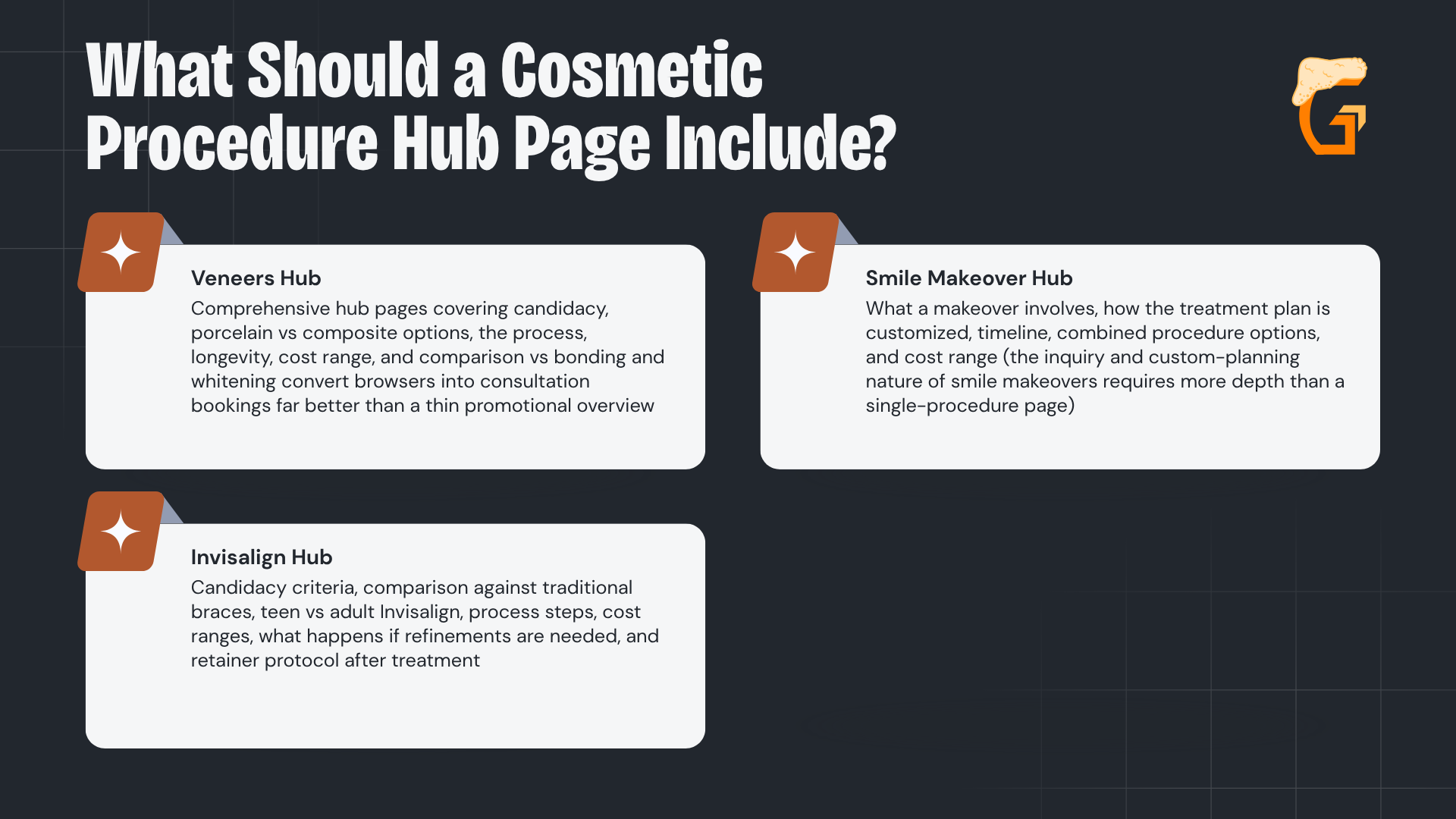
What Should a Cosmetic Procedure Hub Page Include?

Depth is the mechanism.

A short overview leaves patient questions unanswered and sends them to a competitor who answers them:

  • Veneers hub: comprehensive hub pages covering candidacy, porcelain vs composite options, the process, longevity, cost range, and comparison vs bonding and whitening convert browsers into consultation bookings far better than a thin promotional overview
  • Invisalign hub: candidacy criteria, comparison against traditional braces, teen vs adult Invisalign, process steps, cost ranges, what happens if refinements are needed, and retainer protocol after treatment
  • Smile makeover hub: what a makeover involves, how the treatment plan is customized, timeline, combined procedure options, and cost range (the inquiry and custom-planning nature of smile makeovers requires more depth than a single-procedure page)

A hub page wins by answering every candidacy, process, longevity, cost, and comparison question a researching patient has, which is exactly why a thin overview cannot compete for the same terms.

Why Do Cost Pages Convert Best for Cosmetic Procedures?

Patients searching “veneers cost [city]” or “how much does Invisalign cost” are close to making a decision and are actively comparing providers:

  • Transparent pricing outperforms hidden pricing: provide price ranges for each procedure with range context, financing options, and insurance notes (vague “call for pricing” language loses near-decision patients to any competitor who answers the question)
  • Range context builds trust: explaining what affects the final cost (material choice, case complexity, geographic market) alongside a range is more useful and more trustworthy than a single number or no number at all

Transparent pricing with financing context captures patients in final-comparison mode, boosts online visibility, and builds trust at the exact moment they are deciding which practice to call first.

How Should Each Procedure Map to Its Own Page and Keyword?

Avoid putting all cosmetic services on one thin page – that page cannot rank for multiple procedure terms at once:

  • /veneers-[city] targets “veneers [city]”
  • /smile-makeover-[city] targets “smile makeover [city]”
  • /invisalign-[city] targets “Invisalign [city]”

Distinct pages let each procedure target its own keyword, patient questions, and before/after cases.

A practice with dedicated procedure pages climbs search engine rankings over one that lumps services together because each page can build depth and relevance around a single high-intent term.

Growth Saloon builds the deep procedure hub pages that rank for high-value cosmetic searches and convert into qualified new patient inquiries – not just clicks.

Contact our team today to find out how our dental marketing services can lower your cost per new patient and grow your practice.

How’s your SEO going?

Enter your website URL below to get a free comprehensive SEO audit.

The audit includes:

Before/After Photos and E-E-A-T: Trust Signals That Drive Cosmetic Dental Rankings

Before/after galleries are the primary experience signal in a dental website’s content – they prove the dentist has actually performed the procedures being described, not just written about them.

Google’s E-E-A-T framework rewards real clinical proof, and for cosmetic dentistry, a well-organized gallery of actual patient cases outweighs generic stock photos in both SEO value and patient trust.

Replacing stock smile photos with real patient cases is the single highest-impact E-E-A-T change a cosmetic dental website can make.

How Should a Before/After Gallery Be Built and Optimized?

Real patient cases simultaneously prove experience, expertise, and trustworthiness – three of the four E-E-A-T signals at once:

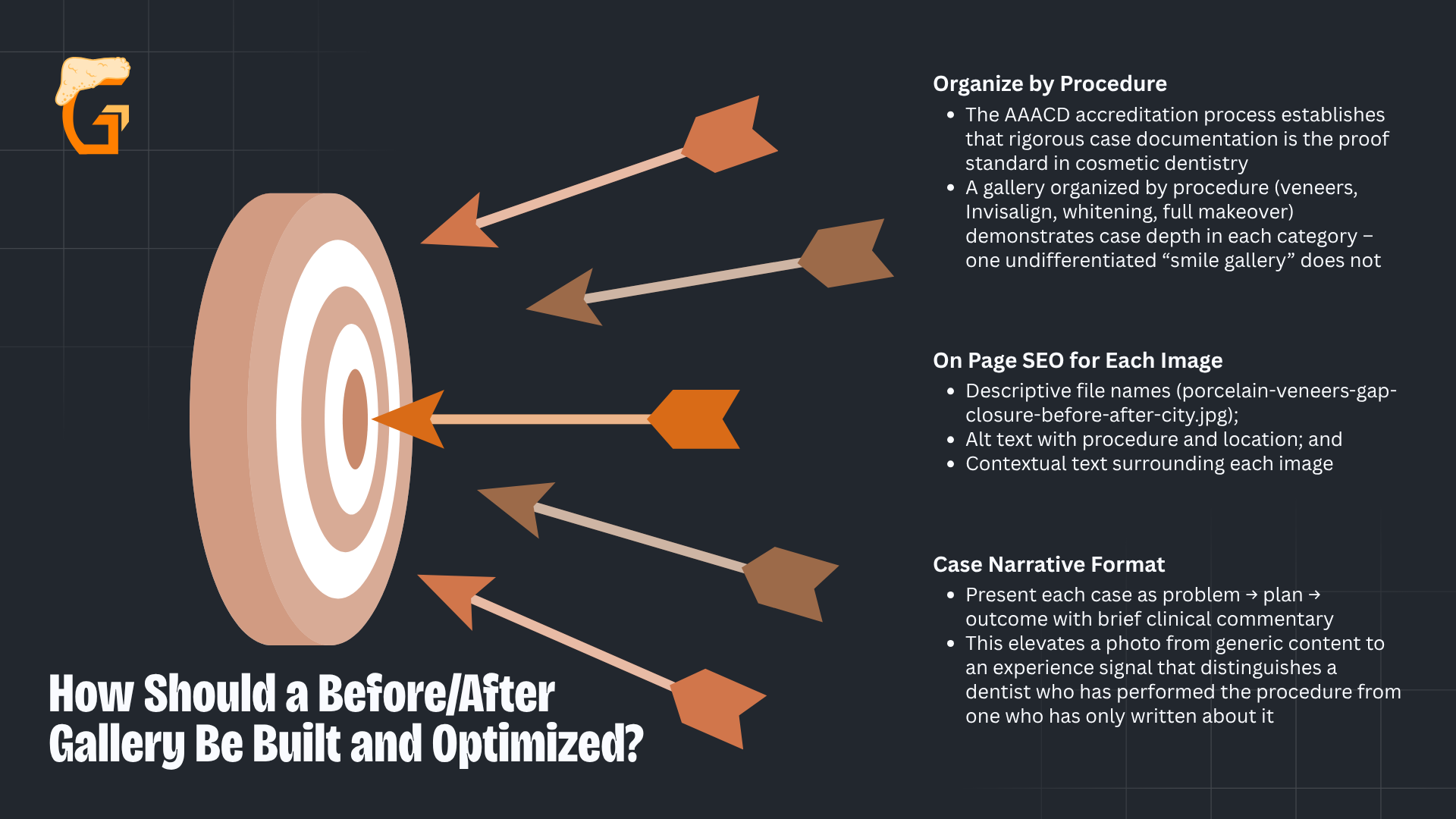
  • Organize by procedure: the AAACD accreditation process establishes that rigorous case documentation is the proof standard in cosmetic dentistry (a gallery organized by procedure (veneers, Invisalign, whitening, full makeover) demonstrates case depth in each category – one undifferentiated “smile gallery” does not)
  • On page SEO for each image: descriptive file names (porcelain-veneers-gap-closure-before-after-city.jpg), alt text with procedure and location, and contextual text surrounding each image contribute to image search visibility and reinforce the relevance of the procedure pages they sit on
  • Case narrative format: present each case as problem → plan → outcome with brief clinical commentary (this elevates a photo from generic content to an experience signal that distinguishes a dentist who has performed the procedure from one who has only written about it)

Procedure-organized galleries with well-written captions and meta descriptions help image search visibility and strengthen the relevance of the procedure pages on which they appear.

Which Cosmetic Credentials and Consent Steps Reinforce Trust?

AAACD accreditation, Kois or Spear training, and CE in aesthetic dentistry are signals general dentists cannot claim – they create a differentiated authority position on procedure pages and in the GBP:

  • Display credentials prominently: AAACD accreditation and advanced aesthetic CE belong on procedure pages, in the author bio on clinical content, and in the GBP description (not buried in an About page)
  • Patient consent for all before/after photos: a signed release is both a legal requirement and a trust signal (consented real patient cases carry more weight than unattributed images that could be stock or borrowed)

Credentials shown on procedure pages paired with consented real-patient photos together signal authority and trustworthiness.

AAACD membership also opens a high-authority directory citation opportunity and high quality backlinks from the AAACD member directory itself.

Growth Saloon builds the before-and-after proof and E-E-A-T signals that make cosmetic pages trustworthy enough to drive qualified new patient inquiries – not just clicks.

Contact our team today to find out how our dental marketing services can lower your cost per new patient and grow your practice.

Content for Every Stage of the Cosmetic Patient Journey

Effective content marketing moves cosmetic dental patients through three stages before booking:

  1. Inspiration (problem-aware, not yet solution-focused);
  2. Evaluation (comparing treatments and providers); and
  3. Decision (ready to book a consultation).

Most cosmetic dental websites only publish decision-stage content (service pages with CTAs) and skip social media management that reaches the larger pool of patients still in the inspiration and evaluation stages.

Capturing inspiration and evaluation patients early through effective marketing strategies builds a pipeline that converts later.

A local patient who finds the practice while researching may book a consultation months afterward.

What Content Does Each Stage of the Cosmetic Patient Journey Need?

Most cosmetic sites publish only decision-stage procedure pages with “book now” CTAs, missing patients who are 3–6 months from booking but actively researching:

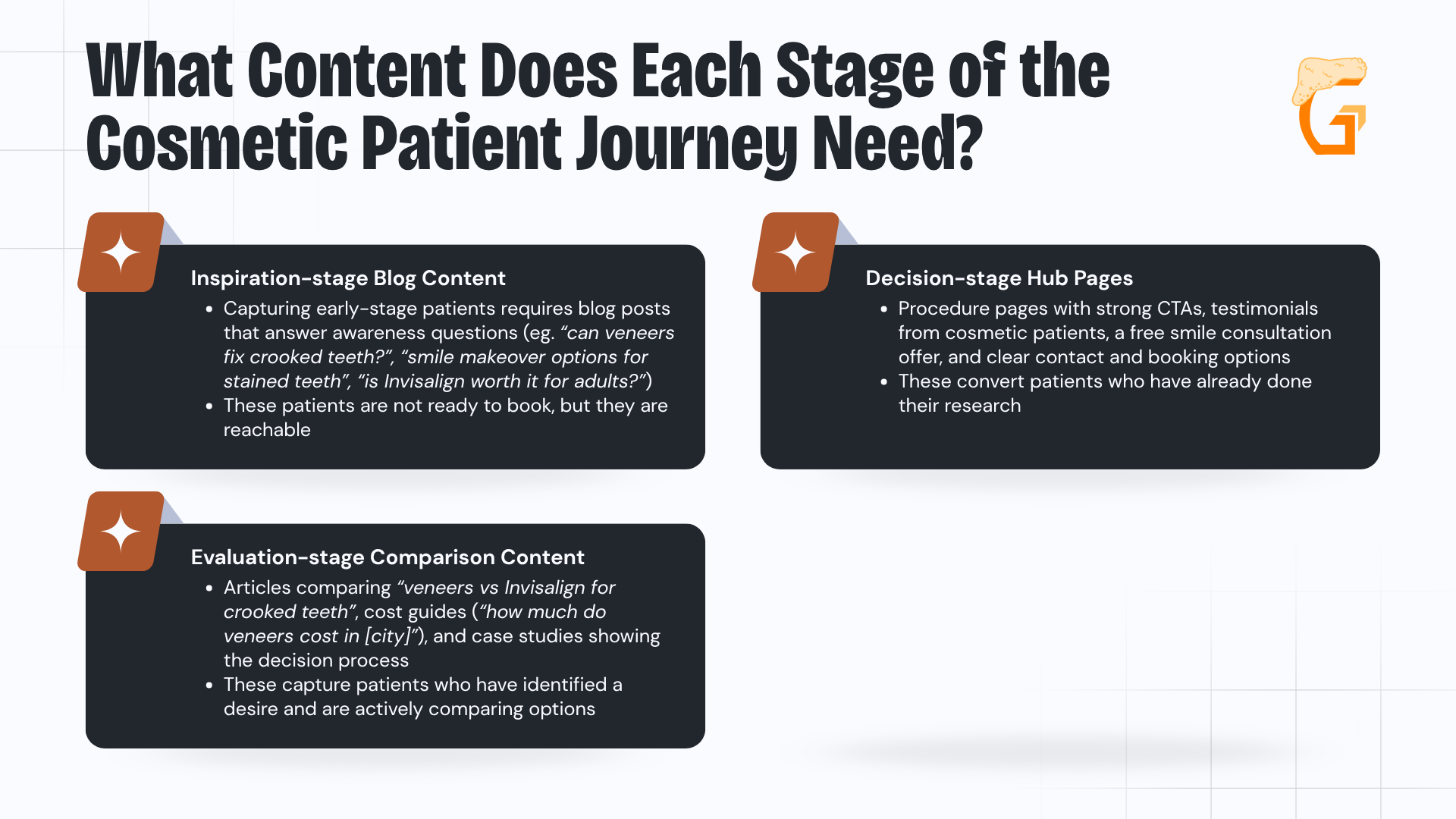
  • Inspiration-stage blog content: capturing early-stage patients requires blog posts that answer awareness questions (“can veneers fix crooked teeth?”, “smile makeover options for stained teeth”, “is Invisalign worth it for adults?”) – these patients are not ready to book, but they are reachable
  • Evaluation-stage comparison content: articles comparing “veneers vs Invisalign for crooked teeth”, cost guides (“how much do veneers cost in [city]”), and case studies showing the decision process (these capture patients who have identified a desire and are actively comparing options)
  • Decision-stage hub pages: procedure pages with strong CTAs, testimonials from cosmetic patients, a free smile consultation offer, and clear contact and booking options (these convert patients who have already done their research)

A cosmetic patient who finds the practice during the inspiration stage and encounters useful evaluation-stage content is far more likely to book when they reach the decision stage than a patient who found the practice only on the day they were ready to call.

How Do Schema Markup and Internal Linking Connect the Journey Stages?

Service schema on procedure pages helps Google categorize clinical content as procedure content, not a generic blog post:

  • Service schema with credentials: add Service schema with procedure type and PerformedBy (DDS credentials) to each hub page (this helps search engines understand the page as clinical procedure content rather than a general blog post)
  • Internal linking by stage, a key piece of technical SEO: inspiration-stage blog posts link to relevant evaluation-stage comparison content, which links to decision-stage procedure hubs (a deliberate link path moves a researcher toward a consultation)

Schema plus a deliberate internal-link path turns separate stage content into a single patient-journey funnel.

Each piece of content at one stage should link clearly to the next stage so marketing efforts give a patient who found the practice through a blog post a frictionless path to the consultation booking page.

Growth Saloon helps cosmetic dental practices build the kind of digital presence that consistently generates qualified new patient inquiries – not just clicks.

Contact our team today to find out how our dental marketing services can lower your cost per new patient and grow your practice.

How Can Growth Saloon Help Your Dental Practice Grow?

Growth Saloon is a Chicago-based digital marketing agency built to strengthen a dental practice’s online presence and help practices attract more patients through performance-driven digital marketing.

Mike Lowe and the Growth Saloon team specialize in SEO, web design, conversion rate optimization, and marketing attribution – working alongside your practice to build a measurable digital presence that generates qualified patient inquiries, not just website traffic.

From ranking for high-intent local search terms to converting site visitors into booked appointments, Growth Saloon focuses on results at every stage of the patient acquisition funnel.

Practice owners and marketing managers get clear visibility into exactly which channels are driving new patient growth.

We know that every open appointment slot has a real cost.

Every decision we make is built around one outcome – helping your practice fill more of them.

Meet the Founder of Growth Saloon

Meet the founder and lead strategist at Growth Saloon – Mike Lowe:

  • As founder and CEO of Growth Saloon, Mike brings years of hands-on experience in SEO strategy, CRO, web design, and marketing attribution for service-based businesses competing in local and regional markets.
  • Based in Chicago and working with practices across the country, Mike has built and managed digital growth campaigns for businesses competing in some of the most contested search markets in the country.
  • Growth Saloon’s data-driven approach to local SEO and patient acquisition helps dental practices turn their websites into their highest-performing new patient marketing channel.

What Does Working With Growth Saloon Look Like?

Growth Saloon operates as a dedicated extension of your marketing team – not a vendor that disappears after onboarding.

Every cosmetic dentistry marketing engagement includes direct access to Mike and the team, transparent reporting tied to actual patient acquisition outcomes, and strategies tailored to your specific services and local market.

Whether your cosmetic dentistry practice is looking to rank for high-value procedures, improve your site’s appointment conversion rate, or finally get clarity on where your new patients are actually coming from, Growth Saloon builds the strategy and does the work.

Growth Saloon helps dental practices build the kind of digital presence that consistently generates qualified new patient inquiries – not just clicks.

Contact our team today to find out how our dental marketing services can lower your cost per new patient and grow your practice.

FAQ
Author

Who is Mike Lowe?

Mike Lowe is a digital marketing strategist and the founder of Growth Saloon, where he specializes in helping businesses cut through the noise with high-converting email strategies and SEO.

With a focus on “organic storytelling,” Mike combines over a decade of agency experience with a passion for helping brands build genuine trust with their audience.

When he’s not optimizing subject lines or scaling SaaS companies, he’s likely sharing insights on how to transform cluttered inboxes into meaningful connection points for online marketers.

Related content
Resources for Dentists

Every resource we’ve published for Dentists, in one place:

Ready to turn your website traffic into real growth?

You’ve read the strategy now let Growth Saloon help you put it into action.

Get a free SEO audit and see what’s holding your website back from ranking, converting, and growing. 

Let's Chat

Let’s discuss your online marketing goals! We’re quick to respond, so we’ll be in touch shortly to set up a time to chat.