

Key takeaways
- Dental directories build local search visibility by creating a consistent NAP (name, address, and phone number) citation profile, and BrightLocal's 2026 local ranking factors place citations at 6% weight for the Local Pack and 7% weight for local organic results, making accuracy across listings a direct ranking factor.
- A focused presence across 20 to 40 high-quality directories (starting with Google Business Profile, then healthcare platforms like Healthgrades and Zocdoc, then dental-specific and dental plan insurance directories) outperforms a scattered footprint across hundreds of low-value sites.
- The most damaging directory errors include inconsistent NAP formatting, duplicate listings that split review prominence, and choosing a wrong primary category like "Dental Clinic" instead of "Dentist," all of which send conflicting signals to Google and reduce Local Pack visibility.
Should You Be Listed in Dental Directories?
Dental directories are one of the most reliable and often overlooked pieces of a dental practice’s local search presence (and most practices are either missing key listings, sitting on incomplete profiles, or dealing with inconsistent information that quietly works against their rankings).
When a potential patient searches for a dentist in your area, the practices that show up first are the ones with the most consistent, trustworthy digital footprint.
A focused, accurate presence across the right directories signals to Google that your dental health practice, and the teeth it cares for, belongs to a real, verified business at a specific location (and that signal carries real weight in local search).
This guide offers practical advice on which directories are worth your time, how to evaluate free versus paid options, the listing mistakes that quietly drag down your rankings, and a step-by-step process for getting listed (and staying listed) correctly.
Use the sections below to work through each piece, contact us with questions, or jump to the area where your practice needs the most attention.
What Are Dental Directories, and Do They Help SEO?
Dental directories are online listings that publish a practice’s name, address, and phone number (NAP).
They build a consistent local citation profile that signals to Google your practice is a real, verified business at a specific location (functioning as both an SEO trust signal and a direct channel for qualified new patient inquiries).
What exactly are dental directories?
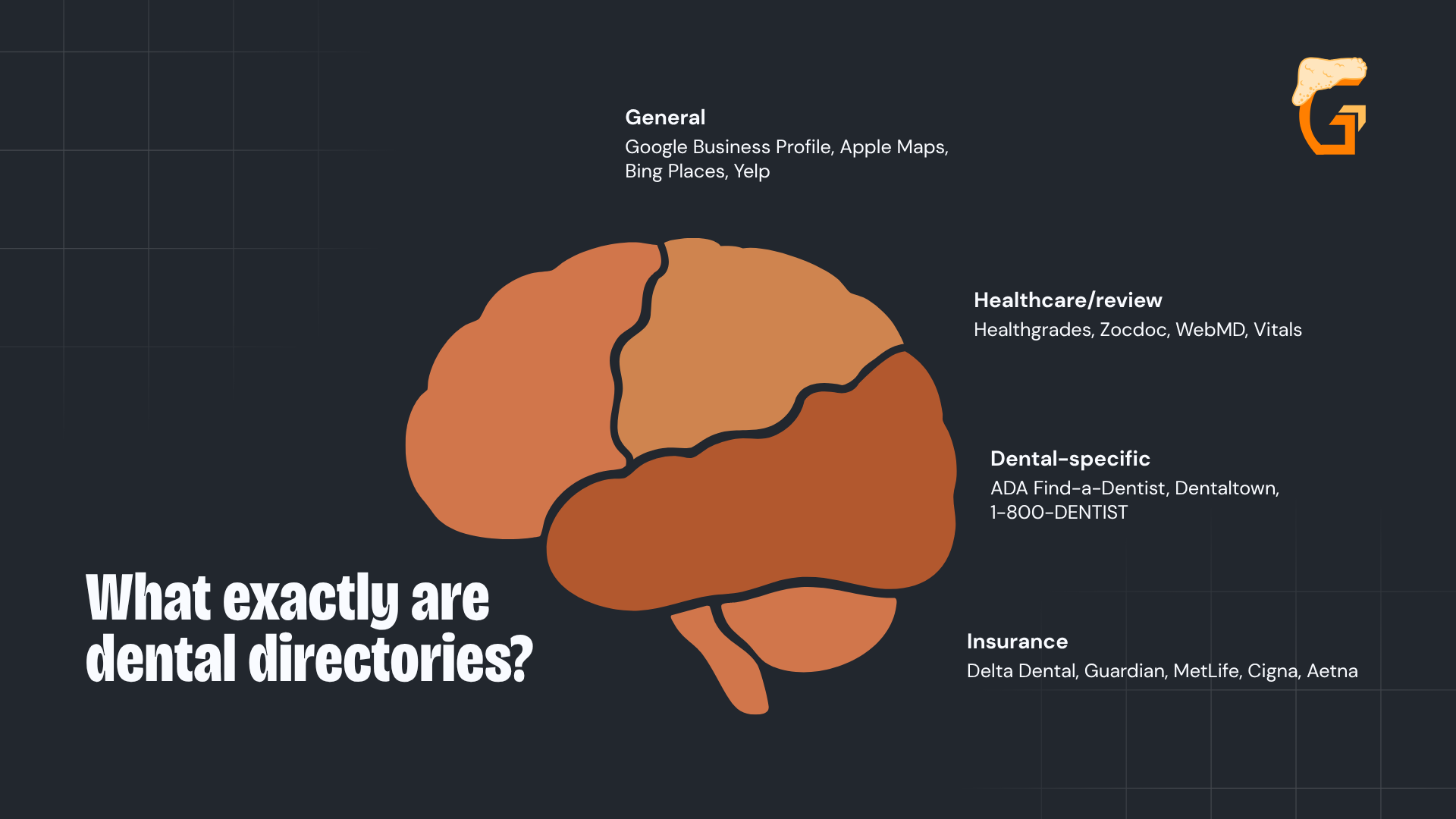
A dental directory is an online listing of a practice’s NAP.
A local citation is any online mention of that NAP, and NAP consistency means those details are identical across every citation (same spelling, same abbreviations, same phone number).
Directories fall into four layers:
- General: Google Business Profile, Apple Maps, Bing Places, Yelp
- Healthcare/review: Healthgrades, Zocdoc, WebMD, Vitals
- Dental-specific: ADA Find-a-Dentist, Dentaltown, 1-800-DENTIST
- Insurance: Delta Dental, Guardian, MetLife, Cigna, Aetna
Google cross-references your NAP across these layers.
Consistent data confirms your practice is legitimate and locally operating, which reinforces your visibility in local search.
Do dental directories actually help SEO?
Yes, as a confirmed prominence signal, though they work best as part of a broader local strategy.
BrightLocal’s 2026 local ranking factors place citations at #6 for the Local Pack (6% weight) and #6 for local organic (7% weight).
Beyond rankings, directories deliver referral traffic and rank independently for “dental care near me” queries (extending your reach without additional ad spend).
The current emphasis has shifted from submission volume to quality and consistency.
A focused, accurate presence across 20–40 trusted directories outperforms a scattered footprint across hundreds of low-value sites.
Growth Saloon builds focused, consistent directory profiles that turn local search into a steady stream of qualified new patient inquiries.
Get a dental directory audit to see exactly where your practice is listed today and which high-value directories you’re missing.
Which Are the Best Dental Directories to List Your Practice In?
Think of directory listings in layers:
- Google Business Profile first;
- Then, high-authority healthcare and review platforms;
- Then, dental-specific directories (including any dentofacial orthopedics focus); and
- Finally, the insurance networks your practice actually accepts.
This prioritized approach builds a citation profile that’s both strong and efficient (covering the services families with children search for) rather than a scattered list of every directory that will take a submission.
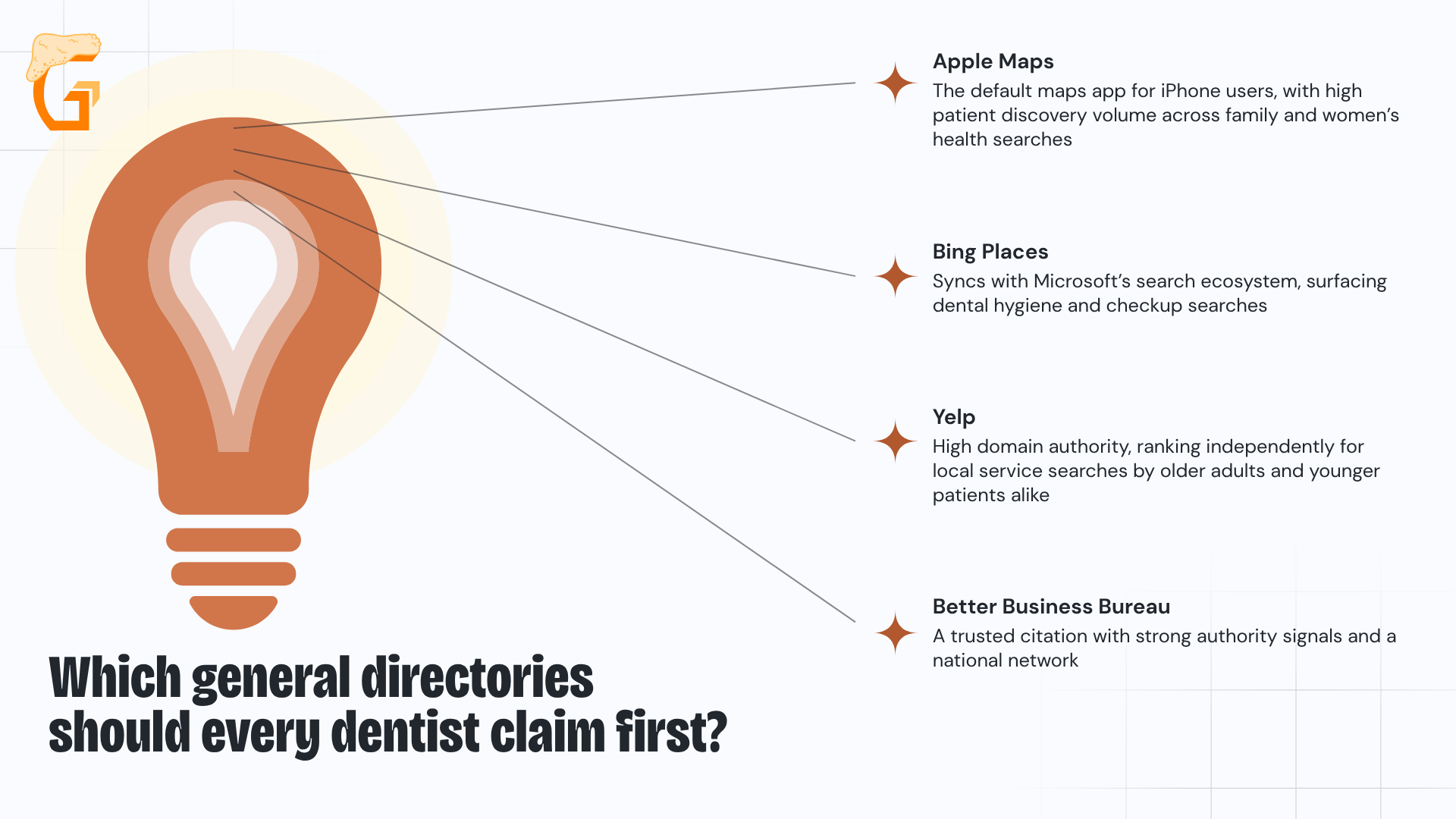
Which general directories should every dentist claim first?
Google Business Profile is the foundational listing (it powers the Local Pack and Google Maps), and a profile must be claimed and verified before it appears on Search or Maps.
Claim it before anything else.
The core general directories that follow:
- Apple Maps: the default maps app for iPhone users, with high patient discovery volume across family and women’s health searches
- Bing Places: syncs with Microsoft’s search ecosystem, surfacing dental hygiene and checkup searches
- Yelp: high domain authority, ranking independently for local service searches by older adults and younger patients alike
- Better Business Bureau: a trusted citation with strong authority signals and a national network
These are where Google begins verifying a business is real and where patients search without a specific provider in mind.
What healthcare and dental-specific directories matter most?
With general listings in place, move to healthcare and dental platforms that rank independently for dental services searches and deliver referral traffic.
Some of these platforms include:
- Healthgrades: education, board certifications, experience, and patient reviews for health care professionals
- Zocdoc: appointment booking with strong local visibility
- WebMD and Vitals: high-traffic health portals that rank for provider and hospital queries
- RealSelf: worth claiming for cosmetic, dental appliances, or implant-focused practices
- Opencare: dental-specific booking and discovery, useful for practices offering dental implants
For the ADA Find-a-Dentist tool, ADA members (including those listing oral surgery) must opt in by checking “Include in Find-a-Dentist” (it’s not automatic).
Dentaltown, 1-800-DENTIST, and state dental associations (useful for patients researching gum disease) round out this layer.
Should you list in dental insurance directories?
Yes.
Insurance “find a dentist” tools, tied to a patient’s dental coverage and used by patients who receive dental insurance through an employer, are a trusted citation and a direct patient-acquisition channel (in-network status, and the dental benefits a plan provides, is often a patient’s first search filter).
Federal No Surprises Act rules require insurers and providers to keep provider directory information accurate, which makes claiming and updating these listings a compliance step as well as a marketing one.
List only with the carriers you actually accept (eg. the Delta Dental companies, Guardian, MetLife, Cigna, and Aetna), since accurate listing data protects your in-network visibility.
The target is roughly 20–40 high-quality directories.
Growth Saloon audits which directories a practice already appears in (including the insurer tools patients use after they purchase dental insurance) before prioritizing new submissions.
Growth Saloon helps dental practices claim and prioritize the right directories, from Google Business Profile to the insurance networks you actually accept.
Talk to our dental marketing team to build a directory list that earns visibility instead of chasing every submission.
Free vs. Paid Dental Directory Listings: What's Worth Paying For?
Start free, pay only when you have proof of patient traffic.
Free citations carry most of the SEO value (and the foundational directories that matter most (Google, Yelp, basic Healthgrades profiles) cost nothing to claim).
Paid upgrades are worth evaluating only when a directory has demonstrable, trackable volume in your specific market.
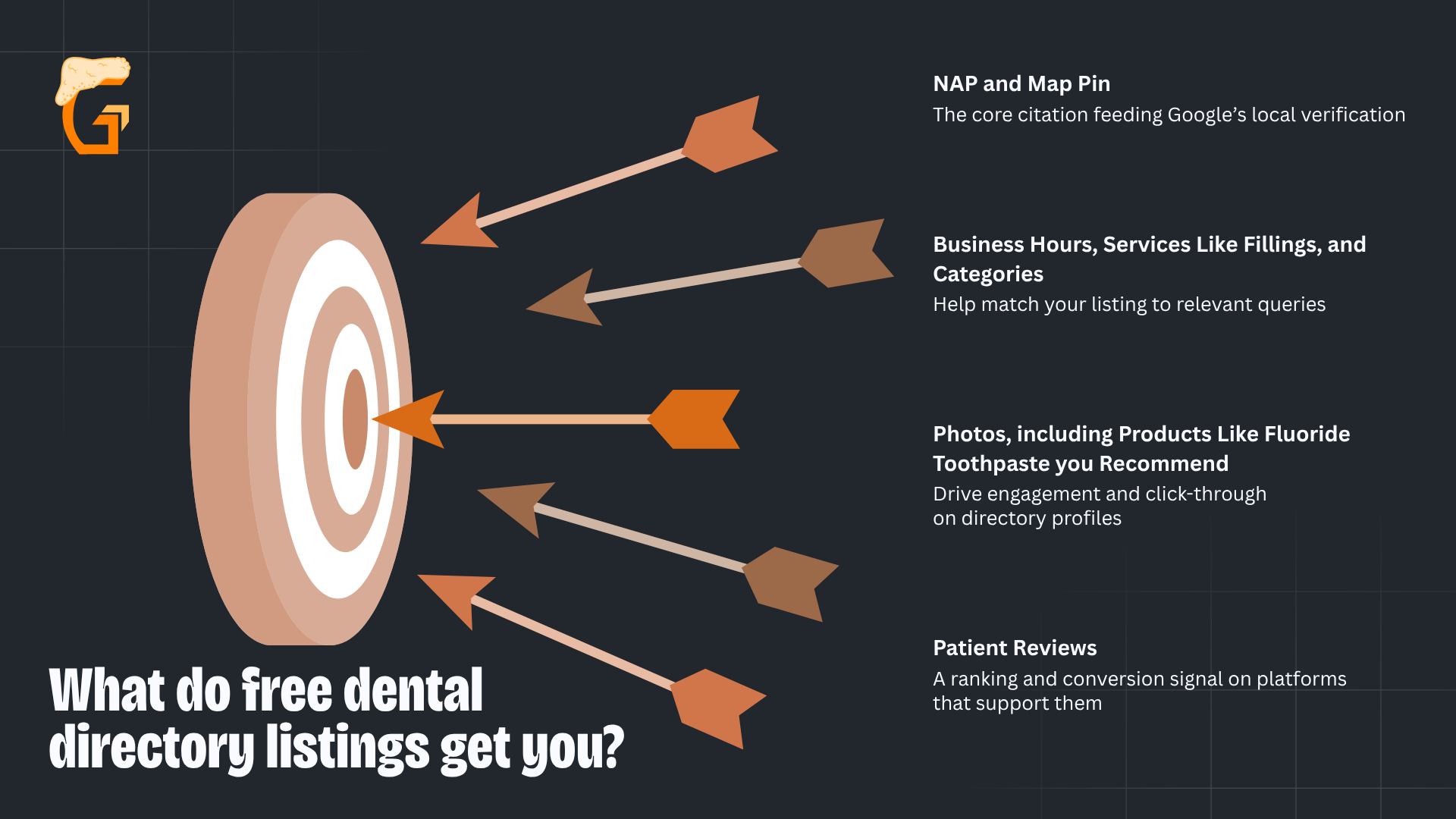
What do free dental directory listings get you?
Free listings provide NAP plus a basic profile describing your oral care services (and that’s where most of the local SEO value lives).
Local citations improve search visibility, credibility, and patient experience by confirming to Google that your practice is real, where it claims to be, and consistently represented across the web.
What a complete free listing typically includes:
- NAP and map pin: the core citation feeding Google’s local verification
- Business hours, services like fillings, and categories: help match your listing to relevant queries
- Photos, including products like fluoride toothpaste you recommend: drive engagement and click-through on directory profiles
- Patient reviews: a ranking and conversion signal on platforms that support them
Consistent, accurate free listings across a focused set of high-authority directories build local visibility and referral traffic without any spend.
When are paid directory listings worth it?
Pay only when a directory has real, trackable patient traffic in your market.
Paid tiers buy priority placement, richer profiles (covering services from cleanings to prescription drugs), and booking or lead-gen tools (but those only return value if patients are actually using the platform).
Pricing structures vary by platform:
- Zocdoc: charges a one-time fee per new patient booked through its Marketplace. No monthly subscription, existing-patient bookings are not charged
- Healthgrades and Vitals: quote-based pricing by market and specialty, with no public rate card
- ADA Find-a-Dentist and AAPD: directory visibility bundled with paid membership, not sold separately
Before committing any budget, test the platform to expose its limitations: unique tracking URL, call source tag, “how did you find us?” at intake.
Growth Saloon helps dental practices spend on directories only where real, trackable patient traffic exists – never on guesswork.
Book a free consultation to find out which paid listings are worth it in your specific market.
How’s your SEO going?
Enter your website URL below to get a free comprehensive SEO audit.
The audit includes:
- A scan of your entire website for technical issues
- A list of your top opportunities to target immediately
- Your highest priority fixes to make
What Are the Most Common Dental Directory Mistakes That Hurt SEO?
The most damaging directory errors accumulate quietly, dragging down the local visibility of even a well-run oral health practice that appears listed everywhere.
The costliest (inconsistent NAP, duplicate listings, wrong categories, call-tracking numbers as the primary phone, and profiles abandoned after setup).
Each sends a conflicting signal to Google about whether your listings represent one real, operating business.
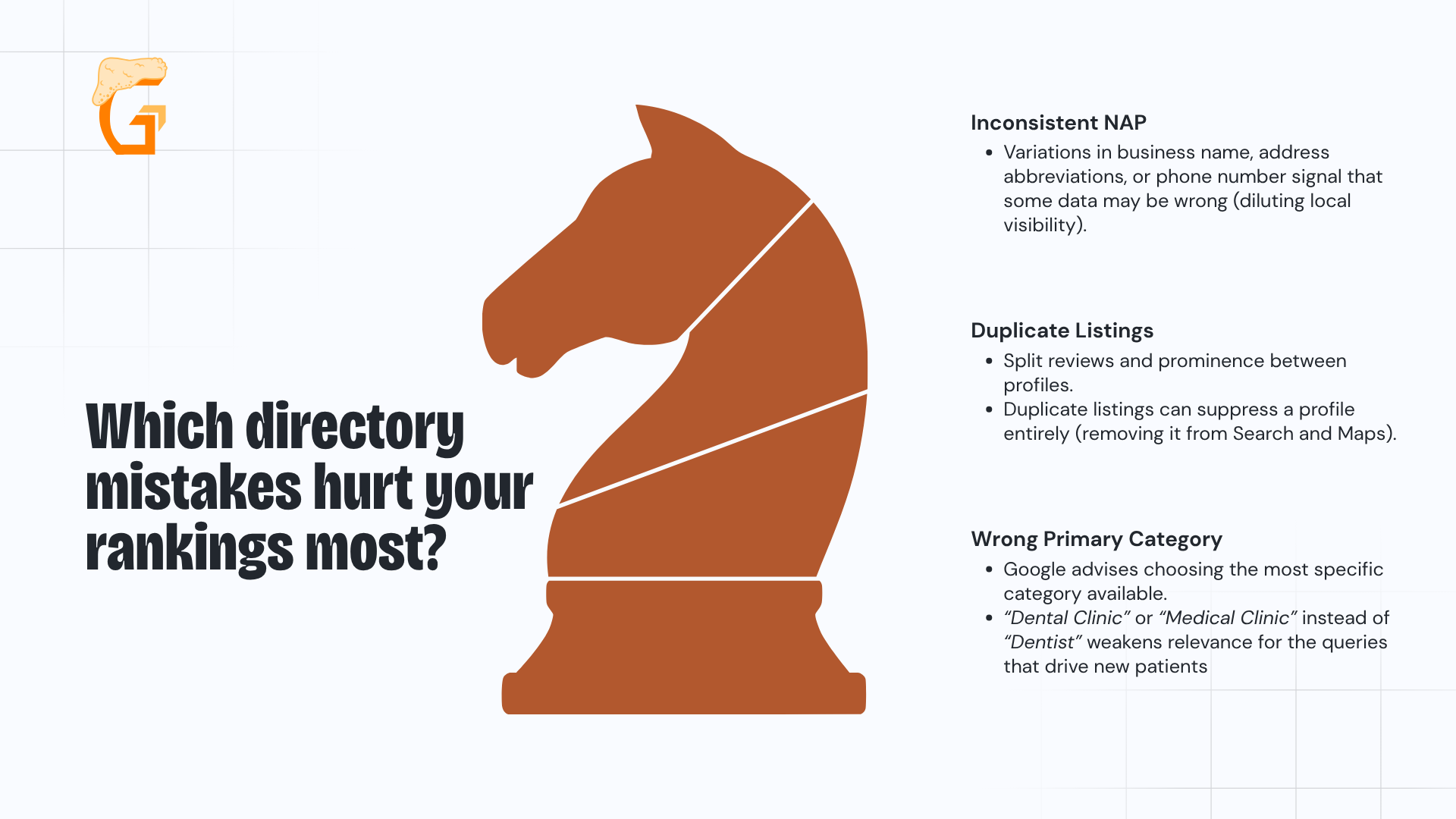
Which directory mistakes hurt your rankings most?
The errors that cause the most damage are the ones that make Google uncertain which listing data to trust.
- Inconsistent NAP: variations in business name, address abbreviations, or phone number signal that some data may be wrong, diluting local visibility
- Duplicate listings: split reviews and prominence between profiles. Duplicate listings can suppress a profile entirely, removing it from Search and Maps
- Wrong primary category: Google advises choosing the most specific category available. “Dental Clinic” or “Medical Clinic” instead of “Dentist” weakens relevance for the queries that drive new patients
Fragmented citation equity and lower trust reduce Local Pack and map visibility (where most new patients first encounter your practice).
What listing habits quietly erode trust over time?
Some mistakes don’t hurt immediately but compound over months.
- Call-tracking numbers or PO boxes as primary NAP: search engines can read inconsistent NAP as separate businesses, diluting visibility. Use a single local number and real physical address
- Set-and-forget profiles: listings go stale after a move, phone change, or rebrand
- Ignored reviews: many directories double as review platforms where patient word of mouth lives, so unmonitored listings cost both trust and conversions
Growth Saloon’s citation audits identify and correct all three (inconsistencies, duplicates, and stale profiles) before they compound.
Growth Saloon finds and fixes the quiet directory errors (inconsistent NAP, duplicates, and stale profiles) that drag down local rankings.
Request a citation cleanup to protect the local visibility your practice depends on for new patients.
How Do You List Your Dental Practice in Directories?
The process follows a repeatable sequence: lock a canonical NAP format, claim and optimize Google Business Profile first, then work outward through priority directories.
Keep your name, address, and phone number identical across every listing and audit on a regular cadence.
Done in order, this takes far less time than correcting a fragmented citation profile later.
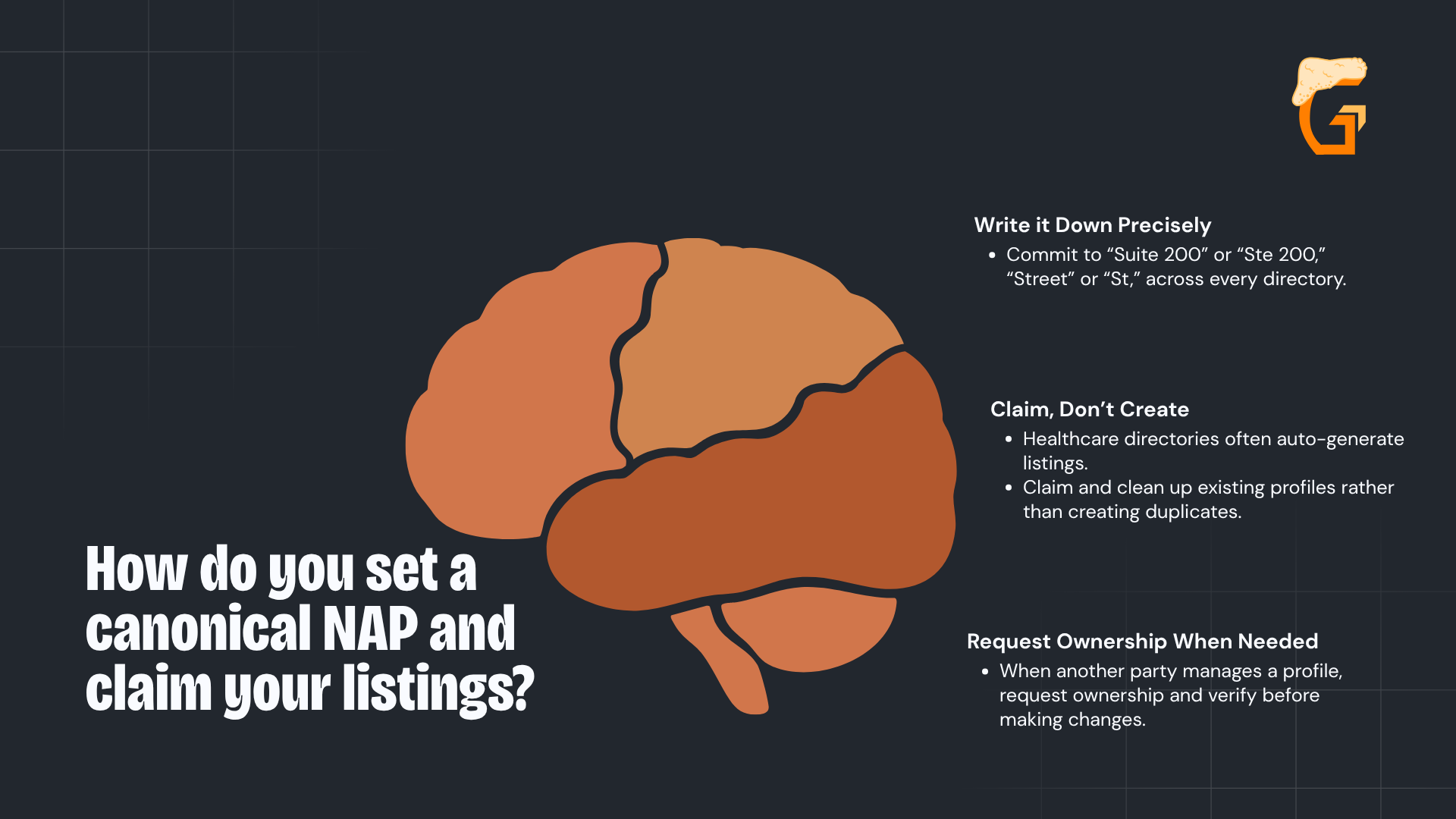
How do you set a canonical NAP and claim your listings?
Document one canonical NAP format (the exact business name, address abbreviations, and local phone number every listing copies).
This is the source of truth for every submission, from a routine cleaning page to a tooth extraction page.
- Write it down precisely: commit to “Suite 200” or “Ste 200,” “Street” or “St,” across every directory
- Claim, don’t create: healthcare directories often auto-generate listings. Claim and clean up existing profiles rather than creating duplicates
- Request ownership when needed: when another party manages a profile, request ownership and verify before making changes
How should you optimize each directory profile?
A complete profile, built from a complete description of your services, outperforms a bare NAP-only listing.
With roughly 149,300 dentists practicing across the U.S. according to the U.S. Bureau of Labor Statistics, a fully built-out profile is often what separates your listing from the next one in the results.
For each directory, even a periodontics-focused one:
- Set “Dentist” as the primary category, adding an Oral Medicine secondary category where it applies. Add secondary categories (Cosmetic Dentist, Pediatric Dentist, Orthodontics) only where accurate
- Upload photos, list services such as dentures, and write unique descriptions
- Link to specific service pages (such as crowns) rather than your homepage where the platform allows
Listing-management software like Moz Local keeps fields complete and propagates updates automatically, replacing manual one-off edits.
How do you keep listings consistent and current?
Enforce NAP exactness down to abbreviations (“Ave” versus “Avenue” are inconsistencies Google can register as different addresses).
Use citation tools like Moz Local or BrightLocal to distribute one consistent NAP and surface duplicates.
A local search audit identifies incomplete or inconsistent directory data before it compounds.
Run a quarterly audit and re-audit after any move, phone change, or rebrand as part of ongoing maintenance.
Growth Saloon manages end-to-end directory listing and NAP cleanup for dental practices.
Growth Saloon manages directory listings and NAP consistency end-to-end, so your practice stays accurate across every platform.
Schedule your strategy call to get your dental practice listed correctly (and keep it that way).
How Can Growth Saloon Help Your Dental Practice Grow?
Growth Saloon is a Chicago-based digital marketing agency built to help dental practices attract more patients and grow their practice through performance-driven digital marketing.
Mike Lowe and the Growth Saloon team specialize in SEO, web design, conversion rate optimization, and marketing attribution for dental professionals (working alongside your practice to build a measurable digital presence that generates qualified patient inquiries, not just website traffic).
From ranking for high-intent local search terms to converting site visitors into booked appointments, Growth Saloon focuses on results at every stage of the patient acquisition funnel.
Practice owners and marketing managers get clear visibility into exactly which channels are driving new patient growth.
We know that every open appointment slot has a real cost.
Every decision we make is built around one outcome: more smiles, and helping your practice fill more open appointment slots.
Meet the Founder of Growth Saloon
Meet the founder and lead strategist at Growth Saloon, Mike Lowe:
- As founder and CEO of Growth Saloon, Mike brings years of hands-on experience in SEO strategy, CRO, web design, and marketing attribution for service-based businesses competing in local and regional markets.
- Based in Chicago and working with practices across the country, Mike has built and managed digital growth campaigns for businesses in the dental profession competing in some of the most contested search markets in the country.
- Growth Saloon’s data-driven approach to local SEO and patient acquisition helps dental practices turn their websites into their highest-performing new patient channel.
What Does Working With Growth Saloon Look Like?
Growth Saloon operates as a dedicated extension of your marketing team – not a vendor that disappears after onboarding.
Every engagement includes direct access to Mike and the team, transparent reporting tied to actual patient acquisition outcomes, and strategies tailored to your specific services and local market.
Whether you’re looking to rank for high-value dental procedures, improve your site’s appointment conversion rate, or finally get clarity on where your new patients are actually coming from, Growth Saloon builds the strategy and does the work.
Growth Saloon helps dental practices build the kind of digital presence that consistently generates qualified new patient inquiries – not just clicks.
Contact our team today to find out how our dental marketing services can lower your cost per new patient and grow your practice.
How's your SEO going?
Get your free comprehensive SEO audit.
Enter your website URL below to get a free comprehensive SEO audit.
- Scan entire website for technical issues
- Get a list of your top opportunities
- See your highest priority fixes to make
-
Yes, though mostly indirectly.
Many directory external links are nofollow, so they pass little direct link authority, but they still confirm your location, build NAP consistency, and drive referral traffic.
High-authority directories like the ADA and Healthgrades, which cover related topics for patients and where they research dental treatment options, also send trust signals that support local rankings, which is why quality matters more than quantity.
-
Effectively, yes.
Google Business Profile is the single most important directory-style listing for local SEO, powering the Local Pack and Google Maps where patients pick a doctor or dentist.
It differs from third-party directories because Google uses it as a primary source of truth, cross-referencing your other listings against it.
Optimize and verify GBP before any other directory to support the overall health of your local presence.
-
Expect a few weeks to a few months, not days.
Directories must be indexed and Google must cross-reference your NAP across enough trusted sources to raise confidence.
Listings on high-authority platforms tend to register faster, but consistent results come from sustained accuracy and review activity rather than a single submission burst.
-
Yes, when they are legitimate and locally relevant.
City chambers of commerce, state dental societies (such as the California Dental Association), and reputable regional directories add geographically relevant citations that reinforce your service area.
Avoid low-quality “city directory” link farms with no real traffic, which add little value and can dilute an otherwise clean citation profile.
-
Yes.
Tools like Moz Local and BrightLocal, or managed citation services, distribute one consistent NAP across dozens of directories and flag duplicates.
They save time and reduce errors, but you still need to claim and own the high-value listings (Google Business Profile, key insurance directories) yourself so you control reviews and updates.
-
Yes.
AI-powered results and assistants still rely on structured, consistent business data to identify and recommend local providers, and directories remain a primary source of that data.
Accurate NAP, categories, and reviews across trusted directories help your practice surface in both traditional Local Pack results and AI-generated local recommendations.
Most agencies sell traffic. We sell actual growth. That’s the Growth Saloon difference.
Are you looking to grow?
Recent blogs
Enter your website URL below to get free comprehensive SEO audit.
- Scan entire website for technical issues
- Get a list of your top opportunities
- See your highest priority fixes to make