

Key takeaways
- Google Maps SEO for dentists ranks the practice in the Map Pack through Google Business Profile signals using relevance, distance, and prominence, with proximity dominating near-me searches so rank shifts block by block.
- Winning the Map Pack means treating GBP as a living asset with the correct primary category, weekly photos, 2 to 4 monthly posts, complete services and attributes, and a steady 10 to 20 treatment-specific reviews per month.
- Measure visibility with geo-grid tools rather than single-point checks since rankings vary by ZIP, and recover from a drop by diagnosing the cause (algorithm shift, competitor gains, unauthorized edits, or review stagnation) before submitting any appeal.
Why Does Google Maps SEO for Dentists Determine Who Gets the New Patient?
Google Maps SEO for dentists is what separates practices that fill their schedules with new dental patients from those that watch that volume go to the office two blocks away.
When patients search “dentist near me” on their phone, they’ve already decided they need care.
What the patient actively searching hasn’t decided yet is which practice gets the call.
The Google Map Pack (the three listings that appear at the top of local results) captures the majority of clicks on that search.
Proximity matters, but a practice with a stronger Google Business Profile, steadier review velocity, and better category alignment will win that top placement over a closer competitor.
That’s the equation Google Maps SEO is designed to tip in your favor.
This guide covers the full scope of Google Maps SEO for dental practices:
- From how Google’s local ranking algorithm weighs relevance, distance, and prominence
- To optimizing your GBP, building a review system that compounds month over month, and measuring your Map Pack footprint with geo-grid tracking.
If your practice doesn’t have a Google Maps presence where patients are searching, the answer is in here.
Growth Saloon helps dental practices build the Map Pack presence that puts them in front of patients who are ready to book.
Reach out today to learn how our dental Google Maps SEO services can expand your local reach and fill more of your schedule.
How is Google Maps SEO different from general local SEO?
Maps SEO is the subset of local SEO focused specifically on ranking in the local search results: the Map Pack, the full Maps interface, and the Local Finder (the surfaces patients see before they ever reach your website).
Key differences between the two approaches include:
- Maps SEO is GBP-centric, heavily proximity-weighted, and driven by behavioral signals like clicks, calls, and direction requests.
- General local SEO is broader (it includes organic blue-link rankings, building local citations, on-page content, and link acquisition) – all of which matter but operate through different mechanisms.
The distinction matters because the tactical focus and measurement approach differ. Maps SEO is measured with geo-grid tracking across your metro. General local SEO is measured with traditional rank tracking for organic positions.
Google Business Profile is the free tool that controls how your practice appears across both Google Search and Maps (it is the primary ranking asset for the Map Pack surfaces).
How Does the Google Maps Ranking Algorithm Work?
Google ranks dental practices in Maps using relevance (category match), distance (proximity to searcher), and prominence (reviews, citations, behavior) – with proximity dominating near-me queries.
Each factor plays a distinct role, and the Map Pack surfaces where those factors intersect most favorably for your practice.
What are relevance, distance, and prominence?
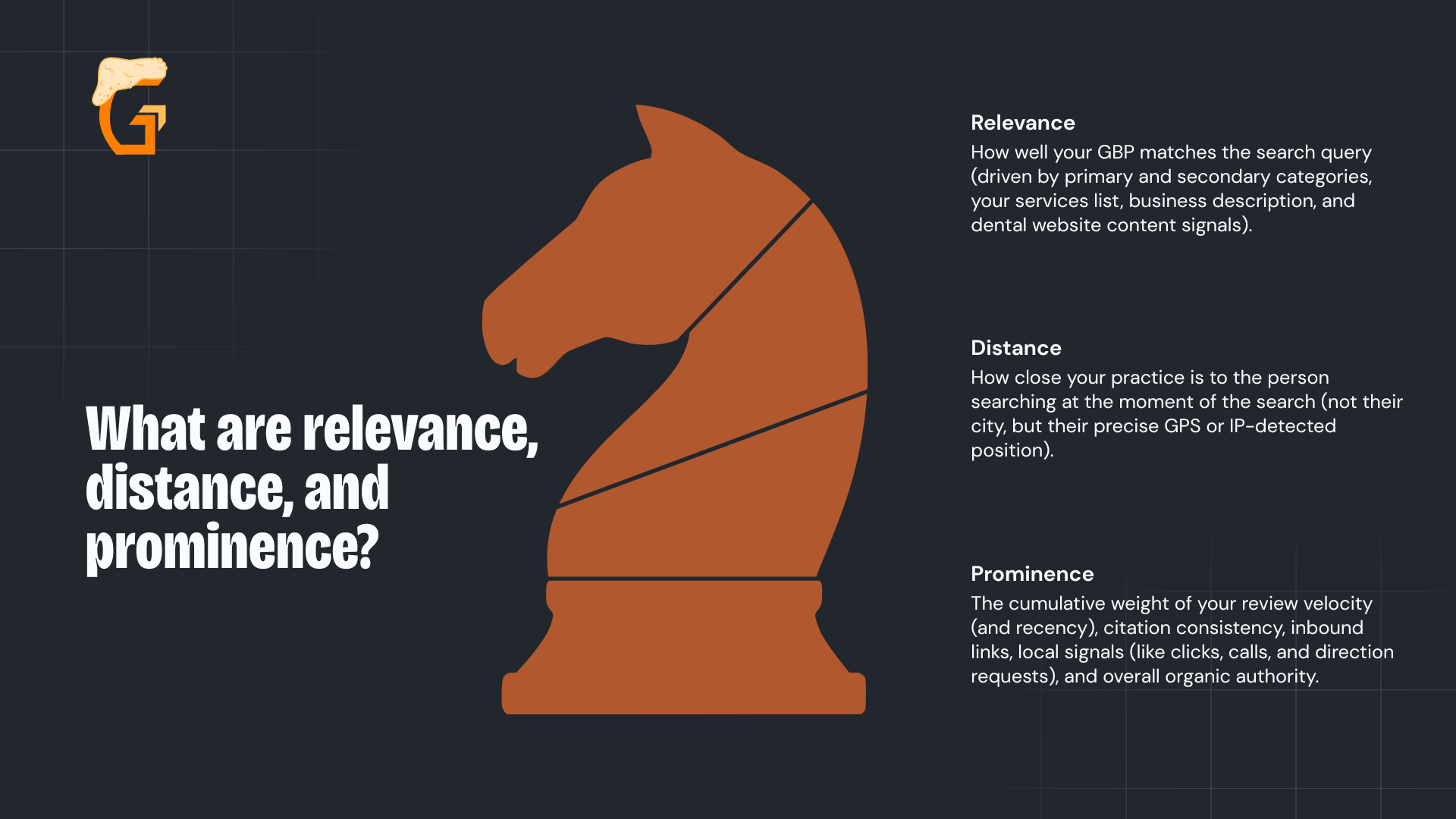
Google’s local ranking algorithm rests on three factors that interact to determine which practices appear in the Map Pack for any given search.
The primary factors Google uses to evaluate these metrics include:
- Relevance: How well your GBP matches the search query (driven by primary and secondary categories, your services list, business description, and dental website content signals).
- Distance: How close your practice is to the person searching at the moment of the search (not their city, but their precise GPS or IP-detected position).
- Prominence: The cumulative weight of your review velocity and recency, citation consistency, inbound links, local signals like clicks, calls, and direction requests, and overall organic authority.
These three factors don’t operate in isolation.
Proximity narrows the candidate pool to practices within a realistic radius of nearby patients. Relevance filters that pool to practices matching the query. Prominence ranks the finalists.
A practice with weaker prominence can still rank locally if proximity and relevance both align.
Why does proximity dominate “dentist near me” searches?
For unmodified queries (“dentist near me,” “dentist open now,” or simply “dentist” typed on mobile), proximity to the searcher has become the dominant ranking factor.
Google detects location via GPS on mobile, IP address on desktop, and WiFi triangulation for tablets – and rank shifts dramatically block by block, often within a half-mile radius in dense markets.
The ways proximity shapes local dental rankings include, but are not limited to:
- How it works: A searcher two blocks from your practice sees a different Map Pack than one six blocks away, so potential patient searches near your competitor may rank them #1 from their street and #6 from yours.
- Service-area settings don’t override proximity: Expanding your GBP service area doesn’t extend your physical proximity advantage – it only affects which searches you’re eligible for, not where you rank within those searches.
- Where prominence regains leverage: For geo-modified queries (“[city] dentist,” “[neighborhood] cosmetic dentistry”), proximity weight shifts toward relevance and prominence inside the named geography, which is where a strong review profile and well-optimized GBP can outrun a closer competitor.
How do Map Pack, Maps interface, and Local Finder differ?
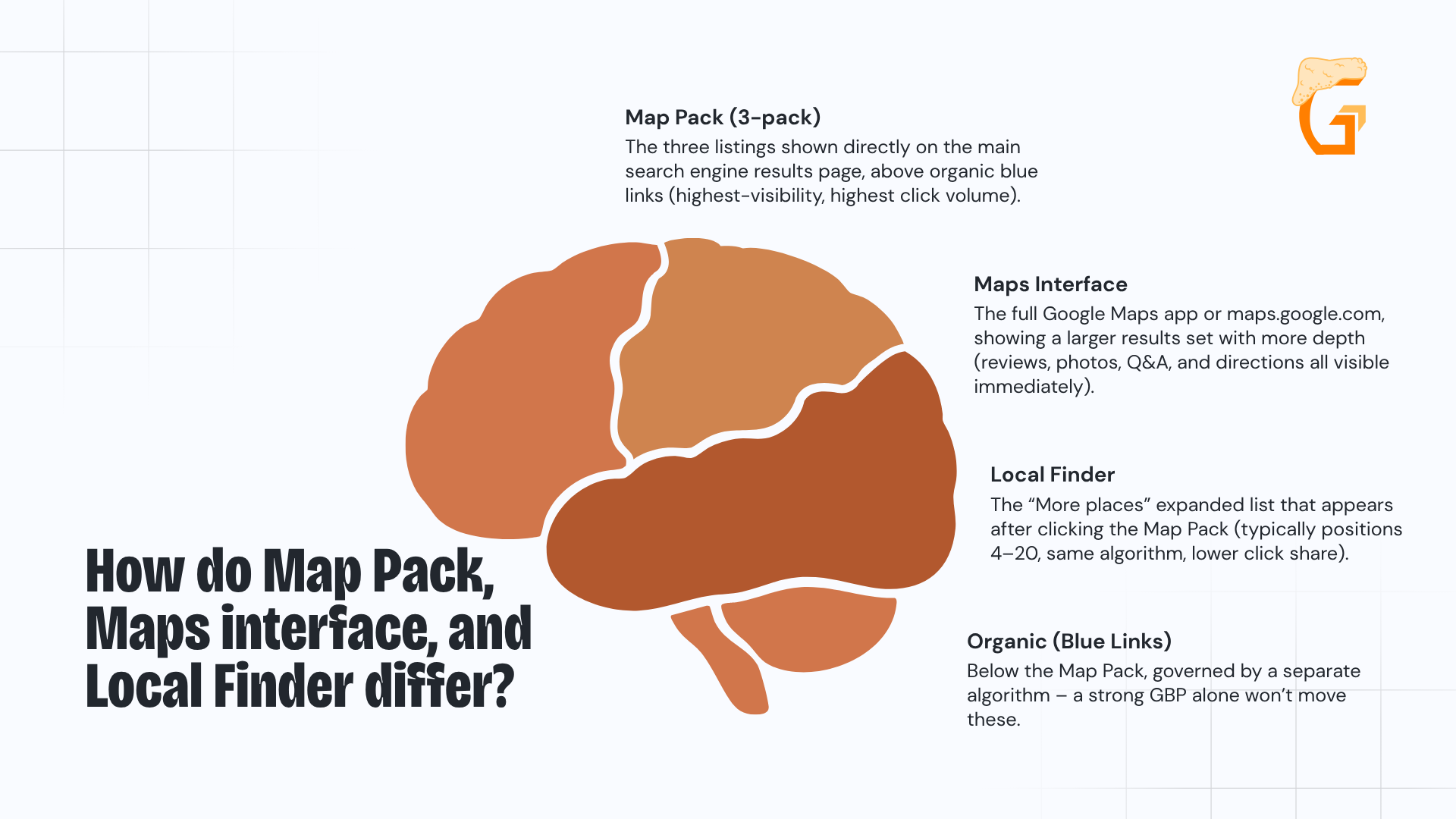
The Map Pack, the full Maps interface, and the Local Finder are three distinct map results surfaces – but they run on the same underlying local algorithm and respond to the same GBP optimization work.
The following surfaces make up the local search landscape:
- Map Pack (3-pack): The three listings shown directly on the main search engine results page, above organic blue links (highest-visibility, highest click volume).
- Maps interface: The full Google Maps app or maps.google.com, showing a larger results set with more depth (reviews, photos, Q&A, and directions all visible immediately).
- Local Finder: The “More places” expanded list that appears after clicking the Map Pack (typically positions 4–20, same algorithm, lower click share).
- Organic (blue links): Below the Map Pack, governed by a separate algorithm – a strong GBP alone won’t move these.
The Map Pack captures roughly 42% of clicks for local queries – making it the highest-leverage SERP surface a dental practice can target.
Optimize the GBP source, and you win local visibility across all three Maps surfaces simultaneously.
Growth Saloon works with dental practices to build and maintain the GBP presence that drives Map Pack rankings (so your team can focus on patient care).
Reach out today to learn how our dental Google Maps SEO strategy can put your practice in front of more local patients.
How Do You Optimize a Dental GBP for Google Maps?
Optimize a dental GBP for Maps with the right primary category, weekly photos, 2–4 monthly posts, services and attributes completed, and a steady stream of reviews mentioning specific treatments.
Google’s own guidance confirms that completeness across categories, hours, photos, and services is what helps a practice rank higher in Google’s local results.
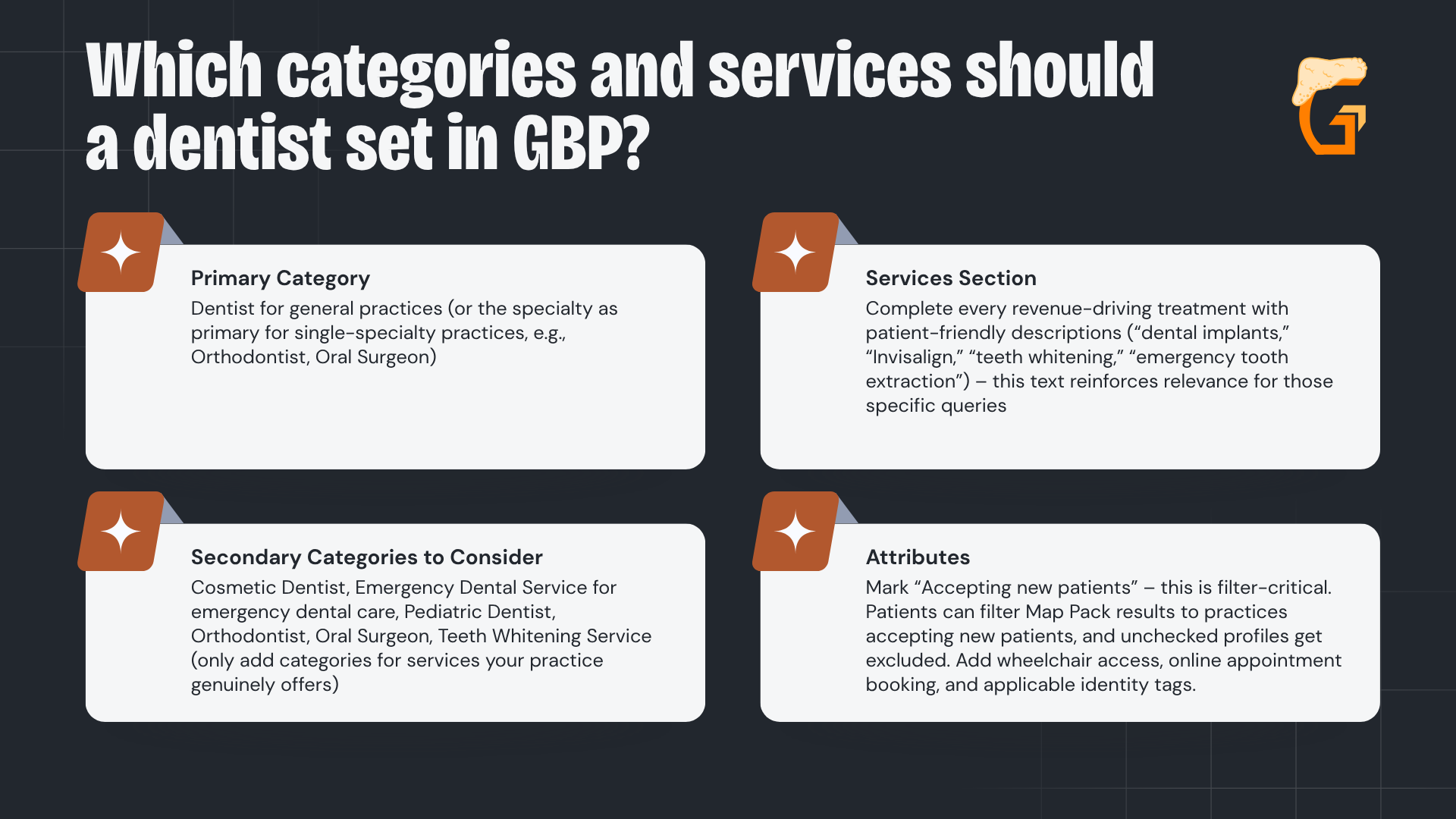
Which categories and services should a dentist set in GBP?
Set “Dentist” as your primary category for a general practice – not “Dental Clinic,” which is less specific.
Add 2–5 secondary categories that match real, in-house services you actually provide.
Up to 9 secondary categories are permitted per Google’s category guidance.
- Primary category: Dentist for general practices (or the specialty as primary for single-specialty practices, e.g., Orthodontist, Oral Surgeon)
- Secondary categories to consider: Cosmetic Dentist, Emergency Dental Service for emergency dental care, Pediatric Dentist, Orthodontist, Oral Surgeon, Teeth Whitening Service (only add categories for services your practice genuinely offers)
- Services section: Complete every revenue-driving treatment with patient-friendly descriptions (“dental implants,” “Invisalign,” “teeth whitening,” “emergency tooth extraction”) – this text reinforces relevance for those specific queries
- Attributes: Mark “Accepting new patients” – this is filter-critical. Patients can filter Map Pack results to practices accepting new patients, and unchecked profiles get excluded. Add wheelchair access, online appointment booking, and applicable identity tags.
For practices using call tracking: set the tracking number as your primary GBP phone and add your real local number as an Additional phone.
This preserves NAP consistency for citation matching while keeping call data intact.
A missing or mismatched phone number across local directories is one of the most common prominence-suppressing issues.
How often should you post photos and updates to a dental GBP?
Photos and posts together signal active engagement and a maintained profile (a direct prominence input that separates practices that maintain their GBP from those that set it once and forget it).
- Photos: Upload 20–50 images at launch covering exterior (from street + parking), reception, treatment rooms, team headshots, and before/after cases (patient consent required). After launch, aim for 3–5 new photos per week (steady addition outperforms bulk uploads).
- Posts: Publish 2–4 GBP Posts per month minimum, mixing Offer posts (seasonal promotions), What’s New posts (new services, team additions), and Event posts (community involvement, open house). Each post should include an image and a CTA button.
- Hours: Keep holiday hours and special hours updated in real time. Practices with incorrect hours get filtered out of “open now” searches (a filter a large portion of emergency dental searchers use).
Quarterly, revisit your primary category, business description, and attributes to ensure they still reflect your current service mix.
GBP is not a set-and-forget asset.
How important are reviews for Map Pack ranking?
Patient reviews are one of the top prominence signals in Google’s local algorithm – and velocity, recency, and review content all matter independently.
A burst of 50 reviews from satisfied patients in one week followed by silence signals less authority than a steady 10–20 per month over time.
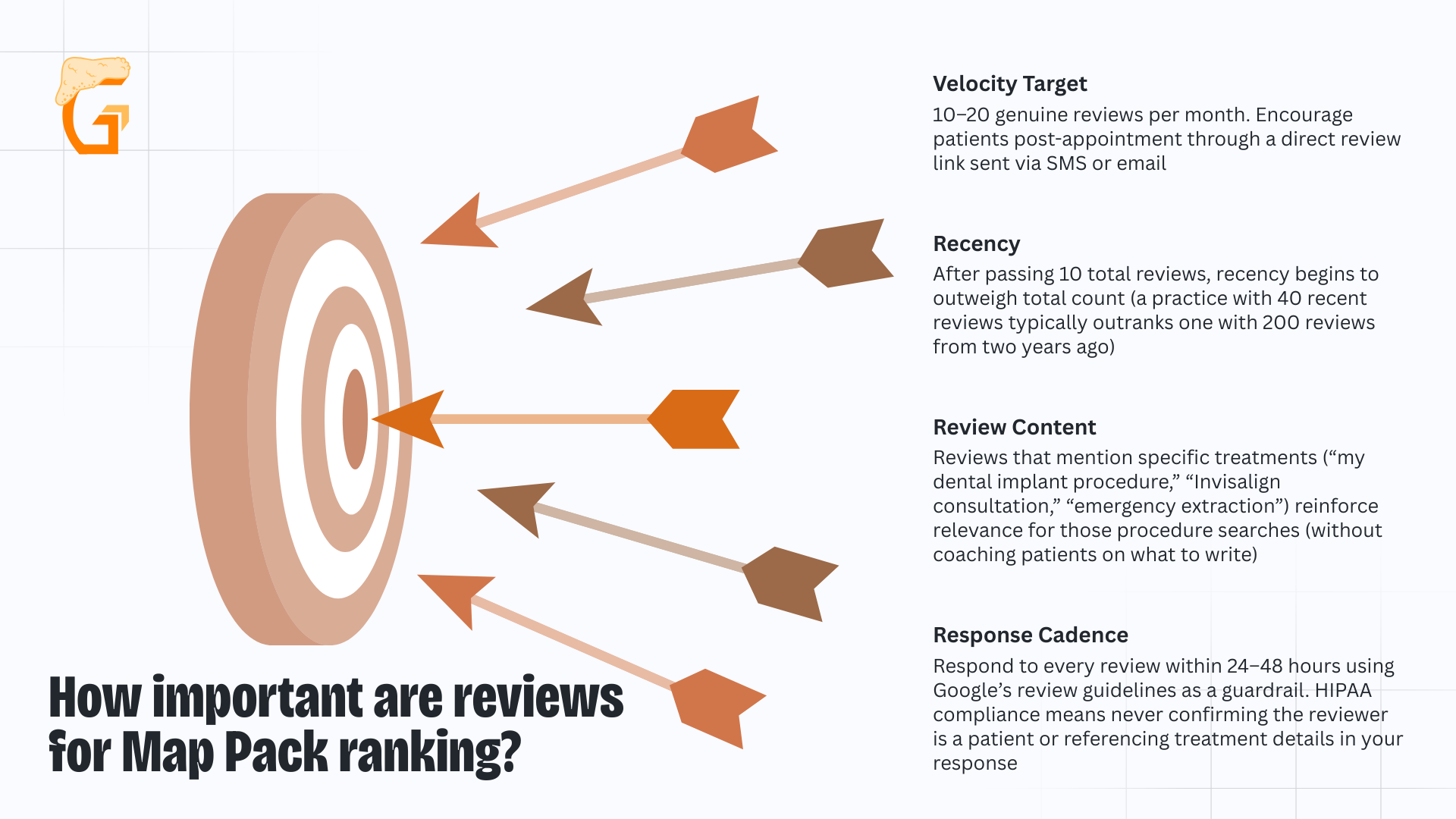
- Velocity target: 10–20 genuine reviews per month. Encourage patients post-appointment through a direct review link sent via SMS or email
- Recency: After passing 10 total reviews, recency begins to outweigh total count (a practice with 40 recent reviews typically outranks one with 200 reviews from two years ago)
- Review content: Reviews that mention specific treatments (“my dental implant procedure,” “Invisalign consultation,” “emergency extraction”) reinforce relevance for those procedure searches (without coaching patients on what to write)
- Response cadence: Respond to every review within 24–48 hours using Google’s review guidelines as a guardrail. HIPAA compliance means never confirming the reviewer is a patient or referencing treatment details in your response
The 10-review inflection point is real (most practices see measurable Map Pack improvement after crossing 10 positive reviews).
Getting there fast matters – staying consistent matters more.
Growth Saloon builds review acquisition systems that keep your dental practice generating fresh, treatment-specific reviews month after month.
Contact us today to see how our Google Maps optimization for dentists can boost your Map Pack visibility and attract more patients.
How Do You Track Dental Google Maps Rankings?
Track dental Map Pack rankings with geo-grid tools like Local Falcon, BrightLocal Local Search Grid, or Whitespark. Single-point rank checks miss the proximity-driven variation across ZIPs.
Local Falcon’s geo-grid rank tracking shows where a practice actually ranks across multiple lat/long points, revealing the real radius your local SEO efforts cover around the office.
Why isn’t single-point rank tracking enough for Maps?
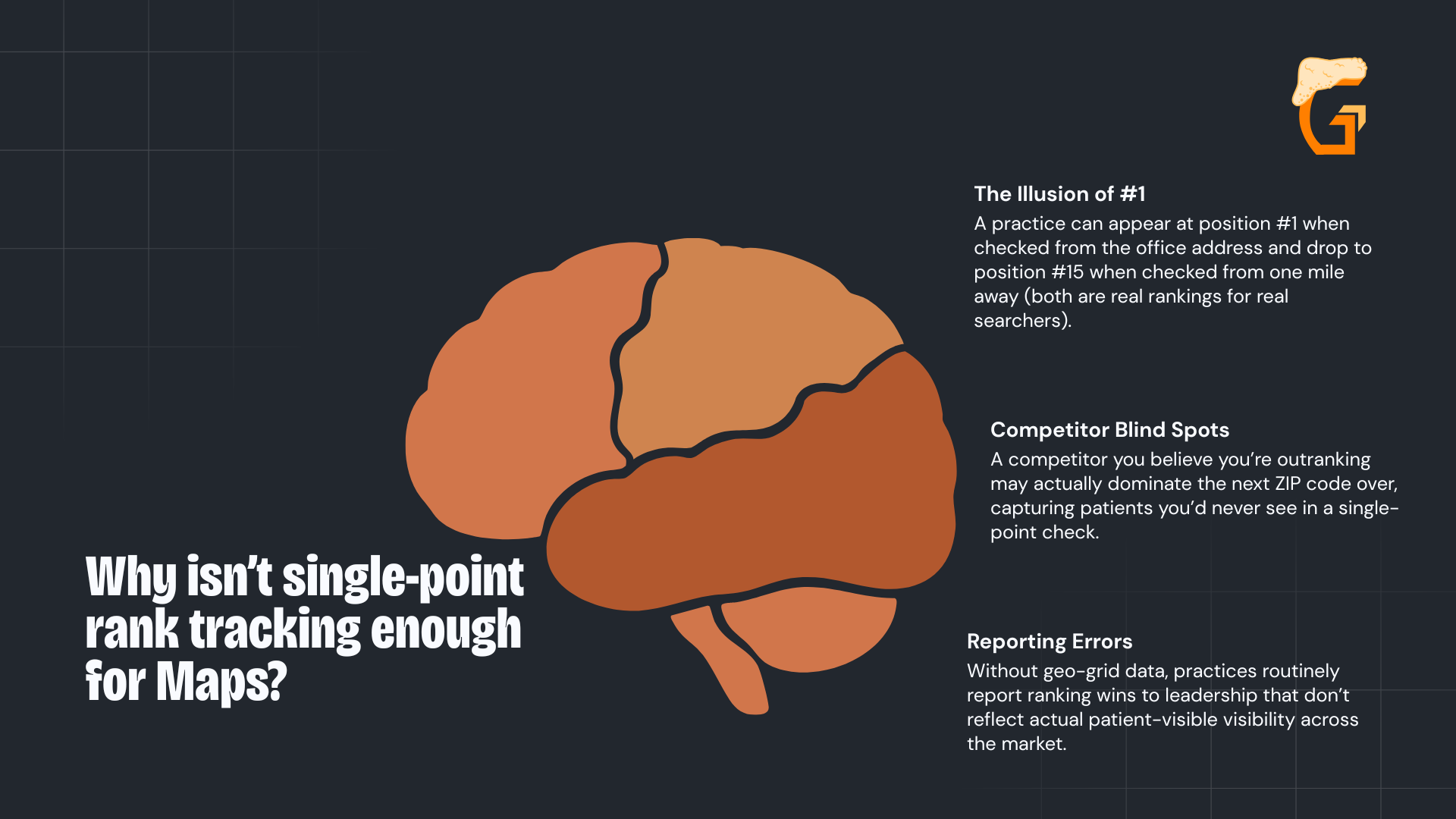
Single-point rank tracking (checking search phrases like “dentist [city]” from one location) produces a misleading picture of Maps performance because rank shifts block by block due to proximity weighting.
- The illusion of #1: A practice can appear at position #1 when checked from the office address and drop to position #15 when checked from one mile away (both are real rankings for real searchers).
- Competitor blind spots: A competitor you believe you’re outranking may actually dominate the next ZIP code over, capturing patients you’d never see in a single-point check.
- Reporting errors: Without geo-grid data, practices routinely report ranking wins to leadership that don’t reflect actual patient-visible visibility across the market.
Geo-grid tracking solves this by producing a heatmap of actual rank across the practice’s metro.
Green zones (positions 1–3) represent Google Local Pack visibility. Yellow zones (positions 4–10) represent Local Finder presence. Red zones (positions 11+) are effectively invisible to that location.
The heatmap is the true picture of your Map Pack footprint.
Growth Saloon uses geo-grid tracking to show dental practices exactly where they rank across their entire metro (not just from the office address).
Get in touch today to find out how our Maps SEO services for dentists can reveal your true Map Pack footprint and expand your reach.
How do you set up a geo-grid tracker for a dental practice?
Six (6) tools dominate geo-grid tracking for dental practices in 2026:
- BrightLocal Local Search Grid
- Local Dominator
- Local Falcon
- Local Viking
- Localo
- Whitespark Local Ranking Grids
Each produces the same core output (a rank heatmap across a configurable grid) with differences in interface, pricing, and scan credits.
- Pick a tool: Local Falcon is the most widely cited for dental practices and other local businesses. BrightLocal integrates with its broader local SEO reporting suite. Whitespark suits agencies managing many locations.
- Set grid size: A 7×7 or 9×9 grid centered on the practice address covers most urban and suburban metros adequately – larger grids for rural markets with wider draw areas.
- Choose keywords: Track 3–5 primary local keywords per location: “dentist,” “cosmetic dentist,” and “emergency dentist” as the core set, plus 1–2 procedure-specific terms like “Invisalign” or “dental implants” if those are revenue priorities.
- Run cadence: Monthly grid pulls as baseline. Run ad-hoc scans after any major GBP edit, a new competitor entering the market, or a suspected algorithm shift.
Use the heatmap over time, not just in isolation.
A month-over-month comparison of green zones expanding or contracting is more actionable than any single snapshot.
Zones sitting at positions 4–10 are the highest-leverage targets – they’re reachable with content and prominence work.
Zones at 11+ in distant parts of your metro are proximity-bound for search visibility – chasing them requires a second physical location, not more GBP optimization.
How’s your SEO going?
Enter your website URL below to get a free comprehensive SEO audit.
The audit includes:
- A scan of your entire website for technical issues
- A list of your top opportunities to target immediately
- Your highest priority fixes to make
Why Did My Dental Map Pack Ranking Drop, and How Do You Recover?
Recover from a dental Map Pack drop by checking GBP for warnings, comparing competitors’ review velocity, running geo-grid diagnostics, and submitting reinstatement only after fixing the underlying violation.
Most dental SEO drops have a traceable cause (the mistake is declaring a permanent loss before running the diagnostic).
What causes sudden dental Map Pack ranking drops?
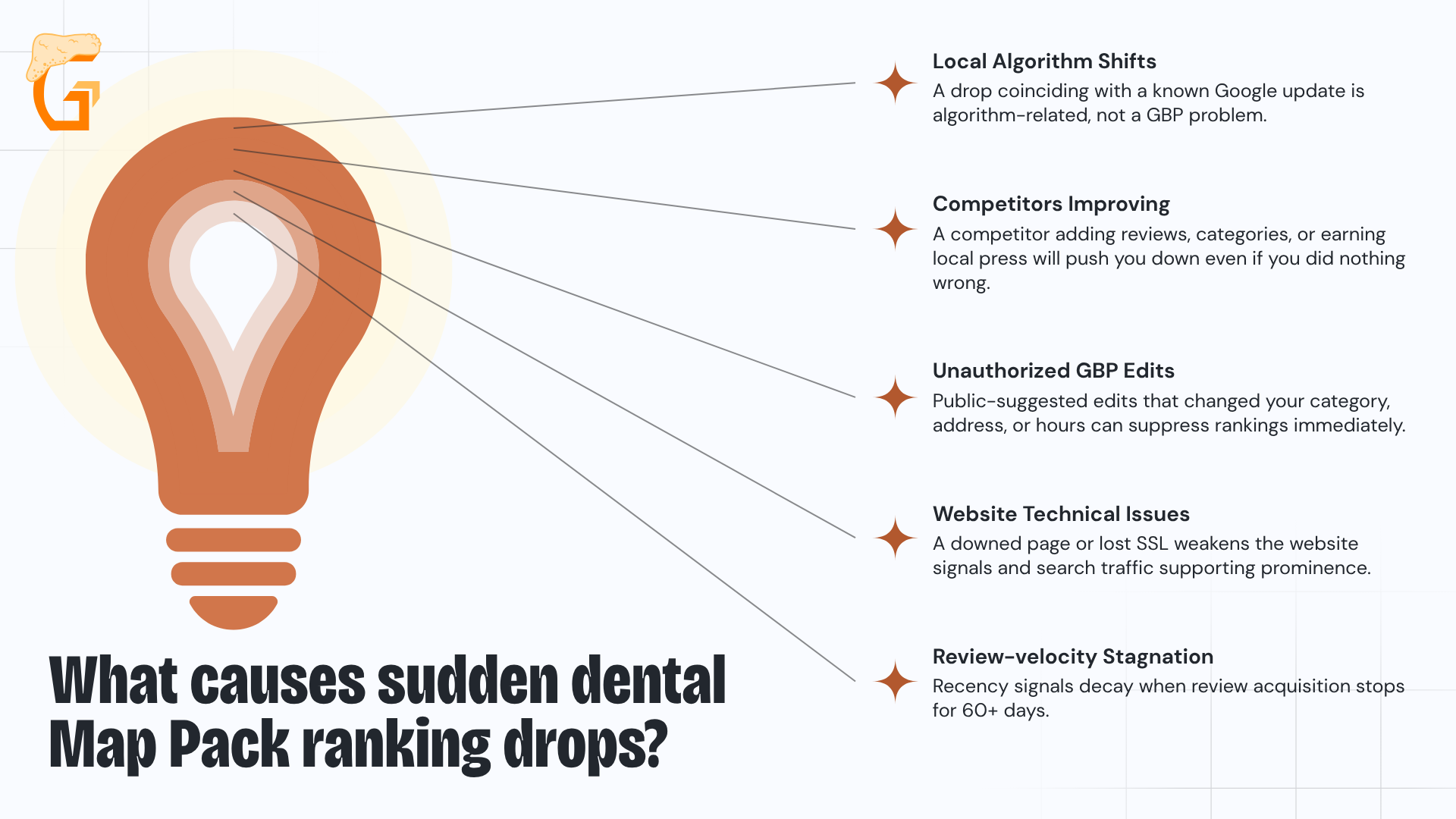
Sudden drops have five common causes, and none are mysterious once you know how local SEO works and check in the right order.
- Local algorithm shifts: A drop coinciding with a known Google update is algorithm-related, not a GBP problem.
- Competitors improving: A competitor adding reviews, categories, or earning local press will push you down even if you did nothing wrong.
- Unauthorized GBP edits: Public-suggested edits that changed your category, address, or hours can suppress rankings immediately.
- Website technical issues: A downed page or lost SSL weakens the website signals and search traffic supporting prominence.
- Review-velocity stagnation: Recency signals decay when review acquisition stops for 60+ days.
Diagnostic order: (1) check GBP for warnings per Google’s reinstatement guidance, (2) check Search Console for crawl errors, (3) run a geo-grid comparison against your last baseline, (4) ramp GBP activity for 4–8 weeks before declaring a permanent loss.
How do you handle competitor spam and Map Pack suspensions?
Competitor spam and suspensions both require dental offices to follow a documented recovery workflow – not a reactive appeal.
- Minor spam: Use “Suggest an edit” to flag keyword-stuffed names, fake addresses, or non-existent listings directly on the offending profile.
- Systematic spam: File Google’s Business Redressal Complaint Form with URLs, Street View screenshots, and license records.
- Suspension recovery: Fix the violation first (stuffed name, virtual office, duplicate listing), then gather exterior photos, license, lease, and matching NAP. Submit the GBP appeal once and allow 1–4+ weeks.
If drops persist beyond 30 days, a suspension exceeds 4 weeks, or spam keeps returning and costing you high value patients, bring in outside help.
Growth Saloon audits dental GBPs and manages Map Pack recovery for practices dealing with ranking drops, suspensions, or competitor spam.
Contact our team today to learn how our dental Maps SEO recovery services can get your practice back into the Map Pack.
How Can Growth Saloon Help Your Dental Practice Grow?
Growth Saloon is a Chicago-based digital marketing agency built to help dental practices attract more patients through Google My Business optimization and performance-driven digital marketing.
Mike Lowe and the Growth Saloon team specialize in SEO, web design, conversion rate optimization, social media accounts, and marketing attribution (working alongside your practice to build a measurable digital presence that generates qualified patient inquiries, not just website traffic).
From ranking for high-intent local search terms to converting potential patients into booked appointments, Growth Saloon focuses on results at every stage of the patient acquisition funnel.
Practice owners and marketing managers get clear visibility into exactly which channels are driving patient engagement and new patient growth.
We know that every open slot for new patient appointments has a real cost. Every decision we make is built around one outcome: helping your practice fill more of them.
Meet the Founder of Growth Saloon
Meet the founder and lead strategist at Growth Saloon, Mike Lowe:
- As founder and CEO of Growth Saloon, Mike brings years of hands-on experience in SEO strategy, CRO, web design, and marketing attribution for service-based businesses competing in local and regional markets.
- Based in Chicago and working with practices and dental associations across the country, Mike has built and managed digital growth campaigns for businesses competing in some of the most contested search markets in the country.
- Growth Saloon’s data-driven approach to local SEO and patient acquisition helps dental practices turn their websites and rankings on search engines into their highest-performing new patient channel.
What Does Working With Growth Saloon Look Like?
Growth Saloon operates as a dedicated extension of your marketing team – not a vendor that disappears after onboarding.
Every engagement includes direct access to Mike and the team, transparent reporting tied to actual patient acquisition outcomes, and strategies tailored to your specific services and local market.
Whether you’re looking to rank for high-value procedures, improve your site’s appointment conversion rate, or finally get clarity on where your new patients are actually coming from, Growth Saloon builds the strategy and does the work.
Growth Saloon helps dental practices build the kind of digital presence that consistently generates qualified new patient inquiries – not just clicks.
Contact our team today to find out how our dental marketing services can lower your cost per new patient and grow your practice.
How's your SEO going?
Get your free comprehensive SEO audit.
Enter your website URL below to get a free comprehensive SEO audit.
- Scan entire website for technical issues
- Get a list of your top opportunities
- See your highest priority fixes to make
-
Expect 8–16 weeks before meaningful Map Pack movement on a new practice.
Verification clears in 1–5 days, but Google needs time to crawl your GBP, gather review signals, cross-reference NAP across directories, and watch behavioral metrics like clicks and patient phone calls.
Practices that nail categories, build 30+ reviews fast, and post weekly reach patients online faster than passive profiles.
-
No. Google requires a real, staffed physical address for GBP listings (virtual offices, UPS stores, and PO boxes trigger suspension).
Service-area-only businesses can rank without showing the address publicly, but a dental practice that doesn’t see patients in person can’t legitimately maintain a GBP listing at all.
The physical address is non-negotiable.
-
No direct boost.
Unlike paid ads, Map Pack rankings come from the organic local algorithm. Google explicitly states Ads spend doesn’t influence it.
However, Ads can appear above the Map Pack as paid placements, capturing website visits that would have gone organic.
Some practices run Local Service Ads alongside Map Pack optimization for compound visibility.
-
Weekly minimum for posts and photos. Quarterly for category review, business description, and attributes. Update immediately for any change in hours, services, or address.
Stale profiles lose prominence over time.
Set a recurring office-manager calendar: Monday photo upload, Wednesday post with appointment links, monthly review of services and attributes.
-
Yes. For obvious violations, use “Suggest an edit” on the listing to flag keyword-stuffed names, fake addresses, or non-existent businesses.
For systematic spam (multiple fake listings, virtual offices, lead-gen redirects), file Google’s Business Redressal Form with documentation that includes (but is not limited to):
- URLs;
- Street View screenshots;
- License records; and
- A factual explanation of what’s occurring.
-
Maps and organic use different algorithms.
Maps weighs GBP signals, proximity, and reviews heavily – organic weighs website authority, content depth, structured data, and backlinks.
A strong GBP with weak website content produces this exact split.
Fix it by building service-page content, writing strong meta descriptions, earning local backlinks, and improving technical SEO (the organic gap closes over months).
-
Yes, but each location needs its own GBP and its own dedicated website page.
Generic “Practice Name” is fine – identical content across location pages triggers duplicate-content filtering.
Multi-location practices also need geo-grid tracking per practice location since proximity bias means each office has a distinct radius of visibility.
Most agencies sell traffic. We sell actual growth. That’s the Growth Saloon difference.
Are you looking to grow?
Recent blogs
Enter your website URL below to get free comprehensive SEO audit.
- Scan entire website for technical issues
- Get a list of your top opportunities
- See your highest priority fixes to make