

Updated:August 11th, 2026

Best Dental SEO Keywords in 2026

Written by

Mike Lowe

Reviewed by

Taylor Coteus

Key takeaways

  • Dental SEO keywords fall into six intent categories (branded, transactional, local, procedure, emergency, and informational), and each maps to a specific page type so every search has a page built to answer it.
  • A keyword's commercial value comes from combining search volume, CPC as an intent proxy, and intent fit, which is why low-volume long-tail and local terms often convert better than high-volume head terms.
  • Small practices win by stacking 100+ specific local and long-tail terms across mapped pages rather than chasing head terms dominated by directories and DSOs, then refreshing the map quarterly.

Why Do Dental SEO Keywords Determine Which Patients Find You?

Dental SEO keywords are the specific terms potential patients search before they book, call, or walk through your door.

Choosing the wrong ones means investing in a website that does nothing for your dental practice’s online visibility and that no new patient ever finds.

Unlike general SEO, dental keyword strategy works across three constraints at once:

  1. Local geography
  2. Procedure specificity
  3. Patient-state urgency

That is why “dentist” tells you almost nothing actionable, while “emergency dentist open Saturday [city]” tells you exactly which page to build and which patient is ready to act.

Best Dental SEO Keywords

This guide maps every major keyword category (branded, transactional, local, procedure, emergency, and informational) to the page type that converts it, giving dental professionals volume and CPC benchmarks to help prioritize where to build first.

Whether you are launching dental search engine optimization for the first time or refreshing a keyword map that has not been updated since 2024, the frameworks here are built for single-location practices competing against national directories and DSOs.

Growth Saloon helps dental practices build keyword strategies that bring in more patients through qualified inquiries – not just clicks.

Contact our team today to find out how we can lower your cost per new patient.

What Are Dental SEO Keywords?

Dental SEO keywords are the search terms prospective patients use to find dental services online: branded, transactional, local, procedure, emergency, and informational categories that each map to a different page.

Unlike generic SEO terms, dental keywords carry three constraints that rarely coexist outside this vertical: local intent, procedure specificity, and patient-state urgency (a pattern driven by the fact that dental caries remains the most prevalent chronic disease in both children and adults).

Moz’s SEO glossary defines a keyword as “a word or phrase that users type into a search engine to find content” – dental SEO keywords are that definition filtered through geography, procedure, and urgency simultaneously.

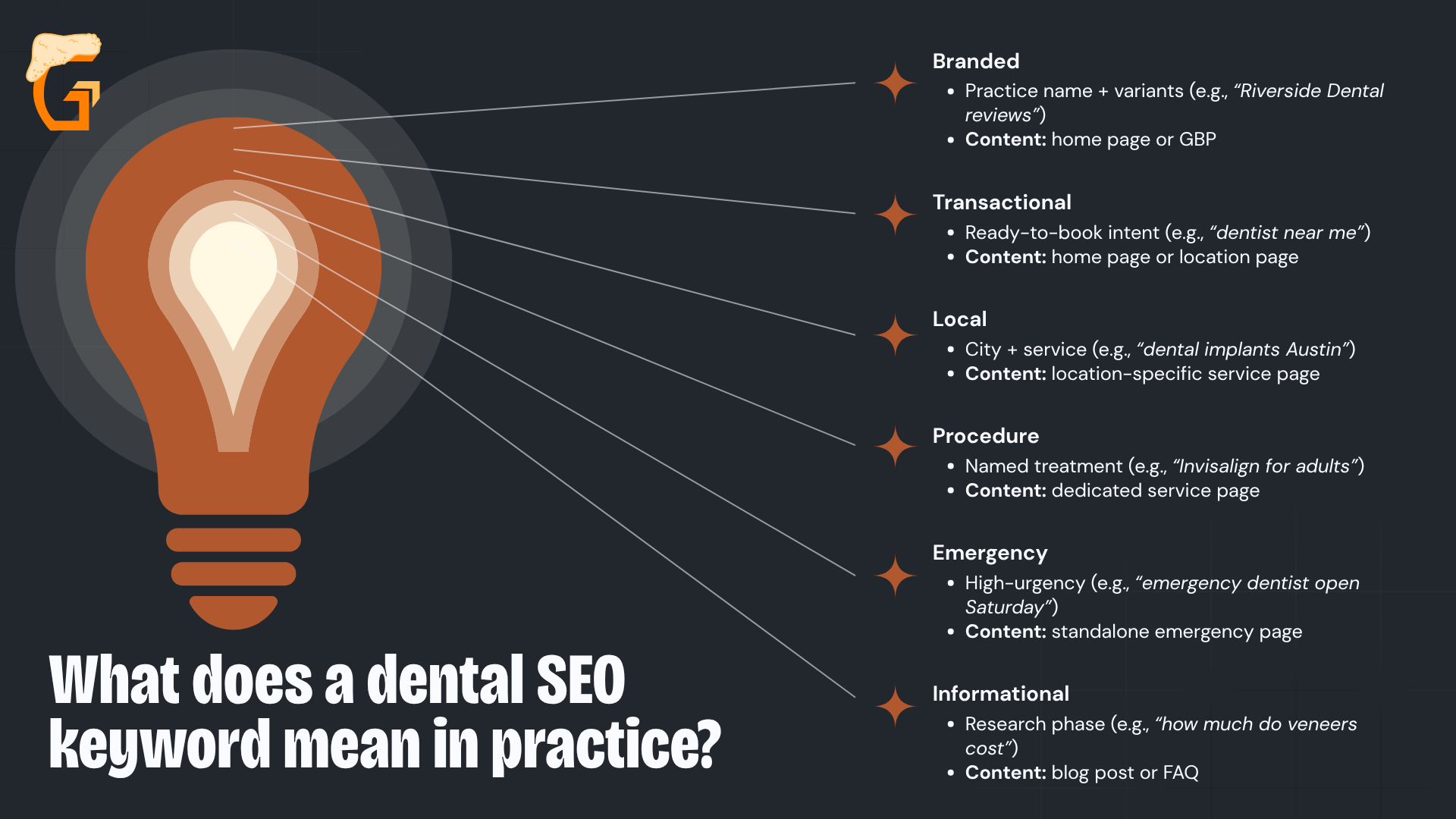
What does a dental SEO keyword mean in practice?
What does a dental SEO keyword mean in practice

A dental SEO keyword is a search term tied to a specific page-and-patient-intent combination, not a freestanding word.

When a patient types a query, the keyword category tells you exactly which page should answer:

  • Branded: practice name + variants (e.g., “Riverside Dental reviews”) → home page or GBP
  • Transactional: ready-to-book intent (e.g., “dentist near me”) → home page or location page
  • Local: city + service (e.g., “dental implants Austin”) → location-specific service page
  • Procedure: named treatment (e.g., “Invisalign for adults”) → dedicated service page
  • Emergency: high-urgency (e.g., “emergency dentist open Saturday”) → standalone emergency page
  • Informational: research phase (e.g., “how much do veneers cost”) → blog post or FAQ

What separates dental from generic keywords is that local intent, procedure specificity, and patient-state urgency all apply at once.

A keyword without a geographic modifier is almost always the wrong one for a dental practice competing in a specific metro.

Why does 2026 dental search look different?

Three search behavior shifts compress head-term value and push it toward local and long-tail phrases.

The shifts reshaping dental search in 2026 include:

  • AI Overviews on head terms: queries like “dental implants” now return an AI answer above organic results, reducing click-through for practices not appearing in the summary
  • Mobile-first near-me behavior: patients on mobile devices expect click-to-call results. “Dentist near me” resolves dynamically to the searcher’s location
  • Quarterly map decay: procedure trends and AI Overview coverage shift fast enough that a 2024 keyword map may already misalign with current SERPs

Practices building maps around many specific local and procedure terms compound faster than those chasing one high-volume term.

Keyword maps need quarterly refreshes – set a calendar reminder.

Growth Saloon helps dental practices build keyword strategies for your dental website that drive real patient bookings, not vanity metrics.

Reach out today to learn how our dental SEO keyword services can put your practice in front of the right patients.
What Are the Main Categories of Dental SEO Keywords?

Dental keywords group into six intent categories, each mapped to a dedicated page type:

  1. Branded (practice name)
  2. Transactional (“dentist near me”)
  3. Local (“[city] dentist”)
  4. Procedure-specific (“dental implants”)
  5. Emergency
  6. Informational

Google’s Search Quality Rater Guidelines classify queries as Know, Do, Website, and Visit-in-person.

The Visit-in-person class maps directly to local dental searches, confirming that intent matching is a primary quality signal.

What are branded and transactional dental keywords?

Branded terms include your practice name.

Transactional terms are the non-branded, ready-to-book searches patients use before they know you exist.

Branded terms protect your floor – transactional terms fuel new-patient growth:

  • Branded:
    • “[Practice Name] dentist”
    • “[Practice Name] reviews”
    • “[Doctor Name] DDS”
    • “[Practice Name] hours”
  • Transactional:
    • “dentist near me”
    • “schedule dental appointment online”
    • “new patient special dentist [city]”
    • “dentist accepting new patients [city]”

Branded terms are easy to own through Google Business Profile optimization, a verified listing, and a steady stream of patient testimonials.

Transactional terms compete against every local dentist, national directory, and DSO in your metro.

Google Keyword Planner’s Discover new right keywords is the canonical tool for pulling location-specific volume estimates for both.

Encourage satisfied patients to leave reviews compounds branded SERP performance (your brand terms gain star ratings in search results, increasing CTR without additional ranking work).

Patients want to know what your past patients are talking about your treatments, how well you’re rated, and whether real experiences align with their desires.

What are procedure and emergency dental keywords?

Procedure keywords, including cosmetic dentistry terms, are the highest-revenue category – emergency keywords are the highest-urgency, and the two blur where they overlap (e.g., “emergency root canal”).

Ahrefs Keywords Explorer is the standard workflow for pulling procedure-keyword volume, difficulty, and CPC:

  • Procedure:
    • Dental implants
    • Invisalign
    • Veneers
    • Teeth whitening
    • Root canal
    • Crowns
    • Pediatric dentistry
    • Cosmetic dentist
    • Sedation dentistry
  • Emergency:
    • Emergency dentist near me
    • Dentist open now
    • Walk in dentist [city]
    • Broken tooth emergency dentist

Agency-cited national volumes include “dental implants” at approximately 135,000 monthly searches and “emergency dentist near me” at approximately 49,500 (treat both as bracket-pending estimates, not Google-published data).

Metro-level volume from Keyword Planner with your city targeted matters more than national averages.

Each major procedure (including cosmetic treatments) deserves its own service page targeting one primary keyword plus 5–15 supporting variants.

Emergency gets a standalone page because its intent differs categorically from scheduled-care pages.

How do informational keywords map to pages?

Informational keywords (from cost comparisons to oral hygiene tips) capture patients in the research phase before they are ready to book: cost, comparison, and symptom-based variants are the three most common clusters.

CDC data show roughly 65% of adults aged 18–64 had a dental visit in the past 12 months, reinforcing that a large share of the patient population is still in a discovery or decision-making stage at any given time.

Google’s Search Quality Rater Guidelines confirm Visit-in-person queries as a distinct intent class, which means informational pages that do not link clearly to corresponding service pages.

The ways keyword intent types map to specific page formats include:

  • Informational → blog post or FAQ:
    • “How much do dental implants cost”
    • “Invisalign vs braces”
    • “How long does a root canal take”
  • The six-category mapping:
    • Branded → home page
    • Transactional → location page
    • Local → location service page
    • Procedure → service page
    • Emergency → standalone page
    • Informational → blog/FAQ

Every informational piece exists to support (not replace) the service page it relates to.

At Growth Saloon, we map every keyword to the right page type so your practice converts more dental patients at every stage of their search.

Contact us to get a custom dental SEO strategy tailored to your practice’s goals.

Which Local and Long-Tail Dental Keywords Convert Best?

Local terms like “dentist near me” and long-tail variants like “Invisalign dentist [city] cost” drive most dental bookings through local search results.

Combined, they outperform broad head terms despite lower individual volumes.

Google’s local ranking guidance confirms local results are ranked on relevance, distance, and prominence together.

The last of which is shaped by citations across local directories (every local keyword decision is simultaneously a content and GBP optimization decision).

What does a local dental keyword look like?

What does a local dental keyword look like

A local dental keyword pairs a service with a geographic modifier, making location based keywords the backbone of metro targeting.

“Near me” is a special class because it resolves dynamically to the searcher’s location, which makes it powerful for local visibility.

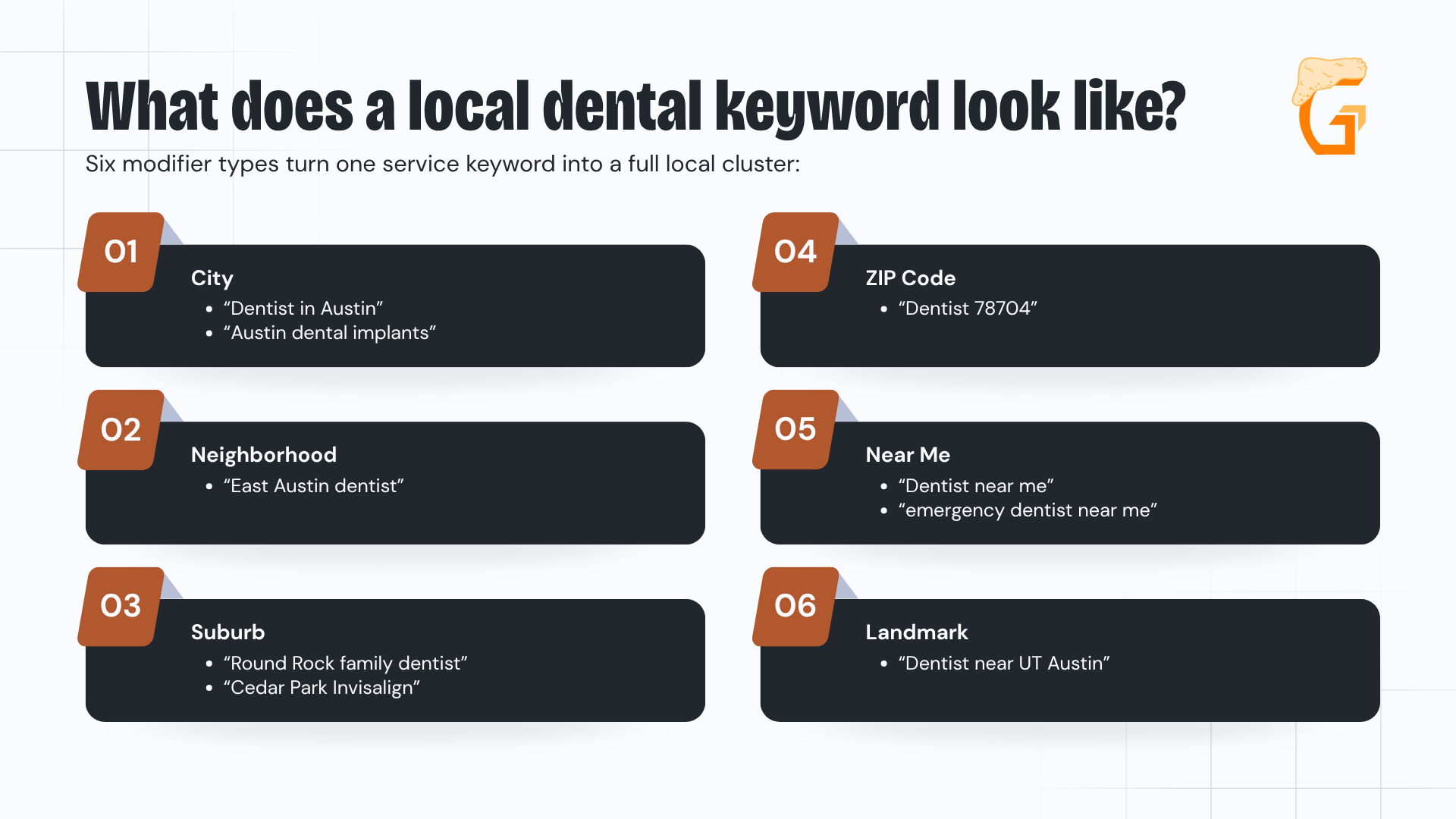
Six modifier types turn one service keyword into a full local cluster:

  • City: “dentist in Austin,” “Austin dental implants”
  • Neighborhood: “East Austin dentist”
  • Suburb: “Round Rock family dentist,” “Cedar Park Invisalign”
  • ZIP code: “dentist 78704”
  • Near me: “dentist near me,” “emergency dentist near me”
  • Landmark: “dentist near UT Austin”

Geographic stacking turns one service into a viable cluster of local SEO keywords: “dental implants” + six modifier types = six landing-page targets.

A single-location practice can build 6–10 viable local variants per core service before overlap becomes a concern, provided each page actually serves that geography.

What does a long-tail dental keyword look like?

Long-tail dental keywords are high intent keywords built from four-or-more-word phrases with strong modifiers:

  • Cost;
  • Time;
  • Insurance;
  • Patient age; or
  • Symptom.

Pairing head terms with long-tails gives your site both long-term authority and near-term conversion power.

A few ways this can be done include:

  • Cost: “dental implants cost [city],” “how much does Invisalign cost [city]”
  • Time: “emergency dentist open Saturday,” “same day dental appointment [city]”
  • Insurance: “dentist accepting Medicaid [city]”
  • Age: “pediatric dentist for toddlers [city]”
  • Symptom: “broken tooth emergency dentist,” “tooth pain dentist open now”

For a practice launching SEO from scratch, long-tail keyword variations are where to start because difficulty is lower and intent is cleaner.

Which long-tail clusters convert best for top dental services?

Which long-tail clusters convert best for top dental services

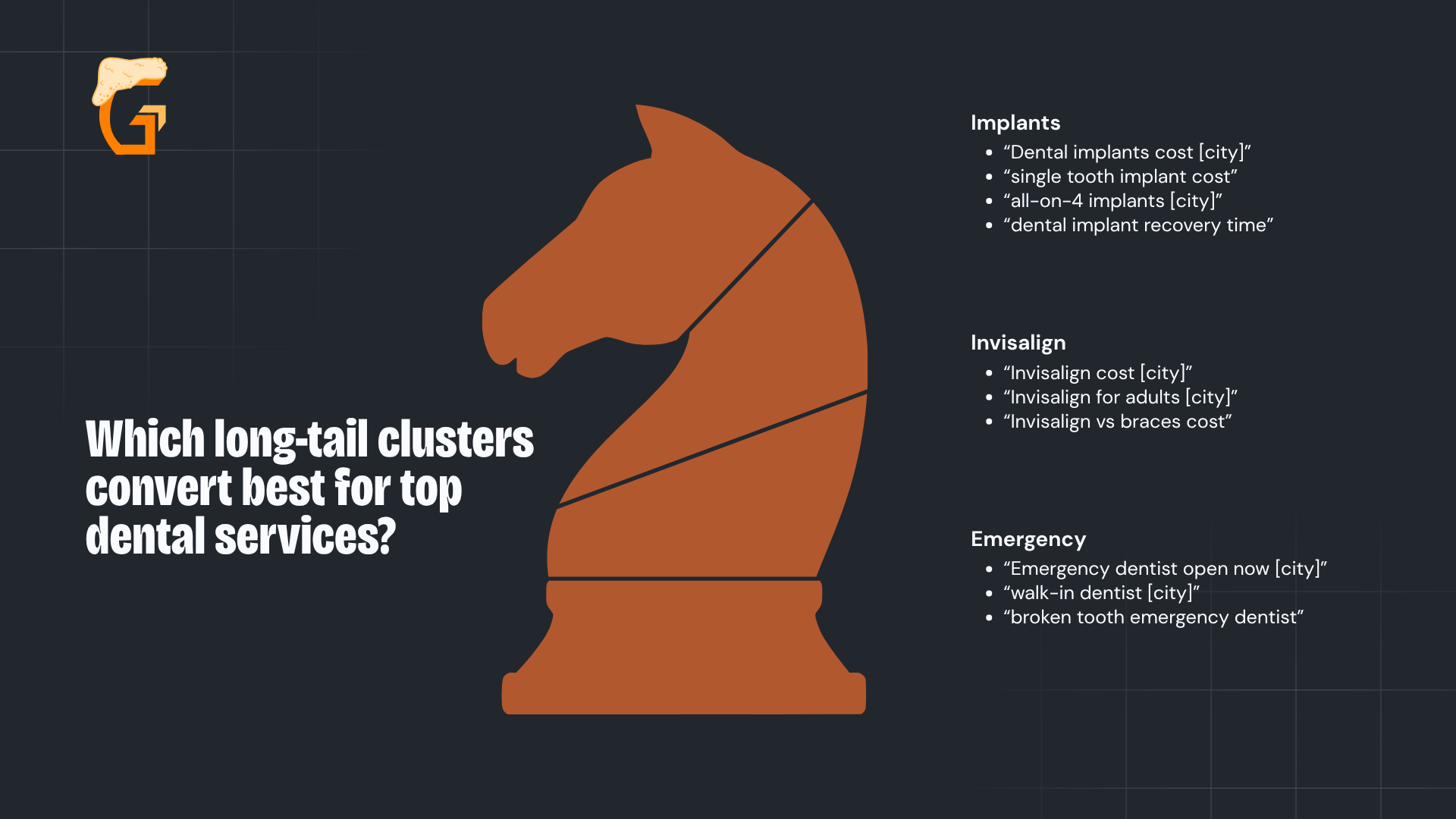
The three highest-value services (implants, Invisalign, and emergency) each have a distinct long-tail cluster worth building first for website traffic that converts.

AnswerThePublic surfaces these clusters by scraping Google autocomplete for a seed term:

  • Implants: “dental implants cost [city],” “single tooth implant cost,” “all-on-4 implants [city],” “dental implant recovery time”
  • Invisalign: “Invisalign cost [city],” “Invisalign for adults [city],” “Invisalign vs braces cost”
  • Emergency: “emergency dentist open now [city],” “walk-in dentist [city],” “broken tooth emergency dentist”

Validate specific terms in Keyword Planner with metro-level targeting before committing to page builds.

For a deeper look at building these clusters, see the long-tail keyword strategy for dentists.

Growth Saloon specializes in turning the local and long-tail keywords patients actually use into booked appointments for dental practices.

Get in touch to see how our SEO keyword research for dentists can grow your patient pipeline.

How’s your SEO going?

Enter your website URL below to get a free comprehensive SEO audit.

The audit includes:

How Do You Measure a Dental Keyword's Commercial Value?

Measure dental keyword value by combining monthly search volume, CPC as a commercial-intent proxy, and search intent fit.

Implants and Invisalign command the highest CPCs, often $9–$29 per click.

WordStream’s 2025 Google Ads Benchmarks put the average CPC for Dentists & Dental Services at $7.85.

Any term well above that baseline signals strong advertiser demand and conversion potential for organic targeting.

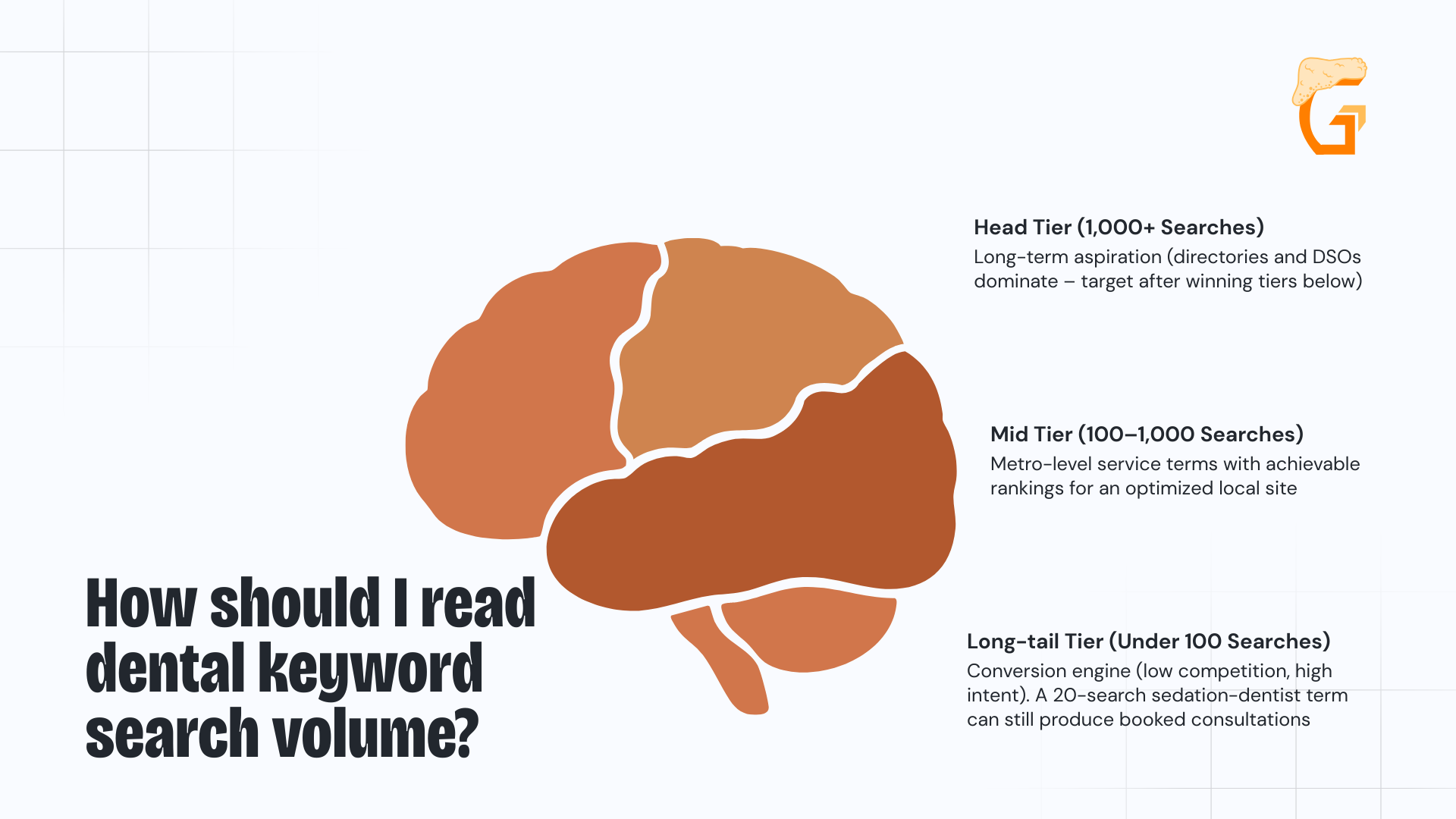
How should I read dental keyword search volume?

How should I read dental keyword search volume

Search volume in dentistry is a noisy signal because city-level variance is significant.

Three volume tiers frame the targeting decision:

  • Head tier (1,000+ searches): long-term aspiration (directories and DSOs dominate – target after winning tiers below)
  • Mid tier (100–1,000 searches): metro-level service terms with achievable rankings for an optimized local site
  • Long-tail tier (under 100 searches): conversion engine (low competition, high intent). A 20-search sedation-dentist term can still produce booked consultations

Google Keyword Planner returns volume estimates scoped to your selected location (always pull with city or metro targeting).

Low volume is not a disqualifier – it is high intent in disguise.

How does CPC reveal commercial intent?

CPC is an auction-derived signal from paid ads: advertisers pay more per click when they believe the click converts at high revenue (a directional proxy for commercial value even in organic targeting).

Industry-cited CPC benchmarks give you a baseline for gauging commercial intent (bracket-verify before publishing):

  • Dental implants: $8–$25+ per click in competitive U.S. markets
  • Invisalign / clear aligners: $5–$15 per click
  • Emergency dentist: $2.54–$12.85 per click
  • Dental category average: $7.85 (WordStream 2025)

CPC reflects ad-buyer competition, not patient lifetime value – some lower-CPC terms still produce strong returns.

Pediatric terms often carry modest CPCs but anchor long family relationships worth multiples of a single high-CPC case.

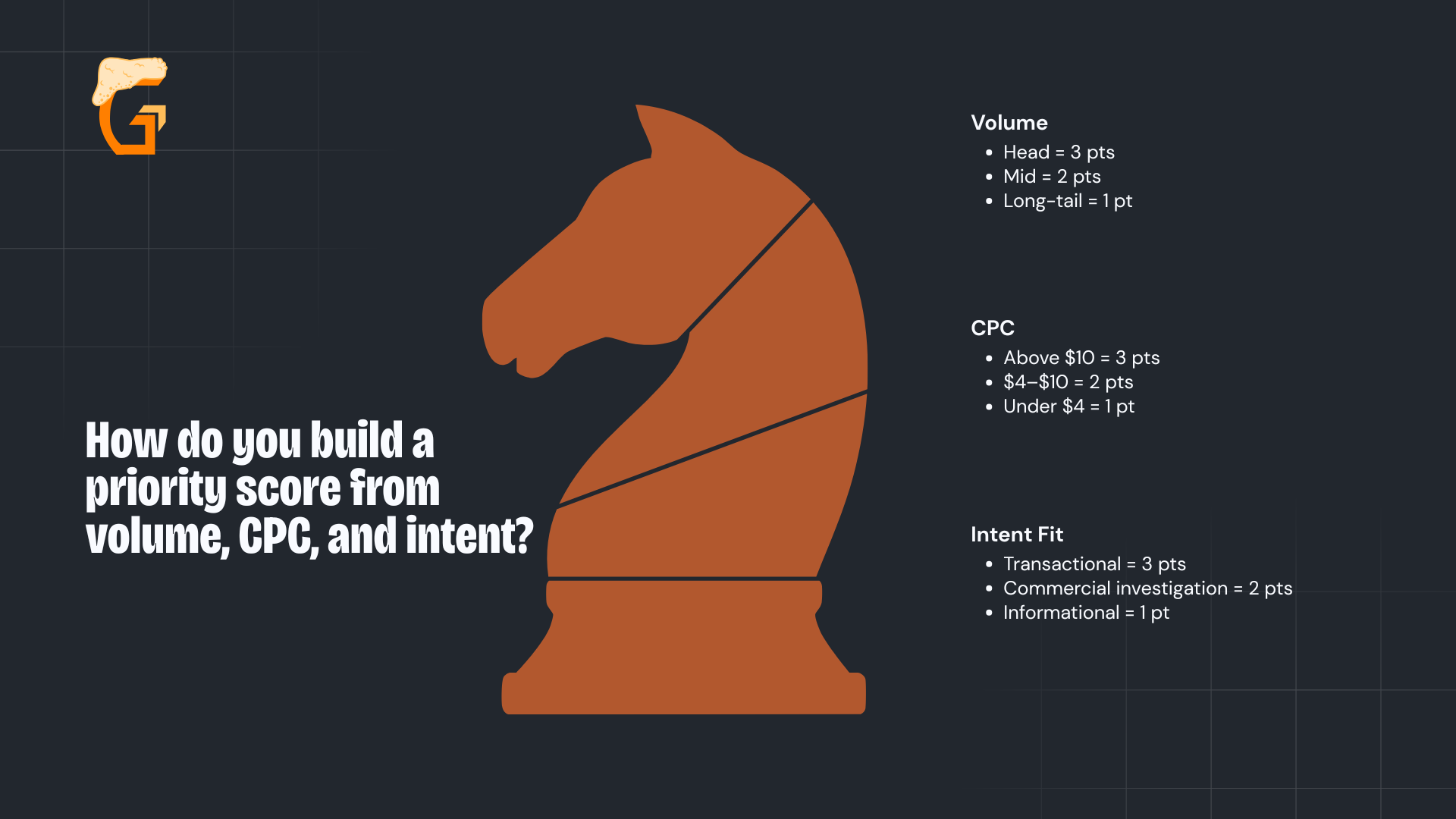
How do you build a priority score from volume, CPC, and intent?

How do you build a priority score from volume, CPC, and intent

Priority scoring combines the three inputs into a working rank order that guides SEO performance.

Backlinko’s local keyword research guide describes prioritizing by volume, intent, difficulty, and fit (applied here as a simple rubric):

  • Volume: head = 3 pts / mid = 2 pts / long-tail = 1 pt
  • CPC: above $10 = 3 pts / $4–$10 = 2 pts / under $4 = 1 pt
  • Intent fit: transactional = 3 pts / commercial investigation = 2 pts / informational = 1 pt

A specific keyword like a dental implants term with mid volume + high CPC + transactional intent scores 8 (a cleaning FAQ term scores 3).

Build your page roadmap in descending order and integrate keywords into each page as you go.

The most common mistake is dismissing keywords below 50 monthly searches without checking CPC and intent (a score-7 term at 30 searches beats a score-3 term at 300).

Priority scores age fast in dentistry – recalibrate monthly.

Growth Saloon takes the guesswork out of keyword prioritization by combining volume, CPC, and intent data into actionable dental SEO marketing plans.

Reach out now to explore our dental keyword optimization services and start ranking for the terms that matter.

How Do You Choose Which Dental SEO Keywords to Target?

Pick the right dental keywords by filtering for relevance, intent, and a low-to-medium keyword difficulty score. Use Google Keyword Planner to validate volume and Ahrefs or Semrush to estimate difficulty.

Google Keyword Planner’s Discover new keywords is the official starting point (set geographic targeting to your metro and run your seed list through it to surface the most relevant keywords).

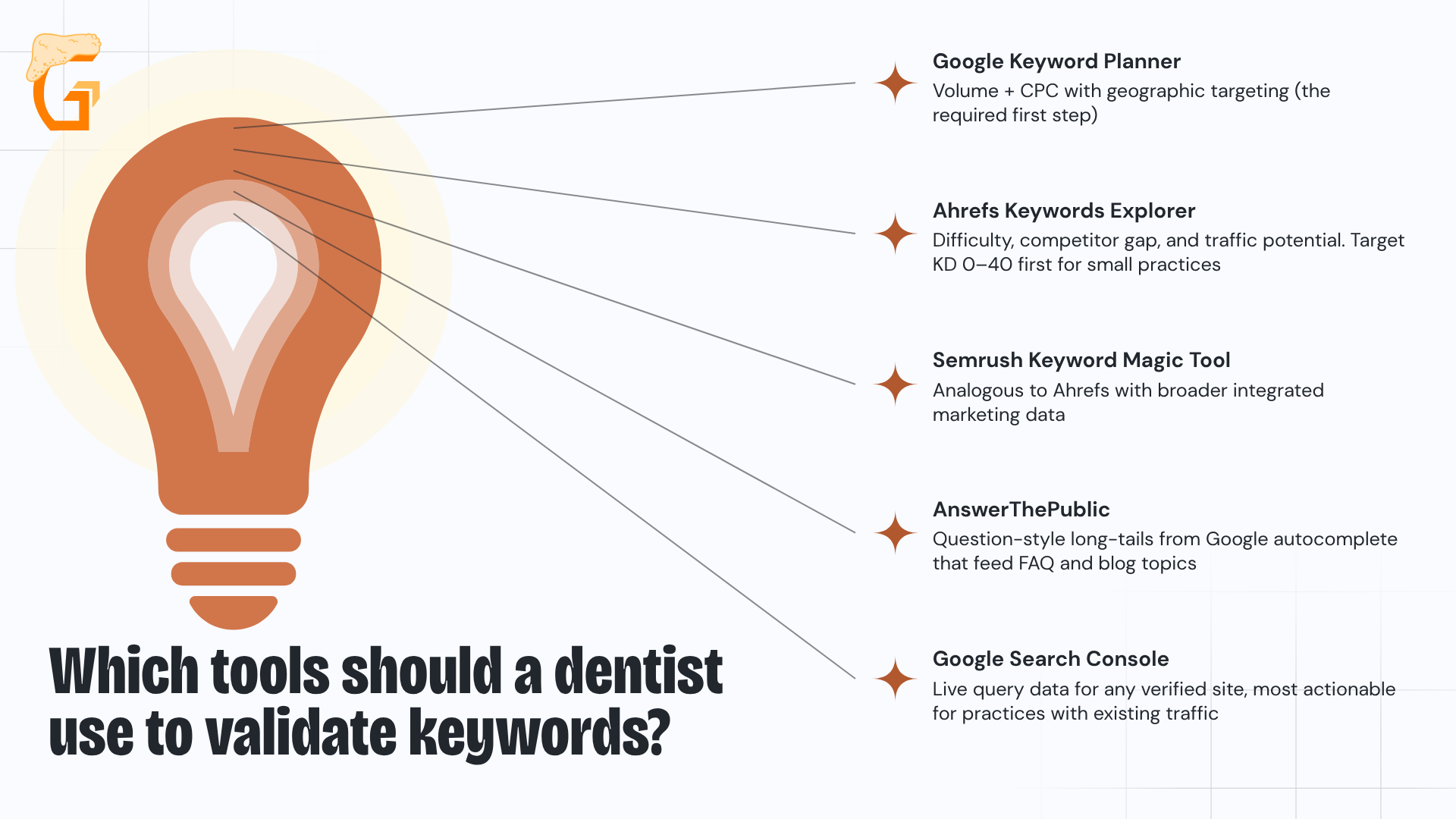
Which tools should a dentist use to validate keywords?

Which tools should a dentist use to validate keywords

Start with Keyword Planner and one paid difficulty tool, then layer in optional research and performance data:

  • Google Keyword Planner: volume + CPC with geographic targeting (the required first step)
  • Ahrefs Keywords Explorer: difficulty, competitor gap, and traffic potential. Target KD 0–40 first for small practices
  • Semrush Keyword Magic Tool: analogous to Ahrefs with broader integrated marketing data
  • AnswerThePublic: question-style long-tails from Google autocomplete that feed FAQ and blog topics
  • Google Search Console: live query data for any verified site, most actionable for practices with existing traffic

Free tools alone are enough to start.

Paid tools matter once competitor tracking and content volume justify the cost.

How do you filter the list down to a final keyword map?

When selecting keywords, run every candidate through these five filter gates before assigning it to a page:

  • Relevance gate: drop procedures you don’t offer, geographies you don’t serve, or terms owned entirely by online directories
  • Intent gate: drop terms where the dominant SERP page type mismatches your planned page type
  • Volume gate: drop terms with zero measurable metro-level volume in Keyword Planner
  • Difficulty gate: drop KD 70+ terms at launch. Build toward trophy terms after winning long-tails
  • Page assignment gate: assign each surviving term to exactly one page (duplicate primaries trigger cannibalization)

Google Search Central’s duplicate content guidance confirms the fix for competing pages is to pick a canonical URL, 301 redirect the others, and update internal links (which is why one-primary-keyword-per-page from the start prevents the problem).

Keyword stuffing is a separate issue – cannibalization is a page-architecture problem.

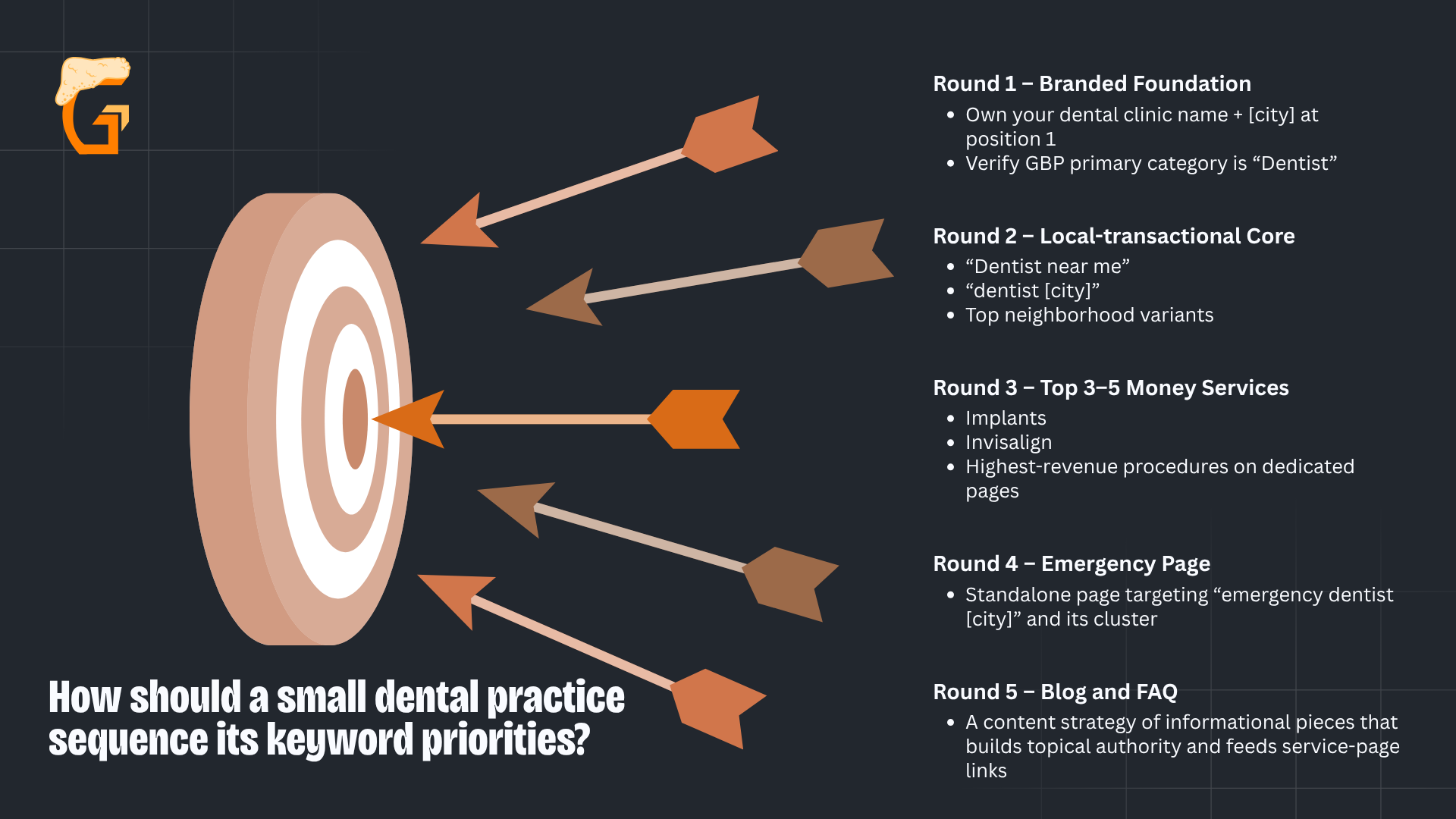
How should a small dental practice sequence its keyword priorities?

How should a small dental practice sequence its keyword priorities

Each round builds on the authority earned in the one before it, so sequence matters from day one:

  • Round 1 – Branded foundation: own your dental clinic name + [city] at position one. Verify GBP primary category is “Dentist”
  • Round 2 – Local-transactional core: “dentist near me,” “dentist [city],” top neighborhood variants
  • Round 3 – Top 3–5 money services: implants, Invisalign, and highest-revenue procedures on dedicated pages
  • Round 4 – Emergency page: standalone page targeting “emergency dentist [city]” and its cluster
  • Round 5 – Blog and FAQ: a content strategy of informational pieces that builds topical authority and feeds service-page links

Google Search Console’s Performance report is your always-on source of truth for keyword performance (review monthly).

Revisit the full keyword map quarterly.

When the map gets complex or spans multiple locations, that is usually when working with a dental SEO company makes more sense than maintaining it in-house.

Growth Saloon builds and maintains keyword maps across single and multi-location dental practices so you can focus on patient care.

Contact Growth Saloon’s dental SEO team today to get a keyword strategy that delivers measurable results.

FAQ
Author

Who is Mike Lowe?

Mike Lowe is a digital marketing strategist and the founder of Growth Saloon, where he specializes in helping businesses cut through the noise with high-converting email strategies and SEO.

With a focus on “organic storytelling,” Mike combines over a decade of agency experience with a passion for helping brands build genuine trust with their audience.

When he’s not optimizing subject lines or scaling SaaS companies, he’s likely sharing insights on how to transform cluttered inboxes into meaningful connection points for online marketers.

Related content
Resources for Dentists

Every resource we’ve published for Dentists, in one place:

Ready to turn your website traffic into real growth?

You’ve read the strategy now let Growth Saloon help you put it into action.

Get a free SEO audit and see what’s holding your website back from ranking, converting, and growing. 

Let's Chat

Let’s discuss your online marketing goals! We’re quick to respond, so we’ll be in touch shortly to set up a time to chat.