

Updated:August 10th, 2026

Link Building for Dentists in 2026

Written by

Mike Lowe

Reviewed by

Taylor Coteus

Key takeaways

  • Dental practices need both backlinks and local citations because each signal does a different job: backlinks pass authority to lift organic (blue-link) rankings, while citations confirm your NAP (name, address, phone) to drive map-pack visibility, and BrightLocal research shows practices with consistent NAP across major citation sources are 40% more likely to appear in local pack results.
  • Tactics like private blog networks, link farms, and paid links without a rel="sponsored" tag can trigger a Google manual "unnatural links" penalty or a silent algorithmic ranking drop, so any vendor offering bulk "500 links" packages or guaranteed rankings should be screened out before you sign a contract.
  • Quality dental backlinks typically cost $100 to $400 each for local and community placements, with agency retainers ranging from $3,000 to $15,000 or more per month, and a sustainable white-hat pace for most practices is 5 to 10 new referring domains per month rather than a one-off bulk campaign.

Why Does Link Building for Dentists Require a Careful Approach?

Link building for dentists is among the most misunderstood levers in dental SEO.

Most practices are told they need backlinks, handed a vendor invoice, and given no real way to tell whether the work is safe or whether it will hold up when Google’s algorithm shifts.

The problem isn’t link building itself.

It’s that a specific set of manipulative tactics (private blog networks, link farms, and bulk directory spam) pass for “link building” at budget price points, and the vendors running them won’t warn you before a penalty lands.

Link Building for Dentists

The legitimate approach is the opposite: earning relevant, editorial links that strengthen a dental practice’s online presence from local, professional, and content-based sources through repeatable outreach that builds authority and compounds over time.

This guide covers what dental link building actually is, how backlinks differ from local citations, which tactics are white-hat and which carry real penalty risk, what it costs, and where to list your practice.

Growth Saloon built this framework around what works for dental practices in competitive local markets.

Use it to evaluate any link-building program you’re considering (or to start building one your practice can run on its own).

What Is Link Building for Dentists?

Link building for dentists is the practice of earning backlinks and local citations from relevant, trustworthy sites so a dental practice ranks higher in local and organic search.

It sits inside a wider dental search engine optimization program alongside on-page content, technical health, and local signals – it is not a standalone fix.

Google’s ranking systems evaluate relevance, quality, and context across hundreds of billions of pages.

Link building is how a practice earns credibility in those signals over time (not by buying links, blasting bulk directories, or running a one-off campaign).

How Do Backlinks and Citations Help a Dental Practice Rank?
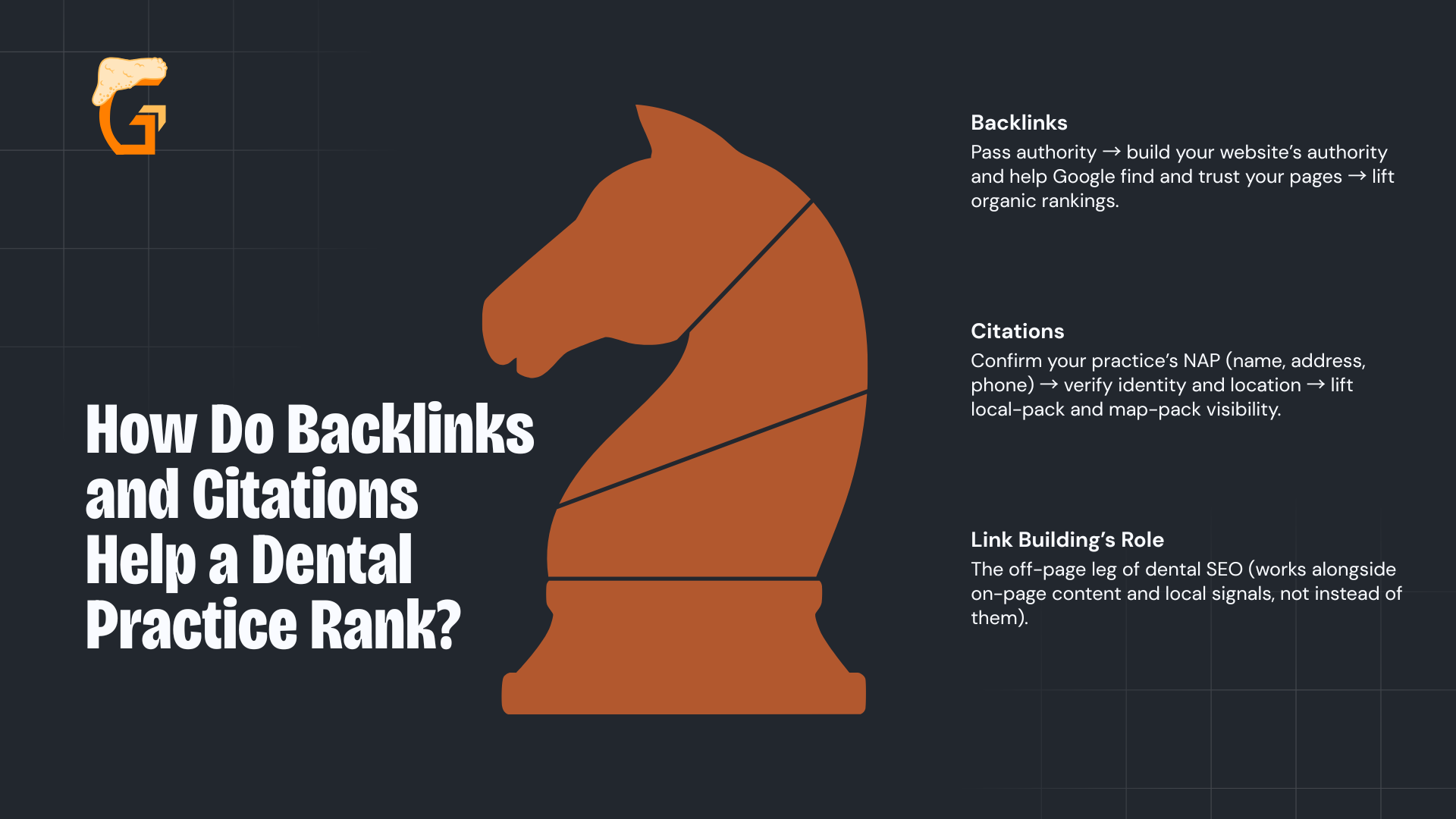
How Do Backlinks and Citations Help a Dental Practice Rank

Google’s SEO Link Best Practices confirm links signal relevancy and help search engine crawlers find new pages. Here is what each signal does for a dental practice:

  • Backlinks: Pass authority → build your website’s authority and help Google find and trust your pages → lift organic rankings.
  • Citations: Confirm your practice’s NAP (name, address, phone) → verify identity and location → lift local-pack and map-pack visibility.
  • Link building’s role: The off-page leg of dental SEO (works alongside on-page content and local signals, not instead of them).

On-page content about your dental services earns relevance – backlinks and citations earn trust.

Both are needed.

What Are the Three Ways Dentists Earn Links?

Relevance outweighs volume in every bucket – dentists earn links from three broad sources:

  • Local and community links: Sponsorships, chamber listings, and local community event pages that link back to the practice.
  • Professional and industry links: Dental association directories, supplier and lab partner pages, and bylines in dental industry publications.
  • Content and digital-PR links: Guest posts, expert commentary, and original content that relevant websites cite.

For a health site, Google gives extra weight to E-E-A-T trust signals (a few relevant, trusted links from other websites outperform hundreds of low-quality directory submissions every time).

Strong dental link building strategies are a relevance game focused on high quality backlinks (not purely a volume game).

Growth Saloon builds relevance-first link profiles for dental practices – from local sponsorships to editorial outreach.

Contact us today to learn how our link-building for dentists services can strengthen your off-page authority and drive more qualified patient inquiries.
What's the Difference Between Dental Backlinks and Local Citations?

Backlinks are hyperlinks that pass authority to a dental practice website for organic rankings – citations are NAP listings that drive map-pack visibility. Most practices need both.

Moz defines a local citation as any online mention of a business’s name, address, and phone number – with or without a link.

A backlink is specifically a hyperlink.

A directory listing that includes your URL is both at once.

What Does Each One Do for Your Rankings?

What Does Each One Do for Your Rankings

Each signal does a distinct job – track them separately:

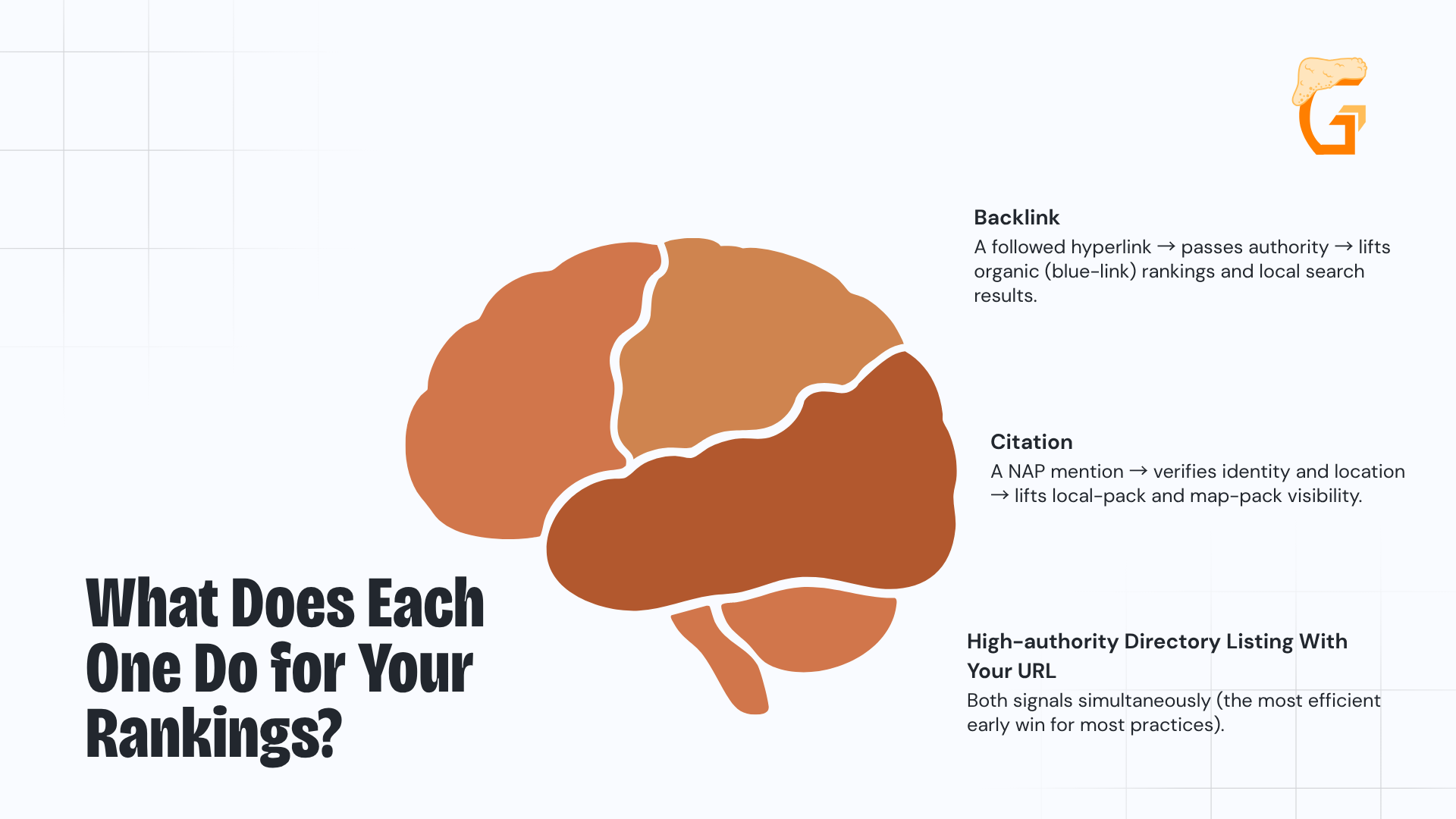
  • Backlink: A followed hyperlink → passes authority → lifts organic (blue-link) rankings and local search results.
  • Citation: A NAP mention → verifies identity and location → lifts local-pack and map-pack visibility.
  • High-authority directory listing with your URL: Both signals simultaneously (the most efficient early win for most practices).

The citation in a local business directory is the business mention – the link inside it is the backlink.

One directory submission can generate backlinks and citations at once (which is why high-authority directories should be the first stop for any practice building its off-page foundation).

Which Should a Dental Practice Prioritize First?

The sequence depends on where the practice is:

  • Newer practice: Build consistent citations on core platforms first to support local search rankings → Google needs to verify NAP before backlinks do their best work.
  • Established practice: Pursue editorial backlinks for competitive organic terms → citations should already be solid at this stage.
  • High-authority directory: Prioritize early regardless (it doubles as both a citation and a backlink).

Growth Saloon helps dental practices build the right mix of citations and backlinks (prioritized by where your practice stands today).

Reach out now to see how our dental link building program can lay the off-page foundation your rankings depend on.

Which Dental Link-Building Tactics Are Safe, and Which Are Toxic?

White-hat dental link building earns editorial, relevant, natural links – toxic tactics like PBNs, link farms, and paid PageRank links risk Google manual actions and ranking demotions.

The danger is not link building itself – it is a specific, nameable set of manipulative tactics that most cheap vendors are quietly running.

This section names them plainly so you know what to avoid and what to ask any partner you hire.

What Does White-Hat Link Building Look Like for a Dentist?

What Does White-Hat Link Building Look Like for a Dentist

White-hat means editorial, relevant, and genuinely earned (the kind Google’s SEO Link Best Practices describe as crawlable links with descriptive anchor text):

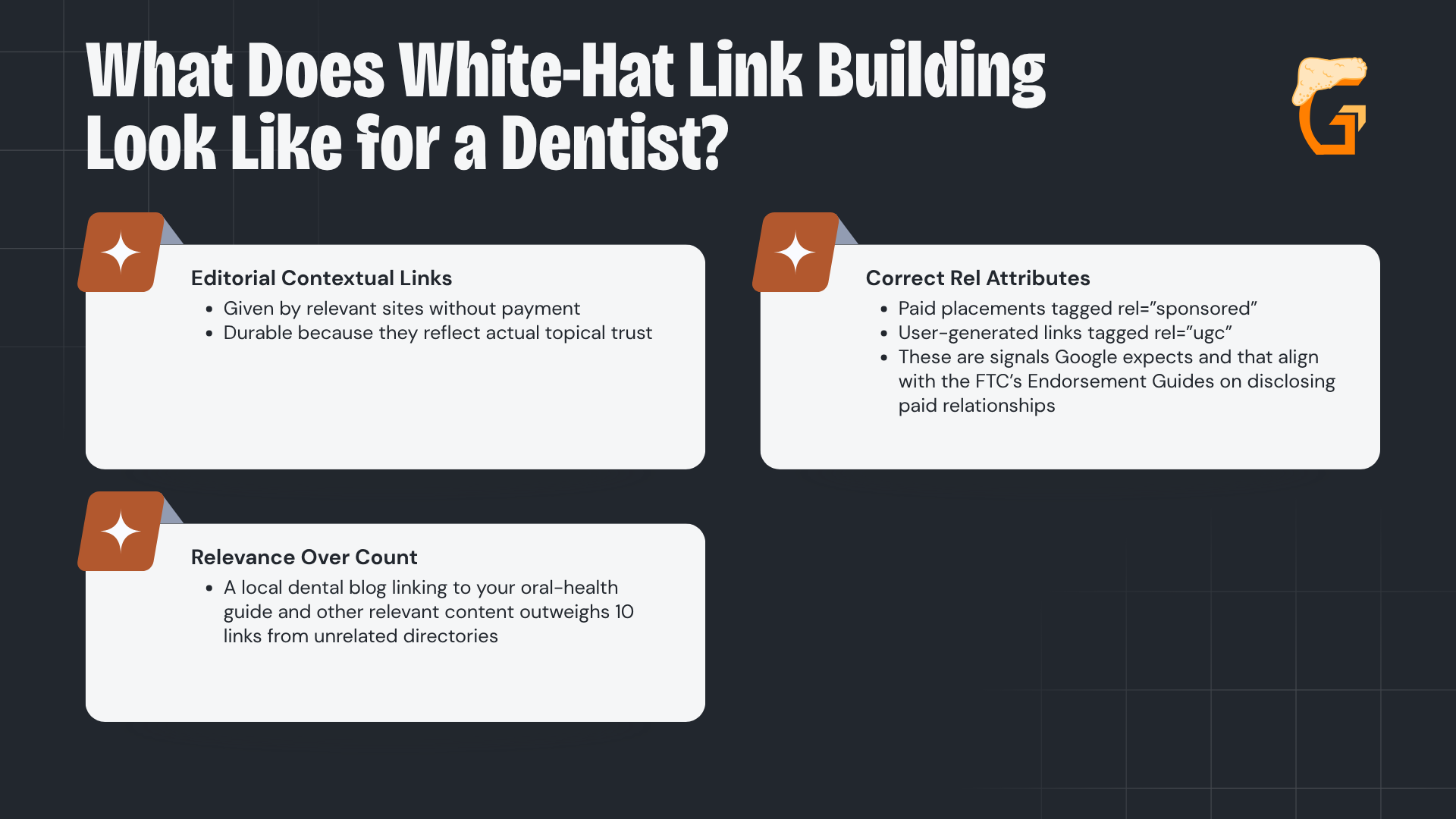
  • Editorial contextual links: Given by relevant sites without payment → durable because they reflect actual topical trust.
  • Relevance over count: A local dental blog linking to your oral-health guide and other relevant content outweighs ten links from unrelated directories.
  • Correct rel attributes: Paid placements tagged rel=”sponsored” (user-generated links tagged rel=”ugc” (signals Google expects and that align with the FTC’s Endorsement Guides on disclosing paid relationships)).

Earned links hold value over time.

Manipulative links get devalued algorithmically in Google’s search results, often taking rankings with them.

Which Tactics Trigger a Google Penalty?

Five categories consistently trigger manual actions or algorithmic devaluation:

  • Private blog networks (PBNs): Fake sites built solely to pass link equity → Google detects and devalues the network.
  • Link farms: Mass-submission schemes with no editorial standard → treated as spam.
  • Paid links passing PageRank: Bought placements without rel=”sponsored” → a direct Google spam policy violation.
  • Bulk link packages: “500 links for $X” → nearly always PBN or link-farm sourced.
  • Irrelevant directories at scale: Off-topic, low-quality submissions that have nothing to do with your practice or other local businesses → dilute rather than build authority.

The consequences (algorithmic devaluation, meaning a silent ranking drop, or a manual “unnatural links” action in Search Console requiring formal remediation).

How Do You Clean Up Toxic Backlinks?

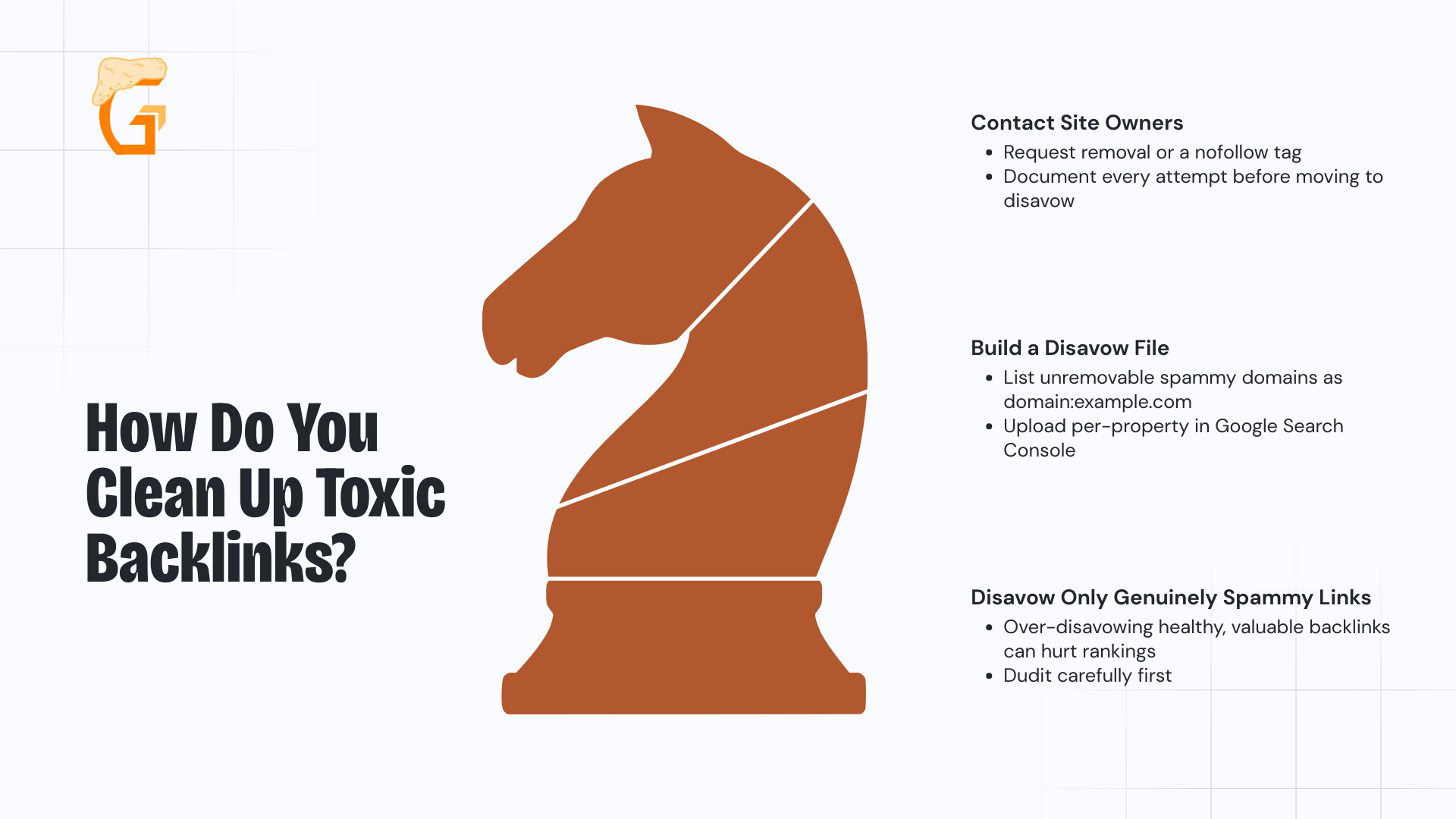
How Do You Clean Up Toxic Backlinks

Two steps: remove at source first → disavow what remains:

  • Contact site owners: Request removal or a nofollow tag → document every attempt before moving to disavow.
  • Build a disavow file: List unremovable spammy domains as domain:example.com → upload per-property in Google Search Console.
  • Disavow only genuinely spammy links: Over-disavowing healthy, valuable backlinks can hurt rankings (audit carefully first).

One caution: scholarship links.

Genuine local or field-aligned scholarship pages earn real .edu links.

“Scholarship farm” listings (sites built solely to sell .edu anchor placements) are a toxic tactic dressed as community outreach.

Vet the destination before submitting, the same way careful dental professionals vet any vendor.

Growth Saloon operates white-hat only – every tactic we run for dental clients is on this list, and none that aren’t.

Contact us today to find out how our link building services for dentists can build durable authority without the penalty risk.

How’s your SEO going?

Enter your website URL below to get a free comprehensive SEO audit.

The audit includes:

How Much Does Dental Link Building Cost, and How Many Links Do You Need?

Quality dental backlinks cost roughly $100–$400 each, so most small practices can keep their link building efforts to dozens of relevant referring domains and target 5–10 new links per month.

Those figures are market-dependent ranges, not fixed prices, and reflect standard dentistry SEO practices rather than a set menu (any vendor quoting a guaranteed number without knowing your market is not giving you honest information).

This section covers what links actually cost, how many you need, and how to vet any service you consider hiring.

What Does a Dental Backlink Actually Cost?

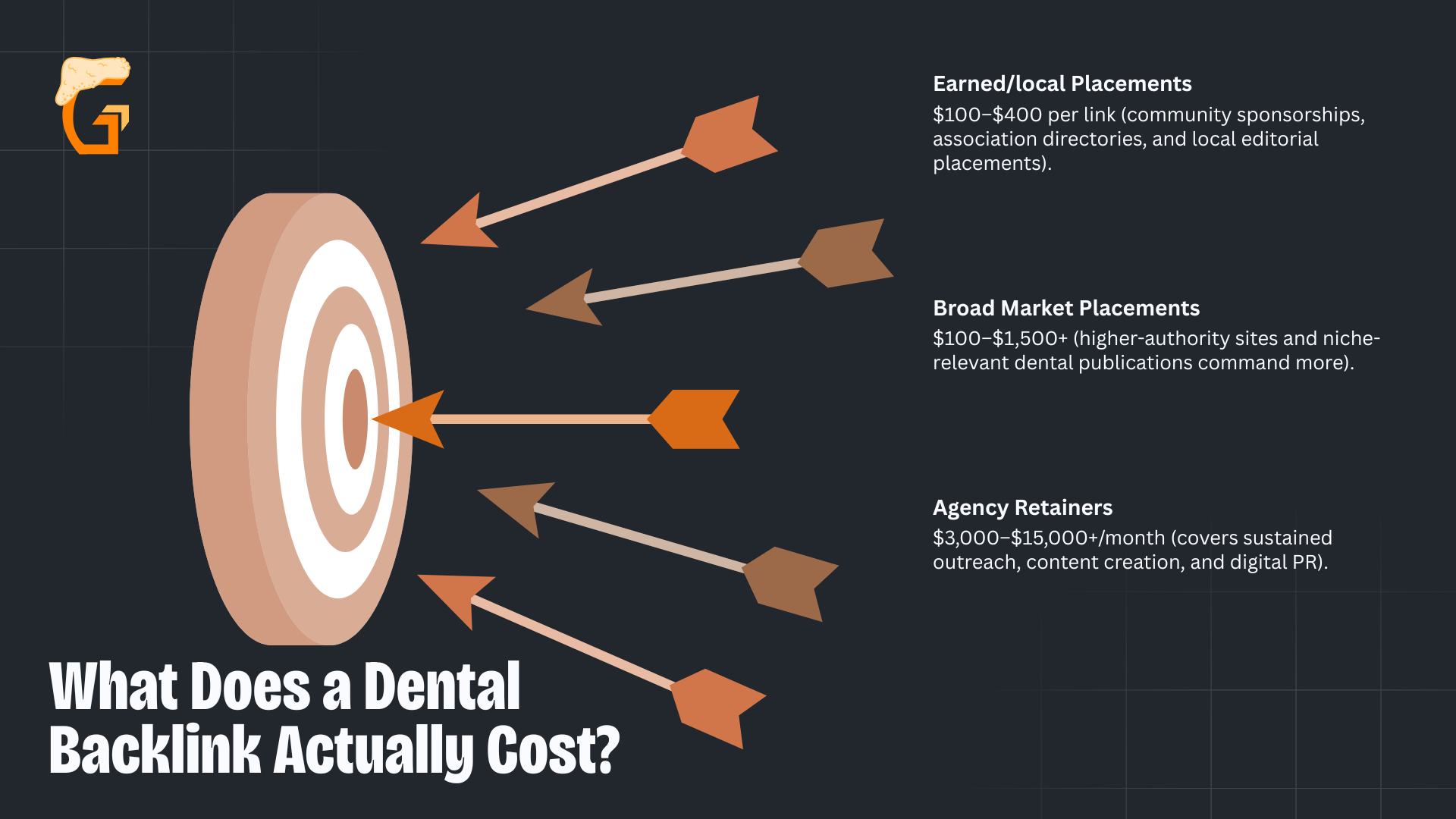
What Does a Dental Backlink Actually Cost

Cost varies by site quality, relevance, and market – no single price applies:

  • Earned/local placements: ~$100–$400 per link (community sponsorships, association directories, and local editorial placements).
  • Broad market placements: $100–$1,500+ (higher-authority sites and niche-relevant dental publications command more).
  • Agency retainers: $3,000–$15,000+/month (covers sustained outreach, content creation, and digital PR).

Siege Media’s link building cost analysis confirms cost is driven by site authority, niche competitiveness, and link quality – not a standard menu price.

Any vendor quoting a single fixed price regardless of quality is a red flag.

How Many Backlinks Does a Dental Website Need?

There is no fixed number – referring-domain diversity and relevance matter more than raw count:

  • Quality over quantity: Dozens of relevant referring domains drive more organic traffic than hundreds of low-quality links for local dental terms.
  • Realistic pace: 5–10 new links per month is a sustainable, white-hat target for most practices.
  • Competitive benchmark: Backlinko’s analysis of 11.8 million Google results found the #1 result averages 3.8x more backlinks than positions #2–#10 (referring-domain diversity is the driver).

The right number is relative to your local competitors, not an absolute target.

Audit the top-ranking practices in your market first.

Should You Build Links In-House or Hire a Service?

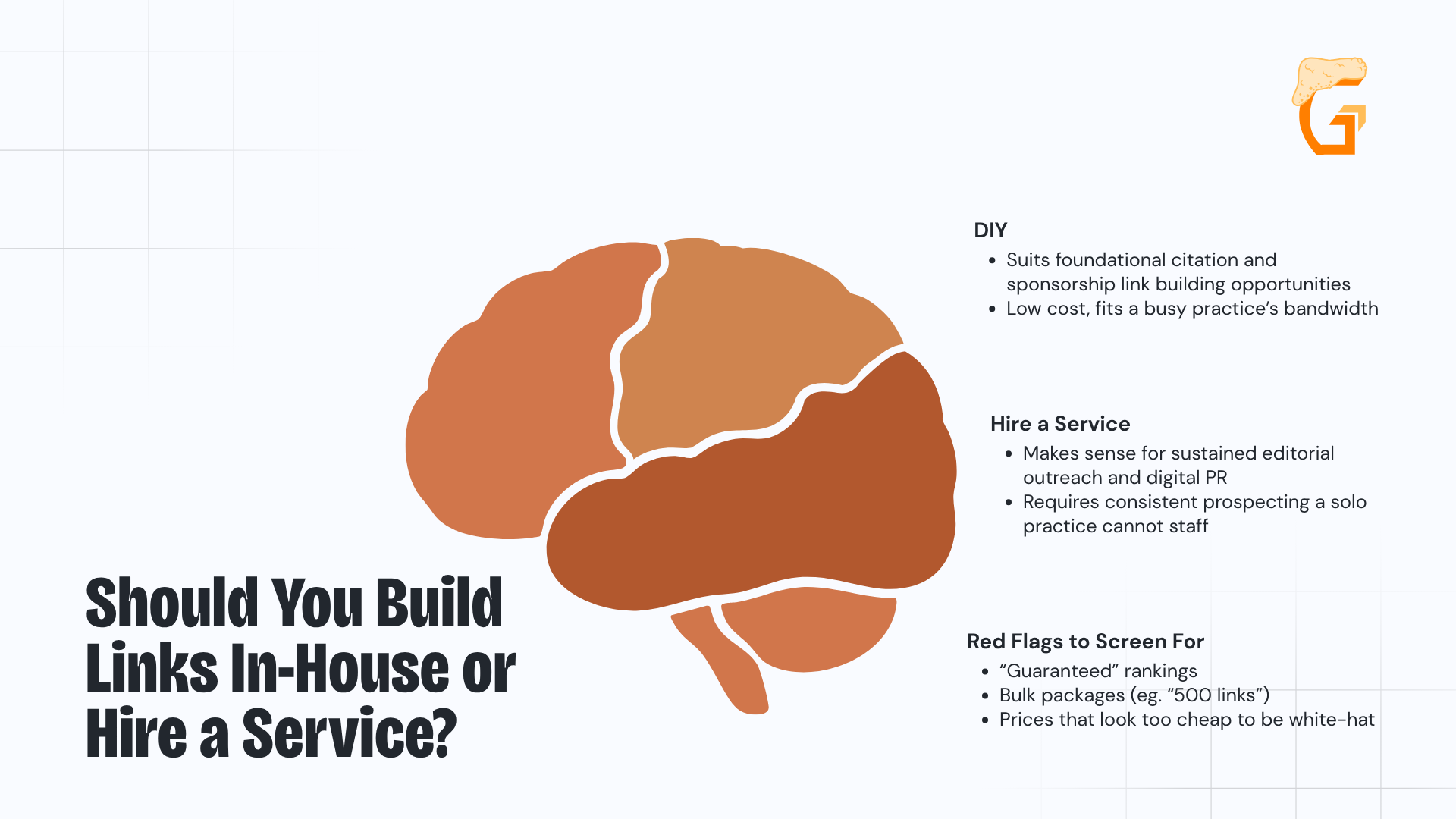
Should You Build Links In-House or Hire a Service

The decision comes down to time and sustained outreach capacity – not budget alone:

  • DIY: Suits foundational citation and sponsorship link building opportunities → low cost, fits a busy practice’s bandwidth.
  • Hire a service: Makes sense for sustained editorial outreach and digital PR → requires consistent prospecting a solo practice cannot staff.
  • Red flags to screen for: “Guaranteed rankings,” bulk “500 links” packages, prices that look too cheap to be white-hat.

Google’s spam policies explicitly prohibit buying or selling links for ranking purposes – any service that cannot explain how it avoids this is not worth the risk.

Vet every partner against it before signing.

Growth Saloon delivers managed, white-hat link building that dental practices can trust – no bulk packages, no shortcuts.

Get started today to see how our dental backlink building services can grow your referring domains the right way.

What Are the Best Link-Building Tactics for Dentists?

The highest-value dental link tactics are local sponsorships, dental association listings, supplier and lab partner pages from relevant local businesses, niche guest posts, and HARO-style digital PR, executed through consistent outreach.

These are safe, repeatable tactics any practice can run without a dedicated SEO tool.

Deep tactic-by-tactic mechanics and outreach templates live on the dental backlinks child page – this section gives the priority stack and where to start.

Which Local and Community Links Should You Pursue First?

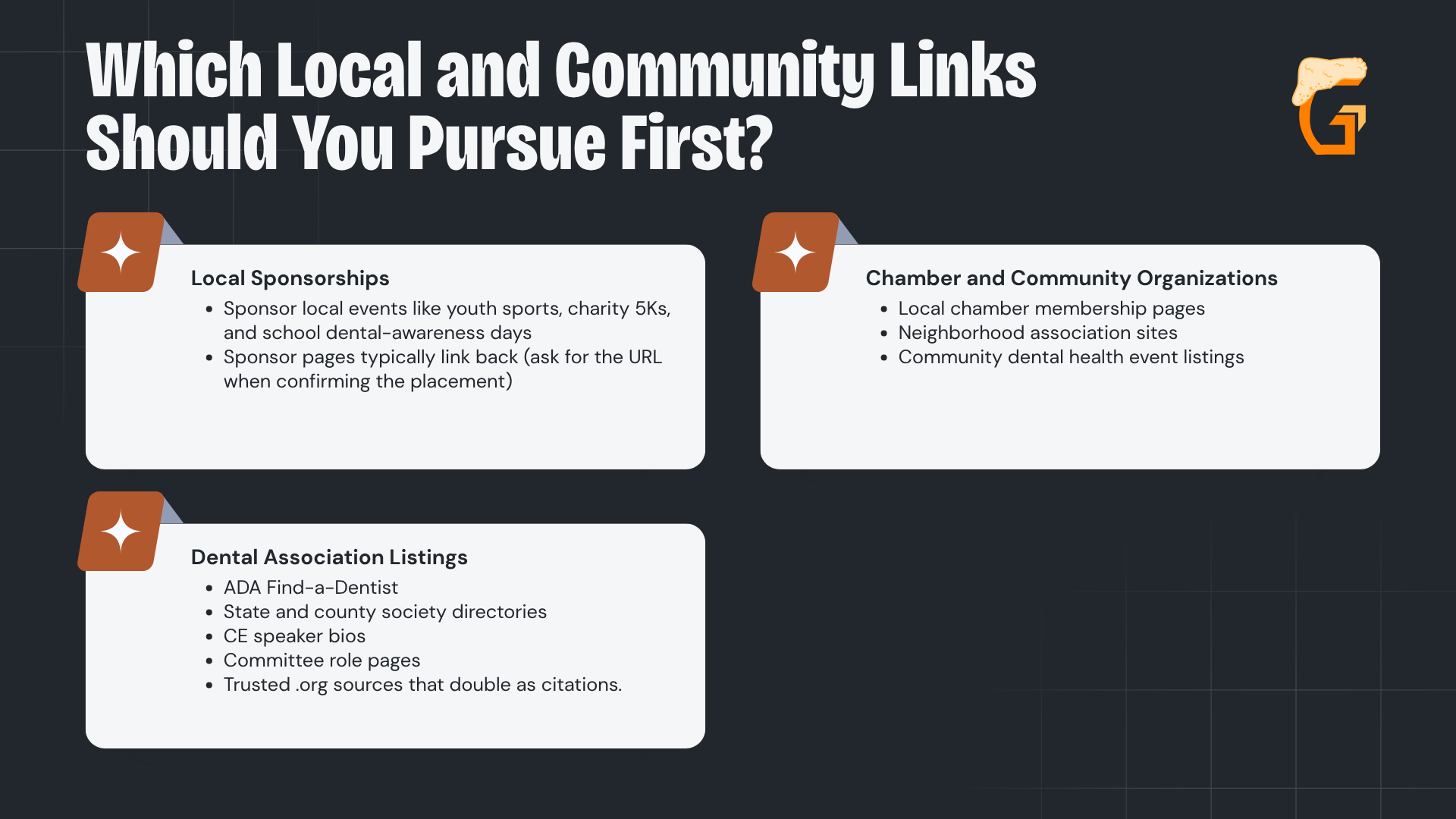
Which Local and Community Links Should You Pursue First

Local and community links are the safest, most relevant first tier (every placement reinforces location signals and most cost nothing beyond the sponsorship itself):

  • Local sponsorships: Sponsor local events like youth sports, charity 5Ks, and school dental-awareness days → sponsor pages typically link back (ask for the URL when confirming the placement).
  • Dental association listings: ADA Find-a-Dentist, state and county society directories, CE speaker bios, committee role pages → trusted .org sources that double as citations.
  • Chamber and community organizations: Local chamber membership pages, neighborhood association sites, and community dental health event listings.

To request the link: provide your NAP, a short practice description, and your preferred URL.

These placements also reinforce local relevance signals and put your practice in front of potential patients beyond the backlink itself.

How Do You Earn Industry and Editorial Links?

Industry and editorial links carry higher authority than local links (and in 2026, AI Overviews are increasingly citing locally relevant experts):

  • Supplier and lab partner pages: Customer spotlights, preferred-provider listings, testimonials → ask your dental lab or equipment vendor if they feature practices on their site.
  • Niche guest posts: Dental industry blogs, health blogs, and local lifestyle outlets → pitch topics your clinical experience qualifies you to write.
  • HARO-style digital PR: HARO (helpareporter.com) and Qwoted → respond to journalist queries as a dental expert → earn editorial citations and referral traffic when quoted.
  • Original-data pitches: Create link worthy content such as a local oral-health survey or practice dataset built on public benchmarks like the CDC’s Oral Health Facts to give journalists a concrete reason to cite your site.

Ahrefs’ link building guide confirms: digital PR and expert-source outreach earn editorial links when you provide genuinely useful, quotable expertise.

The AI-search shift in 2026 makes that signal more valuable, not less.

What Does a Repeatable Outreach Workflow Look Like?

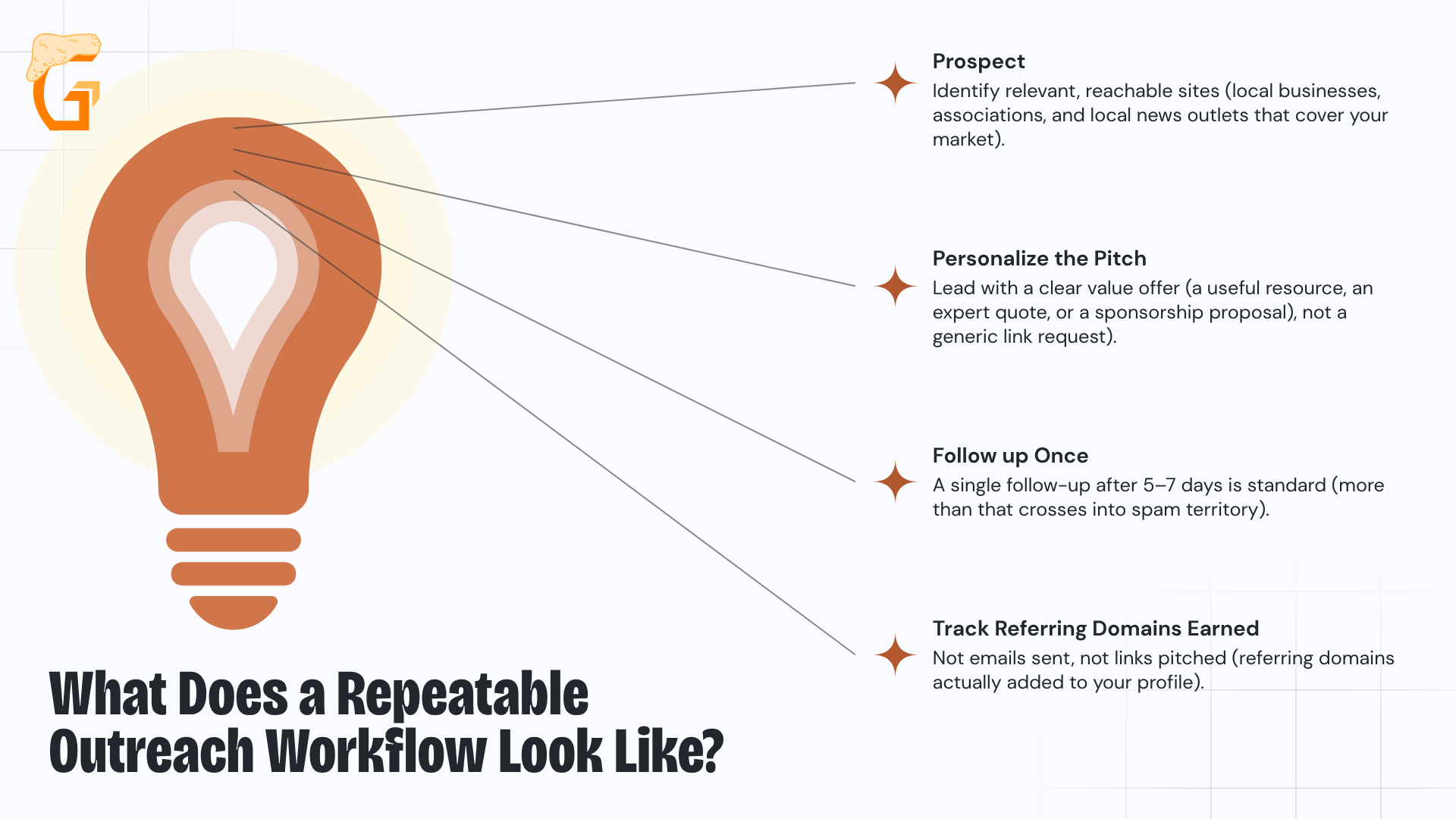
What Does a Repeatable Outreach Workflow Look Like

Outreach is a monthly loop, not a one-off campaign. The core steps are:

  • Prospect: Identify relevant, reachable sites (local businesses, associations, and local news outlets that cover your market).
  • Personalize the pitch: Lead with a clear value offer (a useful resource, an expert quote, or a sponsorship proposal (not a generic link request).
  • Follow up once: A single follow-up after 5–7 days is standard (more than that crosses into spam territory).
  • Track referring domains earned: Not emails sent, not links pitched (referring domains actually added to your profile).

Prioritize prospects by domain authority, topical and local relevance, and effort required.

For the full tactic-by-tactic how-to, see the dental backlinks guide.

Growth Saloon runs this full tactic stack for dental clients (local sponsorships through editorial outreach and digital PR) as a managed monthly program.

Contact us today to learn how our dentist link-building services can build a durable, white-hat backlink profile for your practice.

Where Should Dentists List Their Practice for Citations and Links?

List your practice on Google Business Profile, Apple Maps, Bing, Yelp, and dental directories like Healthgrades and Zocdoc, keeping NAP identical everywhere to strengthen your dental practice’s online visibility and local rankings.

This is the citation half of dental link building (the foundation that map-pack visibility depends on).

The full prioritized where-to-list table lives on the dental directories child page – this section gives the shortlist and the NAP rule every practice must follow.

Which Directories Should Every Dental Practice Be Listed On?

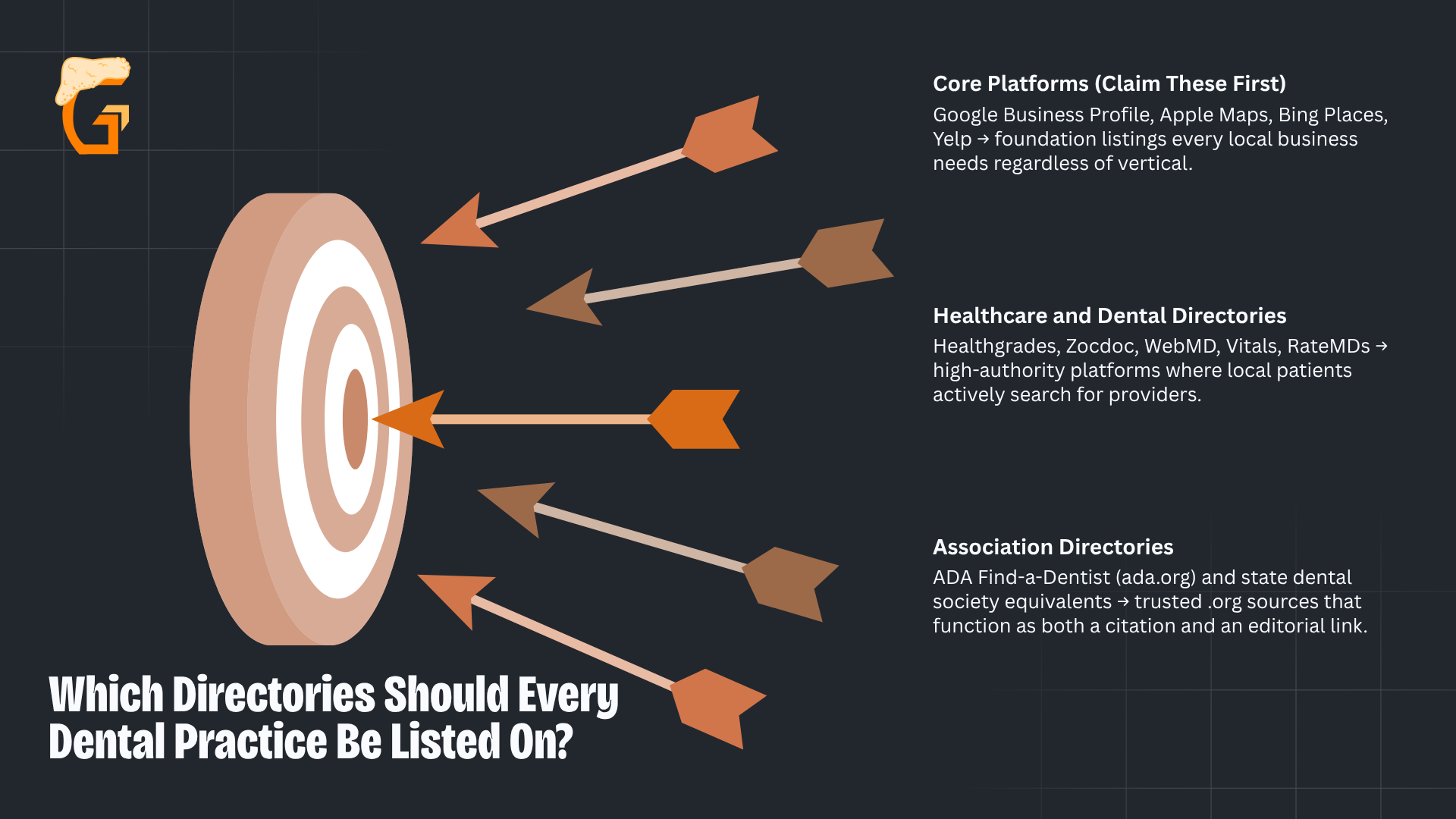
Which Directories Should Every Dental Practice Be Listed On

Two layers of listings – universal local platforms and dental-specific directories:

  • Core platforms (claim these first): Google Business Profile, Apple Maps, Bing Places, Yelp → foundation listings every local business needs regardless of vertical.
  • Healthcare and dental directories: Healthgrades, Zocdoc, WebMD, Vitals, RateMDs → high-authority platforms where local patients actively search for providers.
  • Association directories: ADA Find-a-Dentist (ada.org) and state dental society equivalents → trusted .org sources that function as both a citation and an editorial link.

BrightLocal maintains a regularly updated top citation sites list prioritized by industry and geography.

For the exhaustive where-to-list table, see the dental directories guide.

Why Does NAP Consistency Make or Break Local Rankings?

Inconsistent NAP signals conflicting information to Google – and it erodes local-pack trust quickly:

  • Citations carry measurable weight: BrightLocal data puts citations at ~6% of Local Pack/Maps ranking weight and ~7% of local organic weight.
  • Consistent NAP = 40% more likely in the local pack: According to BrightLocal’s local ranking factors research, businesses with consistent NAP across major citation sources are 40% more likely to appear in local pack results.
  • Run a citation audit periodically: Find and fix name, address, and phone mismatches before they compound across dozens of listings.

The practical first step: claim your Google Business Profile → sync NAP across the shortlist above → layer in local sponsorship links and a mention on a local news site as the first locally-relevant backlink sources once the foundation is clean.

How Can Growth Saloon Help Your Dental Practice Grow?

Growth Saloon is a Chicago-based digital marketing agency built to help dental practices attract more patients and grow their practice through performance-driven digital marketing.

Mike Lowe and the Growth Saloon team specialize in SEO, web design, conversion rate optimization, and marketing attribution – working alongside your practice to build a measurable digital presence that generates qualified patient inquiries, not just website traffic.

From ranking for high-intent local search terms to converting site visitors into booked appointments, Growth Saloon focuses on results at every stage of the patient acquisition funnel.

Practice owners and marketing managers get clear visibility into exactly which channels are driving new patient growth.

We know that every open appointment slot has a real cost.

Every decision we make is built around one outcome – helping your practice fill more of them.

Meet the Founder of Growth Saloon

Meet the founder and lead strategist at Growth Saloon, Mike Lowe:

  • As founder and CEO of Growth Saloon, Mike brings years of hands-on experience in SEO strategy, CRO, web design, and marketing attribution for service-based businesses competing in local and regional markets.
  • Based in Chicago and working with practices across the country, Mike has built and managed digital growth campaigns for businesses competing in some of the most contested search markets in the country.
  • Growth Saloon’s data-driven approach to local SEO and patient acquisition helps dental practices turn their websites into their highest-performing new patient channel.

What Does Working With Growth Saloon Look Like?

Growth Saloon operates as a dedicated extension of your marketing team – not a vendor that disappears after onboarding.

Every engagement includes direct access to Mike and the team, transparent reporting tied to actual patient acquisition outcomes, and strategies tailored to your specific services and local market.

Whether you’re looking to rank for high-value procedures like dental implants, improve your site’s appointment conversion rate, or finally get clarity on where your new patients are actually coming from, Growth Saloon builds the strategy and does the work.

Growth Saloon helps dental practices build the kind of digital presence that consistently generates qualified new patient inquiries – not just clicks.

Contact our team today to find out how our dental marketing services can lower your cost per new patient and grow your practice.

Conclusion

Safe, relevant, locally-focused links beat volume on the search engine results pages every time (and the work compounds over six to twelve months, not six weeks).

The sequence holds regardless of practice size: build consistent citations first, earn editorial and local backlinks through repeatable outreach, and never touch PBNs, link farms, or bought PageRank links.

The tactics in this guide are the ones that hold up when Google’s algorithm updates, because they are built on relevance and trust rather than manipulation.

Growth Saloon manages dental link building programs from citation foundation through editorial outreach – reporting on referring domains earned, not links promised.

Reach out today to discover how our link building for dental practices can build the off-page authority your practice needs to rank and stay ranked.

FAQ
Author

Who is Mike Lowe?

Mike Lowe is a digital marketing strategist and the founder of Growth Saloon, where he specializes in helping businesses cut through the noise with high-converting email strategies and SEO.

With a focus on “organic storytelling,” Mike combines over a decade of agency experience with a passion for helping brands build genuine trust with their audience.

When he’s not optimizing subject lines or scaling SaaS companies, he’s likely sharing insights on how to transform cluttered inboxes into meaningful connection points for online marketers.

Related content
Resources for Dentists

Every resource we’ve published for Dentists, in one place:

Ready to turn your website traffic into real growth?

You’ve read the strategy now let Growth Saloon help you put it into action.

Get a free SEO audit and see what’s holding your website back from ranking, converting, and growing. 

Let's Chat

Let’s discuss your online marketing goals! We’re quick to respond, so we’ll be in touch shortly to set up a time to chat.