

Key takeaways
- A dental SEO expert applies niche knowledge of how patients search for care, which is why a $1,500 per month specialist can outperform a $2,000 per month generalist in a competitive market.
- Treat $99 to $299 per month pricing paired with 12-month contracts as a structural red flag, since that math cannot fund real content, link building, and active optimization at once.
- Expect dental SEO retainers of $1,500 to $5,000 per month, with early movement at 3 to 6 months and meaningful ROI at 6 to 12 months, so any promise of big results in 30 to 60 days is overpromising.
How Do You Know If You Need a Dental SEO Expert?
A dental SEO expert does something a general marketing provider can’t replicate off the shelf: they bring niche knowledge of how patients search for care, what those searches signal about intent, and how local competition shapes every optimization decision your practice faces.
That difference is invisible in a proposal but shows up clearly in month six, when dental search engine optimization is producing patient calls and a generalist playbook is still chasing the wrong keywords.
Many dental practices encounter a market with no shortage of providers claiming expertise – but most of them serve dozens of industries and repurpose the same playbook regardless of vertical.
Your practice competes for a fixed pool of competitive search terms, and the strategies that move the needle there are specific: Google Business Profile signals, service-and-location page optimization, call tracking tied to organic bookings, and content built for patients making health decisions – not generic site visitors.
Growth Saloon helps dental practices build the kind of digital presence that consistently generates qualified new patient inquiries – not just clicks.
Contact our team today to find out how our dental marketing services can lower your cost per new patient and grow your practice.
What Does a Dental SEO Expert Do?
A dental SEO expert improves a practice’s visibility in local search results to drive appointments from qualified prospective patients.
They handle five areas – local SEO and Google Business Profile, on-page optimization of service pages, technical site health, link building, and analytics reporting tied to new patient bookings.
For a dental business, these five areas are not independent – they compound.
Technical issues left unfixed suppress the value of content.
Content marketing without links doesn’t rank.
Rankings without call tracking produce no evidence of patient impact.
What Local SEO and Technical Work Does a Dental SEO Expert Handle?
Dental patients choose providers within a few miles of where they live or work, often starting their search on Google Maps.
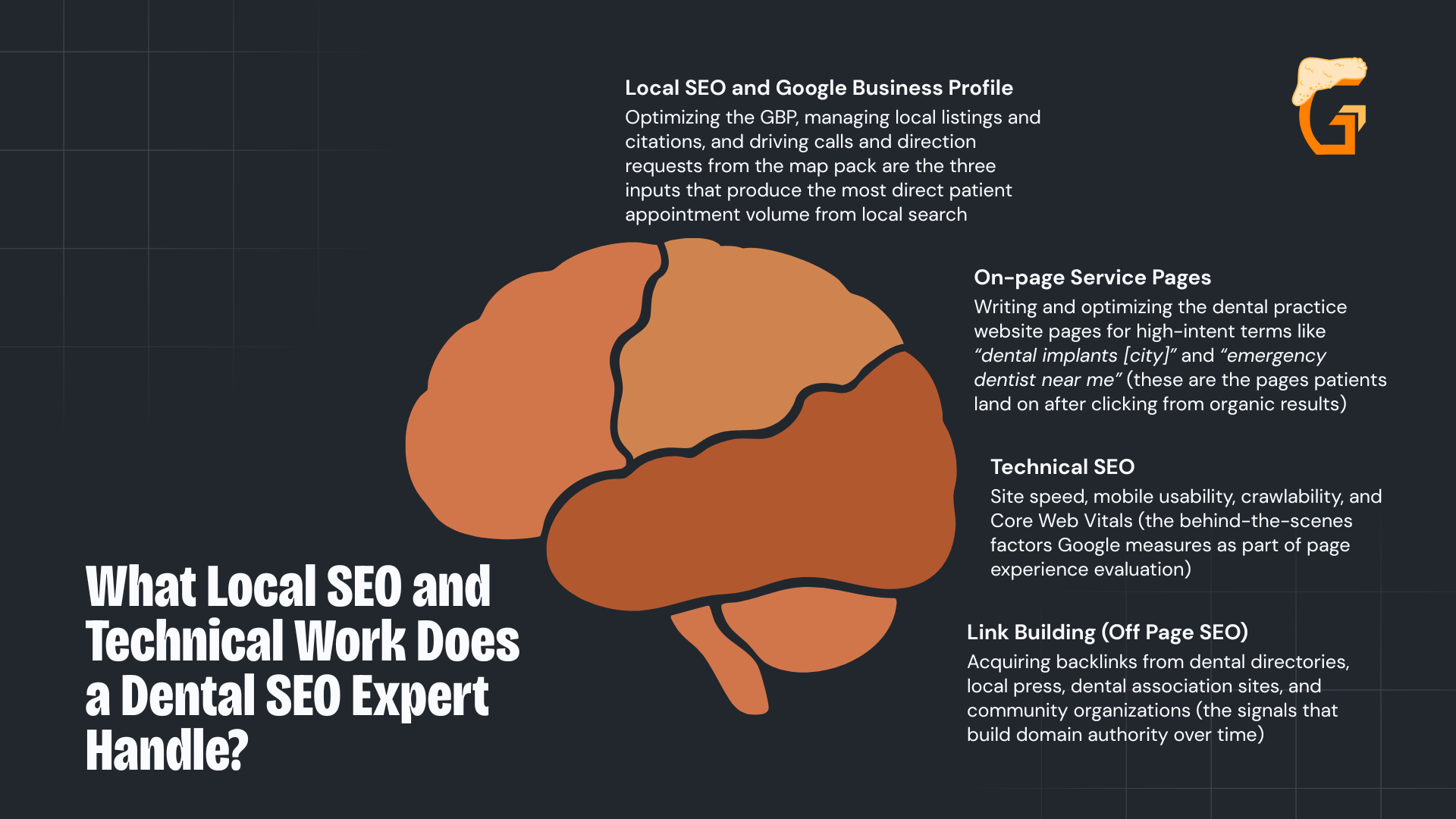
Local search visibility (map pack, GBP, and neighborhood service pages) is the core of what a dental SEO expert delivers:
- Local SEO and Google Business Profile: optimizing the GBP, managing local listings and citations, and driving calls and direction requests from the map pack are the three inputs that produce the most direct patient appointment volume from local search
- On-page service pages: writing and optimizing the dental practice website pages for high-intent terms like “dental implants [city]” and “emergency dentist near me” (these are the pages patients land on after clicking from organic results)
- Technical SEO: site speed, mobile usability, crawlability, and Core Web Vitals (the behind-the-scenes factors Google measures as part of page experience evaluation)
- Link building (off page SEO): acquiring backlinks from dental directories, local press, dental association sites, and community organizations (the signals that build domain authority over time)
Patient bookings (not impressions) are the only metric that matters for a dental practice.
A dental SEO expert structures their work backward from that outcome, not from keyword position tables.
How Does a Dental SEO Expert Track Results and Report on Patient Impact?
Good reporting connects rankings to the things that fill a schedule – calls, form fills, and booked appointments:
- Keyword rankings: tracked for target service and location terms (the leading indicator of future patient volume)
- Google Business Profile actions: calls, direction requests, and website clicks from the GBP listing (the most direct local SEO signal)
- Organic search calls: unique tracked phone numbers on the website attribute inbound organic calls to SEO, separating them from paid ad calls or direct traffic
- Form submissions: organic contact form submissions tracked in Google Analytics, Google Search Console, or equivalent
- Month-over-month trends: all three inputs trended together reveal whether the work is compounding or stalling
If a provider reports only traffic or impressions without connecting to patient inquiries, they are measuring activity – not the booked appointments that define real SEO success.
That’s the single clearest signal to catch during provider interviews.
Dental SEO Expert vs General SEO Agency: Key Differences
A dental SEO specialist brings niche knowledge of patient search behavior, dental service terminology, and local competition that a general provider lacks.
In competitive markets or for high-value procedures like implants and orthodontics, a dental-focused expert typically delivers faster results because they skip the learning curve.
The practical cost of that learning curve – a generalist spends months figuring out which dental keywords patients actually search for and why different query types convert at different rates.
In competitive markets, that time costs ranking ground on the search engine results pages, and that costs booked appointments.
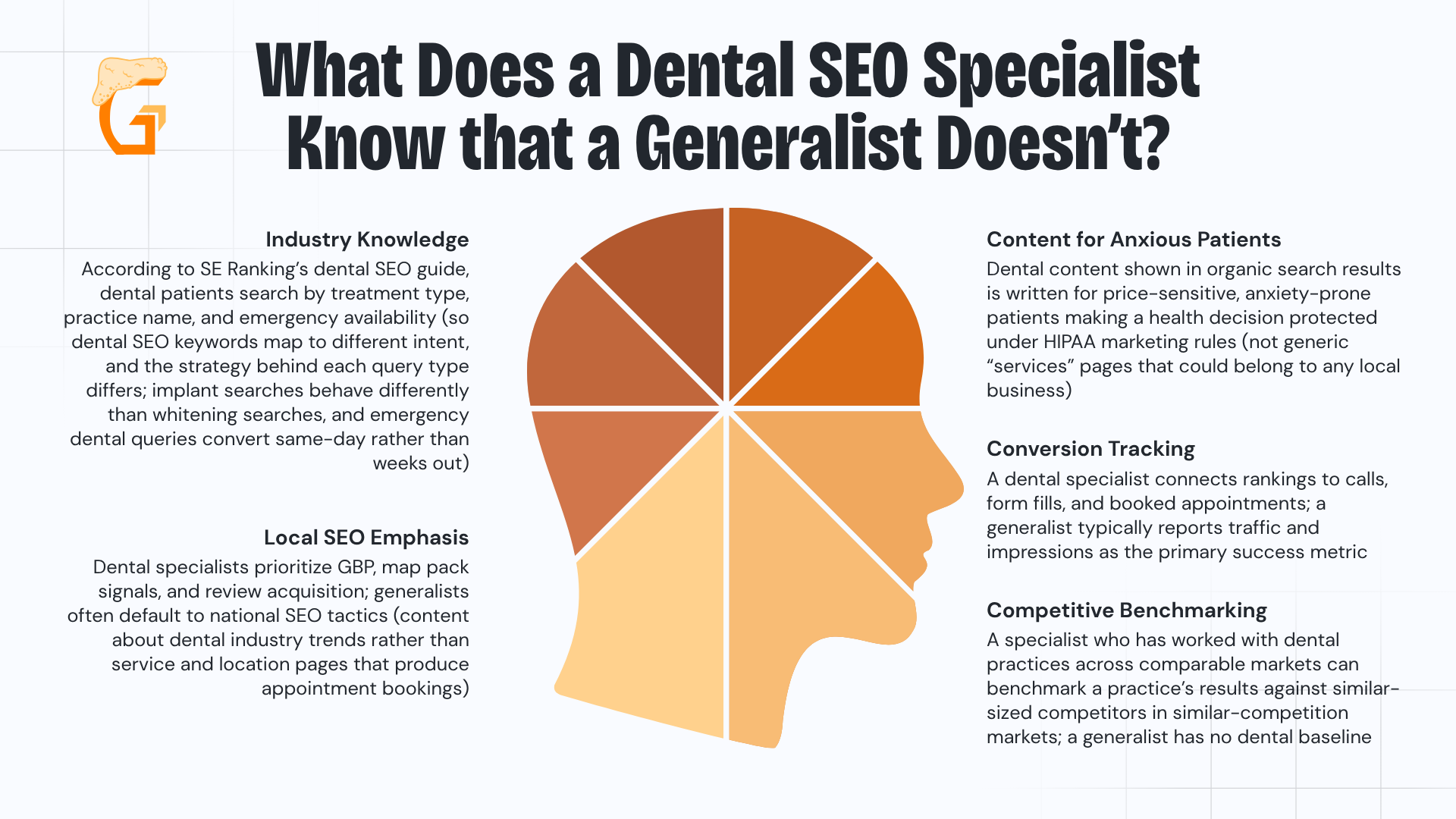
What Does a Dental SEO Specialist Know that a Generalist Doesn’t?
Both a dental specialist and a generalist can run technical SEO and adapt to search engine algorithms.
The difference is what they know about dental patient behavior and how they apply that knowledge:
- Industry knowledge: according to SE Ranking’s dental SEO guide, dental patients search by treatment type, practice name, and emergency availability (so dental SEO keywords map to different intent, and the strategy behind each query type differs; implant searches behave differently than whitening searches, and emergency dental queries convert same-day rather than weeks out)
- Local SEO emphasis: dental specialists prioritize GBP, map pack signals, and review acquisition; generalists often default to national SEO tactics (content about dental industry trends rather than service and location pages that produce appointment bookings)
- Content for anxious patients: dental content shown in organic search results is written for price-sensitive, anxiety-prone patients making a health decision protected under HIPAA marketing rules (not generic “services” pages that could belong to any local business)
- Conversion tracking: a dental specialist connects rankings to calls, form fills, and booked appointments; a generalist typically reports traffic and impressions as the primary success metric
- Competitive benchmarking: a specialist who has worked with dental practices across comparable markets can benchmark a practice’s results against similar-sized competitors in similar-competition markets; a generalist has no dental baseline
In competitive markets or for high-value procedures, that learning period costs ranking ground that a specialist in SEO for dentists captures from month one.
When Is a Generalist SEO Provider an Acceptable Choice for a Dental Practice?
A generalist can be a reasonable choice in specific contexts – the tradeoffs only work in the practice’s favor under certain conditions:
- Low-competition rural markets: foundational SEO fundamentals (GBP optimization, citations, basic on-page) produce results without niche optimization when there are few competitors actively running SEO
- Strong local service business track record: a generalist with a history of producing results for healthcare practices, legal practices, or home service businesses has transferable knowledge and can learn dental context faster than a true generalist
- Technical-only scope: if the primary need is technical optimization like a site migration or citation cleanup (not content strategy or local search growth) specialist knowledge matters less
In competitive markets, for high-value procedures (implants, Invisalign, cosmetic dentistry), or for multi-location practices, the dental-specific expertise gap becomes the margin between meaningful ROI and years of mediocre results.
Growth Saloon brings dental-specific expertise that turns search visibility into qualified new patient inquiries – not just clicks.
Contact our team today to find out how our dental marketing services can lower your cost per new patient and grow your practice.
Questions to Ask Before Hiring a Dental SEO Expert
Before buying dental SEO services, ask for dental-specific case studies with actual outcome data, ask what the first 90 days look like, ask how they measure success beyond rankings, and confirm who owns the website and content if you leave.
Vague answers to any of these are a warning sign.
The interview process separates providers with a real, repeatable process from those who improvise after signing.
Six questions surface the difference reliably.
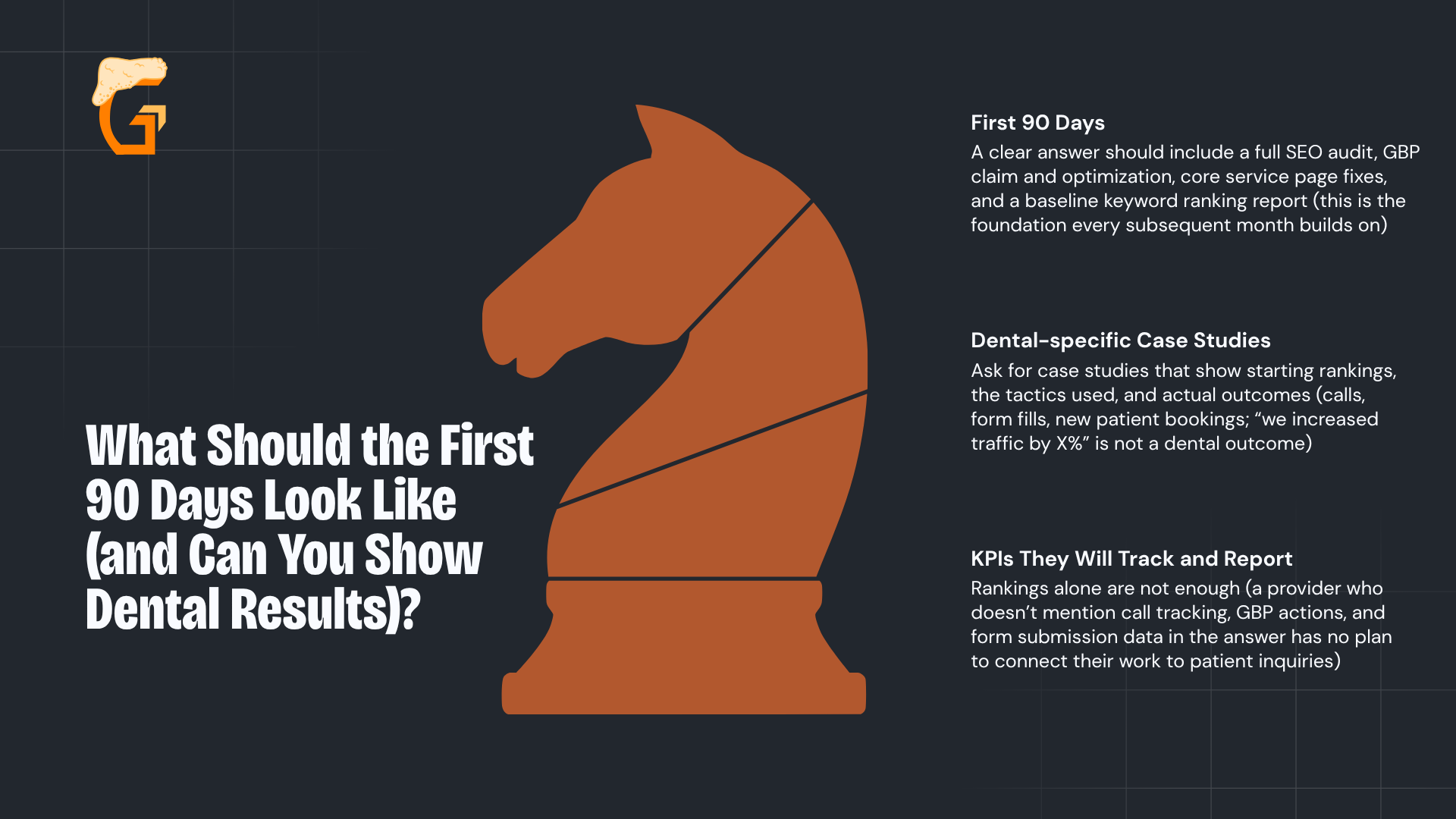
What Should the First 90 Days Look Like (and Can You Show Dental Results)?
The first-90-days question is the most revealing question to ask any dental SEO company during an interview.
A provider with a structured process answers it immediately:
- First 90 days: a clear answer should include a full SEO audit, GBP claim and optimization, core service page fixes, and a baseline keyword ranking report (this is the foundation every subsequent month builds on)
- Dental-specific case studies: ask for case studies that show starting rankings, the tactics used, and actual outcomes (calls, form fills, new patient bookings; “we increased traffic by X%” is not a dental outcome)
- KPIs they will track and report: rankings alone are not enough (a provider who doesn’t mention call tracking, GBP actions, and form submission data in the answer has no plan to connect their work to patient inquiries)
A provider who can’t show dental-specific case studies with actual outcome data hasn’t produced meaningful dental SEO results.
Logos and “we work with dental practices” language used by other dental SEO companies, without outcome data, signal the same gap.
Who Owns the Website, Content, and Accounts (and Do You Guarantee Rankings)?
Ownership is the dealbreaker question.
Vague or evasive answers should end the conversation:
- Ownership: who owns the domain, dental website files, content, GBP admin access, and analytics accounts when the contract ends? (this must be answered in writing before signing)
- Reporting frequency and format: ask for a sample report; it should show call tracking data, GBP actions, and form submissions (not just a keyword position table)
- Rankings guarantee: any provider who answers “yes” to this question is a red flag (as Moz documents, no ethical SEO provider can guarantee search rankings because Google’s algorithm is not controlled by the provider) and the FTC requires that advertising claims be truthful, non-deceptive, and backed by evidence, which a ranking guarantee can’t meet
A practice that signs a contract without confirming ownership terms in writing risks losing their website, domain, and content history if they ever decide to leave.
Starting from zero after switching providers is an expensive mistake that confirmation in writing prevents.
Growth Saloon gives dental practices transparent ownership and reporting tied to qualified new patient inquiries – not just rankings.
Contact our team today to find out how our dental marketing services can lower your cost per new patient and grow your practice.
How’s your SEO going?
Enter your website URL below to get a free comprehensive SEO audit.
The audit includes:
- A scan of your entire website for technical issues
- A list of your top opportunities to target immediately
- Your highest priority fixes to make
Red Flags When Hiring Dental SEO Help
The top red flags when hiring dental SEO help are – guaranteed rankings, ownership traps (they control your website or GBP), extremely low pricing with long contracts, no dental-specific examples, and reports that show traffic but never connect to actual patient inquiries.
These are not minor concerns – they’re the patterns that produce the most expensive outcomes.
Ownership traps cost websites.
Guarantee promises signal either dishonesty or tactics that risk a Google penalty.
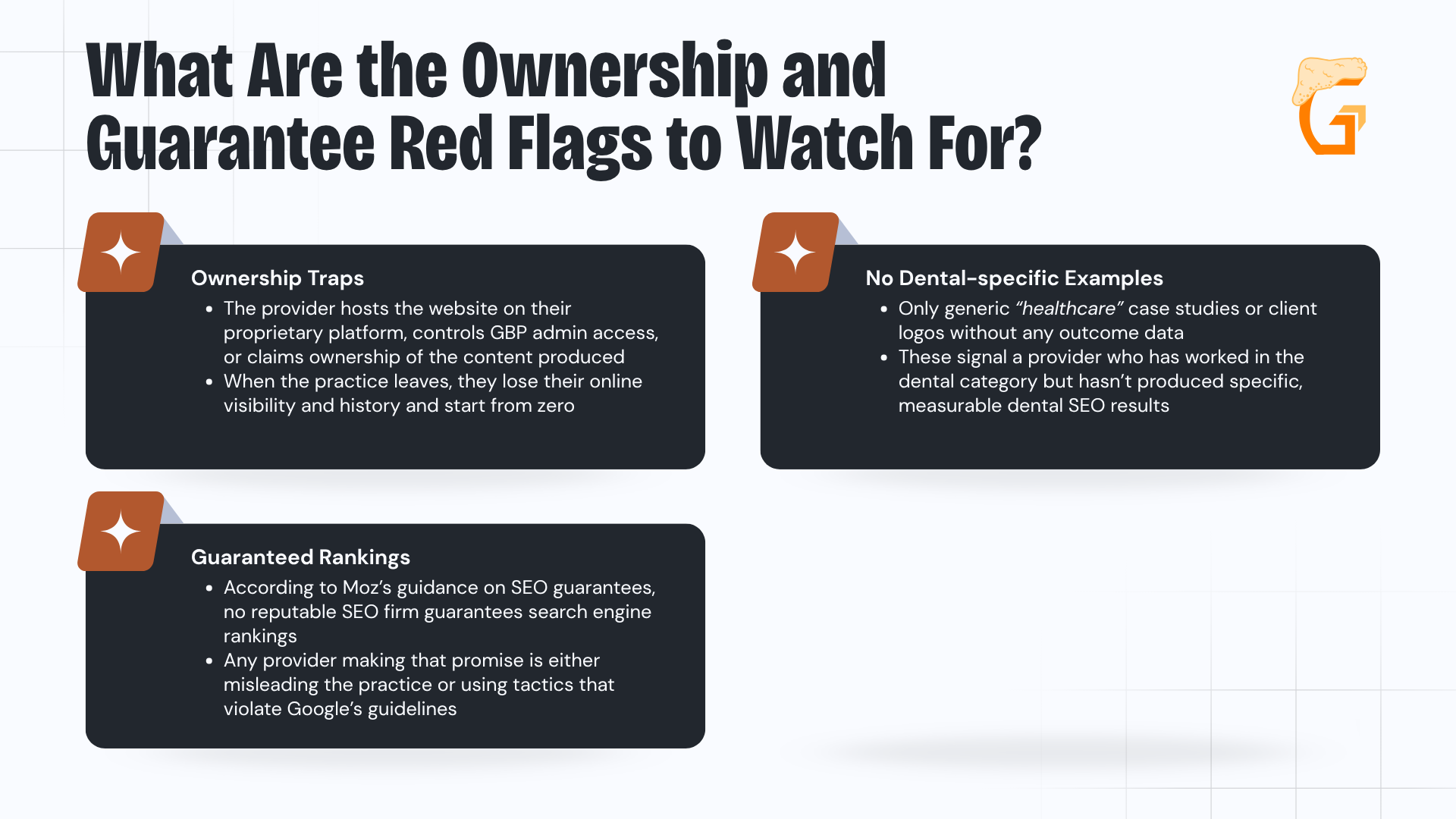
What Are the Ownership and Guarantee Red Flags to Watch For?
The ownership trap is the most expensive mistake in dental SEO contracting:
- Ownership traps: the provider hosts the website on their proprietary platform, controls GBP admin access, or claims ownership of the content produced (when the practice leaves, they lose their online visibility and history and start from zero)
- Guaranteed rankings or ’20 new patients in 30 days’: according to Moz’s guidance on SEO guarantees, no reputable SEO firm guarantees search engine rankings (any provider making that promise is either misleading the practice or using tactics that violate Google’s guidelines)
- No dental-specific examples: only generic “healthcare” case studies or client logos without any outcome data (these signal a provider who has worked in the dental category but hasn’t produced specific, measurable dental SEO results)
These are the patterns that lead to the most costly provider mistakes.
An ownership trap means starting from zero when switching.
A ranking guarantee signals either dishonesty or black-hat tactics that carry algorithm penalty risk.
What Pricing and Reporting Patterns Should Raise Concerns?
The $99–$299/month pricing trap with 12-month commitments is a structural red flag – the math cannot support real work:
- Very low pricing with long contracts: monthly SEO services priced at $99–$299 with a 12-month commitment cannot financially cover real content creation, link building, and active optimization simultaneously (the business model relies on automated tools and templated work, not the active management that produces new patients)
- Reports showing web traffic and impressions only: no call data, no form submissions, no booked appointment attribution (measuring activity rather than outcomes)
- Full upfront payment required for a multi-month engagement: legitimate providers bill monthly; upfront payment requirements for extended engagements are a contract structure to avoid
Low-price, long-contract packages almost always deliver automated or minimal real work.
In a real dental SEO campaign, the combination of cheap pricing and commitment lock-in is designed to collect fees, not produce booked appointments.
Growth Saloon does the real content, link, and optimization work that produces qualified new patient inquiries – not the templated work behind cheap lock-in contracts.
Contact our team today to find out how our dental marketing services can lower your cost per new patient and grow your practice.
What Dental SEO Costs and What Results to Expect
Dental SEO retainers typically run $1,500–$5,000 per month depending on market competitiveness and scope.
Expect early signs of movement at 3–6 months and meaningful ROI at 6–12 months.
This is why SEO takes time: any provider promising significant results in 30–60 days is overpromising.
Cheap plus fast is almost always a sign of corners being cut.
The real cost of dental SEO efforts is the time and expertise required to produce compounding patient growth – and that investment takes months to compound.
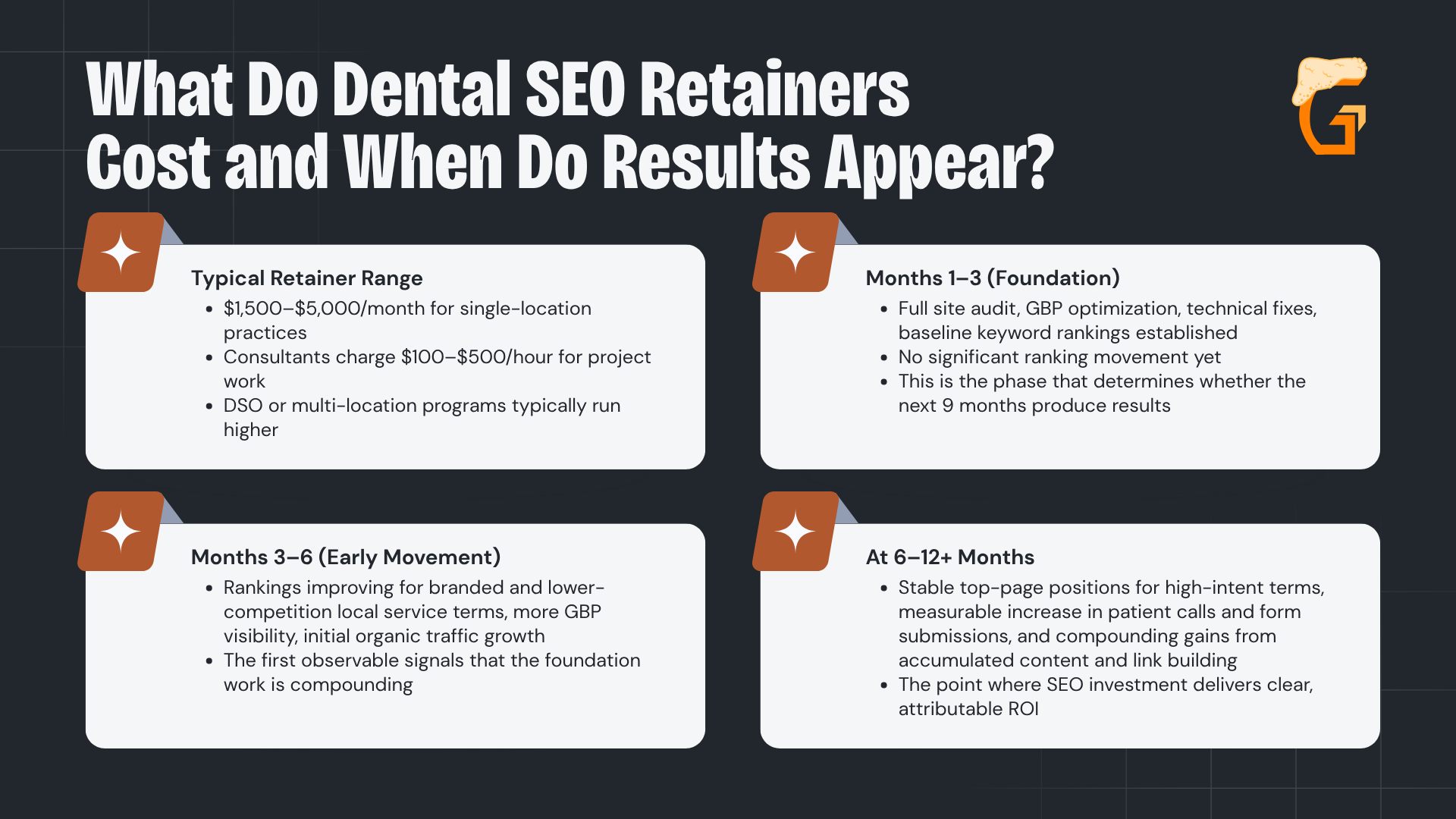
What Do Dental SEO Retainers Cost and When Do Results Appear?
According to Ahrefs’ 2025 SEO pricing benchmarks, retainers for small-to-mid-size local businesses average $1,500–$5,000/month – dental SEO falls within this range with variation based on market competitiveness and scope:
- Typical retainer range: $1,500–$5,000/month for single-location practices; consultants charge $100–$500/hour for project work; DSO or multi-location programs typically run higher
- Months 1–3 (foundation): full site audit, GBP optimization, technical fixes, baseline keyword rankings established (no significant ranking movement yet; this is the phase that determines whether the next 9 months produce results)
- Months 3–6 (early movement): rankings improving for branded and lower-competition local service terms, more GBP visibility, initial organic traffic growth (the first observable signals that the foundation work is compounding)
- At 6–12+ months: stable top-page positions for high-intent terms, measurable increase in patient calls and form submissions, and compounding gains from accumulated content and link building (the point where SEO investment delivers clear, attributable ROI)
How Does Dental SEO ROI Compare to Google Ads over Time?
An SEO service costs more upfront in time but produces a lower cost per new patient once established.
Google Ads produce immediate visibility but stop entirely when the budget stops:
- SEO vs Google Ads: SEO requires 6–12 months to deliver meaningful ROI but typically produces a lower cost per new patient long-term (content that ranks continues earning organic patient bookings long after it’s published; a paused Google Ads campaign produces zero new patients the next day)
- What to measure: organic phone calls, form fills, and appointment bookings from organic search and Google’s Search Generative Experience (not keyword positions alone)
- Months 6–12+: this is where the compounding nature of SEO shows up (content published in month 3 is now ranking and earning calls while new content continues building authority on top of it)
Both SEO and Google Ads have a place in a dental online marketing mix.
At 12+ months, SEO is consistently the higher-ROI acquisition channel in a dental SEO marketing strategy that invests consistently in content, links, and technical maintenance – because the asset continues producing patients after the investment is recovered.
Growth Saloon helps dental practices build the kind of digital presence that consistently generates qualified new patient inquiries – not just clicks.
Contact our team today to find out how our dental marketing services can lower your cost per new patient and grow your practice.
How Can Growth Saloon Help Your Dental Practice Grow?
Growth Saloon is a Chicago-based digital marketing agency built to help dental practices attract more patients and grow their practice through performance-driven digital marketing.
Mike Lowe and the Growth Saloon team specialize in SEO, web design, conversion rate optimization, and marketing attribution for practices ranging from general dentists to pediatric dentists – working alongside your practice to build a measurable digital presence that generates qualified patient inquiries, not just website traffic.
From ranking in Google search results for high-intent local terms to converting site visitors into booked appointments, Growth Saloon focuses on results at every stage of the patient acquisition funnel.
Practice owners and marketing managers get clear visibility into exactly which channels are driving new patient growth.
We know that every open appointment slot has a real cost.
Every decision behind our SEO solutions is built around one outcome – helping your practice fill more of them.
Meet the Founder of Growth Saloon
Meet the founder and lead strategist at Growth Saloon – Mike Lowe:
- As founder and CEO of Growth Saloon, Mike brings years of hands-on experience in SEO strategy, CRO, web design, and marketing attribution for service-based businesses competing in local and regional markets.
- Based in Chicago and working with practices across the country as a dentist SEO company, Mike has built and managed digital growth campaigns for businesses competing in some of the most contested search markets in the country.
- Growth Saloon’s data-driven approach to local SEO and patient acquisition helps dental practices turn their websites into their highest-performing new patient channel.
What Does Working With Growth Saloon Look Like?
Growth Saloon operates as a dedicated extension of your marketing team – not a vendor that disappears after onboarding.
Every engagement includes direct access to Mike and the team, transparent reporting tied to actual patient acquisition outcomes, reputation management, and strategies tailored to your specific services and local market.
Whether you’re looking to rank for high-value procedures, improve your site’s appointment conversion rate, or finally get clarity on where your new patients are actually coming from, Growth Saloon builds the strategy and does the work.
Growth Saloon helps dental practices build the kind of digital presence that consistently generates qualified new patient inquiries – not just clicks.
Contact our team today to find out how our dental marketing services can lower your cost per new patient and grow your practice.
How's your SEO going?
Get your free comprehensive SEO audit.
Enter your website URL below to get a free comprehensive SEO audit.
- Scan entire website for technical issues
- Get a list of your top opportunities
- See your highest priority fixes to make
-
A dental SEO expert understands how patients search for dental services – the difference between implant intent and whitening intent, why emergency dental searches behave differently than routine cleaning searches (the CDC reports that 65.5% of U.S. adults had a dental exam or cleaning in the past year), and how local competition affects ranking difficulty for each service.
A general digital marketing provider can run the same technical playbook, but lacks the niche knowledge to prioritize the right keywords, write content that converts anxious dental patients, manage online reviews, or benchmark results against similar dental markets.
-
Expect visible ranking movement at three to six months and meaningful patient impact (more calls and bookings) at six to twelve months.
The first ninety days are foundation work – auditing the site, optimizing the Google Business Profile, fixing technical issues, and establishing baseline rankings.
Providers promising significant results in thirty days are working with inflated metrics, not the patient inquiries and online reputation that compound over time.
-
Good dental SEO reporting tracks four things – keyword rankings for target service and location terms, Google Business Profile actions (calls, direction requests, website clicks, positive reviews), organic search calls and form submissions (via call tracking and Google Analytics), and month-over-month trends on all three.
Reports showing only traffic or impressions without connecting to patient inquiries tell you very little about whether SEO is actually working for your practice.
-
A freelance consultant typically costs less and offers direct access to the person doing the work, but has limited bandwidth and may lack capacity for technical work, content production, and link building simultaneously.
A provider with a team includes writers, technical SEO, social media, and account management – but introduces more hands between the practice and the work.
For most single-location practices, a dedicated freelance specialist or a small provider focused on dentistry tends to outperform large generalist programs on cost-to-outcome ratio.
-
If your provider built your website on their platform, you may lose the site when you leave.
If they produced content using a license they hold, you may lose that too.
Before signing any contract, confirm in writing that you own the domain, website files, content, Google Business Profile admin access, and all analytics accounts.
Providers who won’t commit to this in writing are signaling an ownership trap.
-
Yes, and this is where dental-specific expertise makes the biggest difference.
Implant and Invisalign searches involve high patient intent and high procedure value, but also high competition.
A dental SEO expert knows the right keyword cluster (implants vs dentures vs all-on-4), understands that these patients research extensively before calling, and can build a content strategy that captures patients at multiple stages of the decision (from “how much do implants cost” to “dental implants [city]”) – converting researchers into booked consultations.
Most agencies sell traffic. We sell actual growth. That’s the Growth Saloon difference.
Are you looking to grow?
Recent blogs
Enter your website URL below to get free comprehensive SEO audit.
- Scan entire website for technical issues
- Get a list of your top opportunities
- See your highest priority fixes to make