


Updated:August 10th, 2026

Google Business Profile for Dentists [2026 Guide]

Written by

Mike Lowe

Reviewed by

Taylor Coteus

How Does a Google Business Profile for Dentists Bring in New Patients?

A Google Business Profile for dentists is the single highest-leverage local SEO asset a practice has – yet most profiles sit half-finished (collecting impressions without converting a single new patient appointment).

Most dental practices have a listing. Very few have one that’s actually doing its job.

The gap matters because patients searching for a dentist right now aren’t browsing casually.

They have a toothache, a cracked crown, or a child overdue for a cleaning – and they’re ready to schedule appointments.

The practice that shows up first in Maps, looks complete and credible, earns more positive reviews, and makes the next step obvious gets that appointment.

Everyone else doesn’t.

Google Business Profile for Dentists

An optimized GBP is what puts a practice in that first position and keeps it there.

This guide covers the full GBP lifecycle for 2026:

  • What the profile is and what’s changed this year;
  • How to claim and verify a listing;
  • How to optimize it for local rankings;
  • How to manage reviews and enable direct booking; and
  • How to recover from a suspension.

If you’d like a head start, request a free SEO audit from our team at Growth Saloon – we’ll show you exactly where your practice stands and what it would take to close the gap.

Contact our team today to find out how our GBP optimization services can lower your cost per new patient and grow your practice.

What Is a Google Business Profile for Dentists?

A Google Business Profile for dentists is the completely free Google listing (rebranded from Google My Business) that controls how a dental practice appears in Maps, the local pack, and near-me searches.

It’s the single highest-leverage local SEO asset a dental practice has, and if you’ve seen older guides referencing “Google My Business,” they’re describing the same product under its pre-2021 name.

What does a Google Business Profile do for a dental practice?

GBP is Google’s free tool for managing a practice’s presence across Search and Maps.

It replaced Google My Business in 2021 – the rebrand is why both terms still appear in older tutorials and forum threads.

Functionally, GBP supports a dental practice’s online visibility the way Healthgrades and other directories do (maintain a consistent NAP citation), but with disproportionate ranking weight.

A complete, actively managed GBP carries more local SEO impact than all other directory listings combined (it can be an extremely powerful marketing tool when used properly).

What’s new in Google Business Profile for 2026?

Three shifts define the 2026 GBP landscape for dental practices.

Video verification is now Google’s default method – practices must submit footage of exterior signage and the interior before a new listing goes live.

AI-generated Q&A is rolling out across profiles, which means practices need to monitor the Q&A section weekly for inaccurate auto-generated answers.

Google also expanded attributes, including the “Accepting new patients” filter tag, which gates whether the practice appears in filtered near-me searches.

GBP itself remains completely free; Reserve with Google booking integration may carry software-side costs depending on the scheduling platform used.

Growth Saloon helps dental practices build Google Business Profiles that consistently generate qualified new patient inquiries – not just impressions.

Contact our team today to find out how our GBP optimization services for dentists can improve your local visibility and grow your practice.
How Do You Claim and Verify a Dental Google Business Profile?

Set up a dental GBP by creating or claiming the listing at business.google.com, then completing video verification (Google’s 2026 default) with footage of exterior signage and treatment rooms.

This is the gating action: nothing else in this guide matters until verification clears.

Edits to business hours and other listing details won’t save, and the practice won’t appear in Maps until Google confirms the listing is legitimate.

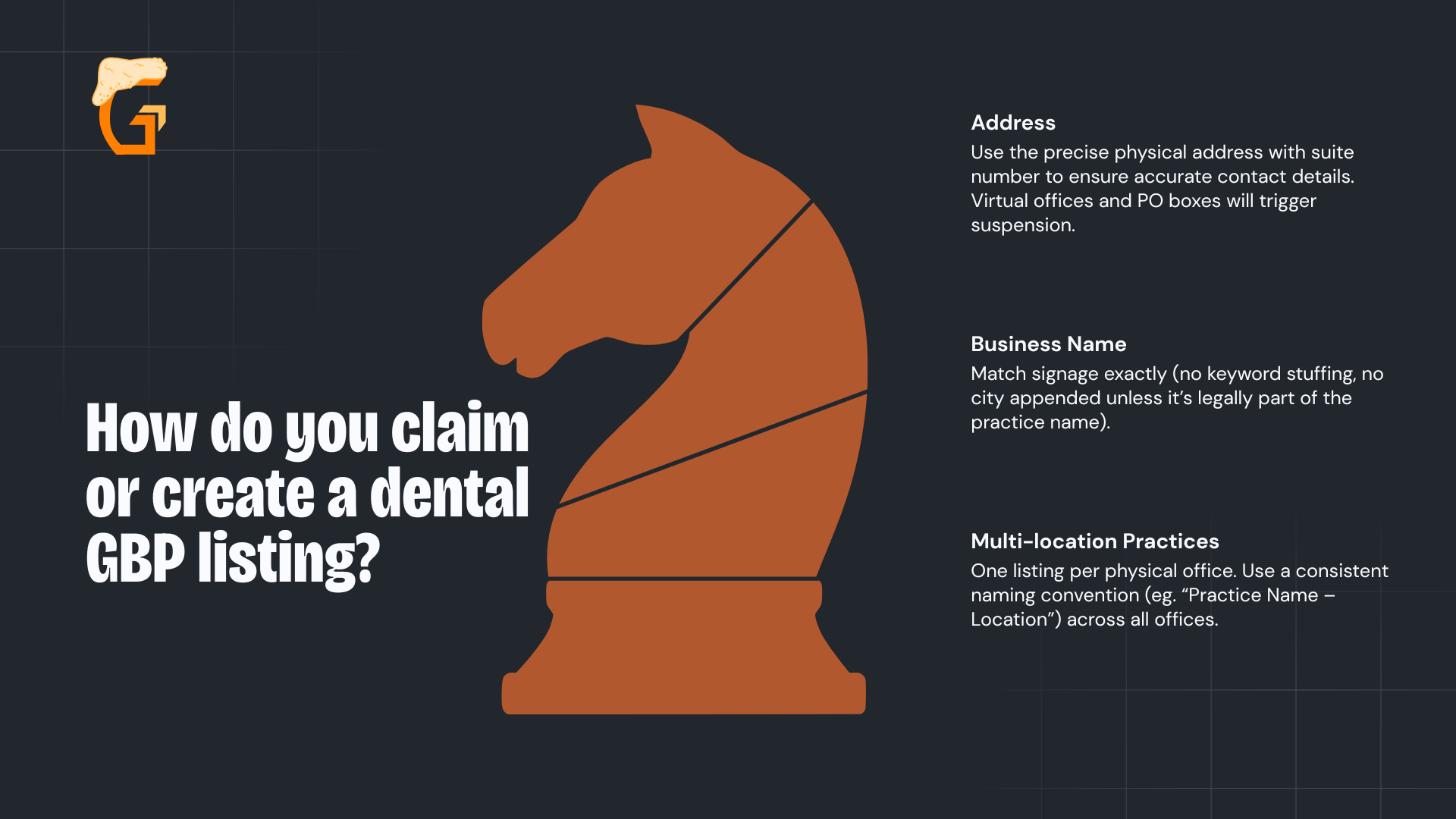
How do you claim or create a dental GBP listing?

How do you claim or create a dental GBP listing

Start at business.google.com or search the practice name in Google while logged into a Google account.

If the profile already exists, claim it under the Google account being used as the practice’s business account; if not, select “Add Business” → “Add single business.”

Because verification hinges on accurate business data, these setup details matter from day one:

  • Address: Use the precise physical address with suite number to ensure accurate contact details. Virtual offices and PO boxes will trigger suspension.
  • Business name: Match signage exactly – no keyword stuffing, no city appended unless it’s legally part of the practice name.
  • Multi-location practices: One listing per physical office. Use a consistent naming convention (“Practice Name – Location”) across all offices.

Multi-location groups should set up a Google Business Profile manager account to handle all locations from one dashboard rather than managing separate logins per office.

How does video verification work in 2026?

Video verification is Google’s default method for new dental listings in 2026.

The submission is a short live or recorded video that must capture exterior signage, the reception area where dental patients are received, at least one treatment room, and mail addressed to the practice (confirming the business operates at the claimed location).

A postcard fallback (which delivers a verification code by mail) remains available for some brick-and-mortar categories, but it’s being phased out.

Phone and email verification are reserved for pre-qualified categories.

No edits save and no Maps visibility happens until verification clears – complete this step before touching anything else.

Growth Saloon has helped dozens of dental practices clear GBP verification on the first attempt and get their listings live faster.

Contact our team today to learn how our Google Business Profile setup services can get your practice appearing in Maps and local search results.

How Do You Optimize Your Dental GBP for Rankings?

Optimize a dental GBP by setting “Dentist” as the primary category, stacking up to nine specialty secondaries, completing services and products, and uploading 10–15 high-quality photos.

According to Google’s local ranking guidance, local results are based primarily on relevance, distance, and prominence (and profile completeness is the lever practices have the most direct control over).

Which business categories should a dentist choose?

“Dentist” is the correct primary category for general practices – not “Dental clinic,” which loses ranking weight because patients rarely search that term.

Add secondary categories (such as family dentistry) that reflect services the practice genuinely offers in-house:

  • Cosmetic Dentist
  • Emergency Dental Service
  • Pediatric Dentist
  • Orthodontist
  • Oral Surgeon
  • Teeth Whitening Service

Google allows up to nine secondary categories per profile.

Adding specialties the practice doesn’t offer is a guideline violation and a suspension risk – only list what’s real.

On call tracking: if the practice uses a tracking number for marketing attribution, set it as the primary GBP phone number and add the real local number as an “Additional Number.”

This preserves NAP consistency across directories while keeping call data intact.

What should go in your business description, services, and products?

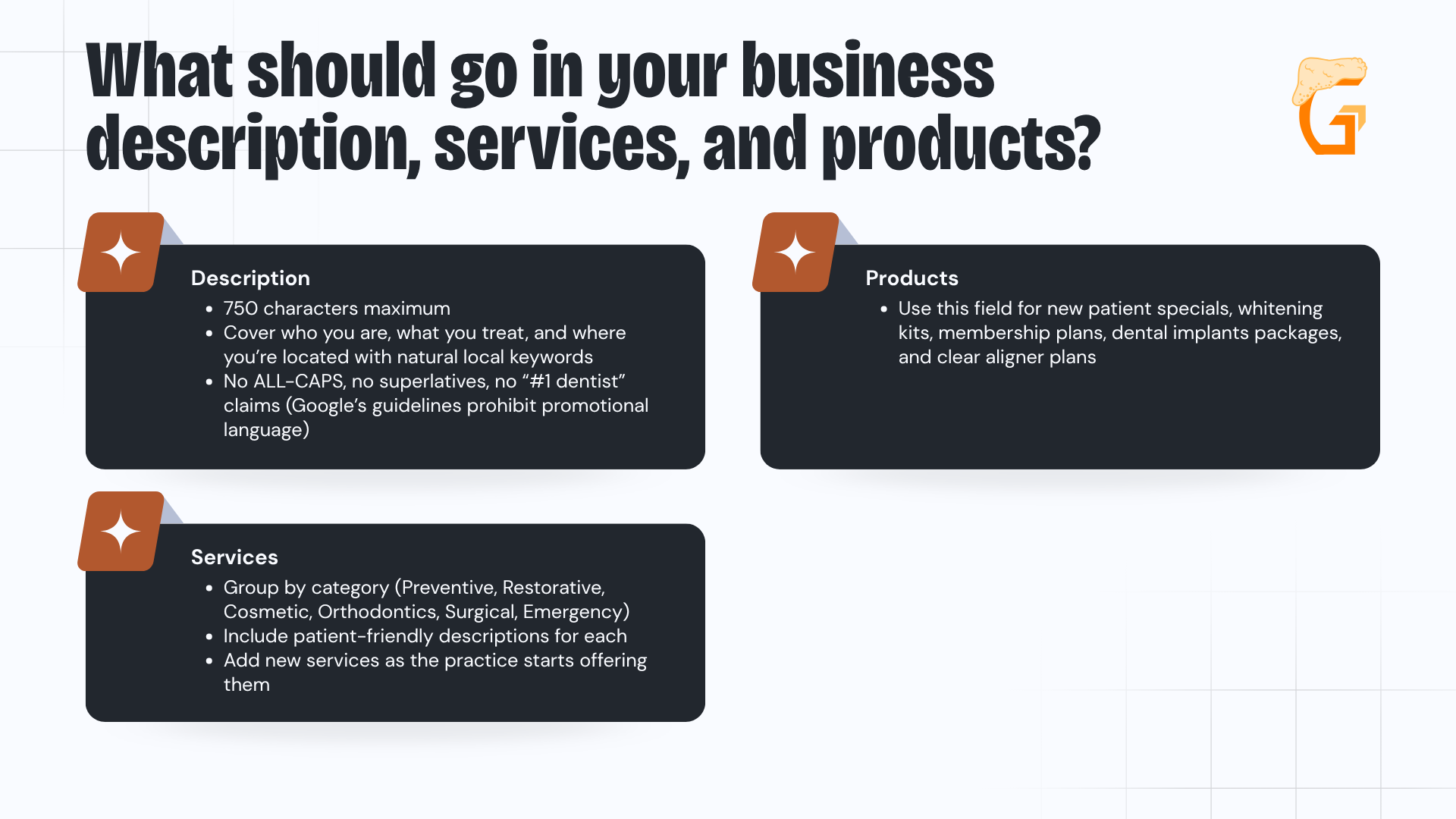
What should go in your business description, services, and products

The description, services, and products fields are the three text inputs that tell Google (and prospective patients reaching the listing through relevant search results) what the practice offers.

Each field serves a distinct purpose in your profile:

  • Description: 750 characters maximum. Cover who you are, what you treat, and where you’re located with natural local keywords. No ALL-CAPS, no superlatives, no “#1 dentist” claims (Google’s guidelines prohibit promotional language).
  • Services: Group by category (Preventive, Restorative, Cosmetic, Orthodontics, Surgical, Emergency) with patient-friendly descriptions for each, and add new services as the practice starts offering them.
  • Products: Use this field for new patient specials, whitening kits, membership plans, dental implants packages, and clear aligner plans.

Avoid ALL-CAPS, superlatives, and “#1” claims throughout – they violate GBP content guidelines, shape how potential patients perceive the practice, and can trigger a profile suspension.

How many photos and attributes does a dental GBP need?

Photos and attributes are the two completeness factors most practices underuse, and both directly affect filter eligibility and ranking.

Two completeness factors (photos and attributes) directly affect filter eligibility and ranking:

  • Photos: Upload 10–15 high quality images at launch covering exterior, signage, reception, treatment rooms, the team, before/after (with patient consent), and any notable technology. Refresh the photo set quarterly.
  • Attributes: Enable every applicable attribute (wheelchair access, online appointments, identity tags). The single most important: “Accepting new patients.” Missing this attribute filters the practice out of every search where a patient adds that filter.

Treat the GBP as a living profile.

A quarterly review of photos, hours, attributes, and services takes under an hour and directly compounds the profile’s prominence signal over time.

Growth Saloon runs full-profile audits that pinpoint exactly which categories, photos, and attributes are costing your practice local visibility.

Contact our team today to request a dental Google Business Profile audit and start turning your listing into a patient acquisition channel.

How’s your SEO going?

Enter your website URL below to get a free comprehensive SEO audit.

The audit includes:

How Should Dentists Manage Reviews and Bookings on GBP?

Drive ongoing GBP value with Reserve with Google for direct booking, honest review requests from every satisfied patient, and HIPAA-safe responses within 48 hours to every review.

Reviews, Q&A, Posts, and booking integration are the patient engagement layer – and they’re the signals Google uses to separate actively managed profiles from dormant ones.

How do you ask for and respond to dental Google reviews?

Google’s review policies prohibit incentivizing patients to leave reviews, review gating, and fake reviews from staff or family.

Encourage patients to provide honest patient feedback (not “a 5-star review”) via QR codes at checkout and post-visit text or email.

Both channels together produce steady review velocity without policy risk.

On responses: every review gets a reply within 24–48 hours, positive or negative.

The HIPAA rule applies to negative reviews and positive ones alike and is non-negotiable – never confirm that the reviewer is a patient, never reference treatment dates, procedures, or billing details in a response.

A safe response to positive feedback acknowledges it and invites continued care; a safe negative response (one that protects your online reputation) thanks the reviewer, keeps it general, and moves the conversation offline.

How often should a dentist post and manage Q&A?

To engage patients, Google Posts should be published 2-4 times per month (mixing in Offers, What’s New, and Events – each with an image and a CTA).

Consistent posting signals an actively managed profile and surfaces promotions and oral health tips directly in search results.

For Q&A, seed the section with the five or six questions patients actually ask at the front desk, monitor weekly, and correct any inaccurate answers posted by users.

With AI-generated Q&A rolling out in 2026, that weekly check matters more than it used to – automated answers can be wrong.

On review velocity – target a steady 10–20 new reviews per month rather than sporadic bursts, which Google’s system can flag as suspicious.

How do you enable Reserve with Google for a dental practice?

Reserve with Google surfaces a “Book Online” button directly on the practice’s search result (a zero-click booking path that doesn’t require the patient to visit the website).

The integration runs through the practice’s scheduling platform, not through Google directly.

Dentrix and Dentrix Ascend are confirmed Reserve with Google partners; Carestream Dental supports online booking but verify current Reserve with Google partner status before launch.

The scheduling platform handles the technical bridge and keeps availability up to date – enabling it is a settings toggle once the platform integration is active.

Treat reviews, posts, Q&A, and booking as a weekly cadence, not a one-time setup.

Growth Saloon handles ongoing GBP management (reviews, posts, Q&A, and booking integration) so your front desk can focus on patient care.

Contact our team today to find out how our GBP management services for dental practices can keep your profile active and generating new patient inquiries.

How Do You Rank in Google Maps and Recover from a Suspension?

Rank in Google Maps by treating GBP as the single most important local search visibility signal, and recover from suspension by fixing the underlying violation before submitting the official reinstatement form.

These are the two sides of dental practice success in local search rankings – building visibility and protecting it.

Which signals drive dental GBP rankings?

Google’s local ranking framework runs on three factors – relevance, distance, and prominence.

A practice can’t move its address, but it controls how patients find it through relevance (category alignment, services, keywords) and prominence (profile completeness, review velocity, post cadence, photo freshness).

Every response to patient reviews, every new post, every quarterly photo refresh contributes to the prominence signal.

For rank tracking, heatmap tools like BrightLocal or Whitespark surface ZIP-level gaps that a single Google search won’t reveal (a practice can rank in the top three one mile from the office and fall off the map two miles out).

What do you do if Google suspends your dental GBP?

The most common suspension causes for dental practices – keyword-stuffed business name, virtual office address, duplicate listings, fake reviews, or wrong primary category.

Fix the violation before filing anything.

Prepare documentation (exterior photos, a utility bill, a dental license, and a screenshot confirming the website NAP matches the GBP exactly) then submit the reinstatement appeal once through Google’s official form.

Don’t create a duplicate profile while waiting, don’t change the business name or address mid-review, and don’t submit multiple appeals.

Practices dealing with repeated suspensions or a listing stuck below the local pack despite clean compliance can request a free GBP audit from Growth Saloon.

Growth Saloon builds the local SEO strategy that improves visibility, gets dental practices into the 3-pack, and keeps them there – whether you’re recovering from a suspension or starting from scratch.

Contact our team today to schedule a free Google Business Profile audit for dentists and see exactly what’s holding your practice back in local search.

How Can Growth Saloon Help Your Dental Practice Grow?

Growth Saloon is a Chicago-based digital marketing agency built to help dental practices attract more patients and grow their practice through performance-driven digital marketing.

Mike Lowe and the Growth Saloon team specialize in SEO, web design, conversion rate optimization, and marketing attribution – working alongside your practice to build a measurable digital presence that helps encourage satisfied patients to leave reviews and generates qualified patient inquiries, not just website traffic.

From ranking for high-intent local search terms to converting site visitors into booked appointments, Growth Saloon focuses on results at every stage of the patient acquisition funnel. Practice owners and marketing managers get clear visibility into exactly which channels are driving new patient growth.

We know that every open dental care appointment slot has a real cost. Every decision we make is built around one outcome – helping your practice fill more of them.

Meet the Founder of Growth Saloon

Meet the founder and lead strategist at Growth Saloon – Mike Lowe:

  • As founder and CEO of Growth Saloon, Mike brings years of hands-on experience in SEO strategy, CRO, web design, and marketing attribution for service-based businesses competing in local and regional markets.
  • Based in Chicago and working with practices across the country, Mike has built and managed digital growth campaigns for businesses competing in some of the most contested search markets in the country.
  • Growth Saloon’s data-driven approach to local SEO and patient acquisition helps dental practices turn their websites into their highest-performing new patient channel.

What Does Working With Growth Saloon Look Like?

Growth Saloon operates as a dedicated extension of your dental marketing efforts – not a vendor that disappears after onboarding.

Every engagement includes direct access to Mike and the team, transparent reporting tied to actual patient acquisition outcomes, and strategies tailored to your specific services and local market.

Whether you’re looking to rank for high-value procedures like cosmetic dentistry, improve your site’s appointment conversion rate, or finally get clarity on where your new patients are actually coming from, Growth Saloon builds the strategy and does the work.

Growth Saloon helps dental practices build the kind of digital presence that consistently generates qualified new patient inquiries – not just clicks.

Contact our team today to find out how our dental marketing services can lower your cost per new patient and grow your practice.

FAQ
Author

Who is Mike Lowe?

Mike Lowe is a digital marketing strategist and the founder of Growth Saloon, where he specializes in helping businesses cut through the noise with high-converting email strategies and SEO.

With a focus on “organic storytelling,” Mike combines over a decade of agency experience with a passion for helping brands build genuine trust with their audience.

When he’s not optimizing subject lines or scaling SaaS companies, he’s likely sharing insights on how to transform cluttered inboxes into meaningful connection points for online marketers.

Related content
Resources for Dentists

Every resource we’ve published for Dentists, in one place:

Ready to turn your website traffic into real growth?

You’ve read the strategy now let Growth Saloon help you put it into action.

Get a free SEO audit and see what’s holding your website back from ranking, converting, and growing. 

Let's Chat

Let’s discuss your online marketing goals! We’re quick to respond, so we’ll be in touch shortly to set up a time to chat.