


Key takeaways
- Dental keyword research follows different rules than generic SEO because dental search is local, procedure-specific, and urgency-driven, so every term must be filtered through geography first.
- The deliverable is a keyword-to-page map built on three pillars (local, procedure, and emergency terms), with one primary keyword per page to prevent cannibalization.
- Small practices win by targeting non-branded local transactional terms, verifying intent against the live SERP, and refreshing the map every 30 days.
Why Does Keyword Research for Dentists Require a Different Approach?
Keyword research for dentists operates by different rules than it does for almost any other type of business (and practices that apply a generic SEO playbook pay for it in wasted time and low-converting pages).
Dental search behavior is local by default, procedure-specific by intent, and urgency-driven in its highest-value moments.
A patient searching for dental services at 9 p.m. with a cracked molar is not typing “oral health services” – they are typing “emergency dentist near me,” and that distinction determines whether your practice appears or a competitor’s does.
This guide walks through a practical, dental-specific process:
- The three keyword pillars every practice needs to cover;
- The tools that are good enough for a single-location office;
- A six-step research workflow; and
- A keyword-to-page map you can use immediately.
Whether you run one location or several, the output is the same – a clean assignment list that tells every page on your site exactly which patient searches it is built to capture.
If you’d like a head start, request a free SEO audit from our team at Growth Saloon – we’ll show you exactly where your practice stands and what it would take to close the gap.
Contact our team today to find out how our dental SEO services can lower your cost per new patient and grow your practice.
What Is Keyword Research for Dentists?
Dental keyword research identifies the local, procedure, and emergency searches prospective patients enter into search engines, then maps each term to the practice page most likely to convert it.
The deliverable is not a spreadsheet – it is a keyword-to-page assignment list.
According to SOCi’s 2024 local SEO statistics, 46% of all Google searches carry local intent, meaning geography shapes most queries a dental practice could realistically rank for.
What does keyword research mean in a dental context?
Keyword research in a dental context means generating keyword ideas from what prospective patients search for and assigning each term to the right page.
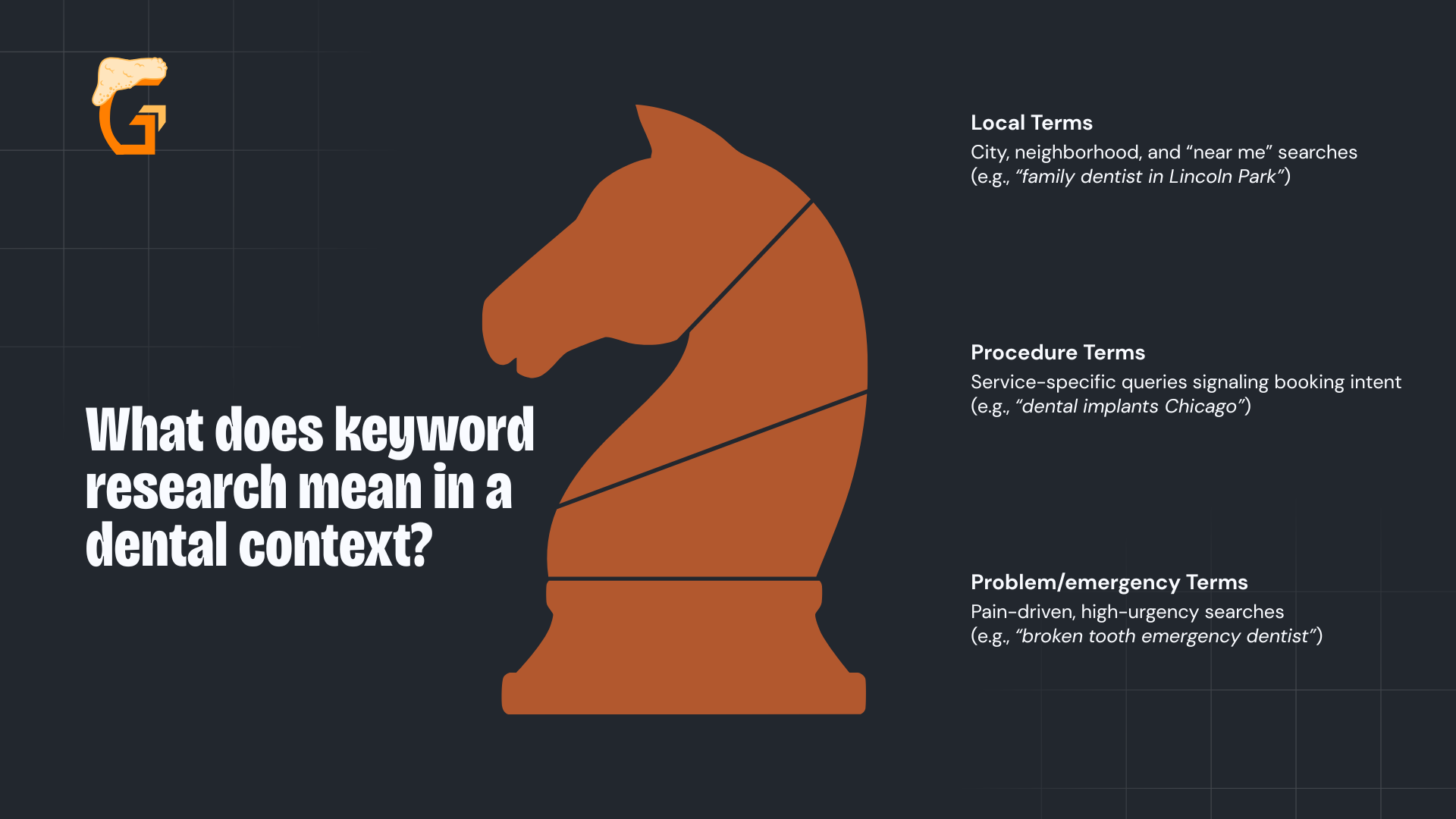
Three pillars organize every dental keyword list:
- Local terms: city, neighborhood, and “near me” searches (e.g., “family dentist in Lincoln Park”)
- Procedure terms: service-specific queries signaling booking intent (e.g., “dental implants Chicago”)
- Problem/emergency terms: pain-driven, high-urgency searches (e.g., “broken tooth emergency dentist”)
The map (not the raw list) is the actual deliverable.
Without page assignments, a spreadsheet tells you what patients search – the map tells you which page captures each one.
Why does 2026 dental search look different than past years?
Three shifts matter most.
Mobile-first near-me behavior means potential patients expect click-to-call results, not a homepage.
And the keyword map now underpins service pages, location pages, blog topics, and your Google Business Profile, expanding your dental practice’s online visibility – build it once and it compounds across every channel.
Whether you run a single-location practice or a multi-office group, Growth Saloon helps dental practices turn keyword research into booked appointments.
Reach out today to learn how our dental SEO services can put your practice in front of the right patients at the right time.
Why Does Local Intent Change Dental Keyword Research?
Local intent dominates dental search and shapes local search results – almost every commercial query carries city, neighborhood, or “near me” modifiers, so keyword decisions must be filtered through geography before competition or volume.
A keyword without a geographic modifier is usually the wrong one (“teeth whitening” is a content play, “teeth whitening dentist Chicago” is a conversion play).
Google’s local ranking guidance confirms that local results turn on relevance, distance, and prominence combined.
How does “near me” search behavior shape dental keyword choices?
Near-me searches are mobile, time-pressured, and ready-to-call.
SOCi’s local SEO statistics report that 60% of smartphone users have contacted a business directly from search results via click-to-call, so your keyword choices determine whether a patient dials you or a competitor.
That intent demands modifier stacking to dominate local search (city, neighborhood, suburb, ZIP, and “near me” variants each represent a distinct keyword surface that needs coverage).
What local foundations must be in place before keywords can rank?

Local keyword rankings are gated by foundations unrelated to on-page content.
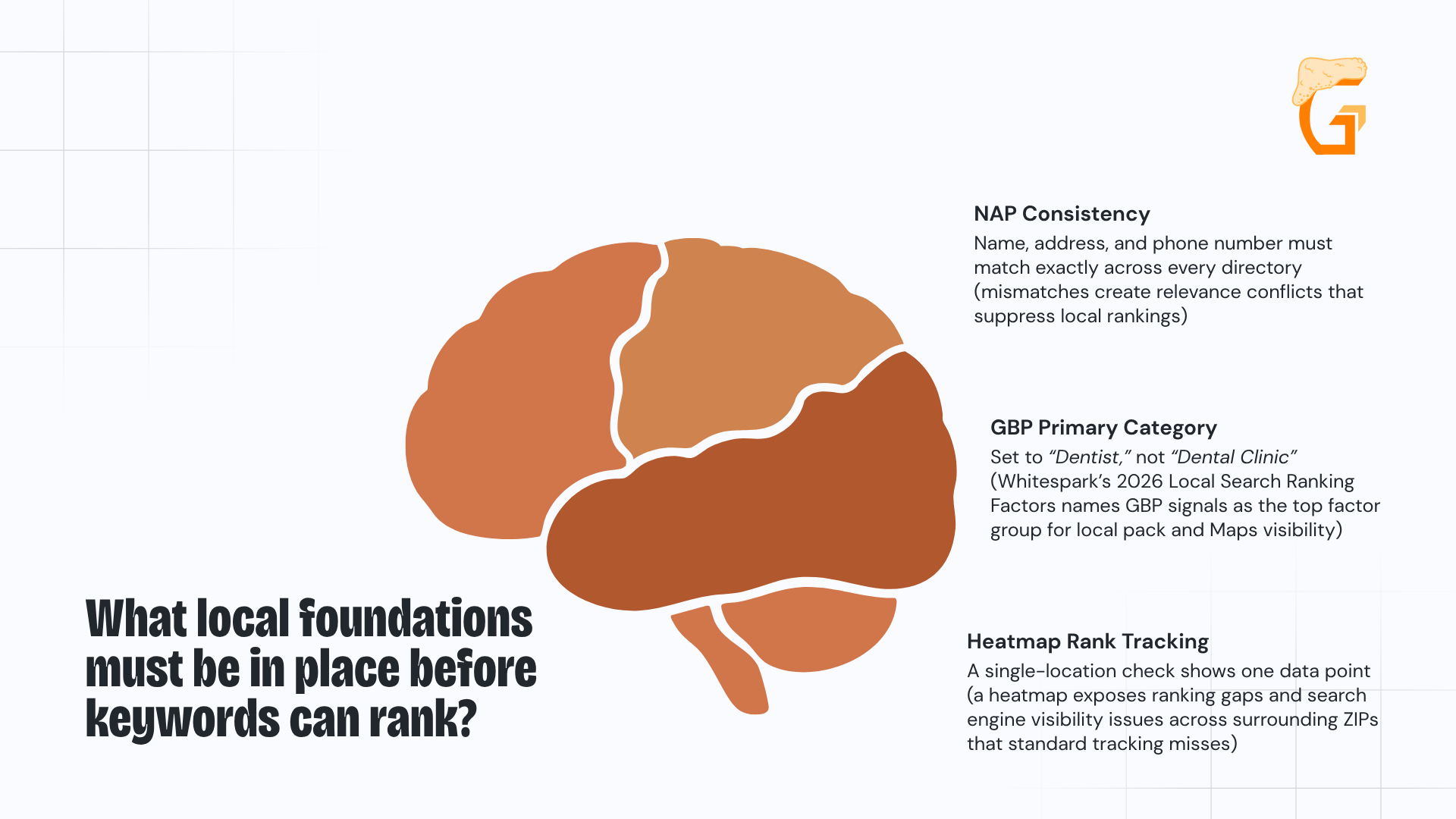
Confirm these three foundations before investing time in keyword research:
- NAP consistency: name, address, and phone number must match exactly across every directory (mismatches create relevance conflicts that suppress local rankings)
- GBP primary category: set to “Dentist,” not “Dental Clinic” (Whitespark’s 2026 Local Search Ranking Factors names GBP signals as the top factor group for local pack and Maps visibility)
- Heatmap rank tracking: a single-location check shows one data point (a heatmap exposes ranking gaps and search engine visibility issues across surrounding ZIPs that standard tracking misses)
What Types of Keywords Should a Dentist Target?
Dentists should target non-branded, local, transactional terms first (e.g., “emergency dentist near me”), then stack long-tail variants like “single tooth implant cost” onto each service page.
Keyword selection is a tiering exercise – small practices win by owning many specific keywords on focused pages rather than chasing one head term.
Google’s Search Quality Rater Guidelines classify query intent into Know, Do, Website, and Visit-in-person (the last maps directly to local dental searches).
How do branded, transactional, and informational keywords differ?
Branded terms protect existing patients – growth comes from non-branded terms your target audience uses before they know you exist.
Four intent classes organize the non-branded universe:
- Informational queries (e.g., “how long do dental implants last”) build awareness;
- Commercial investigation queries (e.g., “Invisalign vs braces cost”) capture comparing patients;
- Transactional queries (e.g., “emergency dentist open Saturday”) signal ready-to-book intent; and
- Navigational queries serve existing patients.
Transactional and commercial investigation terms are the right keywords where SEO investment pays off fastest.
Which dental service keywords have the highest commercial value?

Cost-per-click is the clearest proxy for commercial value and helps you identify high value keywords.
WordStream’s 2025 Google Ads Benchmarks put the average CPC for Dentists & Dental Services at $7.85.
Specific dental services that consistently deliver the strongest return on SEO investment:
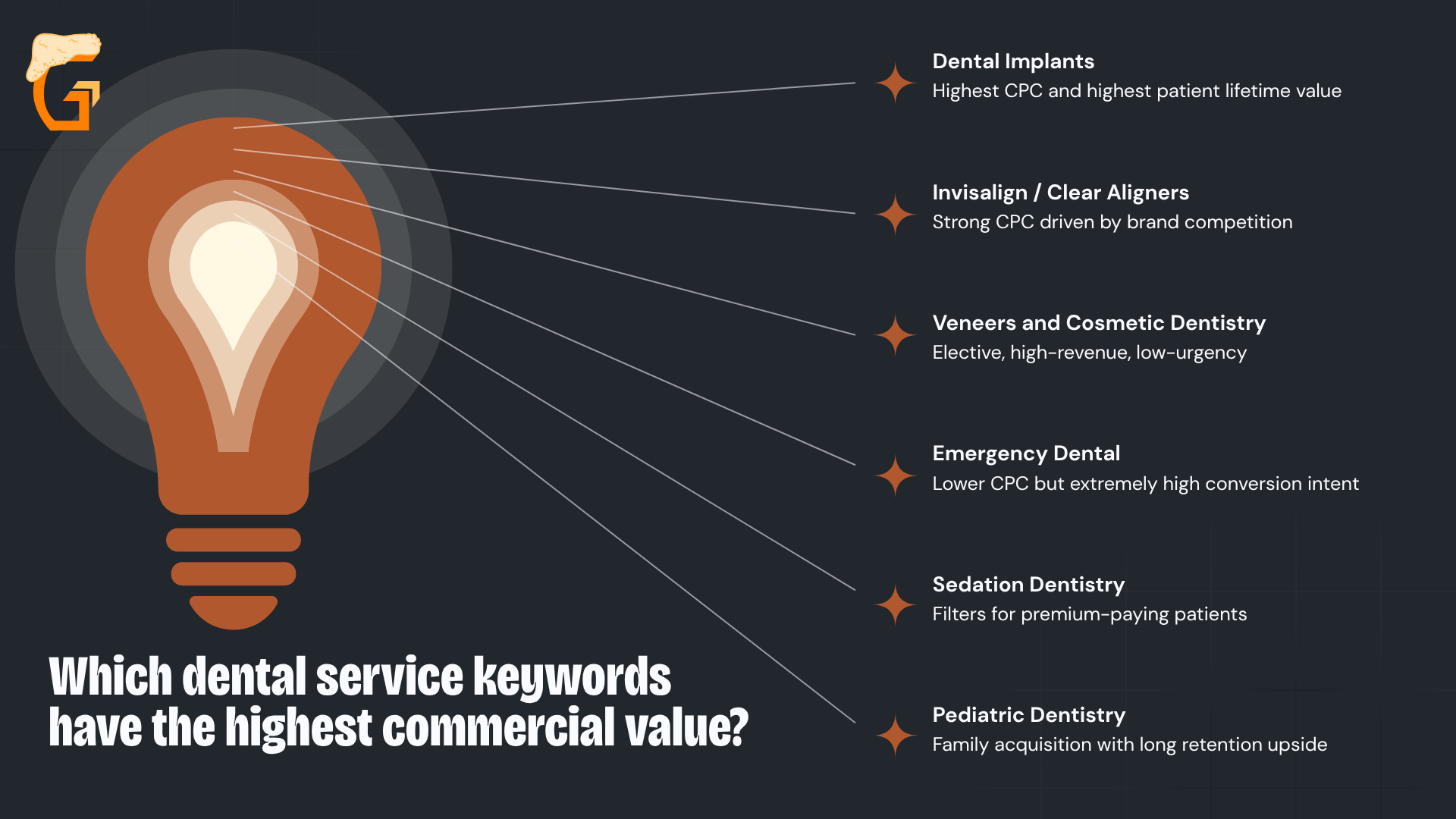
- Dental implants: highest CPC and highest patient lifetime value
- Invisalign / clear aligners: strong CPC driven by brand competition
- Veneers and cosmetic dentistry: elective, high-revenue, low-urgency
- Emergency dental: lower CPC but extremely high conversion intent
- Sedation dentistry: filters for premium-paying patients
- Pediatric dentistry: family acquisition with long retention upside
How should small dental practices prioritize keywords?
Small practices should use a three-tier framework.
- Tier 1: non-branded local transactional terms on your highest-revenue service pages, like a dental implants or pediatric dentist page.
- Tier 2: supporting variants and location pages for each suburb you serve.
- Tier 3: content targeting informational search intent in blogs and FAQs for research-phase patients.
NP Digital’s analysis of 40 search campaigns found that conversion rates climb sharply with keyword length (from 0.17% on single-word terms to nearly 2x that at three words and higher), while broad head terms drive the bulk of raw traffic volume.
Owning 30 focused long-tail dental keywords on a single page captures that high-intent traffic far more effectively than chasing one competitive head term.
Growth Saloon specializes in building keyword strategies that help dental practices rank for the terms that drive real patient bookings.
Contact us today to see how our keyword research for dentists approach can give your practice a competitive edge.
How’s your SEO going?
Enter your website URL below to get a free comprehensive SEO audit.
The audit includes:
- A scan of your entire website for technical issues
- A list of your top opportunities to target immediately
- Your highest priority fixes to make
Which Keyword Research Tools Should Dentists Use?
Google Keyword Planner and AnswerThePublic are the free baseline – paid tools like Ahrefs or Semrush add competitor gap analysis and difficulty scoring that small practices need to prioritize effectively.
Choosing keyword tools is a decision, not a checklist – a single-location practice often needs fewer keyword tools than agencies suggest.
Google’s Keyword Planner documentation covers the full discovery workflow inside Google Ads.
When should a dentist use Google Keyword Planner vs AnswerThePublic?
Use Keyword Planner for keyword search volume, CPC, and competition data with location targeting – set the geography to your city or metro and it returns volumes relevant to your actual market, not national averages.
Use AnswerThePublic for question-style long tail keywords: this tool scrapes Google autocomplete and surfaces phrased questions patients actually type, which feed directly into FAQ sections and blog topics.
Together these two free tools are sufficient for a single-location practice building its first keyword map from search suggestions and volume data.
How do Ahrefs and Semrush compare for dental SEO keyword research?
Both are functionally equivalent for dental research – the choice usually comes down to UI preference or existing contracts.
Where each platform stands apart for dental keyword workflows:
- Ahrefs Keywords Explorer + Content Gap: cleaner difficulty scoring (surfaces relevant keywords competitors rank for that your site does not)
- Semrush Keyword Magic Tool + Keyword Gap: broader integrated marketing data across SEO, PPC, and content
Ahrefs suits practices that want cleaner difficulty scoring – Semrush suits those who want breadth across channels.
Bracket-verify current pricing tiers at publication.
Where do Surfer SEO and Search Console fit in the dental SEO stack?
Surfer SEO is a clustering and on-page coverage tool, not a discovery tool – use it after you have a keyword list to confirm term placement, meta descriptions, and density per page.
Google Search Console is the always-on, free source of live keyword performance data for any verified site: it shows exactly which queries drive impressions and clicks right now, making it the most actionable tool for practices with existing traffic.
Utilize keyword research tools, starting with the free ones – add paid tooling when competitor tracking and content volume justify the cost.
Then move to the execution process.
Not sure which tools are worth the investment for your practice? Growth Saloon handles the tool stack so you can focus on patients.
Get started with a dental SEO keyword strategy built around your market, your services, and your growth goals.
How Do You Do Keyword Research for a Dental Practice?
Start with seed terms from your service menu and patient questions, expand them with Keyword Planner, then mine five to ten local competitors for gaps using Ahrefs Content Gap or Semrush.
This keyword research process runs across six steps in three stages – each step builds on the last.
Google’s Keyword Planner is the official starting point for discovering keywords for dentists with volume and competition data.
How do you build a dental keyword seed list?
- Step 1 (Seed brainstorm): pull terms from your core services and service menu (every procedure you offer), your location list (address, surrounding neighborhoods, nearby suburbs), and recurring patient questions from the front desk. A single-location general practice typically generates 50–100 seeds before tool expansion.
- Step 2 (Expansion): load seeds into Keyword Planner’s Discover new keywords workflow with city or metro-level targeting to surface the search queries patients use. Capture monthly volume, CPC, and competition level (CPC is your commercial intent proxy).
How do you do competitor keyword analysis for dentists?
Competitor analysis means identifying which practices Google ranks for your target queries – not which practices compete offline.
Follow these two steps to analyze competitor keywords and extract your competitors’ advantages:
- Step 3 (Competitor identification): search your top 5–10 target terms in a private window and record practices appearing in both organic search engine results and the Map Pack
- Step 4 (Competitor keyword extraction): run those domains through Ahrefs Content Gap or Semrush Keyword Gap to surface potential keywords they rank for that your site does not
Filter the gap output before adding terms to your map – keep only the right dental keywords with clear local commercial intent.
A competitor ranking for a national informational term may bring website traffic but tells you nothing useful about your local opportunity.
How do you validate intent and lock in a refresh cadence?
- Step 5 (SERP intent verification): before assigning any of your relevant search terms to a page, open the top 10 results in a private window and check the dominant page type. If the top 10 are all blog posts, a service page targeting that query will not rank regardless of optimization (Google’s Search Quality Rater Guidelines treat intent matching as a primary rater signal).
- Step 6 (Refresh cadence): run a 30-day cycle to re-check competitors and review Search Console for new queries. Consistency beats volume (a monthly cadence catches new competitors and seasonal demand shifts before they cost you ground).
Growth Saloon runs this entire six-step process for dental practices, from seed brainstorming through competitor gap analysis and beyond.
Let our team handle your dental keyword research so you can spend less time in spreadsheets and more time with patients.
How Do You Map Keywords to Dental Service Pages?
Assign one primary keyword per page (home, service, location, blog), support it with related keywords and long-tails, and consolidate overlapping pages to prevent cannibalization that splits ranking signals.
The keyword map is the deliverable that determines whether your search visibility across the previous five sections compounds or cancels out.
Google’s duplicate content guidance confirms that competing pages get filtered automatically – better to consolidate deliberately than let Google decide.
How should a dental keyword map be structured?

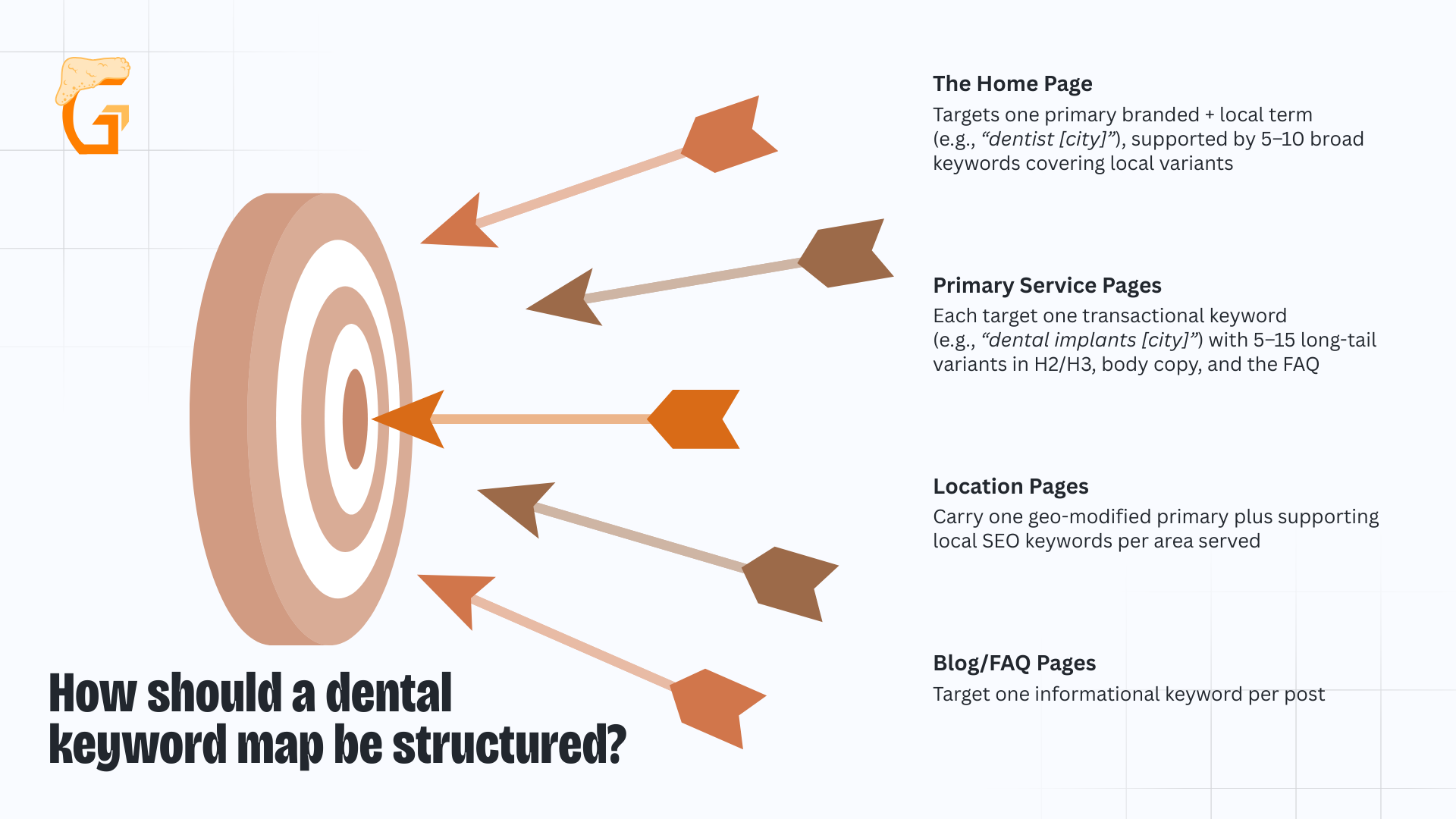
The map spans four page tiers:
- The home page targets one primary branded + local term (e.g., “dentist [city]”) supported by 5–10 broad keywords covering local variants;
- Primary service pages each target one transactional keyword (e.g., “dental implants [city]”) with 5–15 long-tail variants in H2/H3, body copy, and the FAQ;
- Location pages carry one geo-modified primary plus supporting local SEO keywords per area served; and
- Blog/FAQ pages target one informational keyword per post.
The one-primary-keyword-per-page rule is absolute – if two candidates have nearly identical intent, use the higher-volume keyword phrase as primary and the other as a supporting long-tail.
Ahrefs’ content gap analysis guide shows the standard map columns: URL, primary keyword, supporting keywords, volume, difficulty, and current rank.
How do you detect and fix keyword cannibalization on a dental site?
Cannibalization occurs when two or more pages compete for the same primary keyword, splitting ranking signals that should concentrate on one URL.
Spot cannibalization on your site using any of these three methods:
- Site search: site:yourdomain.com “dental implants” surfaces every competing page on your dental website
- Search Console query-to-page filter: checks whether multiple URLs appear for the same query
- Ahrefs or Semrush rank tracking: both flag query-to-page mismatches automatically
Fix: identify the strongest page, 301 redirect weaker overlapping pages to it, and update internal links to point to the canonical URL (Google’s guidance confirms this consolidate + redirect + internal-link-update workflow).
Note the distinction: cannibalization is a page-level competition problem – keyword stuffing is an on-page over-repetition problem (different mistakes, different fixes).
Treat the keyword map as a living document and review it monthly.
From keyword mapping to cannibalization fixes, Growth Saloon builds and maintains the SEO infrastructure that keeps dental practices ranking.
Talk to our team about a dental practice SEO plan tailored to your location, services, and patient base.
How's your SEO going?
Get your free comprehensive SEO audit.
Enter your website URL below to get a free comprehensive SEO audit.
- Scan entire website for technical issues
- Get a list of your top opportunities
- See your highest priority fixes to make
-
Keyword research is one step inside dental search engine optimization (SEO).
SEO is the full picture (keyword research, on-page optimization, technical SEO, local SEO, link building, and content).
Keyword research surfaces the dentist SEO keywords that help you identify what to target in your SEO strategy.
Skipping your dental keyword strategy means executing an SEO campaign without a clear list of pages or terms to rank for.
-
Before.
Keyword research determines which pages you need (one per primary keyword), what they should be titled, and how they internally link – decisions that are expensive to undo once a site is live.
This is what makes keyword research important: building first and retrofitting keywords usually produces overlapping service pages, weak URLs, and the cannibalization problems this guide warns against.
-
Initial keyword research for a single-location practice typically takes 8–16 hours spread over 1–2 weeks:
- 2–4 hours brainstorming seeds and locations
- 2–4 hours running Keyword Planner and Ahrefs or Semrush
- 2–4 hours on competitor extraction
- 2–4 hours classifying intent and building the page map.
Multi-location practices need 50–100% more time per added location.
-
Yes, especially for single-location practices.
Google Keyword Planner, AnswerThePublic, and Google Search Console are free, and the core methodology (seed brainstorm, expansion, competitor scan, intent classification, page mapping) is learnable in a weekend.
Hiring a partner makes sense once you scale past one or two locations or want continuous competitor tracking and content production at volume.
-
One primary keyword per page, supported by 5–15 closely related long-tail variants in the same intent cluster.
A dental implants service page might target “dental implants [city]” as primary, with secondaries like “single tooth implant cost,” “full arch implant,” and “implant recovery time.”
More than 15 variants usually means the page is trying to do two pages’ jobs.
-
Every 30–90 days for active keyword tracking, and a full refresh annually.
Monthly cycles catch new competitors entering your local SERPs, emerging keyword trends, and seasonal demand shifts (back-to-school orthodontics, year-end FSA spending).
Annual deep refreshes catch larger changes that move your search rankings – algorithm updates, new procedures, or shifts in how patients phrase searches as AI Overviews reshape click distribution.
-
No. Low-volume long-tail terms often convert better than high-volume head terms because they signal stronger intent.
A keyword with 20 monthly searches like “sedation dentist for adults with anxiety [city]” can produce more booked consultations than “dentist [city]” at 5,000 searches, where patients are still comparing options or looking up the nearest practice.
Most agencies sell traffic. We sell actual growth. That’s the Growth Saloon difference.
Are you looking to grow?
Recent blogs
Enter your website URL below to get free comprehensive SEO audit.
- Scan entire website for technical issues
- Get a list of your top opportunities
- See your highest priority fixes to make