

Key takeaways
- Competitor research is entirely based on public information, since rival websites, Google Business Profiles, and organic rankings are visible to anyone, and a ranking page proves a keyword already converts in your market.
- A 15-minute manual audit of the top three GBP listings reveals review velocity, category gaps, and services gaps, and review velocity is the one signal you can act on immediately without any technical work.
- Run keyword, backlink, and paid-search comparisons with one tool that matches your biggest gap, then organize findings into four prioritized buckets, starting with GBP fixes and ending with backlinks.
What Does It Actually Mean to Spy on Competitor Dentists?
Studying competitor dentists is one of the highest-leverage moves you can make to strengthen your online presence (because your competitors have already done the hard work of proving what converts in your local market).
Every keyword they rank for, every service page they’ve built, every review they’ve collected is publicly visible data that delivers valuable insights into where to focus your own SEO efforts.
The problem is that most practices either skip studying competitor strategies entirely or treat it as a one-time gut-check rather than a repeatable system.
Meanwhile, the practice down the street is quietly capturing the potential patients searching for your services (because they’ve built the pages, earned the reviews, and optimized the signals that put them on the first page instead of you).
Growth Saloon helps dental practices build the kind of digital presence that consistently generates qualified new patient inquiries – not just clicks.
Contact our team today to find out how our dental marketing services can lower your cost per new patient and grow your practice.
Why Spying on Competitor Dentists Is the Fastest SEO Shortcut Available
Competitive analysis of dental SEO eliminates guesswork by showing exactly which keywords, pages, and local signals are already working for the practices ranking above yours.
Instead of building an SEO strategy from scratch, you copy what’s proven to work in your specific market, then do it better (adding more depth, more reviews, and stronger local signals to gain a competitive edge over the competition).
Competitors in the dental industry have already spent the time, money, and months of effort to prove what works.
Reading their results (with or without digital tools) is not starting from scratch – it’s starting from first principles that have already been validated.
What Does Competitive Dental SEO Research Actually Reveal?
A competitor ranking in position 1 for “dental implants [city]” has already proven that keyword converts.
Replicating their page structure and improving on their content depth is faster than building a strategy from first principles.
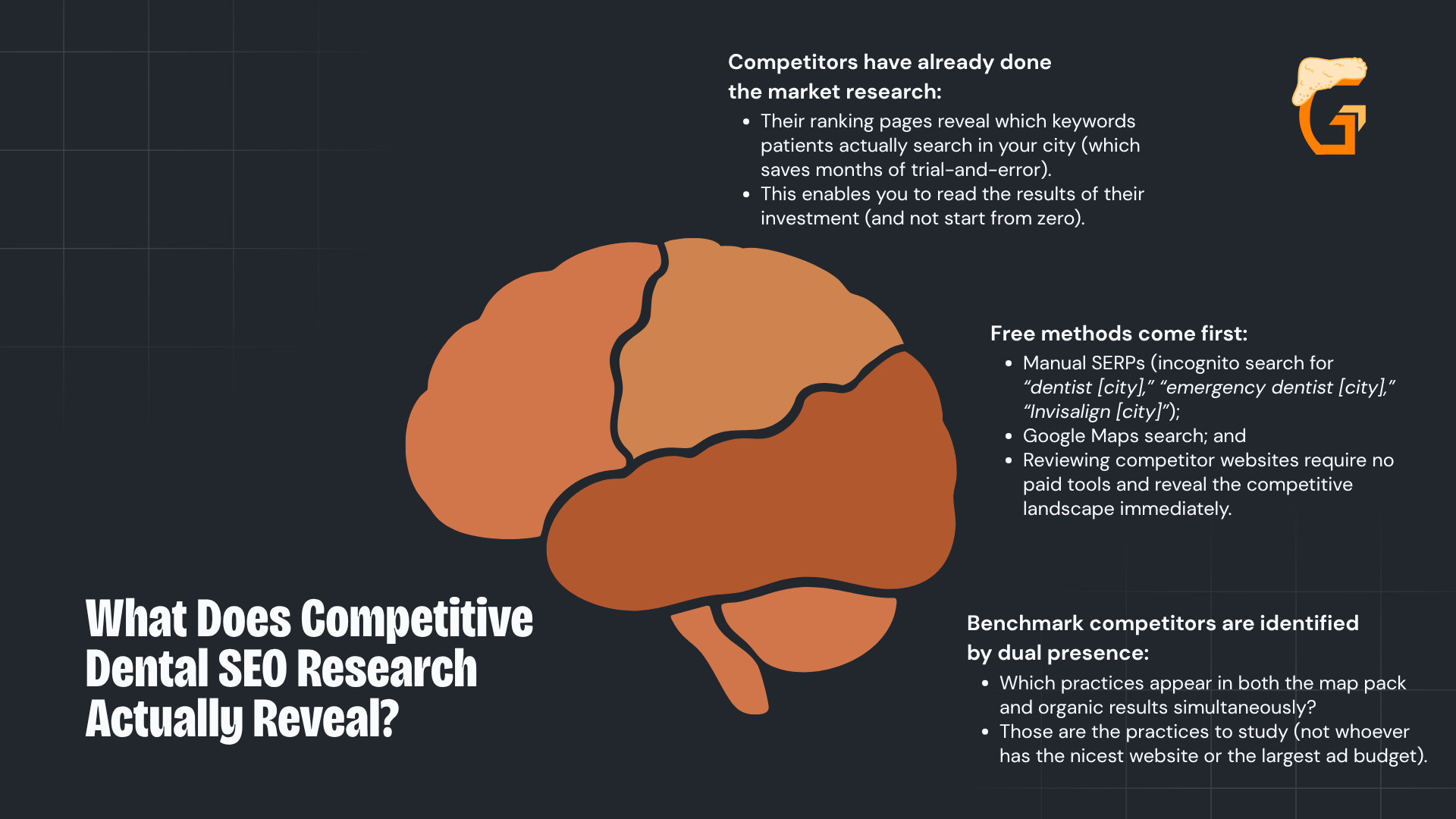
Reading a competitor’s results reveals a few things:
- Competitors have already done the market research:
- Their ranking pages reveal which keywords patients actually search in your city (which saves months of trial-and-error).
- This enables you to read the results of their investment (and not start from zero).
- Free methods come first:
- Manual SERPs (incognito search for “dentist [city],” “emergency dentist [city],” “Invisalign [city]”);
- Google Maps search; and
- Reviewing competitor websites require no paid tools and reveal the competitive landscape immediately.
- Benchmark competitors are identified by dual presence:
- Which practices appear in both the map pack and organic results simultaneously?
- Those are the practices to study (not whoever has the nicest website or the largest ad budget).
A competitor appearing in both the map pack and organic results for the same search term has achieved both local and content authority, and tracking them helps you identify opportunities others miss.
These dual-presence practices are the actual benchmark competitors, not the practices with the largest budgets or the most polished websites.
How Often Should a Dental Practice Monitor Competitors, and What Should the Output Be?
Monthly competitive checks are sufficient for most dental practices; weekly monitoring is appropriate for active campaigns and high-competition markets.
A couple of principles govern how to run that monitoring:
- Monitoring frequency:
- A monthly competitive check (rankings, reviews, new content, GBP changes) is sufficient for most dental practices.
- Weekly monitoring is for active growth campaigns or high-competition metro markets where the competitive landscape shifts faster.
- Research converts to action:
- Competitive intelligence is only valuable if it leads to more informed decisions and a prioritized task list.
- The goal is not reconnaissance, it’s to gather a ranked list of gaps to close in a specific order.
Competitive research that doesn’t end with actionable recommendations is a report that gets filed.
The entire value of competitor analysis is in the action it generates, not the insights it produces.
How to Find the Keywords and Content Gaps Your Competitors Are Exploiting
Keyword and content gap analysis helps you identify gaps by answering the question, “what are my competitors ranking for that I’m not?”
The answer (surfaced through keyword research) is almost always a mix of high-intent service pages built for your target audience (dental implant cost pages, cosmetic dentistry comparison pages, emergency dentistry pages) and local landing pages the competing practice has and yours doesn’t.
Every missing page is a ranking opportunity the competitor is capturing and you’re not.
A competitor with a dedicated page for every service and location query has built a content footprint that a single “services” page cannot compete with.
Each gap is a separate opportunity.
How Do You Find Keyword and Content Gaps a Competitor Dental Practice Is Exploiting?

Every page a competitor ranks for that doesn’t exist on your website is a proven keyword opportunity.
They’ve already done the work of ranking for it, which means the search demand is real and the page structure is validated.
Here are the methods that surface those gaps:
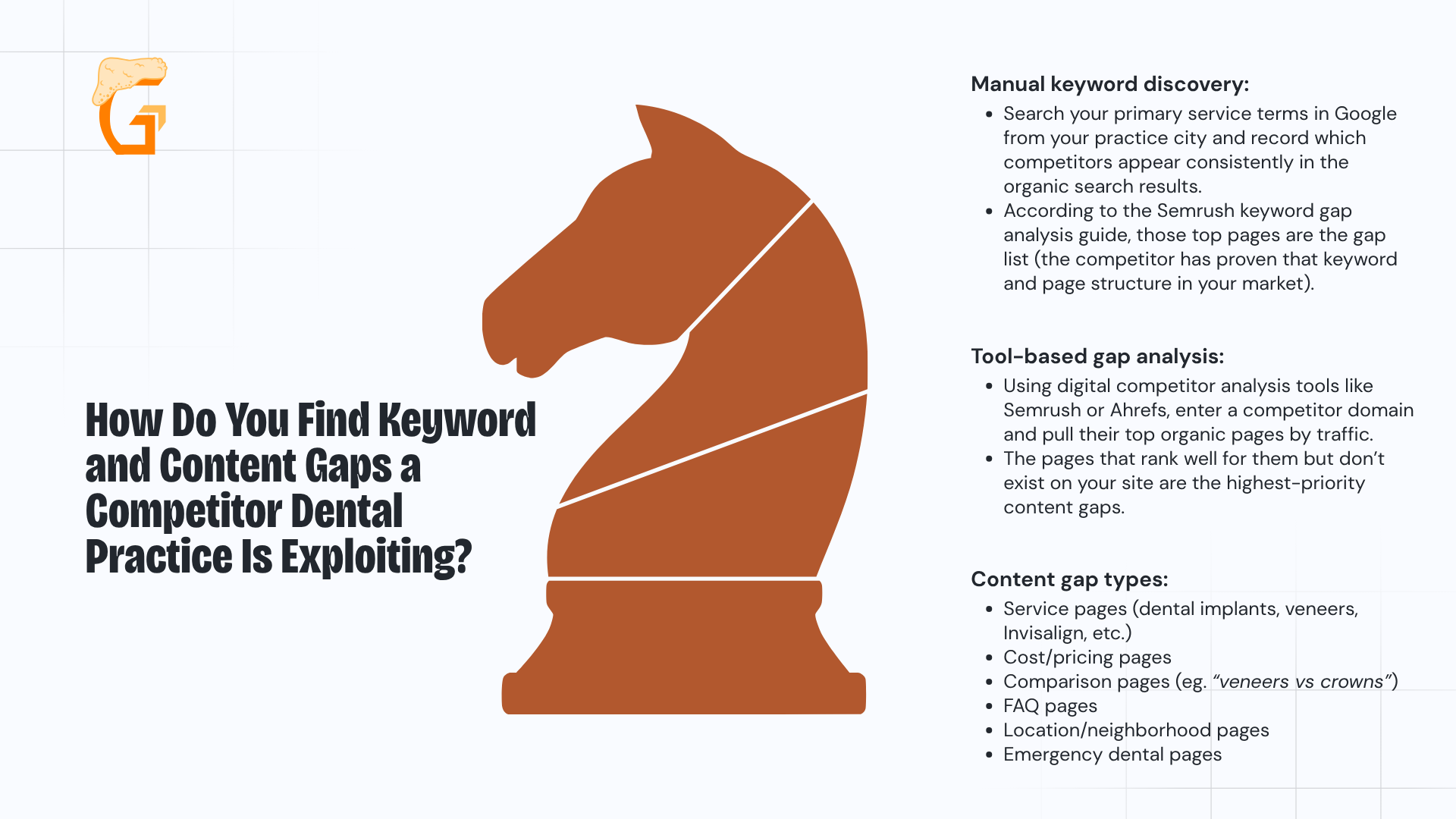
- Manual keyword discovery:
- Search your primary service terms in Google from your practice city and record which competitors appear consistently in the organic search results.
- According to the Semrush keyword gap analysis guide, those top pages are the gap list (the competitor has proven that keyword and page structure in your market).
- Tool-based gap analysis:
- Using digital competitor analysis tools like Semrush or Ahrefs, enter a competitor domain and pull their top organic pages by traffic.
- The pages that rank well for them but don’t exist on your site are the highest-priority content gaps.
- Content gap types (each targets a different patient intent and warrants its own URL):
- Service pages (dental implants, veneers, Invisalign, etc.)
- Cost/pricing pages
- Comparison pages (eg. “veneers vs crowns”)
- FAQ pages
- Location/neighborhood pages
- Emergency dental pages
Cost and procedure-specific pages are the most commonly missing content gap in dental practices.
A competitor who has a dedicated “dental implant cost [city]” page will consistently outrank a practice whose pricing information is buried in a general services page.
How Do Title Tags and Content Depth Reveal What Makes Competitor Pages Rank?
A competitor’s implant page with 1,200 words outranks a practice’s 300-word page on the search engine results pages because depth (not keyword density) is what Google rewards on dental service pages.
A couple of comparisons show why their pages win:
- Title tag and H1 audit:
- Review competitor title tags for the pattern “Service + City + Brand”.
- This is the most common format for ranking dental service pages and the first format to replicate when building or rewriting service pages.
- Content depth comparison:
- Count words on the competitor’s top-ranking page vs your equivalent page.
- If their implant page is 1,200 words and yours is 300, content depth is the gap to close before any other optimization.
Content depth is the most common competitive gap in dental SEO and the most immediately actionable.
Expanding a 300-word service page to 1,200 words with clinical detail, cost ranges, and FAQs is a single-session task that can produce ranking movement within weeks.
Growth Saloon closes the content and keyword gaps competitors are exploiting and turns them into qualified new patient inquiries – not just clicks.
Contact our team today to find out how our dental marketing services can lower your cost per new patient and grow your practice.
Auditing Competitor Google Business Profiles and Map Pack Dominance
The map pack audit is the most direct competitive research action a dental practice can take because it reveals exactly why a competitor ranks in the top three local results.
Most map pack dominance is explained by the following factors (and all three are replicable with a clear action plan):
- The volume and velocity of online reviews;
- GBP category and services completeness; and
- Website relevance for the search term.
A 15-minute manual audit of the top three GBP listings for your primary search term reveals more actionable intelligence for your dental office than most week-long SEO audits.
The information is free and fully visible.
How Do You Pull a Map Pack Snapshot and Compare Competitor Review Velocity?
A manual audit of the top 3 GBP listings for your primary search term takes 15 minutes and is the highest-ROI competitive research action available (review velocity, category completeness, and services list gaps are visible immediately).
Here is what that 15-minute audit covers:
- Map pack snapshot:
- Search your top 5 service terms from your practice location in Google Maps.
- Record the top 3 results for each (capturing key metrics like their review count, rating, and GBP completeness).
- This is your competitive baseline for local search.
- Review velocity comparison:
- A competitor gaining 10 online reviews per month while you gain 2 is pulling away in local ranking authority every week.
- Sort competitor Google reviews by “Newest” and count recent additions to see the velocity gap.
Review velocity is the one map pack signal local dental practices can act on immediately without any technical SEO work.
Setting up a simple post-appointment review request text or email sequence is enough to close a velocity gap within 60 days.
No tools required, no website changes required.
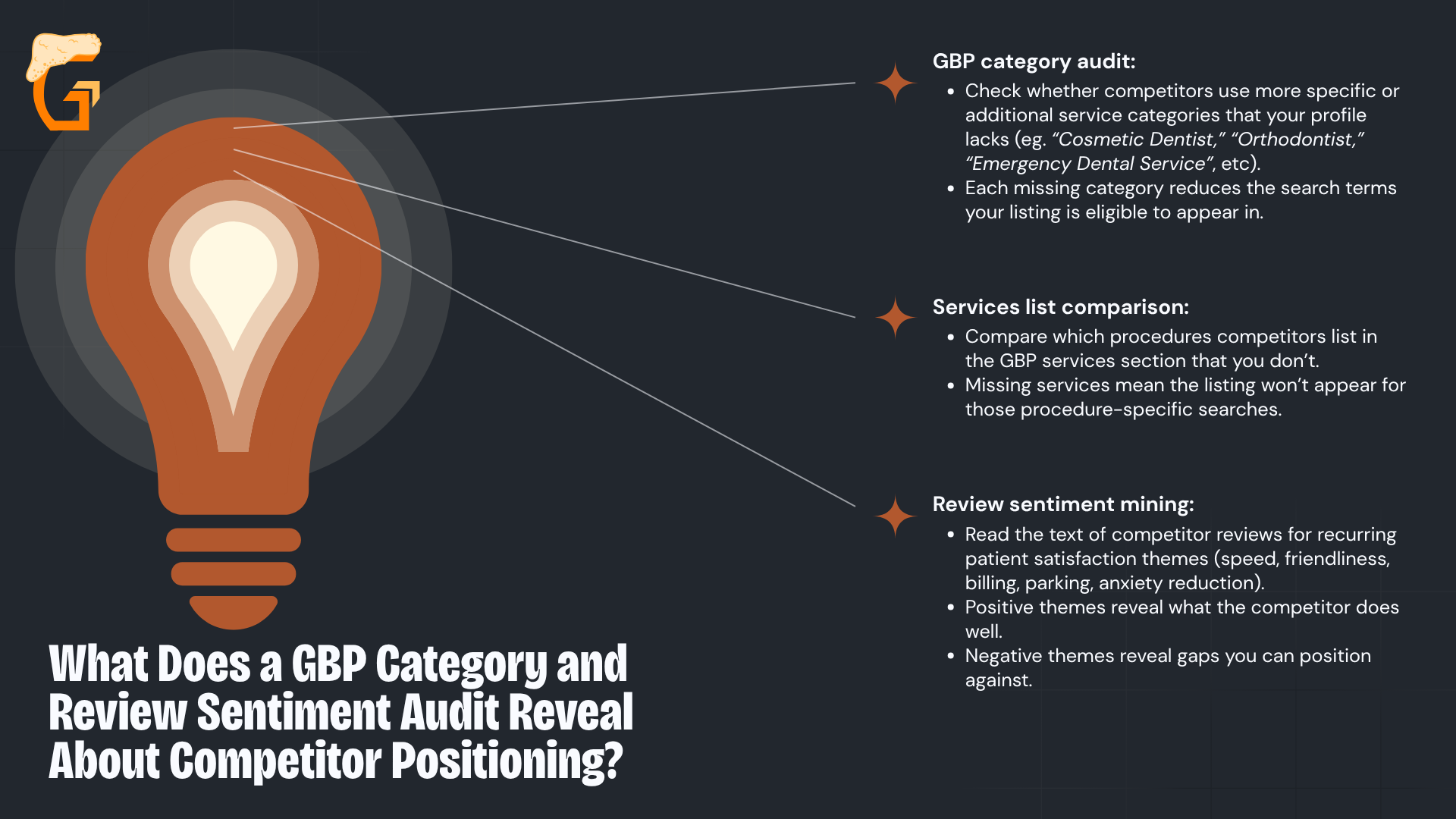
What Does a GBP Category and Review Sentiment Audit Reveal About Competitor Positioning?

GBP category audit and review sentiment mining together reveal both the technical gaps and the positioning opportunities that most practices miss in their competitive research.
The following audits cover both at once:
- GBP category audit:
- Check whether competitors use more specific or additional service categories that your profile lacks (eg. “Cosmetic Dentist,” “Orthodontist,” “Emergency Dental Service”, etc).
- Each missing category reduces the search terms your listing is eligible to appear in.
- Services list comparison:
- Compare which procedures competitors list in the GBP services section that you don’t.
- Missing services mean the listing won’t appear for those procedure-specific searches.
- Review sentiment mining:
- Read the text of competitor reviews for recurring patient satisfaction themes (speed, friendliness, billing, parking, anxiety reduction).
- Positive themes reveal what the competitor does well.
- Negative themes reveal gaps you can position against.
Competitor reviews that repeatedly mention slow wait times, billing confusion, or rushed appointments reveal exactly where to build your unique selling proposition.
Those differentiators belong in your GBP description, your review request prompts, your social media profiles, and your website copy.
Growth Saloon audits competitor GBPs and reviews to find the positioning gaps that win qualified new patient inquiries – not just clicks.
Contact our team today to find out how our dental marketing services can lower your cost per new patient and grow your practice.
How’s your SEO going?
Enter your website URL below to get a free comprehensive SEO audit.
The audit includes:
- A scan of your entire website for technical issues
- A list of your top opportunities to target immediately
- Your highest priority fixes to make
Backlinks, Technical SEO, and Paid Search: What Competitor Audits Reveal
A comprehensive analysis of backlink gaps, technical SEO, and paid search together reveals the structural advantages competitors hold beyond content and reviews.
A competitor’s backlink profile shows which local directories, dental associations, and community organizations are linking to them but not to you.
Their paid search strategy reveals which keywords they’re willing to pay for to defend market share (a reliable signal of which terms convert best in your market).
These three research areas require slightly more effort and resource allocation than a GBP audit but produce the most durable insights about why a competitor consistently outranks a practice over time.
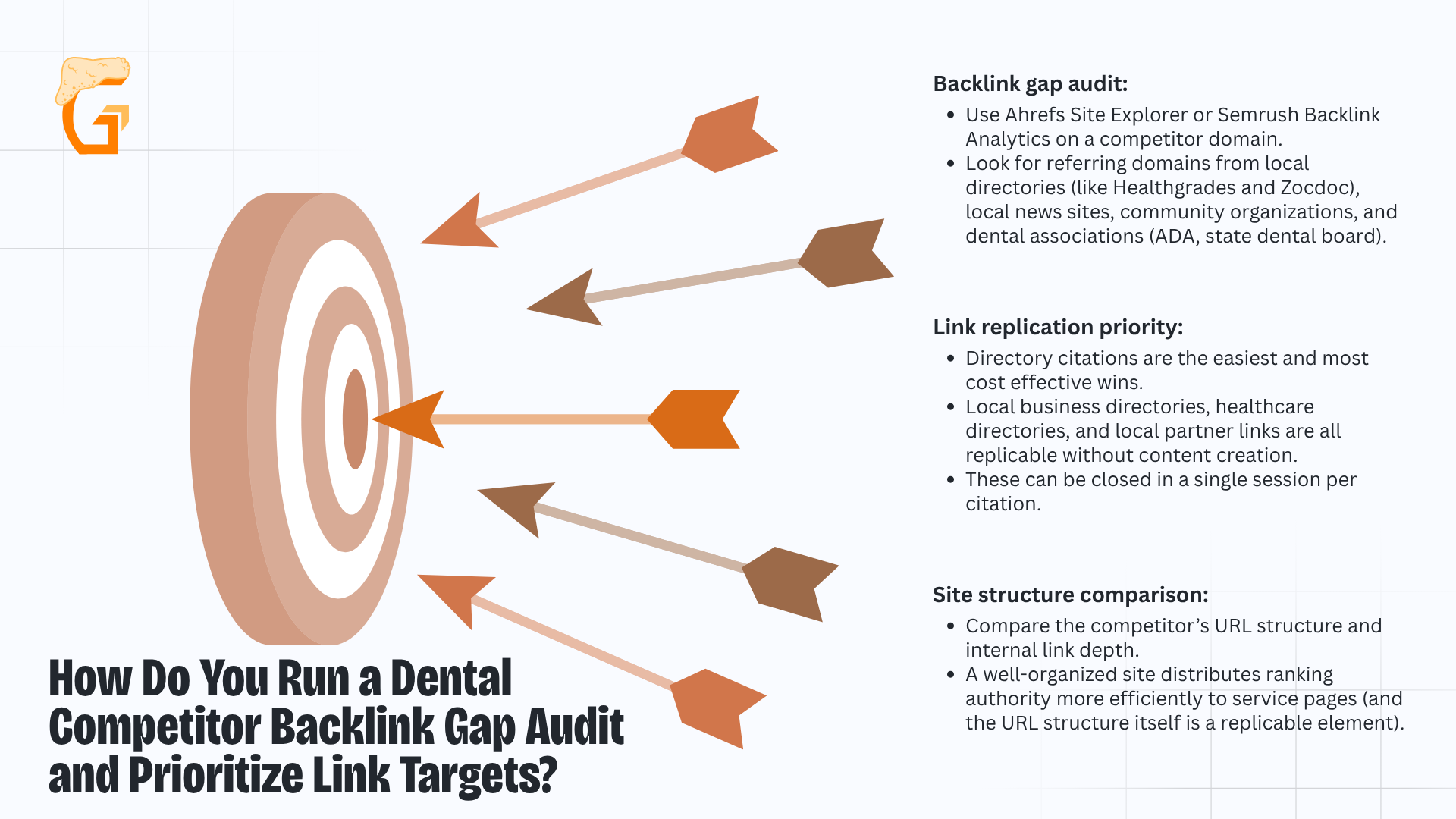
How Do You Run a Dental Competitor Backlink Gap Audit and Prioritize Link Targets?

The competitor’s backlink profile shows where their domain authority comes from, and the gap between their profile and yours is a prioritized list of replicable link opportunities for staying ahead.
Here is how to run the audit and rank the targets:
- Backlink gap audit:
- Use Ahrefs Site Explorer or Semrush Backlink Analytics on a competitor domain.
- Look for referring domains from local directories (like Healthgrades and Zocdoc), local news sites, community organizations, and dental associations (ADA, state dental board).
- Link replication priority:
- Directory citations are the easiest and most cost effective wins.
- Local business directories, healthcare directories, and local partner links are all replicable without content creation.
- These can be closed in a single session per citation.
- Site structure comparison:
- Compare the competitor’s URL structure and internal link depth.
- A well-organized site distributes ranking authority more efficiently to service pages (and the URL structure itself is a replicable element).
Directory citations are the fastest backlink wins from a competitor analysis.
A competitor listed in Healthgrades, Zocdoc, the ADA directory, and three local parenting blogs that you are not listed in has four replicable authority gaps, each closeable in a single session.
What Do Technical SEO Comparison and Paid Search Monitoring Reveal About Competitor Advantages?
A competitor who has been bidding on “dental implants [city]” for 12 months and hasn’t stopped has proven that keyword generates profitable patients.
That’s 12 months of competitive market research available for free.
These areas reveal the structural advantages:
- Technical SEO comparison:
- Check competitor page speed (Google PageSpeed Insights), mobile usability, HTTPS, and schema markup type.
- A faster, better-structured site has a baseline ranking advantage on equal-content pages (these are all replicable technical elements).
- Paid search intelligence:
- Search your top 5 service terms in Google and note which competitors run ads consistently.
- Consistent ad presence on “dental implants [city]” or “Invisalign near me” confirms those terms convert at high enough rates to justify both paid bidding and organic content investment.
Consistent paid search presence on a specific keyword is a confirmed signal of current market trends.
If a competitor has been paying per click for “dental implants [city]” for a year, that keyword is likely producing profitable patient appointments and deserves equivalent organic investment.
Growth Saloon turns competitor backlink, technical, and paid-search intelligence into qualified new patient inquiries – not just clicks.
Contact our team today to find out how our dental marketing services can lower your cost per new patient and grow your practice.
SEO Tools for Dental Competitor Research and How to Build Your Action Plan
The right SEO tool is a powerful tool for dental competitor research, and the best choice depends on the practice’s budget and primary research goal.
Semrush covers keyword, content marketing, and paid search research in one platform.
Ahrefs is the strongest tool for backlink analysis, search engine visibility, and organic traffic estimation.
Moz is the most accessible entry point for local SEO and citation research.
All three have free trials; most dental practices don’t need to subscribe to more than one.
The tool that matches the biggest known gap against your competitive set produces the most immediate value (a practice that knows it’s losing on backlinks doesn’t need Semrush’s keyword tools as urgently as it needs Ahrefs’ Site Explorer).
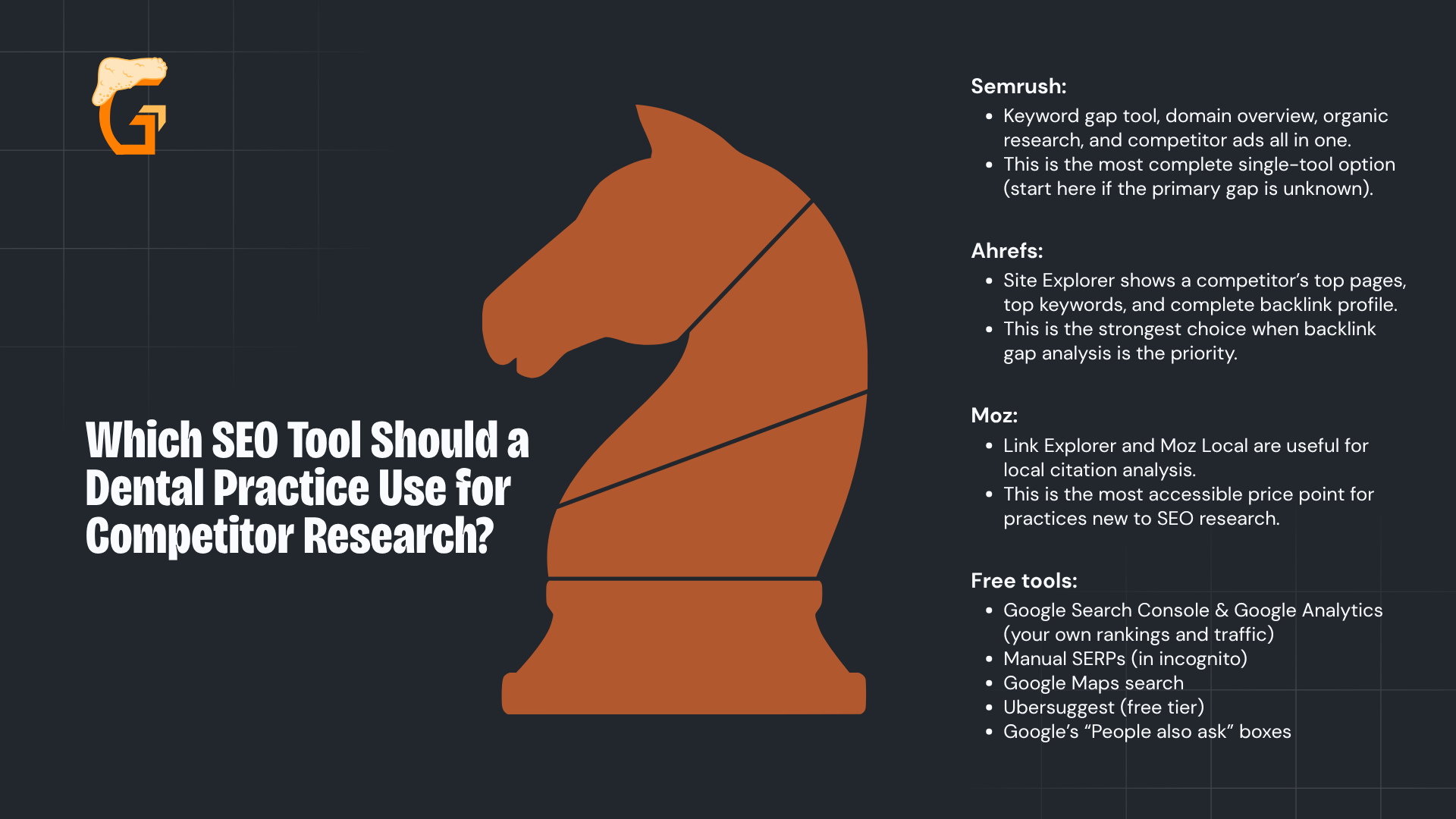
Which SEO Tool Should a Dental Practice Use for Competitor Research?

A dental practice doesn’t need all three tools – it needs the one that matches its biggest gap.
According to the Ahrefs vs Semrush comparison, if you don’t know why a competitor outranks you, start with Semrush’s domain overview (if the issue is links, go straight to Ahrefs).
Here is how the main options compare:
- Semrush for dental practices:
- Keyword gap tool, domain overview, organic research, and competitor ads all in one.
- This is the most complete single-tool option (start here if the primary gap is unknown).
- Ahrefs for dental practices:
- Site Explorer shows a competitor’s top pages, top keywords, and complete backlink profile.
- This is the strongest choice when backlink gap analysis is the priority.
- Moz for dental practices:
- Link Explorer and Moz Local are useful for local citation analysis.
- This is the most accessible price point for practices new to SEO research.
- Free tools that can reveal competitive keyword intelligence at no cost:
- Google Search Console and Google Analytics (your own rankings and traffic)
- Manual SERPs in incognito
- Google Maps search
- Ubersuggest free tier
- Google’s “People also ask” boxes
Most dental practices will get sufficient value from a single monthly subscription to one tool rather than all three (the decision comes down to the biggest competitive gap).
What Four-Bucket Action Plan Should Follow a Dental Competitor Analysis?
Findings from a competitor analysis must be organized into a prioritized action sequence of novel marketing strategies, not a flat list of everything wrong.
Sort the findings into buckets and work them in order:
- Bucket 1 (GBP fixes – fastest impact, weeks):
- Category correction, missing service entries, and photo uploads
- These are reversible, fast to implement, and produce the most direct map pack impact.
- Bucket 2 (Content gaps – 1–3 months):
- Missing service pages, cost pages, and comparison pages
- Create the pages competitors rank for that you don’t have.
- Bucket 3 (Technical fixes – compounding):
- Page speed, mobile usability, and schema markup
- These are foundational improvements that compound with every content and link improvement.
- Bucket 4 (Backlink targets – 3–6 months):
- Directory citations, dental association listings, and local community links
- These are slower-moving but compound domain authority over time.
Working through the buckets in order (GBP first, content second, technical third, backlinks last) produces compounding results and long term growth because each layer builds on the one before it.
Jumping to backlinks before fixing GBP and content is common and produces minimal return.
Growth Saloon helps dental practices build the kind of digital presence that consistently generates qualified new patient inquiries – not just clicks.
Contact our team today to find out how our dental marketing services can lower your cost per new patient and grow your practice.
How Can Growth Saloon Help Your Dental Practice Grow?
Growth Saloon is a Chicago-based digital marketing agency built to help dental practices attract more patients and grow their practice through performance-driven digital marketing.
Mike Lowe and the Growth Saloon team specialize in SEO, web design, conversion rate optimization, and marketing attribution – working alongside dental professionals to build a measurable digital presence that generates qualified patient inquiries, not just website traffic.
From ranking for high-intent local search terms to converting site visitors into booked appointments, Growth Saloon focuses on results at every stage of the patient acquisition funnel.
Practice owners and marketing managers get clear visibility into exactly which channels are bringing in new dental patients.
We know that every open appointment slot has a real cost.
Every decision we make is built around one outcome – helping your practice fill more of them.
Meet the Founder of Growth Saloon
Meet the founder and lead strategist at Growth Saloon – Mike Lowe:
- As founder and CEO of Growth Saloon, Mike brings years of hands-on experience in SEO strategy, CRO, web design, and marketing attribution for service-based businesses competing in local and regional markets.
- Based in Chicago and working with practices across the country, Mike has built and managed digital growth campaigns for businesses competing in some of the most contested search markets in the country.
- Growth Saloon’s data-driven approach to local SEO and improved online visibility helps dental practices turn their websites into their highest-performing new patient channel.
What Does Working With Growth Saloon Look Like?
Growth Saloon operates as a dedicated extension of your marketing team focused on growing your patient base – not a vendor that disappears after onboarding.
Every engagement includes direct access to Mike and the team, transparent reporting tied to actual patient acquisition outcomes, and strategies tailored to your specific services and local market.
Whether you’re looking to rank for high-value procedures, improve patient engagement and your site’s appointment conversion rate, or finally get clarity on where your new patients are actually coming from, Growth Saloon builds the strategy and does the work.
Growth Saloon helps dental practices build the kind of digital presence that consistently generates qualified new patient inquiries – not just clicks.
Contact our team today to find out how our dental marketing services can lower your cost per new patient and grow your practice.
How's your SEO going?
Get your free comprehensive SEO audit.
Enter your website URL below to get a free comprehensive SEO audit.
- Scan entire website for technical issues
- Get a list of your top opportunities
- See your highest priority fixes to make
-
Yes, competitive research and SWOT analysis using publicly available data is standard business practice (not spying in any harmful sense).
Everything this kind of research involves is based entirely on information they have made public (reviewing a competitor’s website, reading their Google reviews, checking their Google Business Profile, using tools like Semrush or Ahrefs to analyze their public search rankings, etc).
No logins are accessed, no private data is obtained, and no platform terms are violated.
The same research your marketing provider runs on competitors is available to any practice owner willing to spend an hour doing it manually.
-
Monthly is sufficient for most dental practices.
A monthly check should cover:
- Ranking positions for your top 10 keywords;
- Review count and rating changes for the top three map pack competitors;
- Any new pages or blog post additions on competitor websites; and
- GBP category or services updates.
Practices in active growth mode or high-competition markets may benefit from bi-weekly tracking of map pack positions and review velocity.
Quarterly deep audits (backlinks, technical SEO, paid search) are enough for the slower-changing signals.
-
Review velocity (the rate at which a competitor is accumulating new Google reviews).
A competitor gaining 15 reviews per month while you gain 2 is pulling ahead in map pack authority every week you don’t address it.
Review velocity is visible for free by sorting a competitor’s Google reviews by “Newest” and noting the dates of the last 10–20 entries.
It’s the one signal that directly affects map pack rankings, requires no SEO tool to monitor, and can be acted on immediately with a simple email marketing review request system.
-
Yes, and the free methods are often the most actionable starting point.
- Manual SERPs: search your top service terms from your practice city in an incognito browser window and record which practices appear in both the organic results and the map pack.
- Google Maps: search each service term and compare the top three GBP listings for review count, rating, categories, and services.
- Competitor websites: review title tags, H1s, page structure, and word count on their top service pages.
- Google Search Console: check your own site’s rankings to identify where competitors are outranking you.
These four steps require only time and no practice management software, yet produce a concrete gap list.
-
Fix the GBP first.
Of all the gaps competitive research reveals, GBP category and services omissions are the fastest to correct and have the most direct impact on a dental practice’s online visibility in the map pack.
After that, prioritize creating any missing service pages that competitors rank for (specifically cost and procedure-specific pages for your highest-value services).
Technical fixes (page speed, mobile usability, schema) come next because they have a compounding effect on all other improvements.
Backlink acquisition is the slowest-moving lever and should be pursued in parallel, not in sequence.
-
Semrush is the best single-tool option for most dental practices seeking competitor research success because it covers keyword gaps, content analysis, competitor organic traffic, and paid search in one platform.
Ahrefs is the better choice when backlink analysis is the priority (its Site Explorer is the most accurate tool for identifying where a competitor’s authority links come from).
Moz is the most accessible entry point for practices new to SEO research, with Moz Local specifically useful for citation comparison.
All three offer free trials; most practices will get sufficient value from a single monthly subscription to one tool rather than paying for all three simultaneously.
Most agencies sell traffic. We sell actual growth. That’s the Growth Saloon difference.
Are you looking to grow?
Recent blogs
Enter your website URL below to get free comprehensive SEO audit.
- Scan entire website for technical issues
- Get a list of your top opportunities
- See your highest priority fixes to make