

Key takeaways
- Meta descriptions for dental websites should be kept between 150 to 160 characters on desktop and around 120 characters on mobile, with the most important information placed within the first 100 characters to prevent truncation from reducing click-through rates.
- Using the same meta description across multiple pages signals to Google that those pages are interchangeable, often causing it to rewrite your snippets with arbitrary body text and stripping your practice of control over how listings appear in search results.
- Pairing a keyword-led title tag with a benefit-led meta description that matches the user's search intent (whether informational or transactional) is the highest-converting combination in dental SEO, and refining this pairing alone can produce double-digit traffic gains within weeks.
How Do Meta Descriptions for Dental Websites Affect Your Patient Acquisition?
Meta descriptions for dental websites are among the most controllable (and most overlooked) pieces of copy your practice publishes.
That short preview beneath your URL in Google search results is the last line of marketing standing between a potential patient and your competitor’s booking page (and most dental practices treat it like a footnote when it should be treated like a headline).
The practices that get this right earn more clicks from the same rankings.
A snippet written around a patient’s actual moment of need (same-day availability, sedation options, a specific neighborhood) consistently outperforms a generic “welcome to our practice” line, even when both listings appear at the same position on the page.
That gap in click-through rate compounds across thousands of monthly impressions and translates directly into appointment volume, not abstract metrics.
This guide covers everything dental marketers need to write, optimize, and maintain high-performing snippets: from character limits and keyword placement to duplicate tag risks and the technical foundations that determine whether Google uses your copy at all.
Work through each section, or jump to the area where your practice needs the most attention.
Growth Saloon helps dental practices build the kind of digital presence that consistently generates qualified new patient inquiries – not just clicks.
Contact our team today to find out how our dental marketing services can lower your cost per new patient and grow your practice.
What Are Meta Descriptions and Why They Matter for Your Dental Practice
A description tag is the short preview that appears beneath your URL across search engines.
Although Google sometimes rewrites snippets based on the searcher’s query, a well-crafted version still gets used a majority of the time, and it is the single most visible piece of marketing copy you control without paying for ads.
Strong snippets shape your dental practice’s online presence in measurable ways.
Better previews earn higher click-through rates, and consistent click engagement lifts your search rankings over time even when the underlying content stays the same.
Small refinements to a few high-traffic descriptions can produce more lift than a complete redesign of a single underperforming page.
How These Snippets Influence Click-Through Rates
Imagine someone with a chipped molar at 9pm scanning Google for immediate help.
Among users searching for emergency relief, the listing whose preview opens with “Same-day repairs, evenings and weekends” wins the click almost every time.
The competitor with a generic “Welcome to our family dental office” line gets passed over without a second thought.
That single line, written for the moment of pain, converts more readers into more patients month after month.
Multiply by thousands of monthly impressions, and a single tight snippet can drive ten to twenty additional appointments per quarter without spending another dollar on traffic.
The Role of Snippets in Modern SEO
Although description tags are not a direct ranking factor, your broader search engine optimization plan benefits when click rates climb.
Google watches how often each listing earns clicks relative to its position, and pages that consistently overperform their slot tend to drift upward in the rankings.
Engagement signals like dwell time and return visits flow from better expectations set upfront.
Treat snippet writing as core to your seo efforts rather than an afterthought, especially on pages targeting high-intent queries where every click represents a real prospect.
First Impressions Set Conversion Ceilings
The snippet is also a filter.
Visitors who arrive expecting one thing and find another bounce within seconds, and bounce-prone pages get demoted over time as Google learns the mismatch.
Tens of thousands of dental searches happen every day in any mid-sized metro, so even a single percentage-point shift in click quality compounds quickly into measurable revenue.
Align expectation with reality.
If your description promises pricing transparency, make sure costs are visible above the fold once the page loads.
If you advertise sedation options, lead the page with that information rather than burying it three sections down.
Understanding Meta Tags Across Dental Services
Meta tags live in the html code of every page and never appear directly to visitors browsing your site.
They speak to crawlers and other automated systems, which helps search engines understand how to interpret and display each page in different contexts, from search listings to social shares to mobile previews.
Practices that operate multiple pages (one each for whitening, root canals, dental implants, and orthodontics) rely on these tags to differentiate one offering from another in the index.
The pattern is even more critical for dental clinics with several office locations under a shared domain, where every page needs to signal its specific service and geography clearly.
How Tags Differ From Page Content
Body copy is written for humans – tags are written for machines.
The two should reinforce each other, but they serve different audiences and follow different rules.
Search engine crawlers parse these structured signals to decide which queries your page should appear for, how the listing should look, and whether to include the URL in indexing at all.
Misconfigured tags can hide an otherwise excellent page from results entirely, and the mistake often goes undetected for months until someone notices traffic has flatlined.
Tag Types Commonly Used on Dental Sites

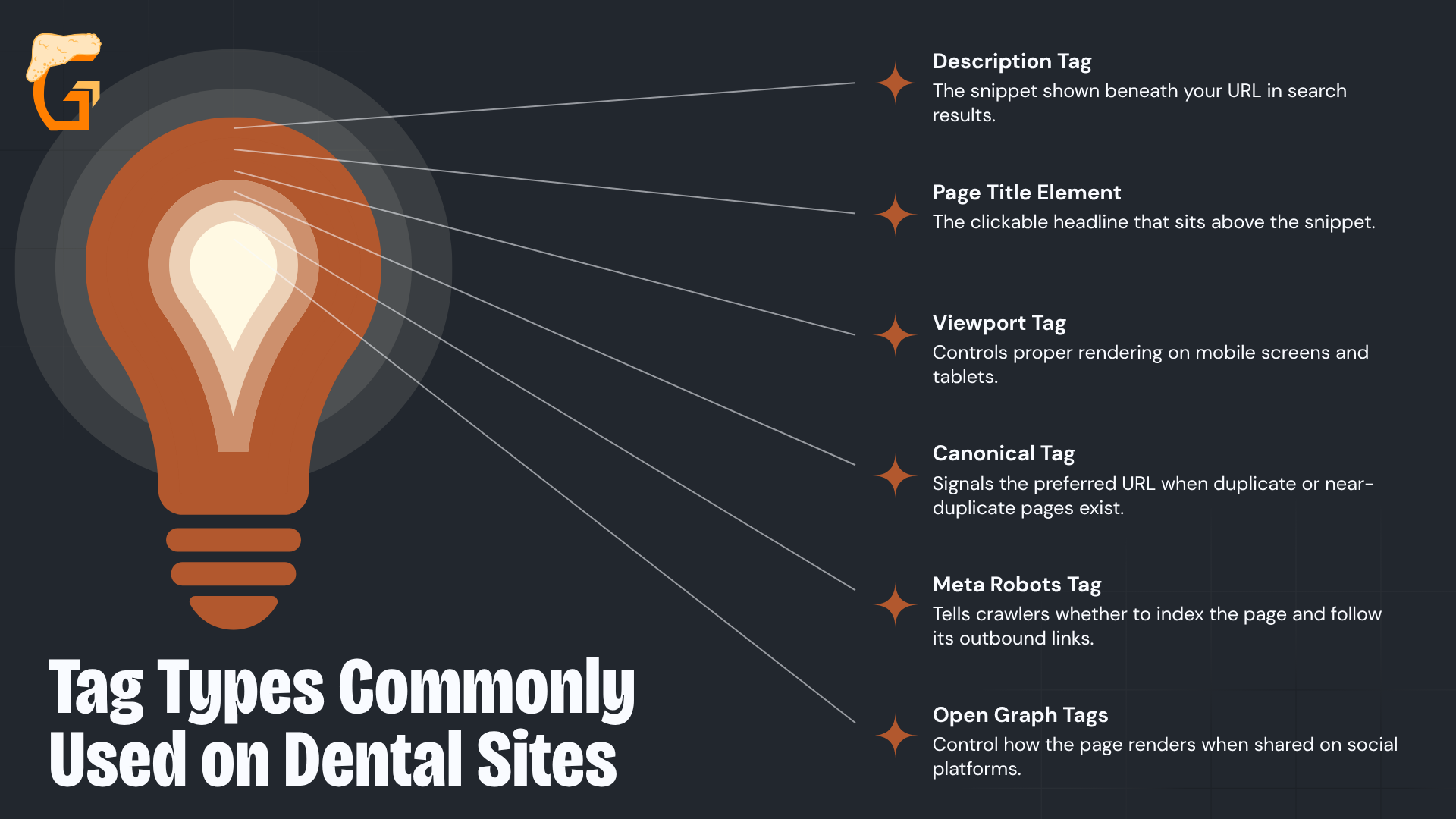
Every dental site should configure a small set of essential tags.
Each plays a distinct role in how your pages are discovered, displayed, and ranked:
- Description tag: the snippet shown beneath your URL in search results.
- Page title element: the clickable headline that sits above the snippet.
- Viewport tag: controls proper rendering on mobile screens and tablets.
- Canonical tag: signals the preferred URL when duplicate or near-duplicate pages exist.
- Meta robots tag: tells crawlers whether to index the page and follow its outbound links.
- Open Graph tags: control how the page renders when shared on social platforms.
None of these should be left at default values from your content management system.
Audit them at least quarterly, and any time you launch a major template change or migrate to a new platform.
Snippet writing is just one lever among many.
Growth Saloon helps dental practices build a complete digital presence that consistently generates qualified new patient inquiries without leaning entirely on google ads to fill the appointment book.
Reach out to our team to see how our dental marketing services can lower your cost per new patient and grow your practice.
Best Practices for Optimizing Meta Descriptions
Effective snippet writing follows a tight formula:
- Lead with a clear benefit;
- Include one or two relevant keywords near the front of the line; and
- Close with a call to action that tells the reader exactly what to do next.
Every word has to earn its space in such a short string.
Proper optimization avoids the temptation of keyword stuffing (cramming target keywords into every available slot).
The keywords relevant to each individual page should appear naturally rather than stuffed.
Google penalizes obvious manipulation and will rewrite poor snippets on the fly anyway, replacing your carefully chosen text with arbitrary sentences pulled from your body content, sometimes mid-paragraph.
Character Limits and Snippet Truncation
Aim for 150 to 160 characters on desktop and around 120 on smaller mobile screens.
Different browsers and devices truncate at slightly different points, so leave yourself a small buffer rather than maxing out the count.
Anything longer gets cut with an ellipsis in google search results, often mid-sentence, which makes your office look careless to anyone scanning the listings.
Place the most important information in the first 100 characters as insurance against truncation across devices and screen sizes.
Writing Compelling Calls to Action

Close every snippet with a verb the reader can act on.
Vague endings like “learn more” or “find out” waste the most valuable real estate in the line and rarely outperform a direct ask.
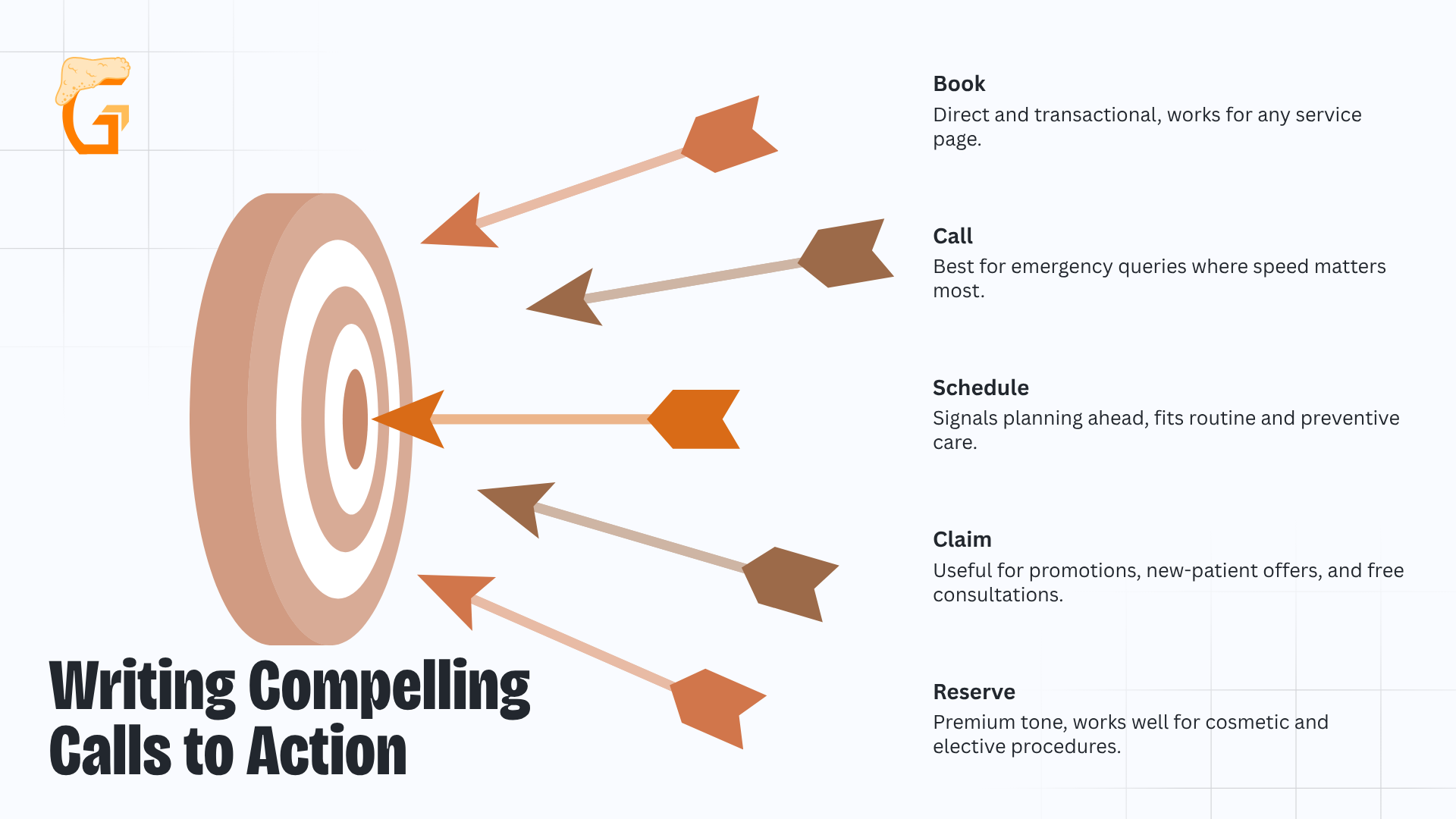
The verbs that consistently outperform in dental snippets fall into a small group:
- Book: direct and transactional, works for any service page.
- Call: best for emergency queries where speed matters most.
- Schedule: signals planning ahead, fits routine and preventive care.
- Claim: useful for promotions, new-patient offers, and free consultations.
- Reserve: premium tone, works well for cosmetic and elective procedures.
Highlight your unique selling points such as same-day appointments, financing plans, sedation options, or new-patient discounts in the limited space available.
If a cosmetic page hosts before and after photos, tease them in the description to spike curiosity-driven clicks from prospects who are actively comparing providers.
How’s your SEO going?
Enter your website URL below to get a free comprehensive SEO audit.
The audit includes:
- A scan of your entire website for technical issues
- A list of your top opportunities to target immediately
- Your highest priority fixes to make
Why You Should Never Use the Same Meta Description Twice
Copy-pasting one snippet across an entire site is the most common mistake in dental SEO.
It is also one of the easiest to fix once flagged.
Each page targets a different query and a different reader (using identical copy across multiple web pages signals to Google that those pages are interchangeable and that one of them should probably be ignored).
Worse, identical previews give searchers zero reason to pick one of your pages over another in the search results list when they scan the listings side by side.
How Duplicate Snippets Hurt Online Visibility Across Search Engine Results Pages
When Google detects duplicate description tags across a domain, it often suppresses several variants and rewrites the others using arbitrary body text.
You lose control over how your most important pages are presented to searchers.
The result is unpredictable, sometimes embarrassing previews, and lost search engine rankings as click metrics decline across the affected URLs.
The damage compounds the longer the duplicates remain in place, since each rewrite trains Google further away from your original intent.
Creating Unique Snippets at Scale
For practices with dozens of URLs, write a template per content category rather than trying to draft each one from a blank slate.
Templates standardize tone while leaving room for page-specific variables.
A service page about veneers gets a different formula than a blog post about flossing technique.
Track which templates outperform and refine them based on real click data pulled from Search Console rather than guessing at what feels persuasive.
Growth Saloon helps dental practices coordinate every on-page element into a digital presence that consistently generates qualified new patient inquiries – not just clicks.
Talk to our team about how our dental marketing services can lower your cost per new patient and grow your practice.
Strong Title Tag Construction for Dental Sites
The headline above the snippet (sometimes called the meta title in older content management systems) carries more SEO weight than the description itself.
It is the first thing Google reads and the first thing a searcher sees, so it sets the framing for everything below it.
A focused, keyword-led headline paired with a benefit-led snippet is the highest-converting combination in dental search engine performance.
Refining the pairing alone often delivers double-digit traffic gains within a few weeks, with no other changes to the page.
Pairing Headlines With Descriptions
The headline should establish the topic.
The description should expand on the value and tell the reader what they will get by clicking.
The two work as a single unit, not as independent fields.
When both work together to match search intent, click rates climb because the listing reads like a coherent answer to the user’s question rather than a generic page label.
A mismatch between the two confuses the scanner and sends them to a competitor’s listing instead.
Keyword Placement Within Headlines
Lead with your primary phrase, follow with a useful modifier, and end with your brand name.
Front-loading the keyword tells both Google and the human reader what the page is about within the first two or three words.
“Veneers in Austin | Smile Studio Dental” outperforms “Smile Studio Dental Cosmetic Services Including Veneers” because the front-loaded structure reflects keyword research best practices and matches how readers scan a results page from top to bottom and left to right.
Mastering On Page SEO Fundamentals
Beyond the snippet, your page needs strong on-page foundations:
- Clean URLs;
- Descriptive image alt text;
- Proper heading hierarchy;
- Fast load times; and
- Accessible markup.
Each piece supports the others, and weakness in one area drags the whole page down.
Even a perfect description cannot rescue a poorly structured page once the visitor lands.
This applies to every offering you provide, from routine cleanings to dental implants to full-mouth reconstructions.
The technical baseline determines how much your snippet effort actually returns.
Header Structure and Hierarchy
One H1 per page, descriptive H2s for major sections, and H3s nested logically beneath them.
Skipping levels or using headings to style text rather than to structure content confuses crawlers and assistive technologies alike.
A page targeting cosmetic dentistry might cover veneers, whitening, bonding, and Invisalign as H2s, each followed by relevant H3s on process, cost, recovery timelines, and aftercare.
A solo cosmetic dentist running their own site can apply the same blueprint to structure clean, scannable service pages without an in-house design team.
Internal Linking Patterns
Connect related pages contextually within body content, using anchor text that describes the destination clearly rather than generic “click here” phrasing.
An article on tooth pain should link to your emergency dental care page.
A piece on Invisalign should link to financing and consultation pages.
Practices offering emergency services should ensure every relevant page funnels readers toward the booking widget within one or two clicks.
These connections distribute authority across your site and help readers find what they need faster, lifting time-on-site metrics in the process.
Local SEO Strategies for Dental Offices
Most dental traffic is local, which means location signals deserve as much attention as content signals.
Optimizing for nearby search terms such as “dentist near me,” “Brooklyn pediatric dentist,” or specific neighborhood names drives the local search volume that fills appointment books faster than any other channel.
Dedicate a separate page to each office location and another to each of the local services you offer to maximize geographic coverage in the index.
When potential patients search for nearby providers, the practices that show up in local search results are the ones that have invested in granular geographic structure rather than relying on a single generic homepage.
Optimizing for Geographic Queries
Include city and neighborhood names in headlines, body copy, image alt text, and structured data markup.
Adding local business schema tells search engines exactly what your office offers and where, which surfaces you in map-pack listings far more reliably than text signals alone.
Maintain a complete, accurate google business profile with current hours, photos, services, and recent posts.
Encourage reviews on Google after every visit and respond to every one, positive or negative, within 48 hours to demonstrate active management.
Building Citations and Reviews
When patients search for “best dentist in [city],” consistent listings across directories such as Yelp, Healthgrades, Zocdoc, and dental association sites reinforce your authority and trustworthiness in the eyes of both Google and the searcher.
Display patient testimonials prominently on service pages and the homepage above the fold, ideally with photos and full names rather than anonymous quotes.
Make sure name, address, and phone match exactly across every citation, down to abbreviation conventions and suite numbers.
Even small mismatches dilute the local signal and confuse Google’s confidence in your office’s true location.
Growth Saloon helps dental practices build the kind of local digital presence that consistently generates qualified new patient inquiries – not just clicks.
Get in touch with our team today to learn how our dental marketing services can lower your cost per new patient and grow your practice.
Building a Dental SEO Foundation
Strong dental marketing online starts with technical seo:
- Fast, mobile-friendly site;
- Structured data markup;
- Secure HTTPS;
- A logical sitemap; and
- Clean redirects for any retired URLs.
None of this work shows up in your snippets directly.
But all of it influences whether Google trusts your domain enough to show those snippets prominently in the first place.
Without the foundation, even great copy stays invisible.
Technical Considerations
Audit your site monthly using google search console and other analytics tools for crawl errors, indexing issues, manual actions, and Core Web Vitals problems.
Most issues are simple to fix once surfaced, but they go unnoticed without active monitoring.
Pay special attention to performance on mobile devices, since the majority of dental queries now happen on phones during moments of immediate need.
A slow mobile site loses prospects before the snippet’s promise can be delivered.
Content Planning and Themes
Map content to the patient journey:
- Awareness articles for early-stage research;
- Comparison guides for evaluation;
- Service deep-dives for decision-makers; and
- FAQs for post-booking reassurance.
Update each piece regularly to keep it accurate and competitive.
If you outsource the work, choose a dental marketing company that values clinical accuracy and compliance, not a generic agency that writes the same copy for every industry from plumbers to personal injury lawyers.
The vocabulary and trust signals matter enormously in healthcare.
Aligning Content with Search Intent
Every query carries an underlying purpose, and your page either matches that purpose or loses the click to a competitor that does.
A search for “wisdom tooth removal recovery” wants reassurance and timelines.
“Wisdom tooth removal near me” wants a phone number and the next available appointment slot.
The same keyword stem produces wildly different optimal pages depending on the modifier.
Your snippet, headline, and page content should map to that purpose at every layer.
A smart social media strategy across social media platforms like Instagram, Facebook, and TikTok can reinforce the same themes off-site, multiplying the impact of every page you optimize by sending pre-qualified traffic from platforms where your prospects already spend time.
Informational Versus Transactional Queries
Informational queries deserve depth (a 2,000-word guide with images, citations, internal links, and clear navigation between sections).
The reader is researching, not buying yet.
Transactional queries deserve speed (a short page with phone number, hours, and a booking widget above the fold).
Map each URL on your dental practice’s website to one of these intents and design the layout accordingly rather than forcing a single template across both types.
Mapping Pages to User Goals
Audit your pages annually for intent alignment, comparing each page’s purpose against the queries actually driving traffic to it.
Anything ranking inconsistently across Google or other search engines is likely intent-misaligned.
Rewrite the snippet first, then the headline, then the content, in that order, and re-measure performance after four weeks before making additional changes.
Aligning every page with real search intent is what separates top-ranked dental sites from the rest.
Growth Saloon helps dental practices build a digital presence that consistently generates qualified new patient inquiries – not just clicks.
Connect with our team today to find out how our dental marketing services can lower your cost per new patient and grow your practice.
How the Robots Meta Tag Controls Indexing
Some pages should never appear in search results at all:
- Thank-you pages after form submissions;
- Internal staff resources;
- Gated lead magnets; or
- Duplicate variants you set up for split testing campaigns.
The robots directive is how you tell Google to skip them while still allowing visitors to access them through internal links or direct URLs.
It is one of the most powerful and most misused tags in the head section of a typical dental site.
Common Directives Explained

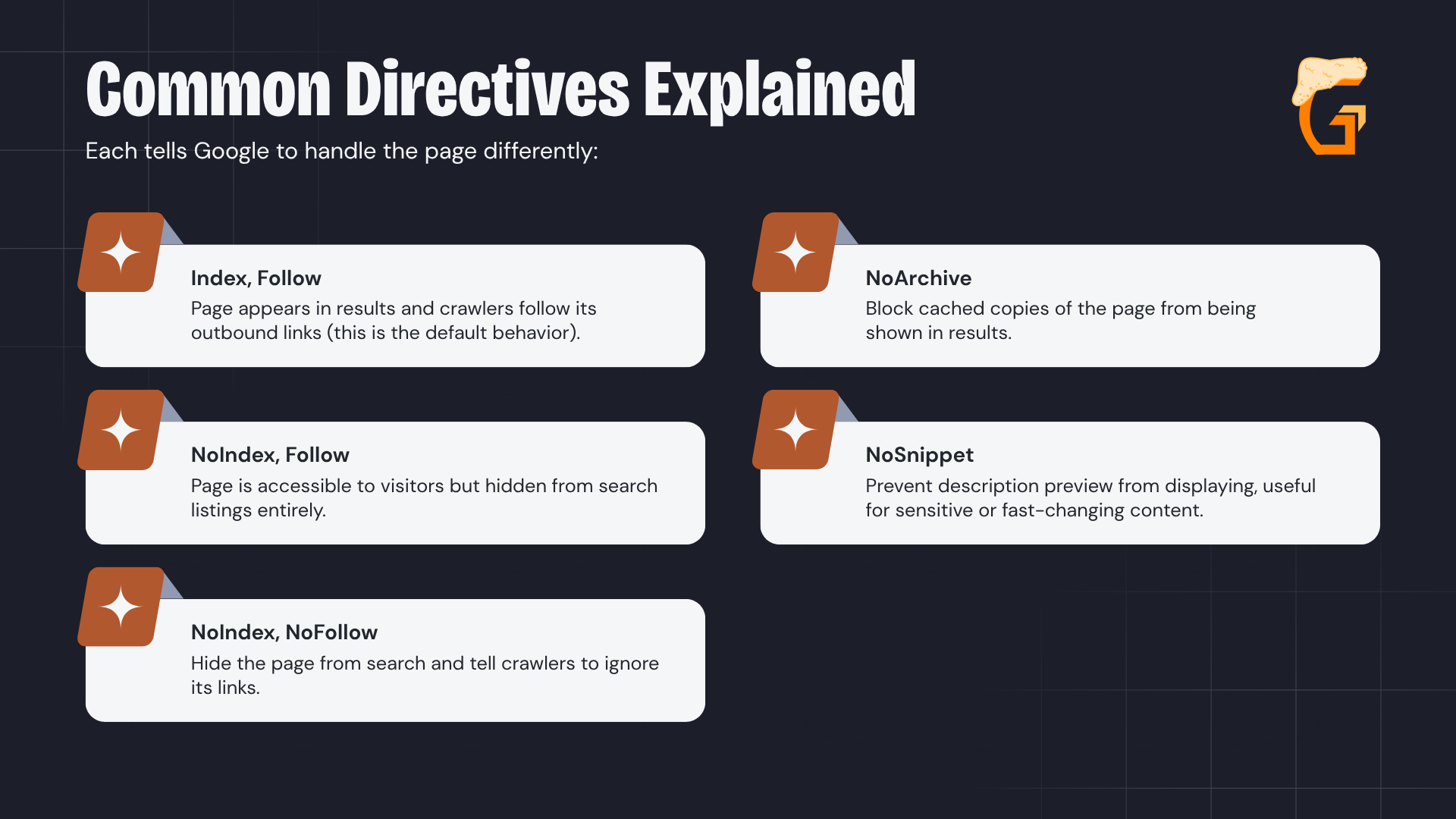
The robots meta tag accepts a small set of directive combinations.
Each tells Google to handle the page differently:
- index, follow: page appears in results and crawlers follow its outbound links (this is the default behavior).
- noindex, follow: page is accessible to visitors but hidden from search listings entirely.
- noindex, nofollow: hide the page from search and tell crawlers to ignore its links.
- noarchive: block cached copies of the page from being shown in results.
- nosnippet: prevent description preview from displaying, useful for sensitive or fast-changing content.
These can be combined in a single tag separated by commas.
Most dental pages only ever need the first two values, but knowing the others exists prevents accidents during site audits.
When to Apply Noindex Rules
Apply noindex to pages with no SEO value (confirmation pages, login screens, internal search results pages, tag archives, and paginated category lists past the first few pages).
Audit your site quarterly to catch pages that drifted into the index by accident, often because a CMS update reset their settings or a template change exposed new URLs.
Prune them so crawl budget concentrates on revenue-generating URLs that drive new appointment requests.
Snippet writing rewards iteration more than perfection.
Schedule a quarterly review where you check Search Console for impression and click data across your top fifty URLs, identify the worst-performing description on each, and rewrite it based on what the query data actually shows.
Real seo success comes from this compound work (the unglamorous, durable kind that builds organic traffic without forcing you to depend entirely on the appointment book).
Stack these improvements over a year and you will measurably grow appointment requests without adding a single new page to the site.
How Can Growth Saloon Help Your Dental Practice Grow?
Growth Saloon is a Chicago-based digital marketing agency built to help dental practices attract more patients and grow their practice through performance-driven digital marketing.
Mike Lowe and the Growth Saloon team specialize in SEO, web design, conversion rate optimization, and marketing attribution (working alongside your practice to build a measurable digital presence that generates qualified patient inquiries, not just website traffic).
From ranking for high-intent local search terms to converting site visitors into booked appointments, Growth Saloon focuses on results at every stage of the patient acquisition funnel.
Practice owners and marketing managers get clear visibility into exactly which channels are driving new patient growth.
We know that every open appointment slot has a real cost.
Every decision we make is built around one outcome: helping your practice fill more of them.
Meet the Founder of Growth Saloon
Meet the founder and lead strategist at Growth Saloon, Mike Lowe:
- As founder and CEO of Growth Saloon, Mike brings years of hands-on experience in SEO strategy, CRO, web design, and marketing attribution for service-based businesses competing in local and regional markets.
- Based in Chicago and working with practices across the country, Mike has built and managed digital growth campaigns for businesses competing in some of the most contested search markets in the country.
- Growth Saloon’s data-driven approach to local SEO and patient acquisition helps dental practices turn their websites into their highest-performing new patient channel.
What Does Working With Growth Saloon Look Like?
Growth Saloon operates as a dedicated extension of your marketing team – not a vendor that disappears after onboarding.
Every engagement includes direct access to Mike and the team, transparent reporting tied to actual patient acquisition outcomes, and strategies tailored to your specific services and local market.
Whether you’re looking to rank for high-value procedures, improve your site’s appointment conversion rate, or finally get clarity on where your new patients are actually coming from, Growth Saloon builds the strategy and does the work.
Growth Saloon helps dental practices build the kind of digital presence that consistently generates qualified new patient inquiries – not just clicks.
Contact our team today to find out how our dental marketing services can lower your cost per new patient and grow your practice.
How's your SEO going?
Get your free comprehensive SEO audit.
Enter your website URL below to get a free comprehensive SEO audit.
- Scan entire website for technical issues
- Get a list of your top opportunities
- See your highest priority fixes to make
-
Meta descriptions should be kept between 150-160 characters to ensure they display fully in search results without being cut off by Google.
Anything longer risks getting truncated mid-sentence, which makes your listing look unprofessional and reduces click-through rates.
-
No. Each page on a dental website should have a unique meta description tailored to its specific content.
Duplicates confuse search engines about which page to rank for a given query and give searchers no reason to choose one of your pages over another in the listings.
-
Dental practices with properly implemented schema markup see a 30% increase in click-through rates compared to those without it, following recent algorithm updates.
Schema gives Google the structured context it needs to show rich results, which command more attention in the search listings.
-
Optimizing for local searches involves ensuring that your practice’s name, address, and phone number (NAP) are consistent across all online directories and your Google Business Profile.
Inconsistent listings dilute the local signal and confuse Google’s confidence in your office’s true location.
-
Google Maps rankings for dental practices depend on three (3) main factors:
- Relevance (how well your listing matches the query)
- Distance (proximity between the searcher and your office)
- Prominence (the strength of your overall reputation)
Together, these factors are essential for local SEO success in the dental industry.
-
Over 60% of dental searches happen on mobile devices, and 76% of people who search for a nearby business on their smartphone visit a business within 24 hours.
Google also ranks websites based on their mobile version, making a mobile-friendly design a baseline requirement for improving search visibility and attracting new patients.
You do not have to implement every tactic in this guide alone.
Growth Saloon helps dental practices build the kind of digital presence that consistently generates qualified new patient inquiries – not just clicks.
Schedule a call with our team today to find out how our dental marketing services can lower your cost per new patient and grow your practice.
Most agencies sell traffic. We sell actual growth. That’s the Growth Saloon difference.
Are you looking to grow?
Recent blogs
Enter your website URL below to get free comprehensive SEO audit.
- Scan entire website for technical issues
- Get a list of your top opportunities
- See your highest priority fixes to make