

Key takeaways
- Competitor analysis matters because top-three organic positions generate about 300% more new-patient inquiries than page two, and 46% of dental searches carry local intent that the map pack captures first.
- Identify your real competitors by searching your own service terms, narrowing to the 5 to 10 practices that appear across multiple queries (the benchmark for where your dental practice stands in both the map pack and organic results).
- Turn the research into a prioritized action list, fixing high-intent service-plus-location page gaps first, then foundational citations, before chasing editorial backlinks or closing review-velocity gaps.
Are You Running Competitor Analysis for Dental SEO (or Just Guessing)?
Competitor analysis for dental SEO is the difference between directing your marketing efforts strategically and spending on assumptions.
When a patient queries search engines for “dental implants [city]” or “Invisalign near me,” the practices showing up on page one are not there by accident.
These practices have mapped what their competitors are doing and built a measurable edge over them.
Without that research, you are aiming your SEO efforts at a benchmark you have never actually looked at.
Competitors are claiming the appointments, earning the reviews, and closing the content gaps while your dental practice’s online presence stalls in areas that may not be moving the needle at all.
The Growth Saloon team works exclusively with dental professionals on exactly this kind of research (turning competitor data into a prioritized action list of pages to build, signals to fix, and links to earn).
Use this guide to run that process yourself, or reach out to dental SEO experts to talk through what it looks like for your specific market.
Growth Saloon helps dental practices build the kind of digital presence that consistently generates qualified new patient inquiries – not just clicks.
Contact our team today to find out how our dental marketing services can lower your cost per new patient and grow your practice.
What Is Dental SEO Competitor Analysis and Why Does It Matter?
Dental SEO competitor analysis is the practice of comparing your site’s keyword rankings, content, backlinks, and local signals against the practices that rank above you (the diagnostic step before investing in dental SEO services).
Without it, you are improving in a vacuum.
What Does Dental SEO Competitor Analysis Actually Involve?
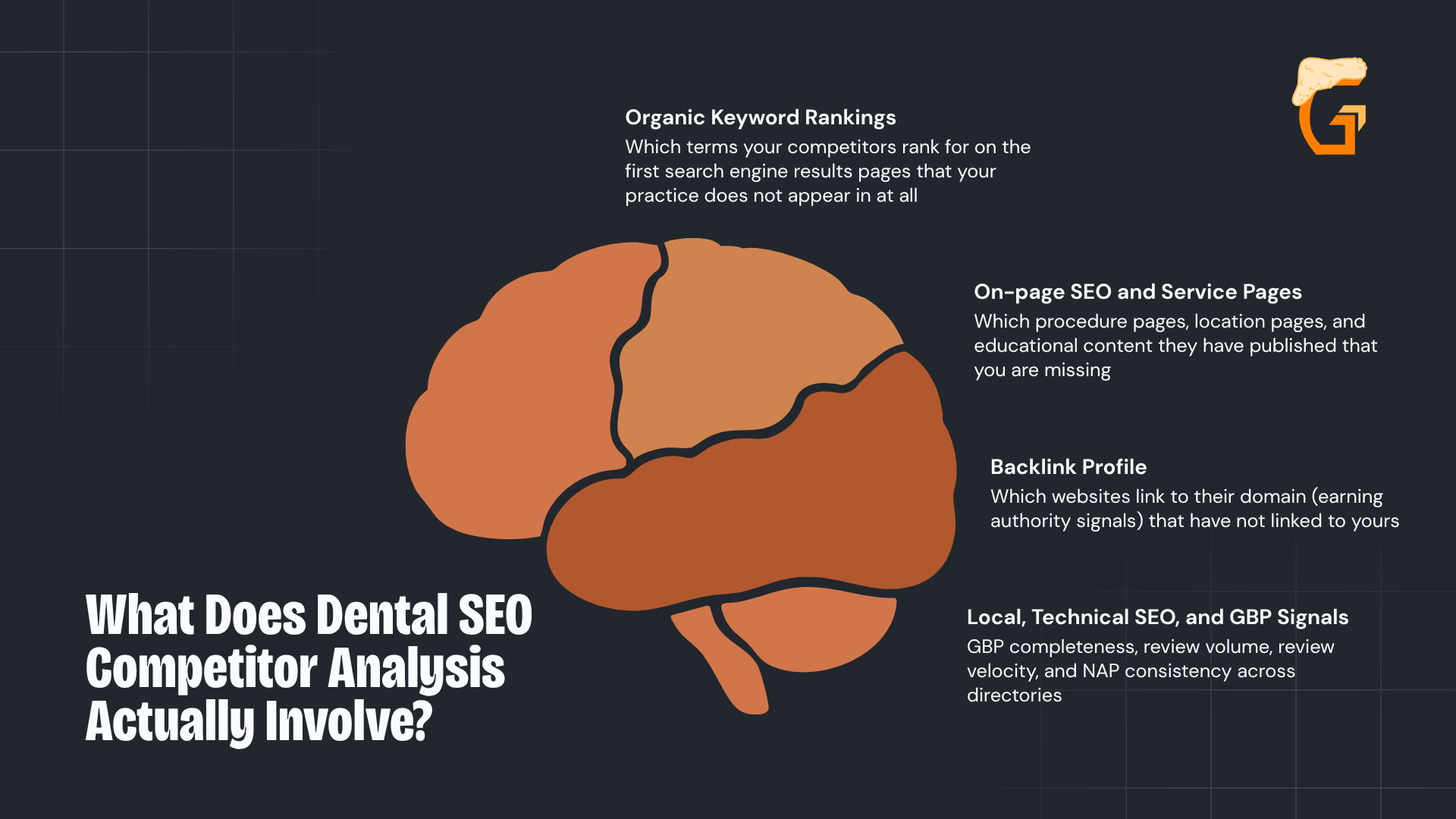
Competitor analysis is a side-by-side comparison across four signal groups:
- Organic keyword rankings: which terms your competitors rank for on the first search engine results pages that your practice does not appear in at all
- On-page SEO and service pages: which procedure pages, location pages, and educational content they have published that you are missing
- Backlink profile: which websites link to their domain (earning authority signals) that have not linked to yours
- Local, technical SEO, and GBP signals: GBP completeness, review volume, review velocity, and NAP consistency across directories
According to Backlinko’s analysis of Google click-through rates, top organic positions capture the overwhelming share of clicks (the #1 result earns a 27.6% click-through rate while page two captures only 0.63% of clicks).
Practices ranking in the top three generate far more new patient inquiries than those on page two or lower.
True competitors are the practices ranking online for your service terms, not necessarily the dental office nearest to you geographically.
The deliverable of a competitor analysis is a specific, prioritized action list (pages to create, content to improve, links to earn).
Not a document that sits in a folder.
Why Does Competitor Analysis Matter for a Local Dental Practice?
Local dental search is high-intent.
When dental patients search “dentist in [city]” or “dental implants near me,” they are typically ready to book within days.
The practice visible at that moment captures the appointment.
The data behind that urgency is consistent:
- 46% of Google searches have local intent (the majority of search queries for dental services land in the local search results)
- 71% of prospective patients research dentists online before booking (visibility is a prerequisite for consideration, not a bonus)
- Top-3 organic and map pack positions drive the bulk of new-patient inquiries; page two is effectively invisible for intent-heavy local searches
Without competitor analysis, your marketing budget for search engine optimization is guesswork.
You are spending against opponents you have never measured.
How to Find Your Real Dental SEO Competitors
Your real dental SEO competitors are the practices with the strongest local search visibility, consistently appearing in page-one organic results and the local map pack for your target service terms (not necessarily the offices closest to you).
Search incognito to see the unfiltered results.
How Do I Identify Competitors by Searching My Own Service Terms?
The manual method is the starting point.
Open an incognito browser window so personalization does not skew results, and search your highest-value service terms.
Run these searches using your city name:
- “dentist [city]”
- “dental implants [city]”
- “Invisalign [city]”
- “cosmetic dentist [city]”
Log the dental clinics that appear consistently across multiple high-value searches.
According to Ahrefs’ local SEO guide, the practices showing up across your service-term searches are your real online competitors (a nearby office that never appears in search is not one, regardless of physical proximity).
Narrow the list to 5–10 practices appearing across multiple queries.
These are the sites to benchmark against.
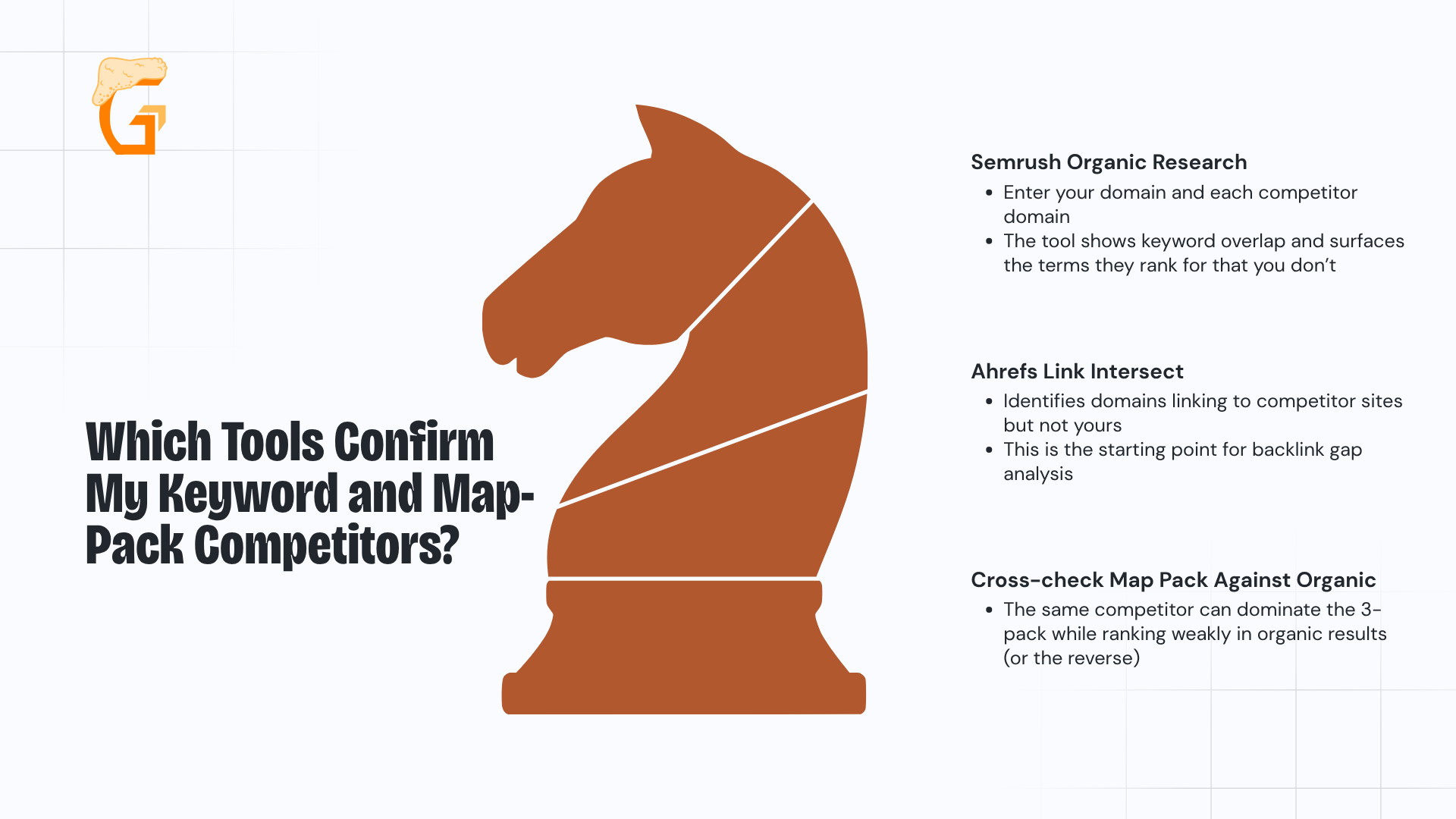
Which Tools Confirm My Keyword and Map-Pack Competitors?

Manual searching and competitive analysis identify who shows up.
Tools confirm the keyword overlap:
- Semrush Organic Research:
- Enter your domain and each competitor domain.
- The tool shows keyword overlap and surfaces the terms they rank for that you don’t.
- Ahrefs Link Intersect:
- This identifies domains linking to competitor sites but not yours.
- This is the starting point for backlink gap analysis.
- Cross-check map pack against organic:
- The same competitor can dominate the 3-pack while ranking weakly in organic results (or the reverse).
A practice can win the local map pack through strong GBP signals and reviews while its organic rankings are modest (the fixes for each gap are different).
Growth Saloon turns competitor research into an action plan that produces qualified new patient inquiries – not just a report of what rivals are doing.
Contact our team today to find out how our dental marketing services can lower your cost per new patient and grow your practice.
How to Find Keyword and Content Gaps in Competing Dental Sites
A keyword gap (surfaced through keyword research) is a search term your competitors rank for that your site doesn’t target.
A content gap is a page type or topic they have that you’re missing.
Both are found using digital competitor analysis tools such as Semrush Keyword Gap or Ahrefs Content Gap.
How Do I Run a Keyword and Content Gap Analysis on Competitors?
Ahrefs’ content gap analysis tool lets you enter your domain alongside up to four competitor domains to surface terms they rank for that your site does not target:
- Enter your domain plus up to four competitor domains for keyword optimization comparison.
- Filter for keywords that include your city name or service terms (“dental implants Austin,” “emergency dentist near me”).
- Review competitor pages promoting dental services online for procedures you offer but have no dedicated page for (implants, Invisalign, veneers, orthodontics, emergency services, etc).
- Scanning competitor blog content for unanswered patient questions surfaces new and refreshing ideas for posts your own site is missing.
The tool output is a raw list.
Competitor blog content is where patient expectations and emerging service trends most often surface (topics patients search before booking that competitors have answered and you have not).
Which Gaps Should a Dental Practice Fix First?

Not all gaps carry equal weight.
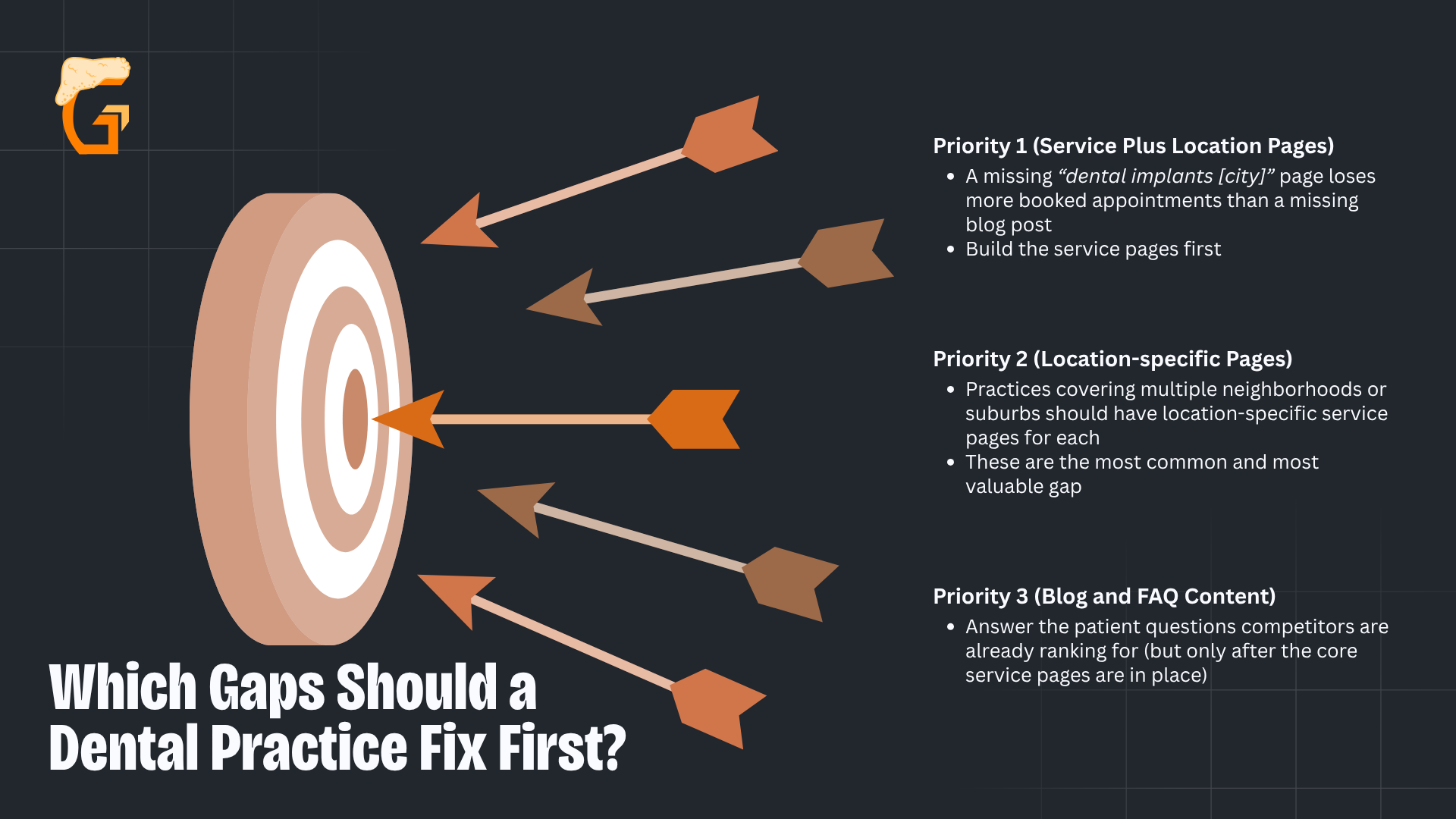
High-intent service plus location terms outrank informational queries for fix priority every time:
- Priority 1 (service plus location pages):
- A missing “dental implants [city]” page loses more booked appointments than a missing blog post.
- Build the service pages first.
- Priority 2 (location-specific pages):
- Practices covering multiple neighborhoods or suburbs should have location-specific service pages for each.
- These are the most common and most valuable gap.
- Priority 3 (blog and FAQ content):
- Answer the patient questions competitors are already ranking for (but only after the core service pages are in place).
The output of this step is a ranked list of pages to create or improve.
Growth Saloon closes the content gaps competitors are exploiting and builds the pages that generate qualified new patient inquiries – not just clicks.
Contact our team today to find out how our dental marketing services can lower your cost per new patient and grow your practice.
A missing service page is the highest-ROI gap; start there.
How’s your SEO going?
Enter your website URL below to get a free comprehensive SEO audit.
The audit includes:
- A scan of your entire website for technical issues
- A list of your top opportunities to target immediately
- Your highest priority fixes to make
How to Analyze Competitor Backlinks for Your Dental Practice
Backlink analysis shows which websites link to top-ranking competitors but not to you – those are your link-building opportunities.
Start with the tools dental SEO companies rely on, Ahrefs or Semrush, to pull competitor backlink profiles and sort by referring domains.
How Do I Read a Competitor’s Backlink Profile?
Pull each competitor’s backlink profile in Ahrefs or Semrush and sort by referring domains, not raw link count:
- BrightLocal’s local competitor analysis framework finds that the strongest backlink opportunities for local businesses come from sites already linking to similar local competitors.
- Separate citations (Healthgrades, Zocdoc, WebMD, and other directory listings) from editorial backlinks (local news, chambers of commerce, partner organizations) – they have different acquisition paths.
- Identify sites linking to two or more of your competitors but not to you (these are the highest-probability targets because they have already shown willingness to link to practices in your category).
- Note anchor-text patterns and what topics your competitors are most cited for (his reveals which content earns links in your market).
The link-intersection view is the most efficient prospecting method.
No cold outreach to sites that have never linked to a dental practice before.
Which Links Should a Dental Practice Pursue First?

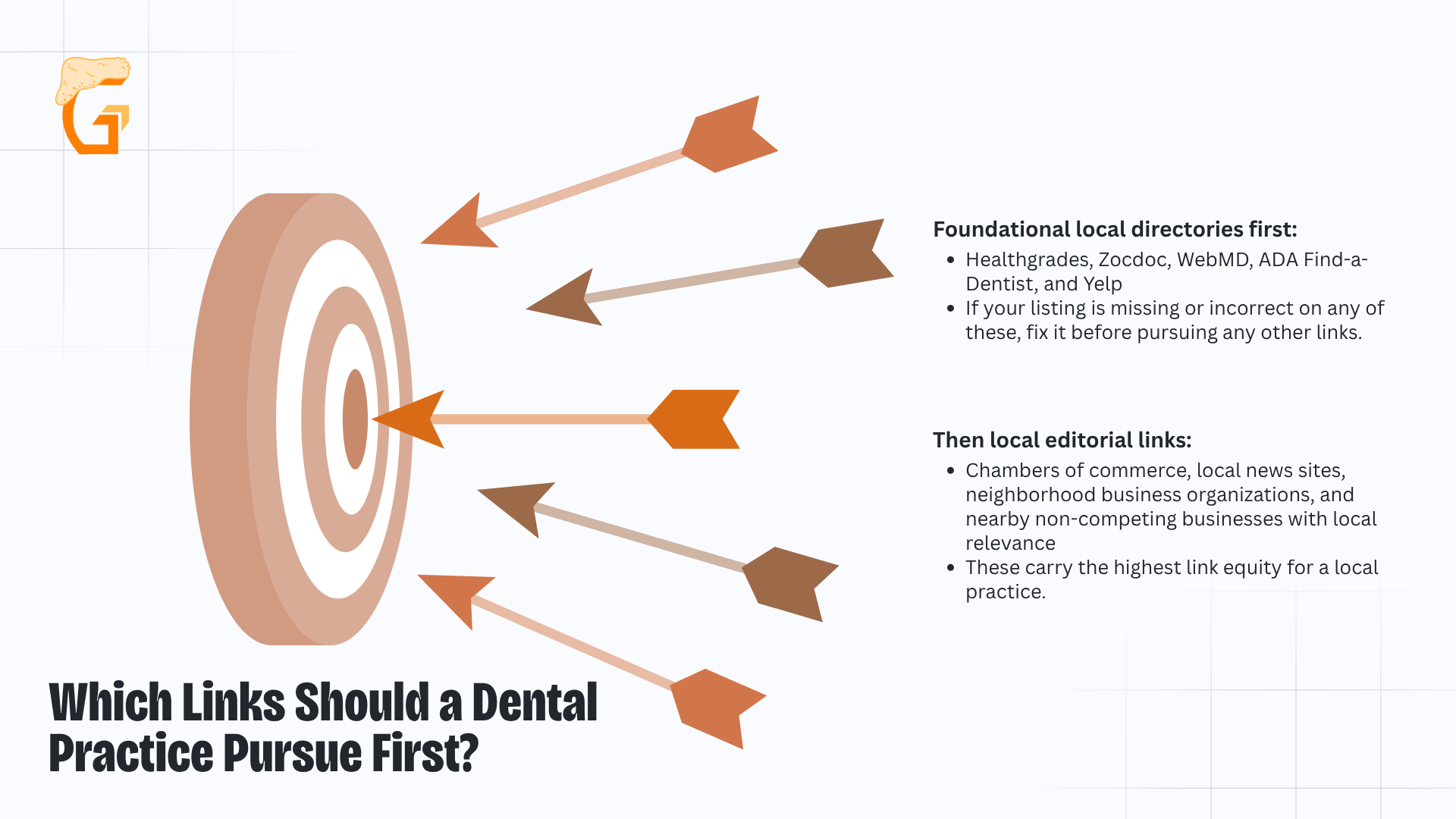
The priority hierarchy begins by getting the foundational citations in place before chasing editorial links.
Pursue link targets in this sequence:
- Foundational local directories first:
- Healthgrades, Zocdoc, WebMD, ADA Find-a-Dentist, and Yelp
- If your listing is missing or incorrect on any of these, fix it before pursuing any other links.
- Local editorial links:
- Chambers of commerce, local news sites, neighborhood business organizations, and nearby non-competing businesses with local relevance
- These carry the highest link equity for a local practice.
The underrated fix: correcting NAP inconsistencies across existing local listings often produces faster local ranking movement than acquiring new links.
A mismatched address or phone number across 40 online directories sends conflicting entity signals that suppress local visibility.
Growth Saloon builds the local links and citation consistency that move a dental practice up the map pack and into qualified new patient inquiries – not just clicks.
Contact our team today to find out how our dental marketing services can lower your cost per new patient and grow your practice.
How to Compare Local SEO Signals Against Top-Ranking Dental Competitors
An SEO audit comparing local signals means auditing competitors’ Google Business Profiles, review volume and velocity, NAP consistency, and location-page strength.
The map pack is the highest-visibility placement for dental searches, and winning it with the right local SEO techniques requires outperforming competitors on these specific signals.
Which Google Business Profile and NAP Signals Should I Compare?

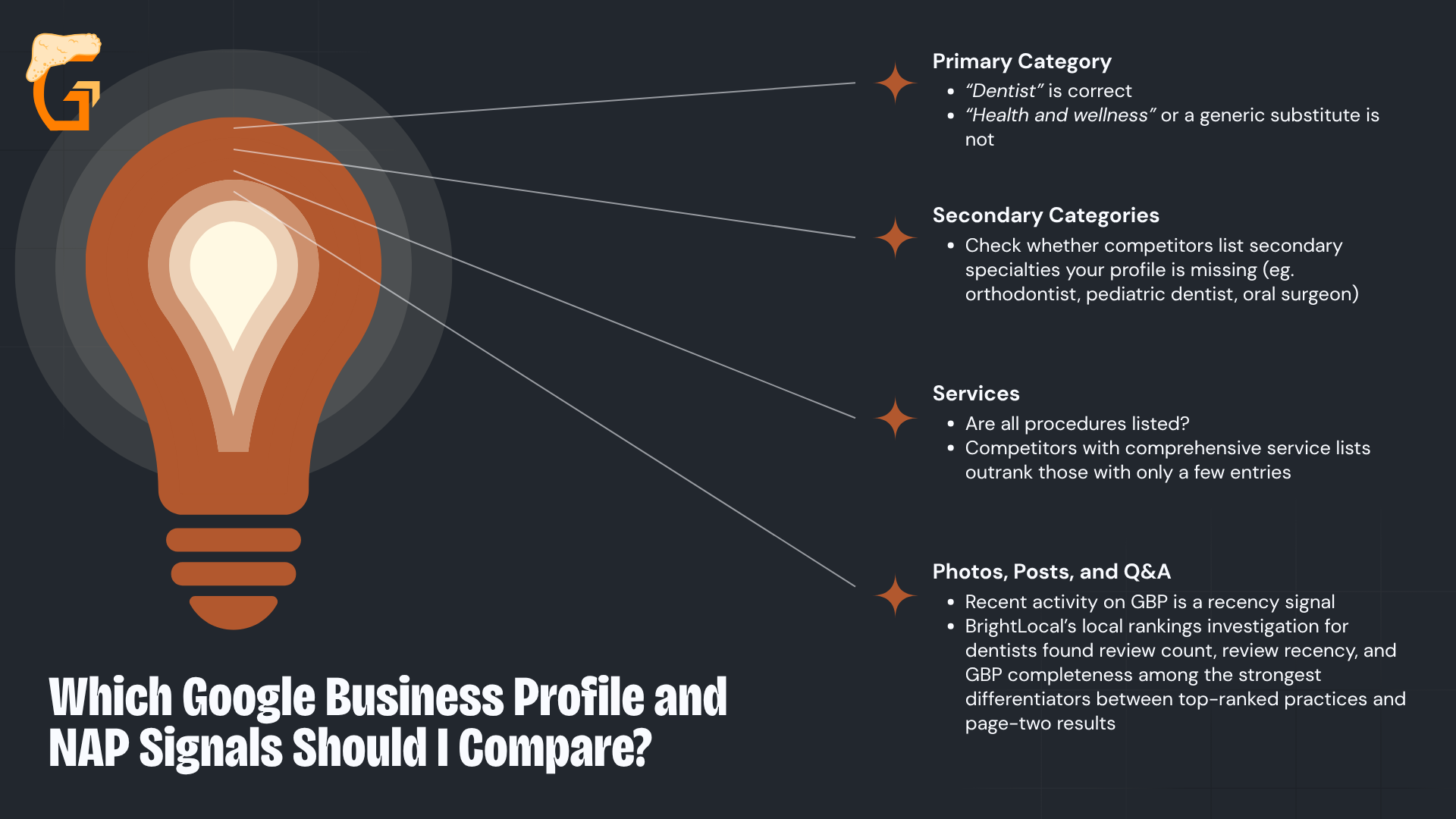
GBP completeness is one of the strongest local ranking signals for dental practices (and the most auditable):
- Primary category:
- “Dentist” is correct.
- “Health and wellness” or a generic substitute is not correct.
- Secondary categories:
- Check whether competitors list secondary specialties your profile is missing (orthodontist, pediatric dentist, oral surgeon, etc).
- Services:
- Are all procedures listed?
- Competitors with comprehensive service lists outrank those with only a few entries.
- Photos, posts, and Q&A:
- Recent activity on GBP is a recency signal.
- BrightLocal’s local rankings investigation for dentists found review count, review recency, and GBP completeness among the strongest differentiators between top-ranked practices and page-two results.
Audit both map pack and organic separately to map a dental practice’s online visibility.
The same competitor can lead one and trail the other (and each gap calls for different fixes).
How Do I Close a Competitor’s Review and Location-Page Gap?
Review velocity is the hardest gap to close (and the one that compounds fastest):
- Review count and star rating:
- Log total reviews and average rating for each competitor as a proxy for patient satisfaction.
- A competitor with 300 reviews at 4.9 stars is not matched in a week.
- Review velocity:
- How many reviews per month is each competitor earning?
- This is the rate you need to exceed, not just a one-time total to chase.
- Location-specific pages:
- Do competitors rank for suburb or neighborhood searches by building dedicated location landing pages?
- If so, and you don’t have them, that is a gap that costs appointments in those areas.
A competitor with 500 reviews at 4.8 stars cannot be overtaken without a systematic process for managing online reviews built into the practice workflow (post-appointment follow-up, text or email prompts, and a consistent response practice on all reviews).
Identify the review gap in the competitor analysis and start the process immediately; review velocity is the metric that takes the longest to move.
Growth Saloon helps dental practices build the kind of digital presence that consistently generates qualified new patient inquiries – not just clicks.
Contact our team today to find out how our dental marketing services can lower your cost per new patient and grow your practice.
How Can Growth Saloon Help Your Dental Practice Grow?
Growth Saloon is a Chicago-based digital marketing agency built to help the dental industry attract more patients and grow through performance-driven digital marketing.
Mike Lowe and the Growth Saloon team specialize in SEO, web design, conversion rate optimization, social media marketing, and marketing attribution – working alongside your practice to build a measurable digital presence that generates qualified patient inquiries, not just website traffic.
From ranking for high-intent local search terms and building social media presence to converting site visitors into booked appointments, Growth Saloon focuses on results at every stage of the patient acquisition funnel.
Practice owners and marketing managers get clear visibility into exactly which channels are driving new patient growth.
We know that every open appointment slot has a real cost.
Every decision we make is built around one outcome – helping your practice fill more of them.
Meet the Founder of Growth Saloon
Meet the founder and lead strategist at Growth Saloon – Mike Lowe:
- As founder and CEO of Growth Saloon, Mike brings years of hands-on experience in SEO strategy, CRO, web design, and marketing attribution for service-based businesses competing in local and regional markets.
- Based in Chicago and working with practices across the country, Mike has built and managed digital growth campaigns that support the business strategies of companies competing in some of the most contested search markets in the country.
- Growth Saloon’s data-driven approach to local SEO and patient acquisition raises a website’s visibility, turning it into a dental practice’s highest-performing new patient channel.
What Does Working With Growth Saloon Look Like?
Growth Saloon operates as a dedicated extension of your marketing team – not a vendor that disappears after onboarding.
Every engagement includes direct access to Mike and the team, transparent reporting tied to actual patient acquisition outcomes, and strategies tailored to your specific services and local market.
Whether you’re looking to rank for high-value procedures, improve your site’s appointment conversion rate, or finally get clarity on where your new patients are actually coming from, Growth Saloon builds the strategy and does the work.
Growth Saloon helps dental practices build the kind of digital presence that consistently generates qualified new patient inquiries – not just clicks.
Contact our team today to find out how our dental marketing services can lower your cost per new patient and grow your practice.
How's your SEO going?
Get your free comprehensive SEO audit.
Enter your website URL below to get a free comprehensive SEO audit.
- Scan entire website for technical issues
- Get a list of your top opportunities
- See your highest priority fixes to make
-
Run a full competitor analysis every six months, and do a lighter check quarterly.
Rankings shift after Google core updates, when a competitor publishes new content, or when a new practice enters your market.
Quarterly spot-checks on your top five competitor rankings and review counts keep you from falling behind without requiring a full audit each time.
-
Google Search Console and Google Analytics show your own ranking queries and pages.
Google Business Profile Insights shows how you compare on calls and direction requests.
For competitor keyword data, Semrush and Ahrefs offer limited free tiers.
The most practical free workflow is manual:
- Search your top service terms incognito.
- Note who ranks.
- Audit their pages directly.
Free tools give you direction; paid tools give you scale.
-
Competitor analysis should inform your marketing strategy, not produce copies.
Copying a competitor’s page structure or content can hurt you.
Google penalizes duplicate content and rewards original, useful pages.
Use competitor research to shape your dental practice’s SEO strategy, identifying topics they cover and gaps they leave open, then create better, more specific content.
The goal is to outperform them with novel marketing strategies, not replicate them.
-
Enter a competitor’s domain into Semrush’s Organic Research tool or Ahrefs’ Site Explorer.
Both let you track keyword rankings, estimated traffic, and the specific pages driving those rankings.
Filter for relevant keywords containing your city name or service terms.
Focus on the pages holding search rankings in positions one through ten.
Those are the pages your new or improved content needs to beat.
-
Focus primarily on local practices (those actually competing for patients in your market).
National chains like Aspen Dental or Heartland may rank for generic dental care terms, but local intent searches are dominated by local and regional results.
Track the chains if they appear in your local three-pack, but build your dental practice’s reputation on local relevance rather than competing with their domain authority.
Your edge is local relevance, not domain size.
-
Prioritize by impact.
Start with high-intent pages you’re missing (service plus location pages for procedures you offer) before moving to content gaps or backlink opportunities.
A missing “dental implants [city]” page loses more appointments from potential patients than a missing blog post.
Build or improve your core service pages first, then address content gaps, then work on link acquisition from directories and local sources your competitors use.
Most agencies sell traffic. We sell actual growth. That’s the Growth Saloon difference.
Are you looking to grow?
Recent blogs
Enter your website URL below to get free comprehensive SEO audit.
- Scan entire website for technical issues
- Get a list of your top opportunities
- See your highest priority fixes to make