Key takeaways
- Long-tail dental keywords are 4+ word phrases with lower volume but higher intent and rankable difficulty, and 2026 shifts like AI Overview CTR suppression and voice search widen their advantage over head terms.
- Low search volume is not low value, since stacking 10 to 15 high-intent variants per page captures cumulative demand, and scoring each term by intent, relevance, and difficulty keeps the map focused on terms that book patients.
- Deploy clusters with one primary keyword per page plus 5 to 15 supporting variants across headings, FAQ blocks, and body copy to avoid cannibalization and compound rankings over time.
Why Do Long-Tail Keywords for Dentists Convert Better Than Head Terms?
Long-tail keywords for dentists are the specific, multi-word search phrases that bring high-intent patients to your dental practice website (potential patients who have already made most of their decision before clicking a result).
While high traffic keywords like “dentist near me” or “dental implants” attract heavy search volume, they’re dominated by directories, DSOs, and competitors with years of domain authority stacked against single-location practices.
A patient actively seeking care by typing “emergency dentist open Saturday near me” or “how much do dental implants cost in [city]” has already self-qualified.
That specificity is the signal: local keywords bring lower competition, higher intent, and a searcher ready to book.
With 73% of small businesses now investing in online marketing, the race for generic head terms grows fiercer every year while long-tail opportunity stays within reach for practices that know where to look to attract local patients.
This guide covers:
- What long-tail keywords are and why 2026 favors them;
- A four-step discovery workflow any practice can run;
- Six procedure-cluster examples with representative terms;
- A scoring rubric for low-volume candidates; and
- On-page deployment guidance that avoids cannibalization.
Growth Saloon’s dental SEO team has mapped these patterns across practices in some of the most competitive local markets in the country – use this framework to build a keyword map that produces booked patients, not just impressions.
What Are Long Tail Keywords for Dentists?
Long tail keywords for dentists are 4+ word, specific phrases like “emergency dentist open Saturday” or “how much do dental implants cost in [city]” (specific enough to signal booking-ready intent).
This section covers the conceptual foundation: what long-tail means in dental search engine optimization, how it compares to head terms, and why 2026 has widened the long-tail advantage.
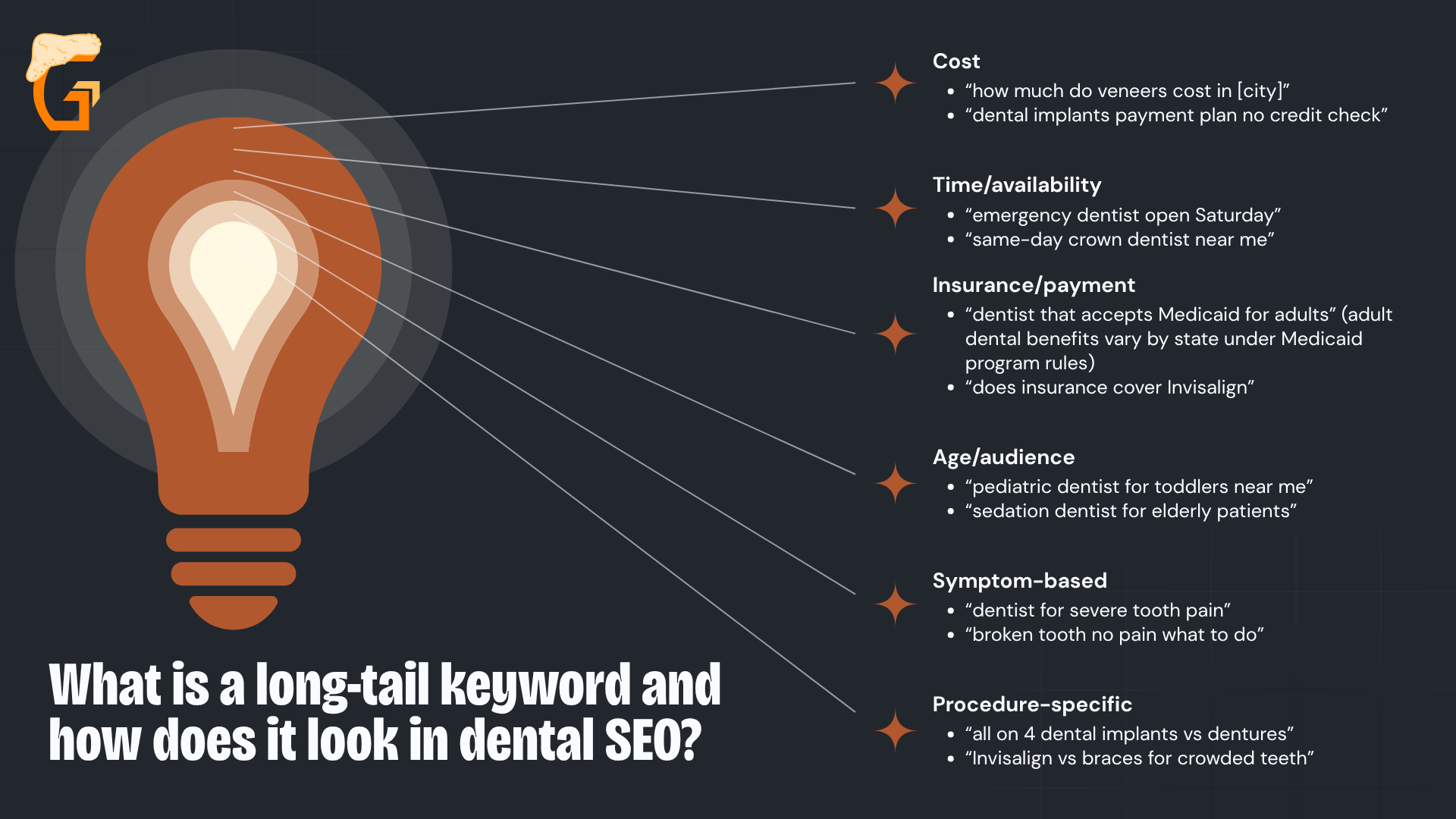
What is a long-tail keyword and how does it look in dental SEO?

A long-tail keyword is a 4+ word phrase tied to specific patient intent, and location based keywords combine a service, a place, and a qualifier.
Backlinko defines them as “longer, more specific search queries that tend to attract more qualified visitors.”
Dental long-tail search terms fall across six modifier classes:
- Cost: “how much do veneers cost in [city],” “dental implants payment plan no credit check”
- Time/availability: “emergency dentist open Saturday,” “same-day crown dentist near me”
- Insurance/payment: “dentist that accepts Medicaid for adults” (adult dental benefits vary by state under Medicaid program rules), “does insurance cover Invisalign”
- Age/audience: “pediatric dentist for toddlers near me,” “sedation dentist for elderly patients”
- Symptom-based: “dentist for severe tooth pain,” “broken tooth no pain what to do”
- Procedure-specific: “all on 4 dental implants vs dentures,” “Invisalign vs braces for crowded teeth”
Dental long-tail differs from generic SEO long-tail – local SEO keywords here are transactional and local-first.
A patient typing “dental implants for diabetics safety” is self-qualifying as a candidate, not researching.
How do long-tail keywords compare to head terms?
Head terms like “dentist” or “dental implants” carry high volume but low intent in local search results, with competition dominated by directories and DSOs.
Long-tail dental care keywords invert what matters for a single-location practice: lower volume, higher intent, and rankable difficulty.
HubSpot’s keyword data puts long-tail conversion at roughly 2.35% against about 0.77% for broad generic terms, more than three times higher, even as head terms pull far more raw search volume per query.
A practice optimizing for booked patients takes that trade.
Why does 2026 favor long-tail keywords more than ever?
Two structural shifts have compressed head-term value while leaving long-tail opportunity intact:
- AI Overview CTR suppression: A 2025 Pew Research Center analysis of nearly 69,000 searches found users clicked an organic result just 8% of the time when an AI Overview appeared, versus 15% when it did not. AI Overviews surface most on the informational head terms where dental practices compete hardest.
- Voice search alignment: Queries like “find an emergency dentist near me open right now” are structurally long-tail. Voice search growth expands the long-tail pool of such keywords, not the head-term pool.
Dental practices overweighting head terms in 2026 pay more for less.
Long-tail is where single-location practices win on organic search engine rankings.
Growth Saloon helps dental practices identify and rank for the essential keywords that produce booked patients – not just impressions.
Contact our team today to learn how our long-tail keyword strategy for dentists can fill your appointment book with high-intent organic traffic.
How Do You Find Long Tail Keywords for a Dental Practice?
Find long-tail dental keywords by combining Google Keyword Planner, AnswerThePublic, Google Search Console live queries, local directories, autocomplete mining, People Also Ask scraping, and competitor analysis with Ahrefs or Semrush.
The workflow runs in four steps: seed list, free-tier tools, live data sources, and competitor discovery.
What’s the seed list for dental long-tail research?

The seed list of relevant keywords is the prerequisite for every tool in the workflow.
Google’s Keyword Planner expands from seed terms into volume and competition data (making seed quality the first constraint).
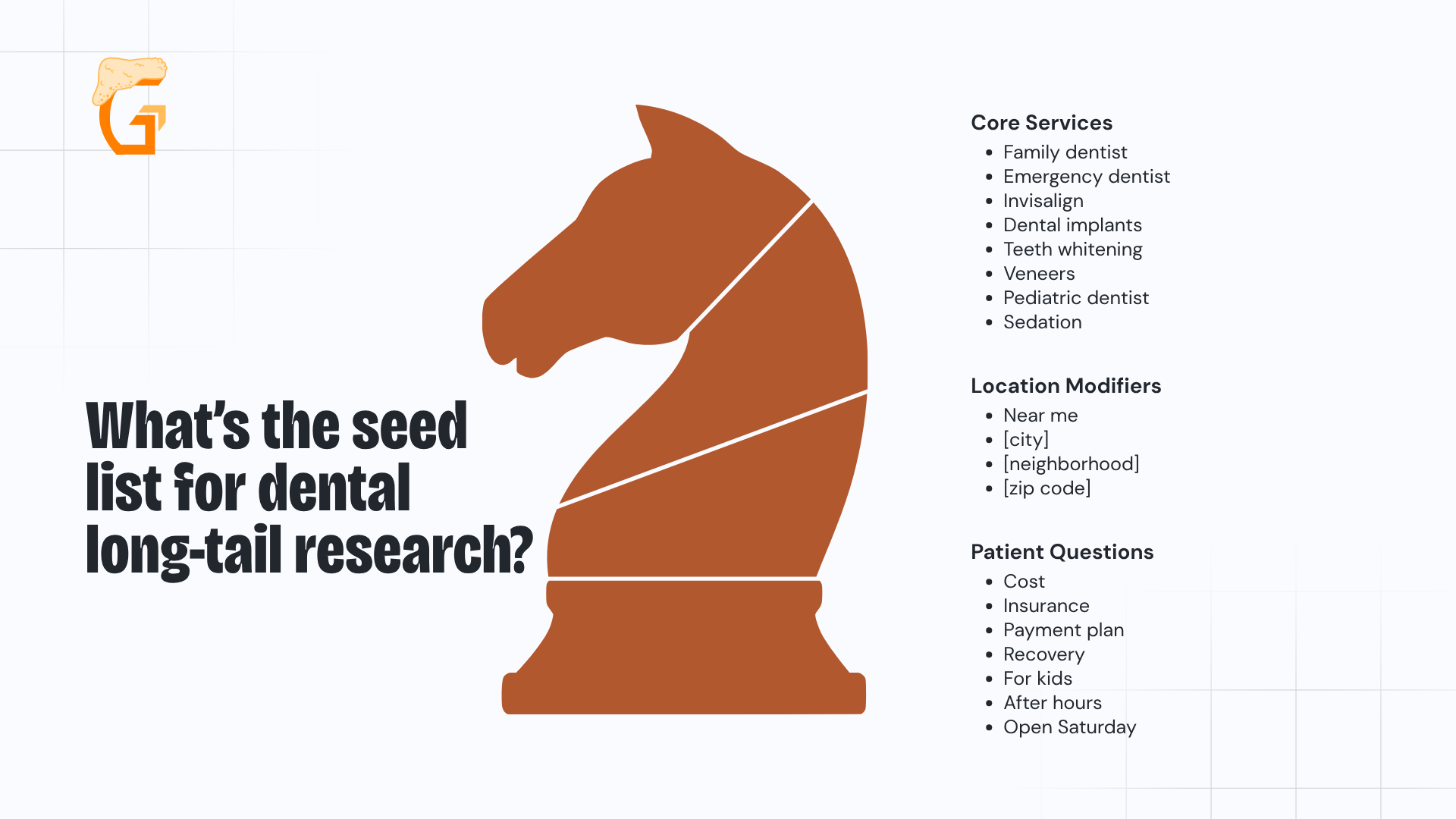
Build seeds across three categories:
- Core services: family dentist, emergency dentist, Invisalign, dental implants, teeth whitening, veneers, pediatric dentist, sedation
- Location modifiers: near me, [city], [neighborhood], [zip code]
- Patient questions: cost, insurance, payment plan, recovery, for kids, after hours, open Saturday
Reach 50–100 seed and target keywords before moving to tool expansion.
Under 50 misses modifier combinations the tools surface.
How do you use Google Keyword Planner and AnswerThePublic?
Keyword Planner and AnswerThePublic are the free-tier discovery pair:
- Keyword Planner provides volume and CPC data.
- AnswerThePublic surfaces question-style long-tails patients actually type.
A simple first-pass discovery workflow might look like this:
- Keyword Planner setup: Start in Discover new keywords, enter core service seeds, and set location targeting to the practice metro (this keeps the export tied to the market the dentist actually serves).
- Keyword Planner filtering: Filter for longer queries of three or more words, then export CPC and competition columns (this helps separate broad head terms from higher-intent long-tail opportunities).
- AnswerThePublic question mining: Enter each core service as a seed and collect questions by What, How, Why, Where, When, and Can (these often become FAQ-style targets).
- FAQ-style query mapping: Use question patterns like “how long do dental implants last” and “can you get implants with bone loss” to shape H3s, FAQ blocks, and supporting service-page copy.
AnswerThePublic excels at FAQ and symptom-based questions.
Keyword Planner handles cost and service variants with volume data.
Run both before moving to live sources.
How do you mine Search Console, autocomplete, and People Also Ask?

Google Search Central’s Performance report shows every query the site appeared for in the last 28 days (the most accurate source in the workflow).
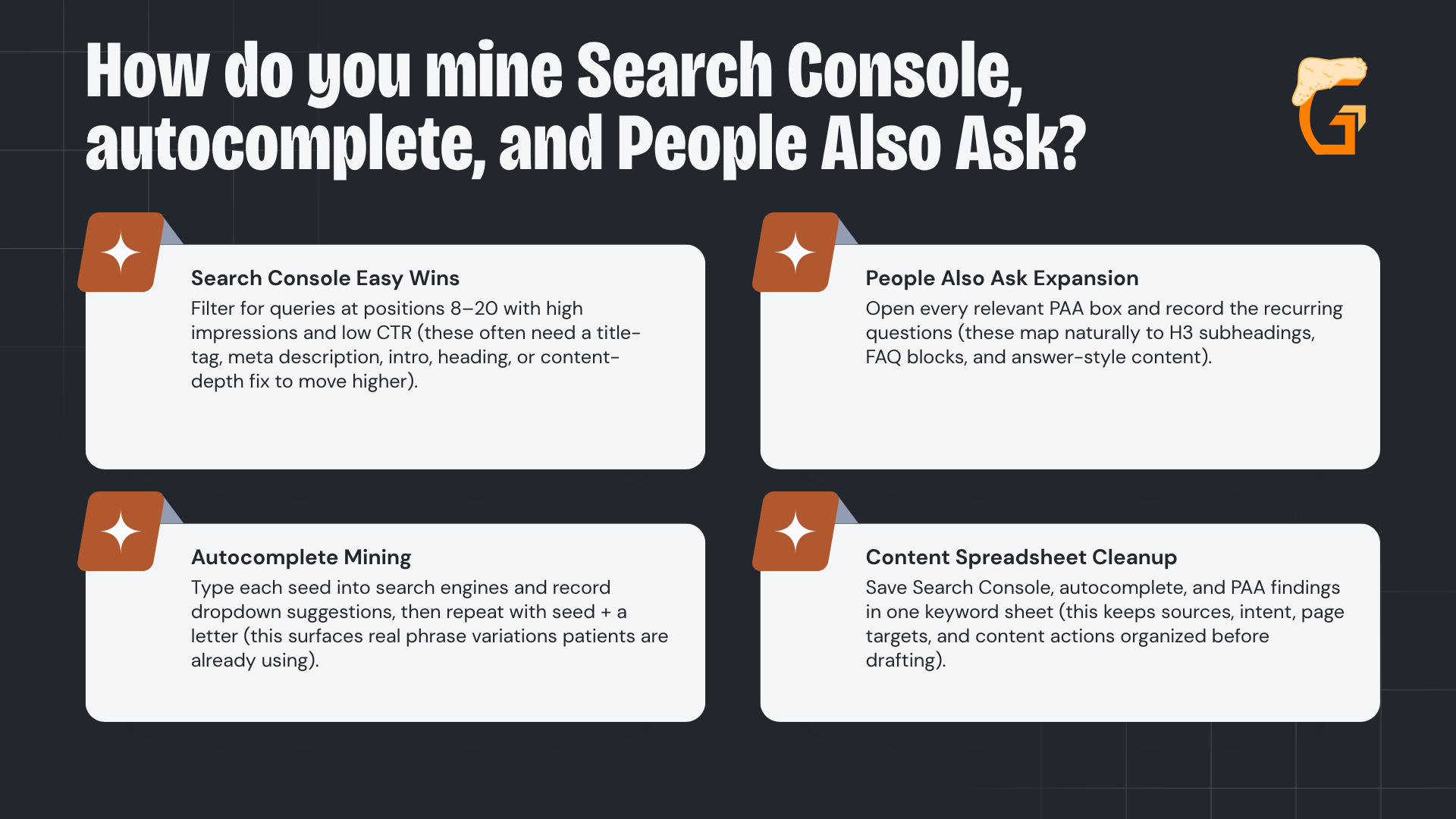
Additional long-tail opportunities often come from live search behavior and existing site data:
- Search Console easy wins: Filter for queries at positions 8–20 with high impressions and low CTR (these often need a title-tag, meta description, intro, heading, or content-depth fix to move higher).
- Autocomplete mining: Type each seed into search engines and record dropdown suggestions, then repeat with seed + a letter (this surfaces real phrase variations patients are already using).
- People Also Ask expansion: Open every relevant PAA box and record the recurring questions (these map naturally to H3 subheadings, FAQ blocks, and answer-style content).
- Content spreadsheet cleanup: Save Search Console, autocomplete, and PAA findings in one keyword sheet (this keeps sources, intent, page targets, and content actions organized before drafting).
Save everything to a central keyword spreadsheet.
Manual capture surfaces terms tool-only workflows miss.
How do you do competitor long-tail discovery?
Competitor long-tail discovery identifies terms local practices rank for that your site does not.
Ahrefs Content Gap makes the gap visible in minutes.
- Identify competitors: Pull 5–10 local practices from the Google Maps pack and organic results for your primary head terms
- Pull their ranking keywords: Filter by 3+ word length, question modifiers, and keyword difficulty under 40
- Filter for intent: Confirm the local commercial search intent and a service-page match before adding any term to the map
Run competitor discovery monthly – new long-tail opportunities surface every 30 days.
Growth Saloon runs the full four-step keyword discovery workflow for dental practices, from seed lists to competitor gap analysis.
Reach out today to see how our dental long-tail keyword research services can uncover the terms your competitors are ranking for that you’re missing.
How’s your SEO going?
Enter your website URL below to get a free comprehensive SEO audit.
The audit includes:
- A scan of your entire website for technical issues
- A list of your top opportunities to target immediately
- Your highest priority fixes to make
What Are the Best Long Tail Keyword Examples for Dental Services?
The best long-tail dental keyword examples cluster around procedure, modifier type, and location (each cluster maps to one page).
Six service categories of high value keywords follow with representative long-tails and a deployment note.
Dental implants long-tail cluster examples
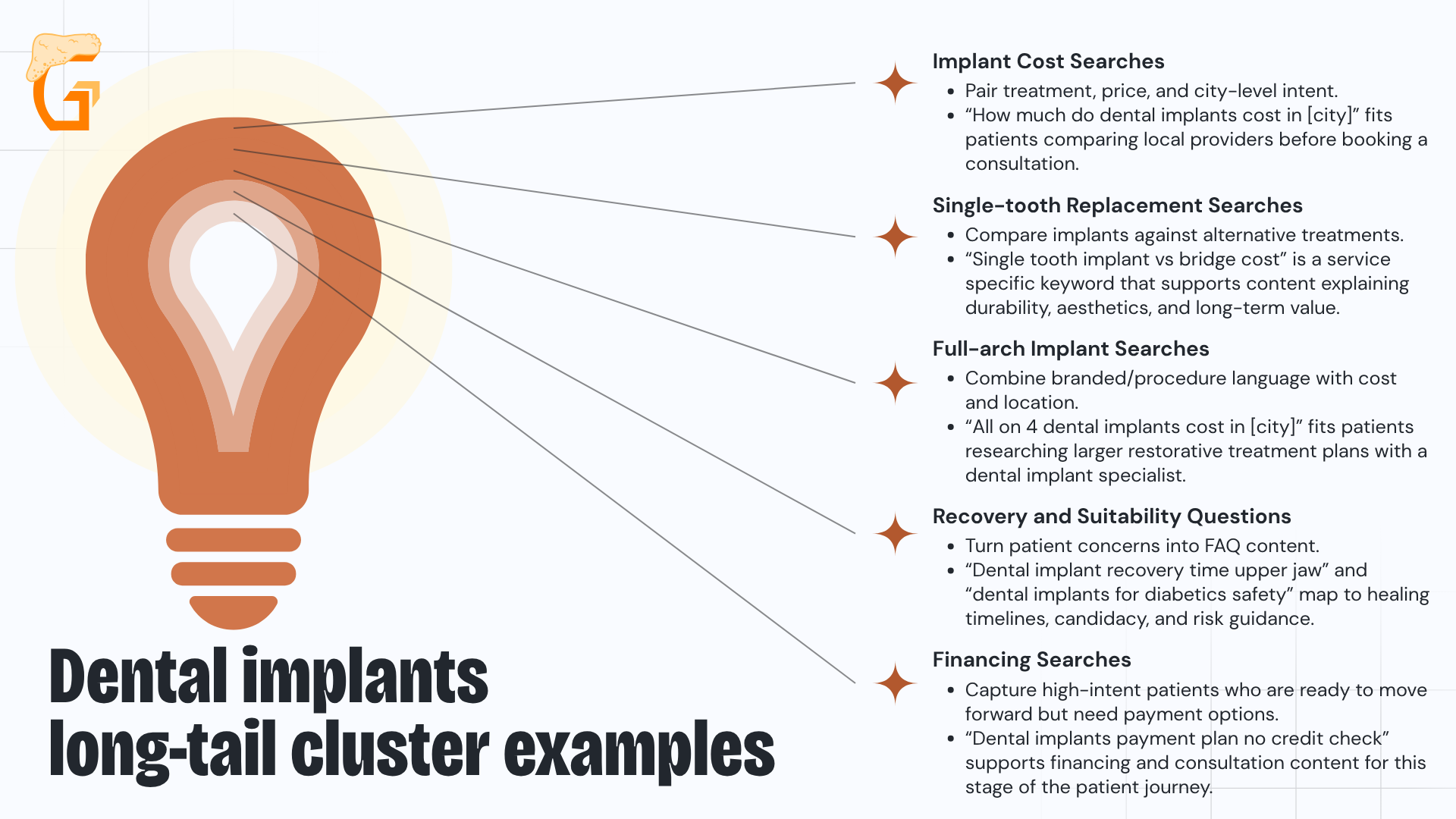
Dental implants are a high-value procedure category, where patients often search with cost, procedure type, recovery, and financing intent.
Relevant searches in this implant cluster often combine procedure, price, location, and candidacy language:
- Implant cost searches: Pair treatment, price, and city-level intent. “How much do dental implants cost in [city]” fits patients comparing local providers before booking a consultation.
- Single-tooth replacement searches: Compare implants against alternative treatments. “Single tooth implant vs bridge cost” is a service specific keyword that supports content explaining durability, aesthetics, and long-term value.
- Full-arch implant searches: Combine branded/procedure language with cost and location. “All on 4 dental implants cost in [city]” fits patients researching larger restorative treatment plans with a dental implant specialist.
- Recovery and suitability questions: Turn patient concerns into FAQ content. “Dental implant recovery time upper jaw” and “dental implants for diabetics safety” map to healing timelines, candidacy, and risk guidance.
- Financing searches: Capture high-intent patients who are ready to move forward but need payment options. “Dental implants payment plan no credit check” supports financing and consultation content for this stage of the patient journey.
Deploy on the dental implants service page with FAQ blocks covering cost, recovery, candidacy, and financing.
Invisalign long-tail cluster examples
Invisalign is a strong commercial-intent category, especially for adults comparing treatment cost, timelines, insurance, and alternatives.
Searches in this Invisalign cluster often combine treatment, price, age group, and comparison language:
- Adult cost searches: Pair treatment, audience, and location language. “Invisalign cost for adults in [city]” fits patients looking for clear pricing before scheduling.
- Treatment comparison searches: Capture patients weighing orthodontic options. “Invisalign vs braces cost comparison” supports content that explains price, convenience, appearance, and treatment fit.
- Insurance coverage searches: Connect payment questions with geographic intent. “Does insurance cover Invisalign in [state]” maps to FAQ content on benefits, coverage limits, and financing.
- Provider-intent searches: Capture patients close to booking. “Best dentist for Invisalign for adults near me” supports local authority, reviews, and consultation-focused content.
- Condition and timeline questions: Turn pre-treatment concerns into FAQ content. “Invisalign for crowded teeth adults” and “how long does Invisalign take for mild crowding” map to candidacy, treatment planning, and expected timelines.
Anchor on the Invisalign service page with FAQ blocks covering cost, insurance, treatment comparison, candidacy, and timeline.
Emergency dentist long-tail cluster examples
Emergency terms convert fastest because intent is immediate.
CDC data shows roughly 59 emergency department visits per 10,000 people per year for tooth disorders – a steady stream of high-urgency searchers who would prefer a dental office over an ED if they can find one fast.
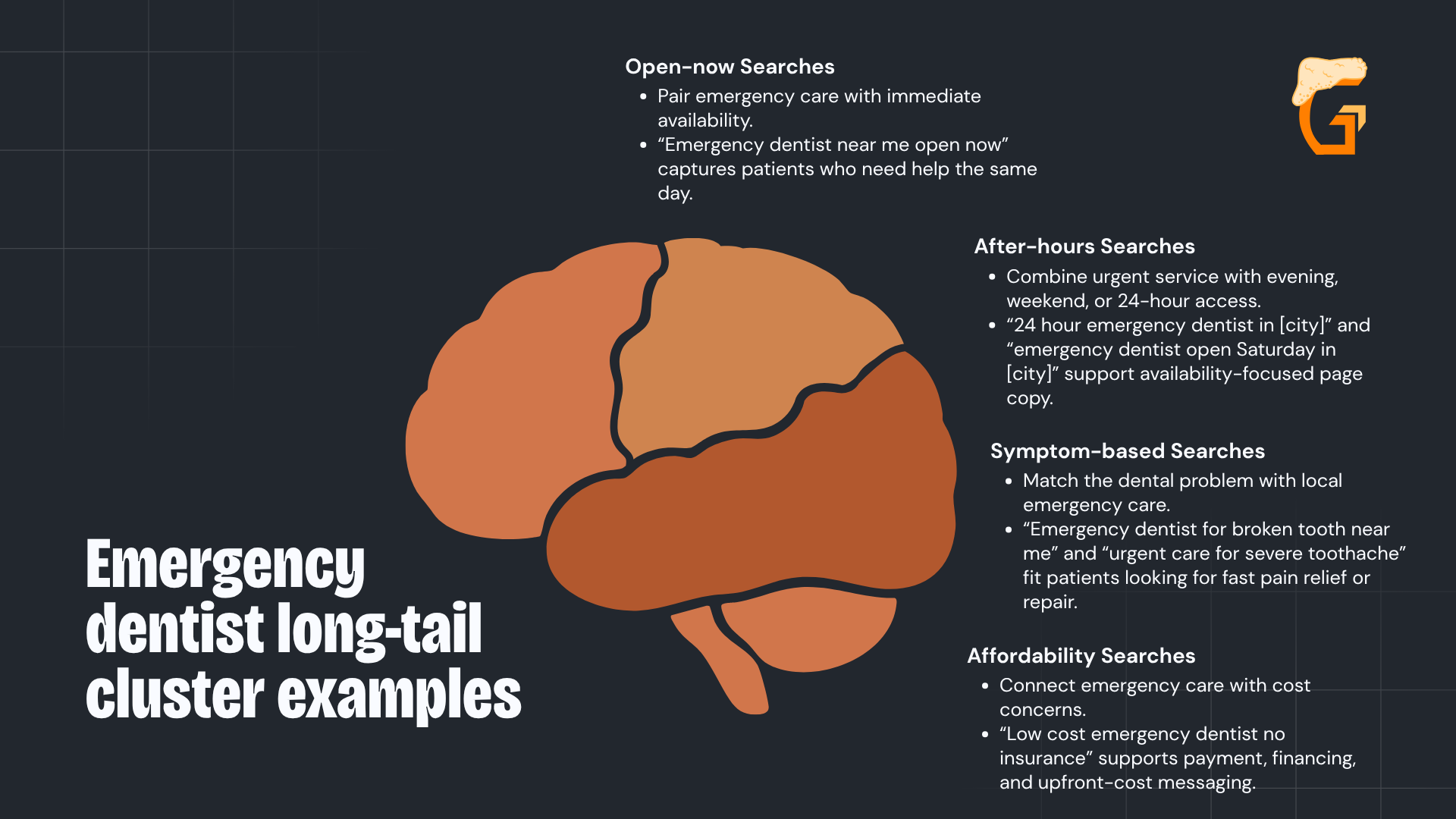
Emergency-intent searches tend to focus on urgency, availability, and cost:
- Open-now searches: Pair emergency care with immediate availability. “Emergency dentist near me open now” captures patients who need help the same day.
- After-hours searches: Combine urgent service with evening, weekend, or 24-hour access. “24 hour emergency dentist in [city]” and “emergency dentist open Saturday in [city]” support availability-focused page copy.
- Symptom-based searches: Match the dental problem with local emergency care. “Emergency dentist for broken tooth near me” and “urgent care for severe toothache” fit patients looking for fast pain relief or repair.
- Affordability searches: Connect emergency care with cost concerns. “Low cost emergency dentist no insurance” supports payment, financing, and upfront-cost messaging.
The emergency page must back each term with practical content: hours, same-day availability, and after-hours phone.
Pediatric dentist long-tail cluster examples
Pediatric terms stack age, special needs, and preventive procedures.
The CDC recommends children visit a dentist by their first birthday (a guideline that fuels the steady “first dentist appointment” and “fluoride treatment” query patterns parents type).
Parent search patterns in this cluster often include age, anxiety, access, and special-care needs:
- New-patient searches: Combine specialty, proximity, and availability. “Pediatric dental clinic near me accepting new patients” fits parents ready to schedule.
- Weekend access searches: Pair kids dentistry with flexible appointment timing. “Kids dentist in [city] with Saturday hours” supports content for parents balancing school and work schedules.
- Anxiety and special-care searches: Name the child’s care need directly. “Pediatric dentist for anxious kids” and “gentle kids dentist specializing in autism” map to comfort-focused, sensory-aware language.
- First-visit searches: Turn milestone questions into educational content. “Baby’s first dentist appointment what to expect” fits first-visit guides and parent FAQ blocks.
Deploy on the pediatric service page with a FAQ on first visits, insurance, and preventive care.
Cosmetic and teeth whitening long-tail cluster examples
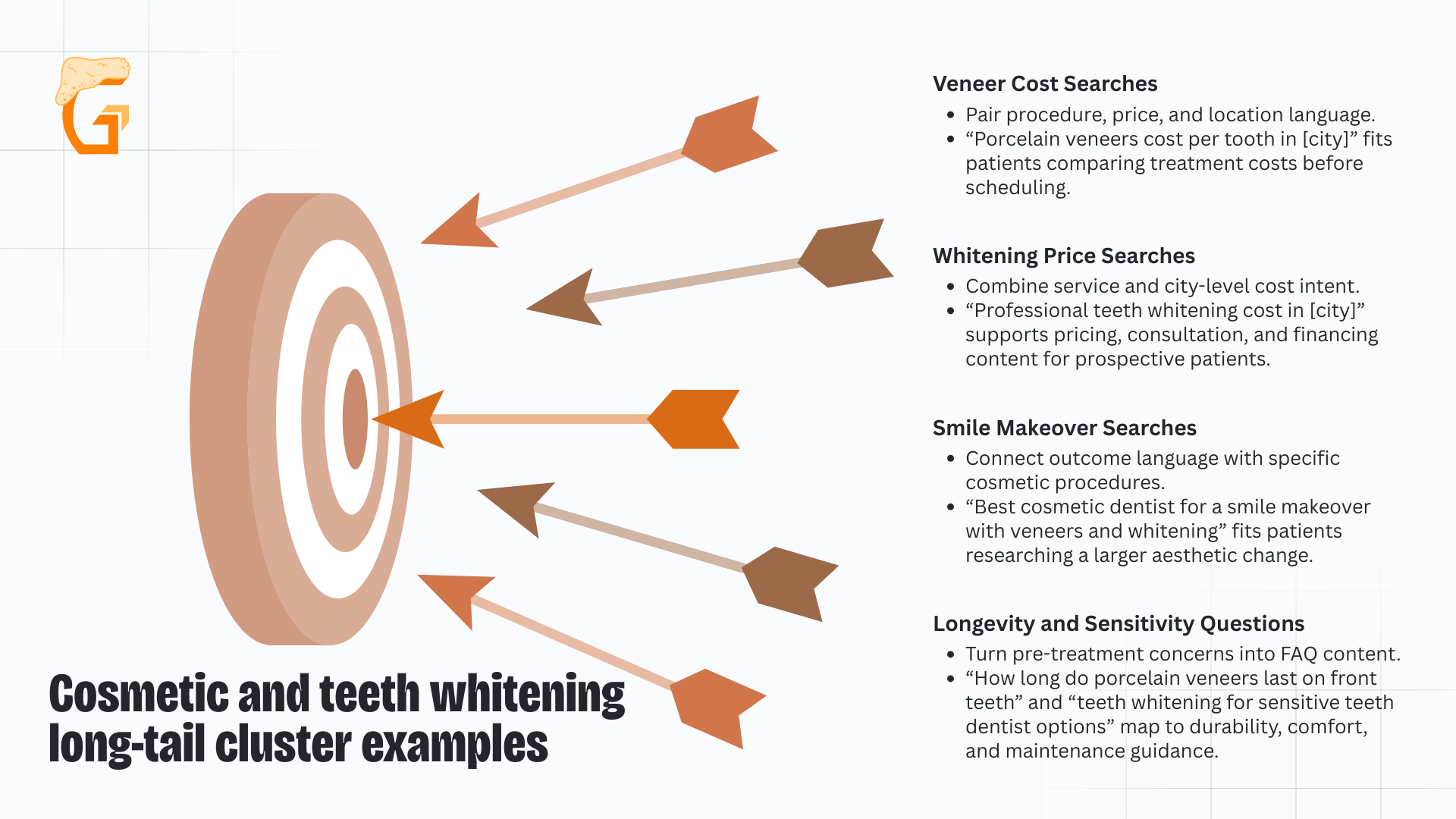
Cosmetic and whitening are the discretionary-spend category, combining outcome intent with specific cost questions.
Searches in this cosmetic cluster often combine procedure, price, and outcome language:
- Veneer cost searches: Pair procedure, price, and location language. “Porcelain veneers cost per tooth in [city]” fits patients comparing treatment costs before scheduling.
- Whitening price searches: Combine service and city-level cost intent. “Professional teeth whitening cost in [city]” supports pricing, consultation, and financing content for prospective patients.
- Smile makeover searches: Connect outcome language with specific cosmetic procedures. “Best cosmetic dentist for a smile makeover with veneers and whitening” fits patients researching a larger aesthetic change.
- Longevity and sensitivity questions: Turn pre-treatment concerns into FAQ content. “How long do porcelain veneers last on front teeth” and “teeth whitening for sensitive teeth dentist options” map to durability, comfort, and maintenance guidance.
Support cosmetic marketing strategies by deploying these terms on the service page with before/after photos and FAQ blocks on longevity.
Growth Saloon maps long-tail keyword clusters to every revenue-driving procedure on your dental site, from implants to cosmetic and emergency.
Get in touch today to find out how our long-tail keyword services for dentists can turn your service pages into high-intent patient magnets.

How Should Dentists Prioritize Low-Volume Long Tail Keywords?
Long-tail keywords with under 50 monthly searches still produce booked patients because stacking 10–15 variants per page captures cumulative demand without competing for a single head term.
Why is low search volume not actually low value?

The low-volume objection assumes term volume equals term value – it doesn’t.
Google’s Keyword Planner returns volume as ranges, and terms reported as “zero” often receive 5–20 actual monthly searches.
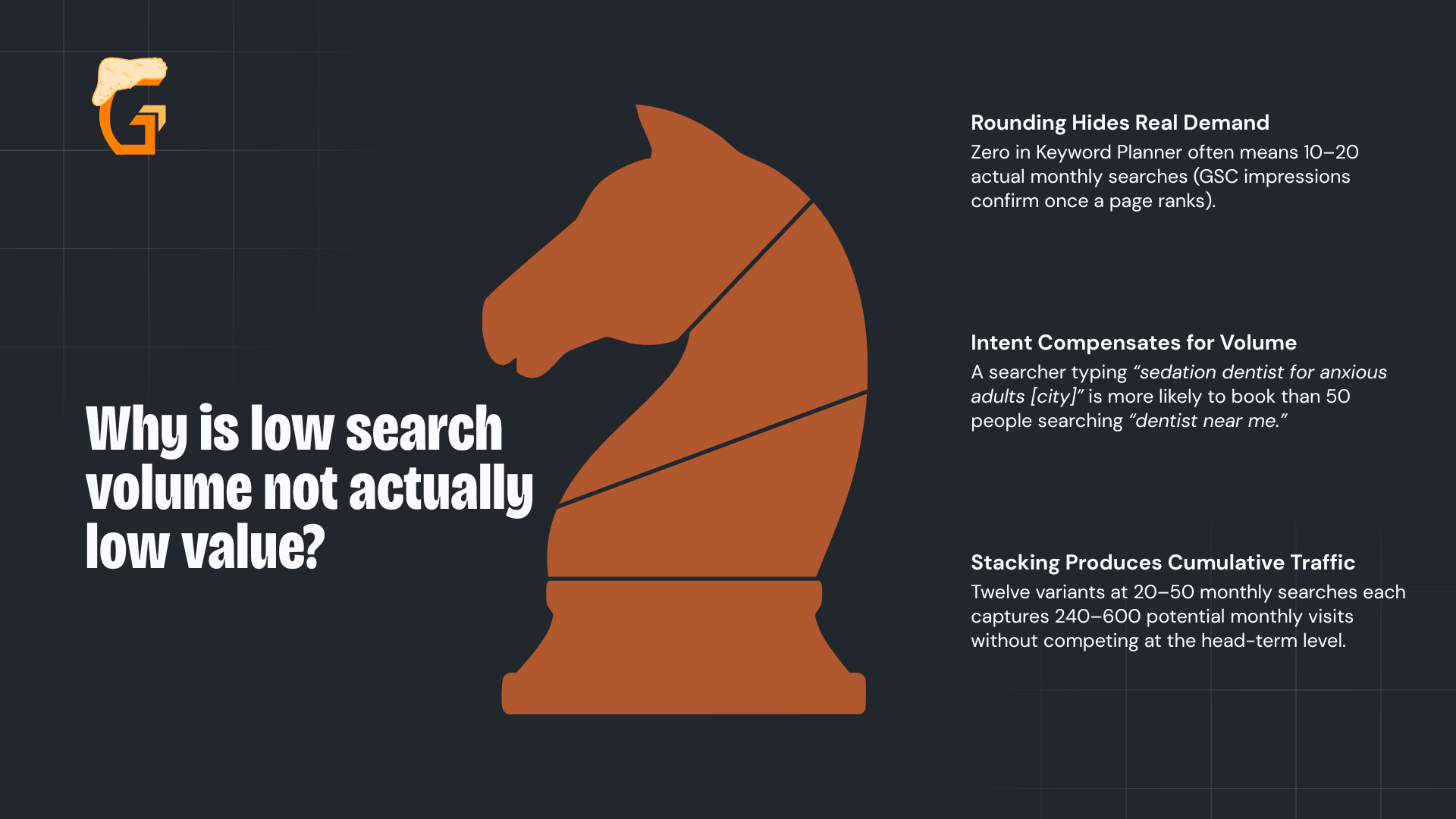
Three reframes:
- Rounding hides real demand: Zero in Keyword Planner often means 10–20 actual monthly searches (GSC impressions confirm once a page ranks).
- Intent compensates for volume: A searcher typing “sedation dentist for anxious adults [city]” is more likely to book than 50 people searching “dentist near me.”
- Stacking produces cumulative traffic: Twelve variants at 20–50 monthly searches each captures 240–600 potential monthly visits without competing at the head-term level.
“Sedation dentist for anxious adults [city]” may show 20 monthly searches but produce 3–5 booked consultations per year because every modifier filters for a ready-to-book patient.
How do you score long-tail keywords for priority?
The three-factor rubric (intent × relevance × difficulty) gives every candidate a defensible rank.
Backlinko’s local SEO keyword research framework prioritizes by difficulty, volume, intent, and fit.
Score each term 1–3:
- Intent:
- Transactional = 3
- Commercial = 2
- Informational = 1
- Relevance:
- Real service offered = 3
- Adjacent = 2
- Off-topic = 1
- Difficulty:
- KD 0–20 = 3
- KD 20–40 = 2
- KD 40–60 = 1
- KD 60+ = 0
Multiply the scores:
- Primary target = Above 12
- Supporting = 6–12
- Skip = under 6
Prioritize KD 0–40 first – defer high-difficulty head terms until authority builds.
When should you skip a long-tail dental keyword?
Not every long-tail belongs on the map.
Google’s Search Quality Rater Guidelines treat intent matching as a primary signal (making intent mismatch the clearest skip trigger).
Skip when:
- The practice doesn’t offer the service;
- The SERP returns informational results a service page can’t rank against;
- Targeting the term would force a standalone thin page; or
- Keyword difficulty exceeds 60 at launch.
Track skipped terms in a spreadsheet column – when a service is added or intent shifts, the skip list is the first place to look.
Growth Saloon scores and prioritizes every keyword on your dental map using the intent × relevance × difficulty rubric (so your team targets the terms that actually book patients).
Contact our team today to learn how a dental long-tail keyword audit can sharpen your keyword strategy and drive more qualified traffic.
How Do You Use Long Tail Keywords on a Dental Website?
Use long-tail keywords by clustering related variants per page:
- One primary plus 5–15 supporting terms placed in H2/H3 subheadings, FAQ blocks, and body.
- Never use two pages targeting the same cluster.
How do you cluster and place long-tail keywords on a page?

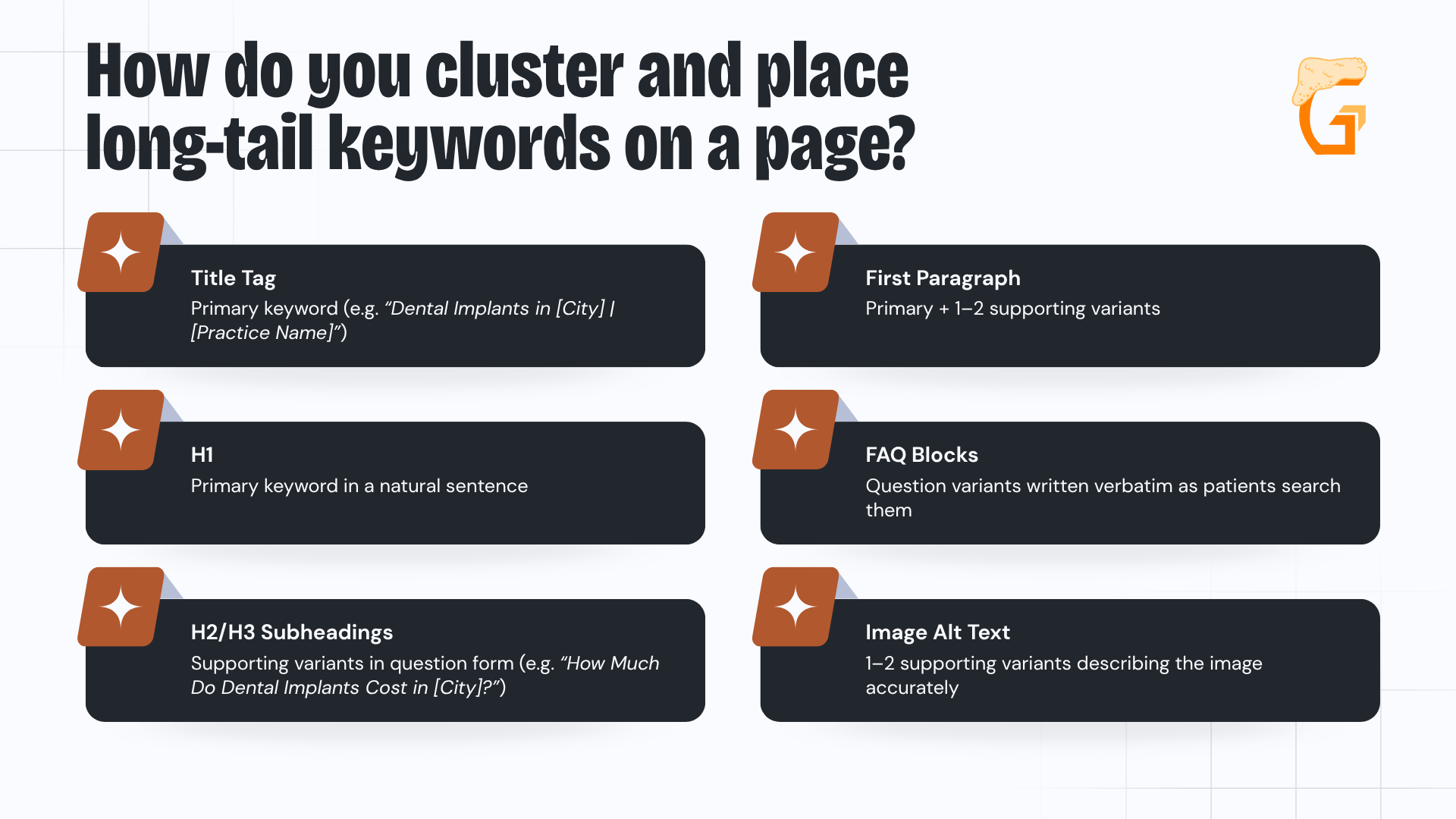
A keyword cluster is one primary long-tail plus 5–15 supporting variants serving the same intent.
Ahrefs’ on-page SEO guide defines the canonical placement surfaces: title tag, H1, H2/H3, first paragraph, body content, and image alt text.
Placement map for a dental service page:
- Title tag: Primary keyword, e.g. “Dental Implants in [City] | [Practice Name]”
- H1: Primary keyword in a natural sentence
- H2/H3 subheadings: Supporting variants in question form, e.g. “How Much Do Dental Implants Cost in [City]?”
- First paragraph: Primary + 1–2 supporting variants
- FAQ blocks: Question variants written verbatim as patients search them
- Image alt text: 1–2 supporting variants describing the image accurately
Internal links from blog posts and FAQ pages to the service page should use the primary keyword as anchor text.
The Google Business Profile description can echo the primary cluster term for cross-channel consistency.
How do you avoid cannibalization between long-tail pages?
Cannibalization occurs when two pages compete for the same cluster primary – Google can’t decide which to rank, and both perform below potential.
Google Search Central’s duplicate content guidance documents the consolidate-and-canonical workflow that resolves it.
Detection and fix:
- Detection: Run site:domain.com “[primary keyword]” to find competing pages. Check Search Console for the same query pointing to multiple URLs
- Fix: Consolidate to the strongest page, 301 redirect the weaker, update all internal links to the canonical URL
The prevention rule is one primary keyword per page.
Treat the long-tail map as a living document and audit for cannibalization quarterly (SERP intent shifts can make previously safe page pairs competitive over time).
Growth Saloon deploys long-tail keywords across dental sites with a one-primary-per-page discipline that prevents cannibalization and compounds rankings over time.
Talk to our team today to see how our long-tail SEO for dentists can build a keyword map that turns every service page into a patient acquisition asset.
How Can Growth Saloon Help Your Dental Practice Grow?
Growth Saloon is a Chicago-based digital marketing agency built to help dental practices attract more patients and grow their practice through performance-driven digital marketing.
Mike Lowe and the Growth Saloon team specialize in building a dental practice’s online presence through SEO, web design, conversion rate optimization, and marketing attribution (working alongside your practice to build a measurable digital presence that generates qualified patient inquiries, not just website traffic).
From helping patients find your practice through high-intent local search terms to converting site visitors into booked appointments, Growth Saloon focuses on results at every stage of the patient acquisition funnel.
Practice owners and marketing managers get clear visibility, through tools like Google Analytics, into exactly which channels are driving new patient growth.
We know that every open appointment slot has a real cost.
Every decision we make is built around one outcome: helping your practice fill more of them.
Meet the Founder of Growth Saloon
Meet the founder and lead strategist at Growth Saloon, Mike Lowe:
- As founder and CEO of Growth Saloon, Mike brings years of hands-on experience in SEO strategy, CRO, web design, and marketing attribution for service-based businesses competing in local and regional markets.
- Based in Chicago and working with practices across the country, Mike has built and managed digital growth campaigns for businesses competing in some of the most contested search markets in the country.
- Growth Saloon’s data-driven approach to local SEO and patient acquisition improves a practice’s online visibility and turns websites into their highest-performing new patient channel.
What Does Working With Growth Saloon Look Like?
Growth Saloon operates as a dedicated extension of your marketing team – not a vendor that disappears after onboarding.
Every engagement includes direct access to Mike and the team, transparent reporting tied to actual patient acquisition outcomes, and strategies tailored to your specific services and local market.
Whether you’re looking to rank for high-value procedures, improve your site’s appointment conversion rate, or finally get clarity on where your new patients are actually coming from, Growth Saloon builds the strategy and does the work.
Growth Saloon helps dental practices build the kind of digital presence that consistently generates qualified new patient inquiries – not just clicks.
Contact our team today to find out how our dental marketing services can lower your cost per new patient and grow your practice.
How's your SEO going?
Get your free comprehensive SEO audit.
Enter your website URL below to get a free comprehensive SEO audit.
- Scan entire website for technical issues
- Get a list of your top opportunities
- See your highest priority fixes to make
-
One primary long-tail keyword per page, supported by 5–15 closely related variants in the same intent cluster.
A dental implants service page might target “dental implants in [city]” as primary, with secondaries like “single tooth implant cost,” “dental implant recovery time,” and “dental implants payment plan.”
More than 15 variants usually means the page should be split into separate service pages.
-
Yes, especially in dentistry.
Keyword Planner’s “zero volume” data is rounded and often misses 5–20 monthly searches that still convert when intent is strong.
A term like “sedation dentist for adults with severe anxiety [city]” may show zero volume but produce booked consultations because the searcher has already filtered themselves through six modifiers before typing the query.
-
No. Cluster related long-tails onto one well-mapped page rather than splitting them.
Each procedure or one of your exact services deserves a dedicated page.
Each long-tail variant slots inside that page as an H2/H3, FAQ entry, or body mention.
Splitting fractures the ranking signals search engine algorithms rely on and triggers cannibalization.
The exception: distinct specialized services that each need their own conversion path and page.
-
Use Google Search Console as the primary feed (filter the Performance report by queries of 3+ words and watch impressions, CTR, and average position).
Layer in a local rank tracker for geographic-grid views of SEO performance.
The clearest win signal in long-tail strategy is a term moving from positions 11–20 into the top 10 of the search engine results pages, where click-through rates increase substantially.
-
Yes – voice queries are inherently long-tail and conversational.
Phrases like “Hey Google, find an emergency dentist near me open right now” show how people find healthcare providers by voice and match the natural-language patterns long-tail keyword research surfaces.
Practices that build FAQ sections with full-sentence questions and direct first-sentence answers rank better for voice queries than practices targeting only head terms.
-
Every 30–90 days for active monitoring and once a year for a full refresh.
New competitors, AI Overview shifts, and seasonal procedures (back-to-school orthodontics, year-end FSA spending) introduce new long-tail opportunities monthly.
Set a quarterly calendar reminder to pull the latest Search Console queries and re-mine autocomplete and People Also Ask results.
-
Only as a starting point.
AI tools produce plausible-sounding long-tails but routinely hallucinate search volumes and miss local modifiers.
Use AI-generated lists as a brainstorm input, then validate every term in Google Keyword Planner with the practice’s metro selected before adding it to the keyword map.
Treat AI output as a Tier-3 brainstorm source, not a source of truth.
Most agencies sell traffic. We sell actual growth. That’s the Growth Saloon difference.
Are you looking to grow?
Recent blogs
Enter your website URL below to get free comprehensive SEO audit.
- Scan entire website for technical issues
- Get a list of your top opportunities
- See your highest priority fixes to make