

Updated:August 18th, 2026

Technical SEO for Dentists in 2026

Written by

Mike Lowe

Reviewed by

Taylor Coteus

Key takeaways

  • Technical SEO is the prerequisite layer beneath all other dental marketing efforts, because Google cannot rank content it cannot crawl or index, and with roughly 46% of all searches carrying local intent, a single crawl failure translates directly into lost patient bookings.
  • Passing Google's Core Web Vitals thresholds (LCP under 2.5 seconds, INP under 200ms, and CLS under 0.1) is a direct ranking requirement, yet fewer than half of mobile sites currently meet all three, making speed optimization one of the fastest ways for a dental practice to gain ground on local competitors.
  • A dental technical SEO audit using Google Search Console, Screaming Frog, and PageSpeed Insights typically uncovers 15 to 30 fixable issues, and resolving the top priorities (crawl errors, mobile speed failures, and missing local schema) can bring organic patient acquisition costs down to $50 to $150 per new patient, compared to $100 to $350 via paid search.

What Does Technical SEO for Dentists Actually Affect?

Technical SEO for dentists affects every other investment you make in your website (content, local SEO, Google Business Profile optimization) because none of it can rank if Google cannot crawl, read, and index your pages in the first place.

Most dental practices that struggle with dental practice SEO have a content or keyword problem on the surface, but a technical problem underneath.

When Googlebot hits a slow page, a misconfigured robots.txt, or a site that fails Core Web Vitals on mobile, it does not bookmark it for later – it moves on.

Technical SEO for Dentists

That means service pages you have invested in, blog posts written to attract potential patients, and local signals you have built over months can sit entirely outside search results.

For a practice competing in a local market where 71% of patients research a practice online before booking, a broken technical foundation is a direct hit to your patient acquisition channel.

This guide walks through every technical layer a dental site depends on (crawlability, indexing, site speed, Core Web Vitals, on-page signals, schema markup, and local foundations) with essential SEO tips and prioritized fixes you can act on right away.

Growth Saloon helps dental practices build the kind of digital presence that consistently generates qualified new patient inquiries – not just clicks.

Contact our team today to find out how our dental SEO services can lower your cost per new patient and grow your practice.

What Is Technical SEO for Dentists, and Why Is It the Foundation of Growth?

Technical SEO for dentists is the crawl-index-rank foundation (crawlability, indexing, site speed, mobile, HTTPS, schema, and architecture) that must work before content or local efforts can pay off.

Every blog post you publish and every citation you build through your dental SEO efforts sits on top of this layer.

If the foundation has problems, the floors above it do not hold.

Google defines SEO as helping search engines find and read your content – and that work starts at the technical layer.

What Does Technical SEO Cover (and How Does It Differ From On-Page and Content SEO)?
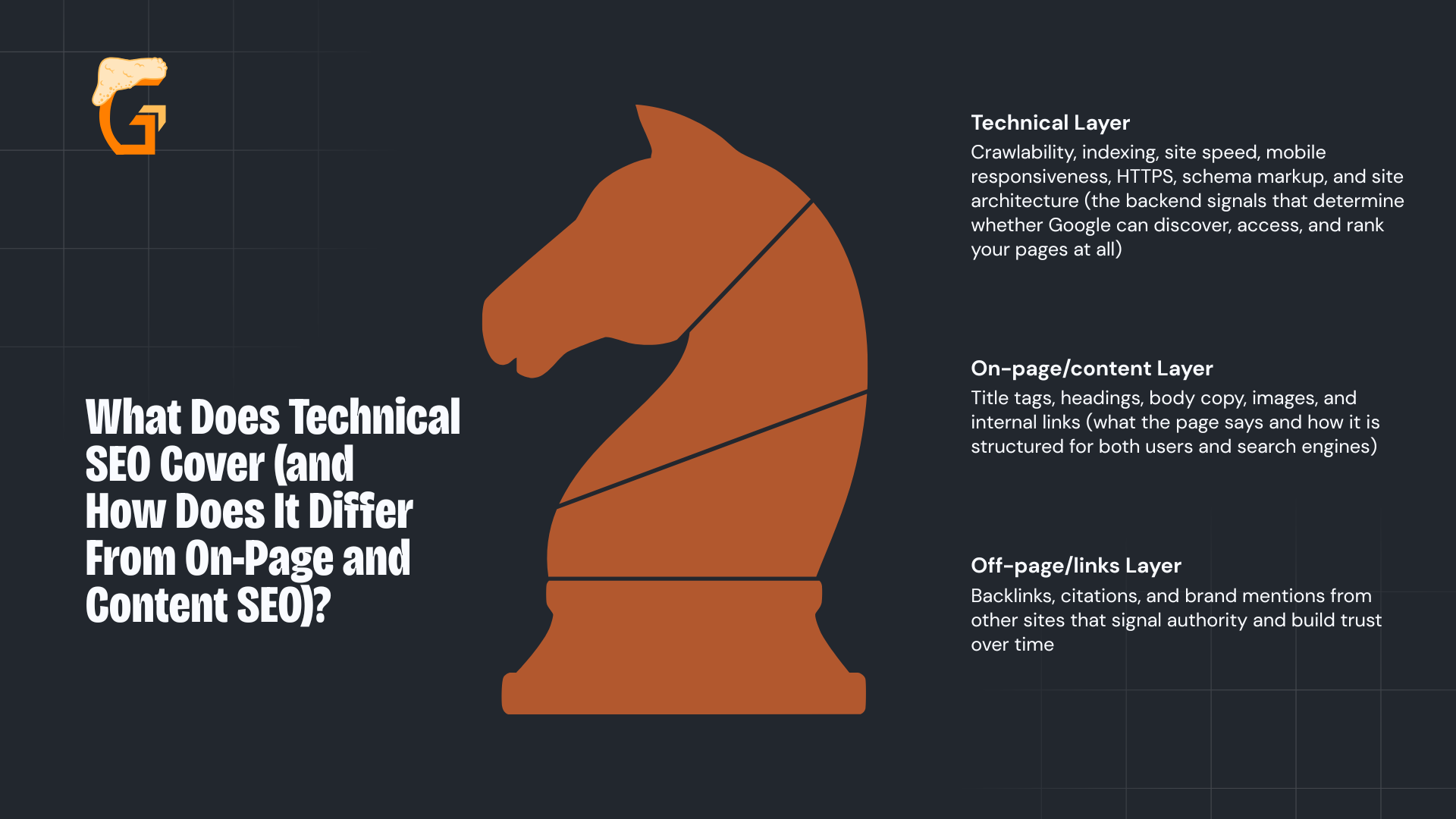
What Does Technical SEO Cover, and How Does It Differ From On-Page and Content SEO

Search engine optimization (SEO) operates across three distinct layers, and technical SEO is the one that makes the other two work.

Without a crawlable, indexable foundation, on-page content and off-page authority have nowhere to land. Here is how the three layers break down:

  • Technical layer: crawlability, indexing, site speed, mobile responsiveness, HTTPS, schema markup, and site architecture (the backend signals that determine whether Google can discover, access, and rank your pages at all)
  • On-page/content layer: title tags, headings, body copy, images, and internal links (what the page says and how it is structured for both users and search engines)
  • Off-page/links layer: backlinks, citations, and brand mentions from other sites that signal authority and build trust over time

The layering matters because SEO for dental practices covers all three, and technical SEO is its backbone.

You can produce quality website content and earn backlinks from respected dental associations, but if Googlebot is blocked by a misconfigured robots.txt or your site fails Core Web Vitals, none of it appears in search results.

How Do Search Engines Decide Your Rankings, and Where Does Dental SEO Fit?

Search visibility for dental practices comes down to volume, local intent, and whether Google can access the site at all.

Technical health determines all three:

  • Google processes more than 5 trillion searches per year (roughly 13–14 billion per day) making organic search visibility a volume game where small ranking gains translate to real appointment increases
  • A figure Google cited in 2018 put roughly 46% of all searches at local intent, meaning a large share of people who find local dental services want one nearby (making local-pack visibility as valuable as broad organic rankings)
  • Technical health is the prerequisite (Google cannot rank what it cannot crawl, index, or load quickly, regardless of content quality or backlink profile)

That local-intent figure is why dental practices compete hard for map-pack placement alongside broad organic rankings.

Map-pack visibility also depends on technical health – your Google Business Profile data is crawled and indexed, and a slow or error-ridden site undermines your online visibility and every local signal you send.

How Do Search Engines Crawl, Index, and Rank Dental Practice Websites?
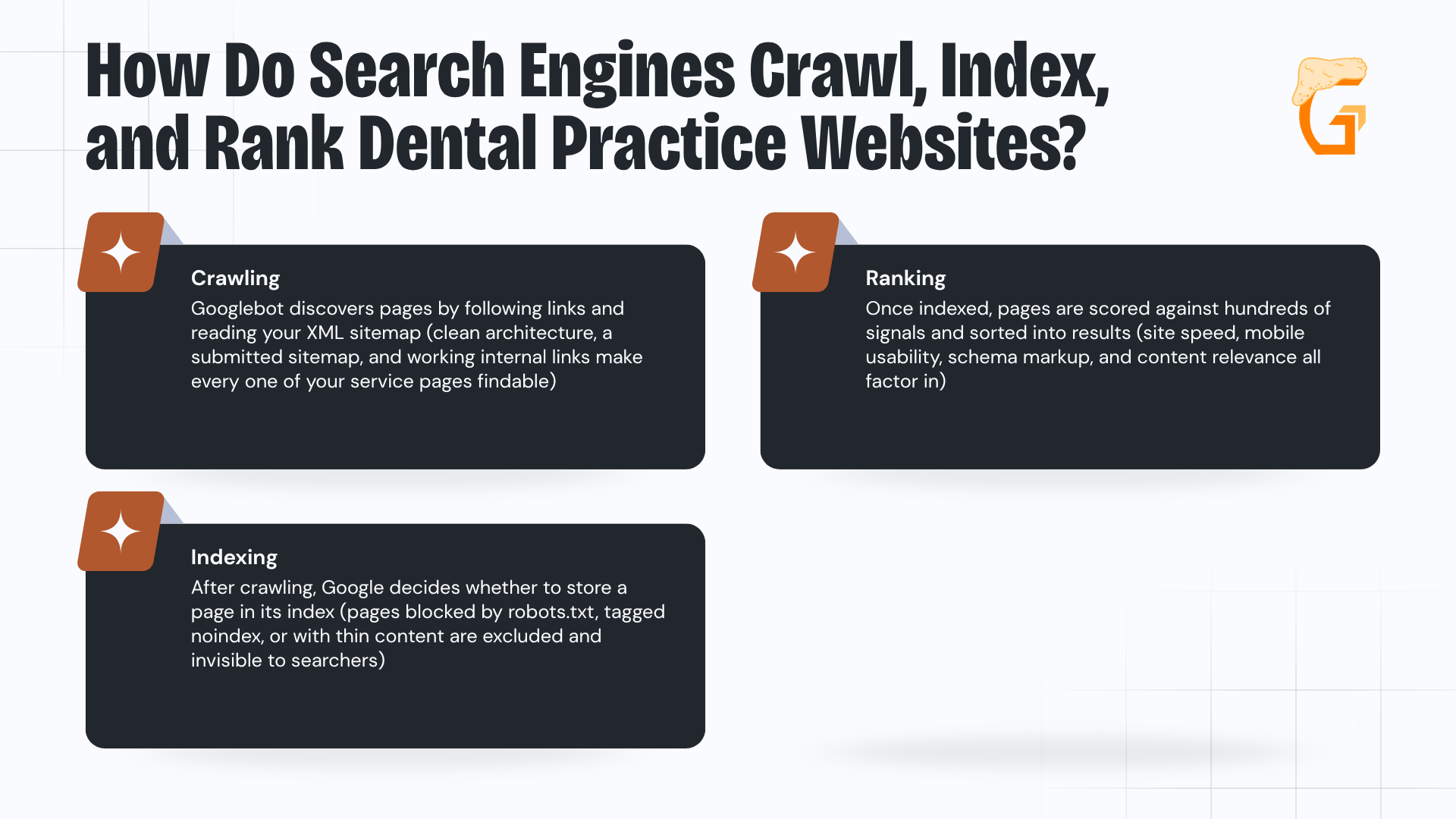
How Do Search Engines Crawl, Index, and Rank Dental Practice Websites

Google runs every dental website through a sequence of gates before it ever appears in search results, and skipping one stage stops everything after it.

Here is what happens at each step:

  • Crawling: Googlebot discovers pages by following links and reading your XML sitemap (clean architecture, a submitted sitemap, and working internal links make every one of your service pages findable)
  • Indexing: after crawling, Google decides whether to store a page in its index (pages blocked by robots.txt, tagged noindex, or with thin content are excluded and invisible to searchers)
  • Ranking: once indexed, pages are scored against hundreds of signals and sorted into results (site speed, mobile usability, schema markup, and content relevance all factor in)

Google’s documentation confirms that crawling, indexing, and serving results are the three stages of how Search works (and every content and local effort you make depends on clearing all three).

With roughly 46% of all searches carrying local intent, a crawl or indexing failure is not just a technical issue.

For a dental practice, it is a direct patient-acquisition problem.

Growth Saloon helps dental practices build the technical foundation that turns search visibility into new patient appointments.

Our team audits your site’s crawlability, indexing, and architecture so you can start ranking for the searches that drive bookings – explore our dental SEO services to see how we do it.
How Do You Build a Crawlable Dental Site Structure and Service Pages?

A crawlable dental website uses hub-and-spoke (silo) architecture where every service is reachable within 2–3 clicks, so search engines can find and index every page without wasting crawl budget.

A disorganized site structure forces Googlebot to burn crawl budget on low-priority pages while missing the service pages that drive bookings.

A SearchPilot controlled test found that strategic internal linking produced an estimated 5% uplift in website traffic – before any content changes.

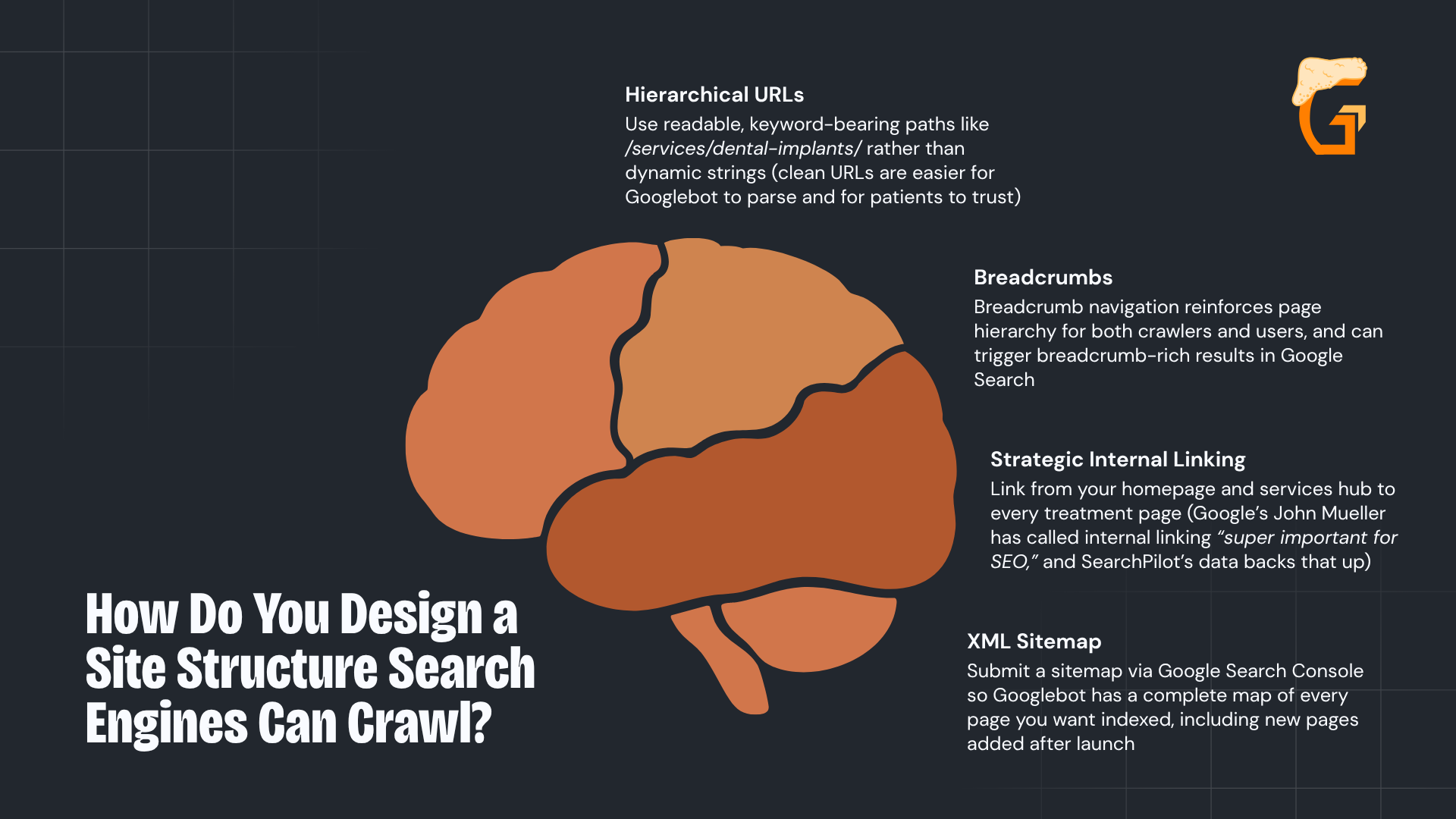
How Do You Design a Site Structure Search Engines Can Crawl?

How Do You Design a Site Structure Search Engines Can Crawl

A dental site structure should mirror how patients think – homepage at the top, a services hub one level down, and a dedicated page for treatments like dental implants below that.

That structure only works if crawlers and patients can find every page within a few clicks.

Four elements make that possible:

  • Hierarchical URLs: use readable, keyword-bearing paths like /services/dental-implants/ rather than dynamic strings (clean URLs are easier for Googlebot to parse and for patients to trust)
  • Breadcrumbs: breadcrumb navigation reinforces page hierarchy for both crawlers and users, and can trigger breadcrumb-rich results in Google Search
  • Strategic internal linking: link from your homepage and services hub to every treatment page (Google’s John Mueller has called internal linking “super important for SEO,” and SearchPilot’s data backs that up)
  • XML sitemap: submit a sitemap via Google Search Console so Googlebot has a complete map of every page you want indexed, including new pages added after launch

The payoff is crawl budget efficiency.

When internal links flow logically from hub to spoke, Googlebot prioritizes the pages that rank rather than hunting for orphaned service pages.

For most dental practices, site architecture is the first thing a technical SEO partner addresses – it is the layer that makes everything else indexable.

How Do You Optimize Service Pages and Fix Broken Links?

Each dental service needs its own dedicated page (one for implants, one for teeth whitening, one for pediatric dentistry, etc) written to satisfy what patients are searching for.

Google is direct on content length – there is no preferred word count, and writing to a number is not how rankings work.

Write to satisfy the intent your keyword research uncovers, then keep those pages crawlable and free of the technical issues that block them:

  • One page per service: combining multiple treatments on a single page dilutes keyword relevance and makes it harder for Google to rank any topic clearly
  • Orphan page audit: pages with no internal links pointing to them are effectively invisible to Googlebot (Botify finds orphan pages consume roughly 26% of crawl budget on average, displacing pages that should rank)
  • Broken link repair: broken links waste crawl budget and damage user experience (crawl with Screaming Frog quarterly and fix all 404s)
  • 301 redirects on redesigns: missing redirects after a site rebuild commonly cause 30–50% traffic drops (map every old URL before launch, not after)
  • Robots.txt and canonicals: verify robots.txt is not blocking key service pages, and use canonical tags to prevent duplicate-content issues across location pages

Service pages are where patients decide to book.

Clean structure ensures they are indexed – intent-focused content ensures they convert.

A technical SEO audit before any site redesign is the simplest way to prevent the redirect errors that routinely cost practices months of organic recovery time.

Growth Saloon designs crawlable site architectures and service page structures that get every treatment page indexed and ranking.

If your dental website has orphaned pages, broken links, or redirect issues holding it back, our dental website SEO specialists can fix them.

Why Do Mobile Optimization, Site Speed, and Core Web Vitals Decide Your Rankings?

Mobile optimization and site speed are direct ranking and revenue levers for dentists because a majority of searches by dental patients happen on mobile and Google uses mobile-first indexing.

This means Google evaluates the mobile version of your site when deciding where you rank.

Google’s data confirms that 53% of mobile site visits are abandoned when a page takes longer than 3 seconds to load (and a patient who leaves is a booking that never happens).

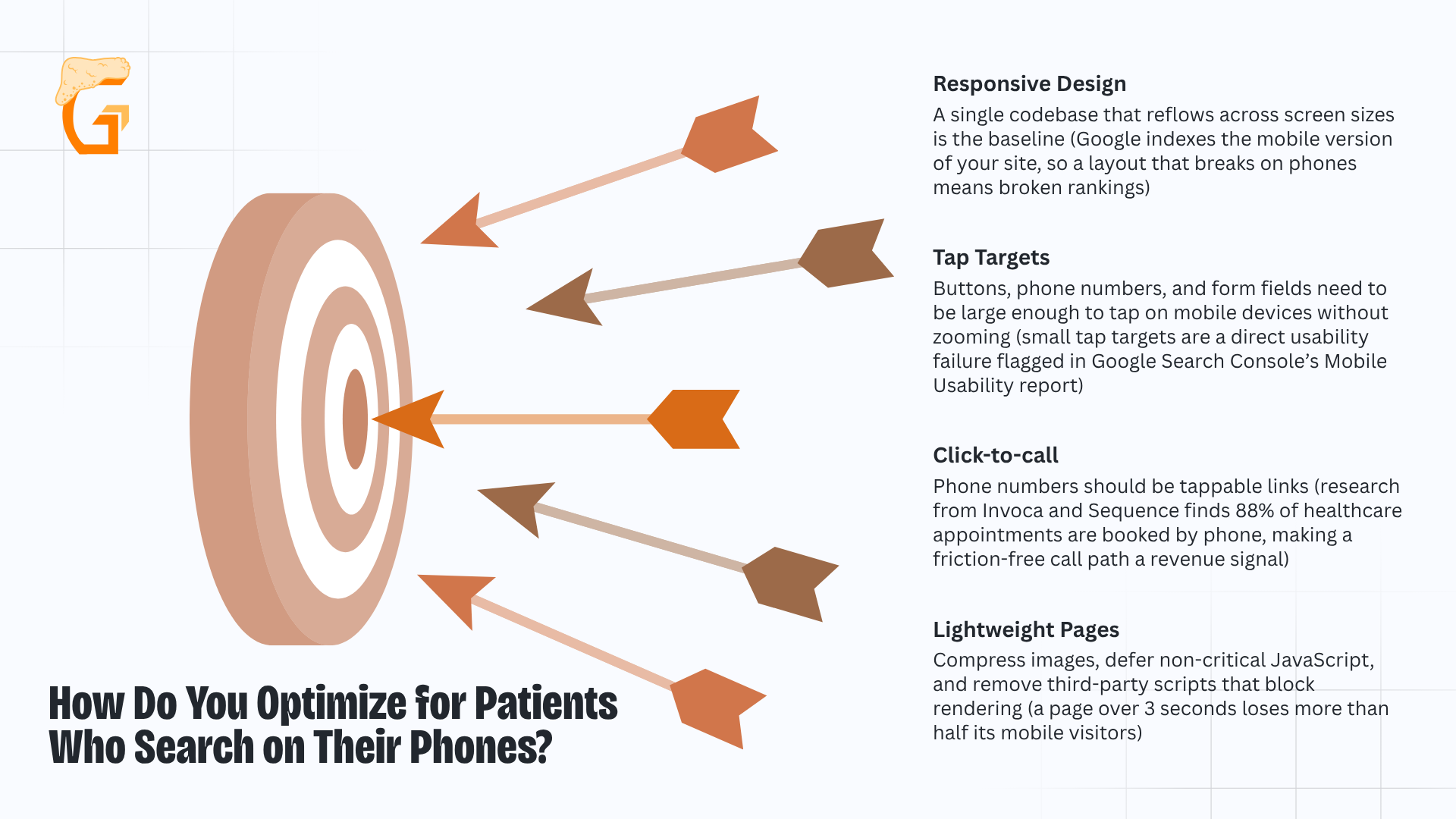
How Do You Optimize for Patients Who Search on Their Phones?

How Do You Optimize for Patients Who Search on Their Phones

Mobile optimization for a dental site goes beyond a single design choice.

Every patient touchpoint (reading about a treatment, tapping a phone number, submitting a contact form) needs to work without friction on a small screen:

Mobile usability failures are auditable in Google Search Console and fixable without a full rebuild.

A patient who cannot tap your phone number or load your booking form on mobile will book elsewhere.

What Core Web Vitals Thresholds Affect Your Rankings, and How Do You Hit Them?

Core Web Vitals are Google’s standardized page experience metrics that directly impact search engine rankings.

Passing all three Core Web Vitals is the bar every dental site should target (and fewer than half of mobile sites currently do):

  • LCP (2.5 seconds or under): measures how quickly the main content loads (slow LCP is usually caused by unoptimized images or render-blocking resources)
  • INP (200ms or under): measures responsiveness to user input (INP replaced First Input Delay as a Core Web Vital in March 2024, measured at the 75th percentile of all interactions)
  • CLS (0.1 or under): measures visual stability (ads, embeds, and images without declared dimensions are the most common causes of layout shift on dental sites)
  • TTFB – 0.8 seconds or under: Time to First Byte is not a Core Web Vital but a key upstream signal (slow TTFB points to server response time or hosting quality)

Around 46–47% of mobile origins passed all three Core Web Vitals in 2024, based on Chrome User Experience Report data published by Google’s web.dev team.

Standard website speed fixes include, but are not limited to:

  • Converting images to WebP and/or AVIF;
  • Enabling browser caching;
  • Deploying a CDN; and
  • Removing render-blocking scripts.

For a dental practice, every failed Core Web Vital is a direct patient-booking risk.

Growth Saloon improves mobile speed and Core Web Vitals for dental sites so patients stay on your pages and book appointments instead of bouncing.

Get the fixes that move rankings where it counts most – work with our dental site speed optimization team today.

How’s your SEO going?

Enter your website URL below to get a free comprehensive SEO audit.

The audit includes:

Which On-Page Technical Elements Shape How You Appear in Search Results?

On page SEO elements (title tags, meta descriptions, and schema markup) control how a dental practice appears in search results and how many searchers click through.

A title tag that is too long gets rewritten in Google’s search results, losing its keyword targeting.

Missing meta descriptions let Google pull an irrelevant sentence from the page body text.

Schema markup done correctly can earn enhanced search appearances with measurably higher click-through rates.

Cyrus Shepard’s research at Zyppy found Google rewrote 99.9% of title tags longer than 70 characters.

How Do Meta Descriptions and Title Tags Drive Click-Through From Search Results?

How Do Meta Descriptions and Title Tags Drive Click-Through From Search Results

Title tags and meta descriptions are the first thing a searcher sees in organic results.

Getting them right is a conversion task – the snippet determines whether a patient clicks through to your site at all:

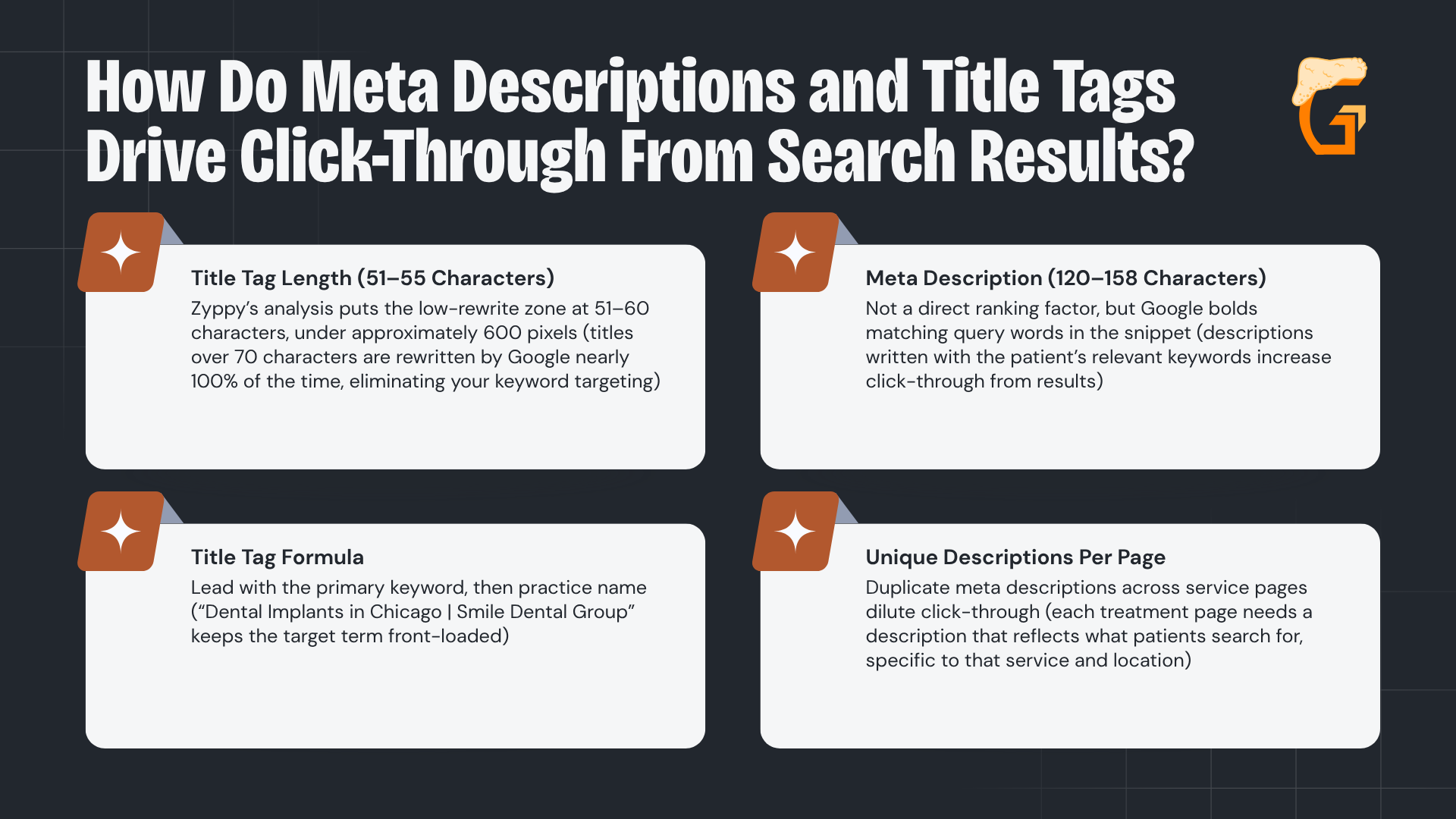
  • Title tag length (51–55 characters): Zyppy’s analysis puts the low-rewrite zone at 51–60 characters, under approximately 600 pixels (titles over 70 characters are rewritten by Google nearly 100% of the time, eliminating your keyword targeting)
  • Title tag formula: lead with the primary keyword, then practice name (“Dental Implants in Chicago | Smile Dental Group” keeps the target term front-loaded)
  • Meta description (120–158 characters): not a direct ranking factor, but Google bolds matching query words in the snippet (descriptions written with the patient’s relevant keywords increase click-through from results)
  • Unique descriptions per page: duplicate meta descriptions across service pages dilute click-through (each treatment page needs a description that reflects what patients search for, specific to that service and location)

Auditing title tags and meta descriptions with Google Search Console’s Performance report or a crawl tool takes under an hour and typically reveals dozens of pages with missing or duplicate tags (each one a missed opportunity in search results).

How Does Schema Markup and Structured Data Help Dental Services Stand Out?

Schema markup is structured data in JSON-LD format that helps search engines understand page content and (for eligible types) display rich results with higher visual prominence in search.

A dental site benefits from four types in particular:

  • Dentist schema: the Dentist type (a subtype of LocalBusiness) tells Google your practice name, address, phone, hours, and specializations in a format it can read without inferring from body text
  • LocalBusiness schema: includes geo-coordinates, service area, price range, and accepted payment methods (like other local businesses, your practice relies on it to reinforce the local signals Google uses for map-pack ranking)
  • FAQPage schema: eligible pages can earn FAQ-style rich results in search (note that since 2023 Google has restricted FAQ rich results primarily to government and health-authority sites, so eligibility should be confirmed via Google’s Rich Results Test before implementation)
  • CTR uplift from structured data: Google’s own documented examples show measurable click-through gains from enhanced results (Rotten Tomatoes saw a 25% higher click-through rate on pages with structured data, illustrating the revenue case for implementing schema correctly)

Validate every schema implementation using Google’s Rich Results Test before and after deployment.

Errors in structured data produce no rich results and can create conflicting signals.

The FAQ section at the bottom of this page uses FAQPage schema as a live implementation example.

What Are the Technical Foundations of Local SEO for Dental Practices?

The technical foundations of local search engine optimization for dentists are a complete Google Business Profile, consistent NAP citations, and a steady flow of reviews (the signals that decide map-pack visibility).

The Local Pack captures approximately 42% of local-result clicks, making map-pack placement some of the highest-value organic real estate available to a dental practice.

The 2026 Whitespark Local Search Ranking Factors study identifies Google Business Profile signals as the largest local-pack ranking factor at roughly 32% of total weight.

How Do Google Business Profile and Google Maps Drive Local Search Visibility?

How Do Google Business Profile and Google Maps Drive Local Search Visibility

Your Google Business Profile (the listing that powers your presence on Google Maps) is the technical anchor of local SEO for a dental practice.

It is what Google reads to decide whether your practice belongs in local search results (and an incomplete profile is a direct ranking disadvantage):

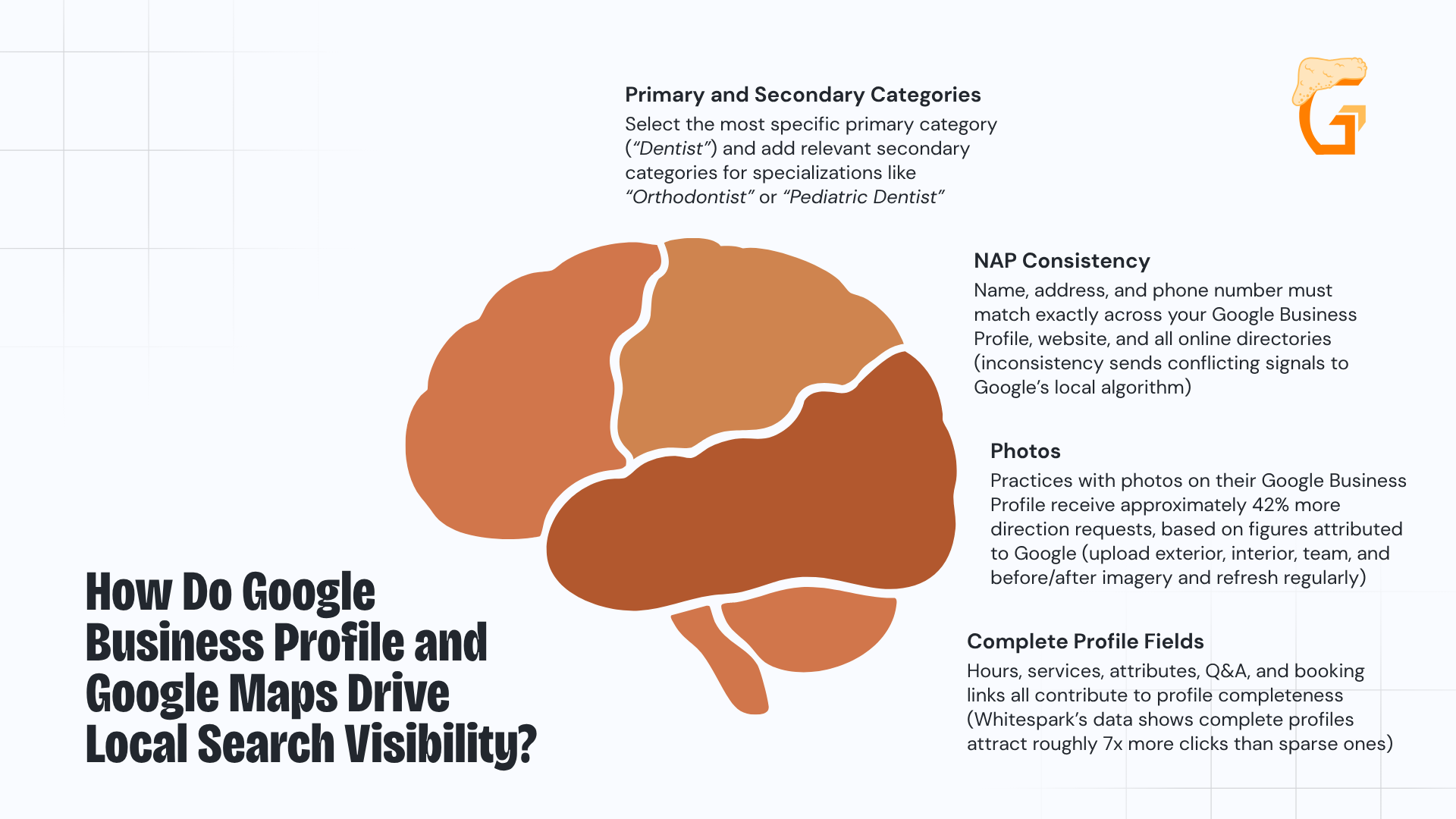
  • Primary and secondary categories: select the most specific primary category (“Dentist”) and add relevant secondary categories for specializations like “Orthodontist” or “Pediatric Dentist” (categories are among the highest-weight signals in the GBP ranking category)
  • NAP consistency: name, address, and phone number must match exactly across your Google Business Profile, website, and all online directories (inconsistency sends conflicting signals to Google’s local algorithm)
  • Photos: practices with photos on their Google Business Profile receive approximately 42% more direction requests, based on figures attributed to Google (upload exterior, interior, team, and before/after imagery and refresh regularly)
  • Complete profile fields: hours, services, attributes, Q&A, and booking links all contribute to profile completeness (Whitespark’s data shows complete profiles attract roughly 7x more clicks than sparse ones)

Google Business Profile data is crawled and indexed (which means an error in your profile is a technical SEO problem, not just a local one).

You own your profile and your data – a technical SEO partner’s job is to optimize it, not lock it behind a proprietary system.

How Do Online Reviews, Citations, and Directories Strengthen Local Rankings?

Review signals (among the strongest local SEO elements) account for roughly 20% of local-pack ranking weight per the 2026 Whitespark Local Search Ranking Factors study – a quantifiable ranking lever, not a soft brand concern.

Citation consistency and directory presence carry similar weight, and four factors combine to move that needle:

Consistent NAP data is the connective tissue between your website, your Google Business Profile, and your directory listings.

Every citation is a data point Google uses to verify your practice’s location and legitimacy – inconsistencies reduce the trust signals that support the broader crawl-index-rank foundation.

Growth Saloon builds and audits the local SEO foundations that get dental practices into the map pack and in front of nearby patients.

From Google Business Profile optimization to NAP citation cleanup, our local SEO for dentists covers every signal that drives map-pack placement.

How Do You Run a Technical SEO Audit and Turn Site Health Into New Patients?

A technical SEO audit uses Google Search Console, Screaming Frog, and PageSpeed Insights to surface indexing, speed, and crawl issues (then prioritizes the fixes that convert site health into new-patient bookings).

SEO patient acquisition runs roughly $50–$150 per new patient, compared to $100–$350 via paid search, per FirstPageSage’s patient acquisition cost data.

A technically healthy site lowers that cost further by reducing the crawl waste that keeps high-value pages unranked.

How Do You Run a Technical SEO Audit With Google Search Console?

How Do You Run a Technical SEO Audit With Google Search Console

Google Search Console is the starting point for any dental technical SEO audit – it is free, connects directly to Google’s view of your site, and surfaces indexing and crawl issues that third-party tools cannot replicate.

Four reports do most of the work:

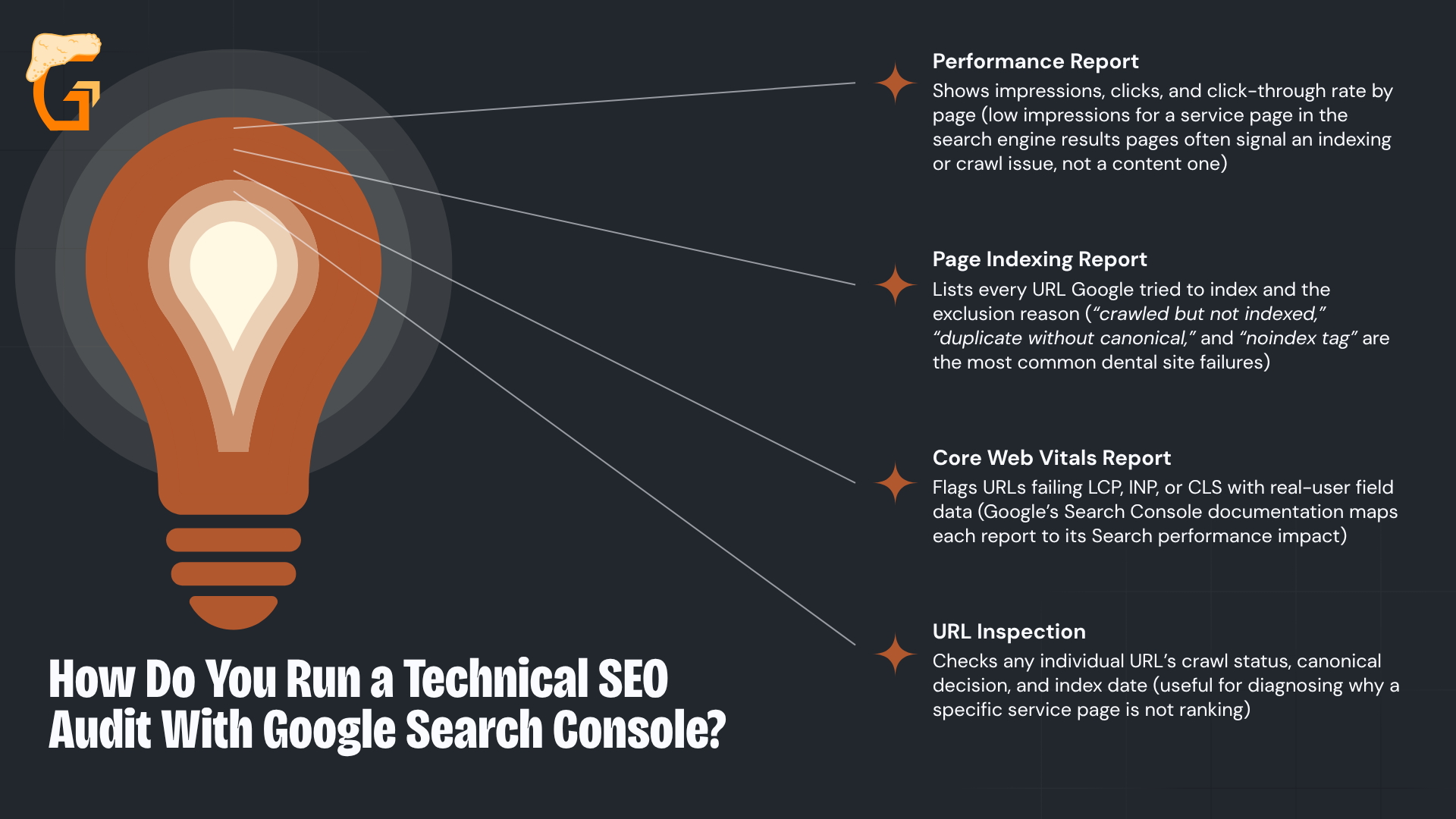
  • Performance report: shows impressions, clicks, and click-through rate by page (low impressions for a service page in the search engine results pages often signal an indexing or crawl issue, not a content one)
  • Page Indexing report: lists every URL Google tried to index and the exclusion reason (“crawled but not indexed,” “duplicate without canonical,” and “noindex tag” are the most common dental site failures)
  • Core Web Vitals report: flags URLs failing LCP, INP, or CLS with real-user field data (Google’s Search Console documentation maps each report to its Search performance impact)
  • URL Inspection: checks any individual URL’s crawl status, canonical decision, and index date (useful for diagnosing why a specific service page is not ranking)

Layer Screaming Frog over Search Console to catch broken links, missing tags, and redirect chains in bulk.

Run a full audit quarterly and a targeted crawl after any significant site change.

What SEO Strategies Turn Site Health Into New Patients?

Most dental site audits surface 15–30 fixable issues.

Not every fix carries equal weight, and the order you tackle them in determines how fast rankings and patient calls move:

  • Fix crawl and indexing first: an unindexed page cannot rank (resolve noindex errors, blocked URLs, and redirect chains before tackling any content or local work)
  • Prioritize mobile speed: Core Web Vitals failures suppress rankings where most dental patients search (mobile optimization fixes typically produce the fastest measurable organic gains)
  • Track patient-acquisition KPIs: organic intake volume, call volume, and cost per new patient are what matter (GSC click-through and impression data show which pages need title tag or meta description work)
  • Local proximity intent: a Google-cited figure puts 76% of people who search for something nearby visiting a business within 24 hours (local pack placement converts searches into same-day appointments)

The SEO strategies that move the needle on patient acquisition are crawl and indexing errors, mobile speed failures, and missing local schema – prioritize in that order.

The goal of a technical audit is a lower cost per new patient and more new patients booking from organic.

Growth Saloon structures every audit around SEO success – you own your site and your data, you have direct access to the strategist doing the work, and every recommendation connects to appointment volume, not vanity metrics.

Growth Saloon runs technical SEO audits built around one goal: lowering your cost per new patient and filling more appointment slots from organic search.

Ready to turn site health into measurable growth? Connect with our dental SEO experts and see what’s holding your rankings back.

How Can Growth Saloon Help Your Dental Practice Grow?

Growth Saloon is a Chicago-based digital marketing agency built to help dental practices attract more patients and grow their practice through performance-driven digital marketing.

Mike Lowe and the Growth Saloon team specialize in SEO, web design, conversion rate optimization, and marketing attribution for the dental industry – working alongside your practice to build a measurable digital presence that generates qualified patient inquiries, not just website traffic.

From building search visibility for high-intent local terms to converting site visitors into booked appointments, Growth Saloon focuses on results at every stage of the patient acquisition funnel.

Practice owners and marketing managers get clear visibility into exactly which channels are driving new patient growth.

We know that every open appointment slot has a real cost.

Every decision we make is built around one outcome – helping your practice fill more of them.

Meet the Founder of Growth Saloon

Meet the founder and lead strategist at Growth Saloon – Mike Lowe:

  • As founder and CEO of Growth Saloon, Mike brings years of hands-on experience in SEO strategy, CRO, web design, and marketing attribution for service-based businesses competing in local and regional markets.
  • Based in Chicago and working with practices across the country, Mike has built and managed digital growth campaigns for businesses competing in some of the most contested search markets in the country.
  • Growth Saloon’s data-driven approach to local SEO and patient acquisition helps dental practices turn their websites into their highest-performing new patient channel.

What Does Working With Growth Saloon Look Like?

Growth Saloon operates as a dedicated extension of your marketing team – not a vendor that disappears after onboarding.

Every engagement includes direct access to Mike and the team, transparent reporting tied to actual patient acquisition outcomes, and strategies tailored to your specific services and local market.

Whether you’re improving search engine visibility for high-value procedures, lifting your site’s appointment conversion rate, or finally getting clarity on where your new patients are actually coming from, Growth Saloon builds the dental SEO strategy and does the work.

Growth Saloon helps build a dental practice’s online presence that consistently generates qualified new patient inquiries – not just clicks.

Contact our team today to find out how our dental marketing services can lower your cost per new patient and grow your practice.

FAQ
Author

Who is Mike Lowe?

Mike Lowe is a digital marketing strategist and the founder of Growth Saloon, where he specializes in helping businesses cut through the noise with high-converting email strategies and SEO.

With a focus on “organic storytelling,” Mike combines over a decade of agency experience with a passion for helping brands build genuine trust with their audience.

When he’s not optimizing subject lines or scaling SaaS companies, he’s likely sharing insights on how to transform cluttered inboxes into meaningful connection points for online marketers.

Related content
Resources for Dentists

Every resource we’ve published for Dentists, in one place:

Ready to turn your website traffic into real growth?

You’ve read the strategy now let Growth Saloon help you put it into action.

Get a free SEO audit and see what’s holding your website back from ranking, converting, and growing. 

Let's Chat

Let’s discuss your online marketing goals! We’re quick to respond, so we’ll be in touch shortly to set up a time to chat.