

Key takeaways
- In pediatric dental SEO the searcher is always the parent, so every keyword, page tone, and conversion element must address parent concerns like safety, comfort, and trust rather than the child.
- Set the GBP primary category to "Pediatric Dentist" and request reviews that mention a child's age and first-visit experience, since the right category and specific reviews win the click before a website is ever seen.
- Build dedicated high-intent pages for sedation, special needs, insurance, and Medicaid, and capture early-research parents with first-visit and anxiety content months before they are ready to book.
Why Are More Pediatric Dental Practices Investing in SEO for Pediatric Dentists?
Search engine optimization for pediatric dentists is how your practice gets in front of parents at the exact moment they are searching for a kids’ dentist – before they’ve called anyone, before they’ve asked a neighbor, and often before they’ve even decided which practice to vet first.
When parents search for pediatric dentists “near me” on a Thursday evening, the practice that shows up is the one that gets the appointment.
The one that doesn’t is invisible.
What separates pediatric dental SEO from general dental marketing is the target audience doing the searching.
Every search – “gentle kids dentist,” “first dental visit toddler,” “pediatric dentist that accepts Medicaid” – is made by a parent evaluating safety, comfort, and credentials on behalf of a child who can’t advocate for themselves.
That parent-as-searcher dynamic changes every content decision, every service page, and every local SEO signal your practice needs to compete.
Growth Saloon helps pediatric dental practices build the kind of digital presence that consistently generates qualified new patient inquiries – not just clicks.
Contact our team today to find out how our dental marketing services can lower your cost per new patient and grow your practice.
What Makes Pediatric Dentist SEO Different from General Dental SEO
Pediatric dentist SEO targets parents, not patients.
Every search (“kids dentist near me,” “first dental visit for toddler,” “gentle pediatric dentist”) is made by an adult evaluating safety, comfort, and trust on behalf of a child.
This parent-as-searcher dynamic means content about children’s oral health must address anxiety, reassurance, and credentials differently from general dental practices, which serve adult patients making decisions for themselves.
Understanding the searcher difference is step one.
The second part is knowing that children’s health content faces Google’s highest quality evaluation standards – which means the content and credential requirements are stricter than they are for nearly any other local business.
How Does the Parent-As-Searcher Dynamic Change a Pediatric Dental SEO Strategy?
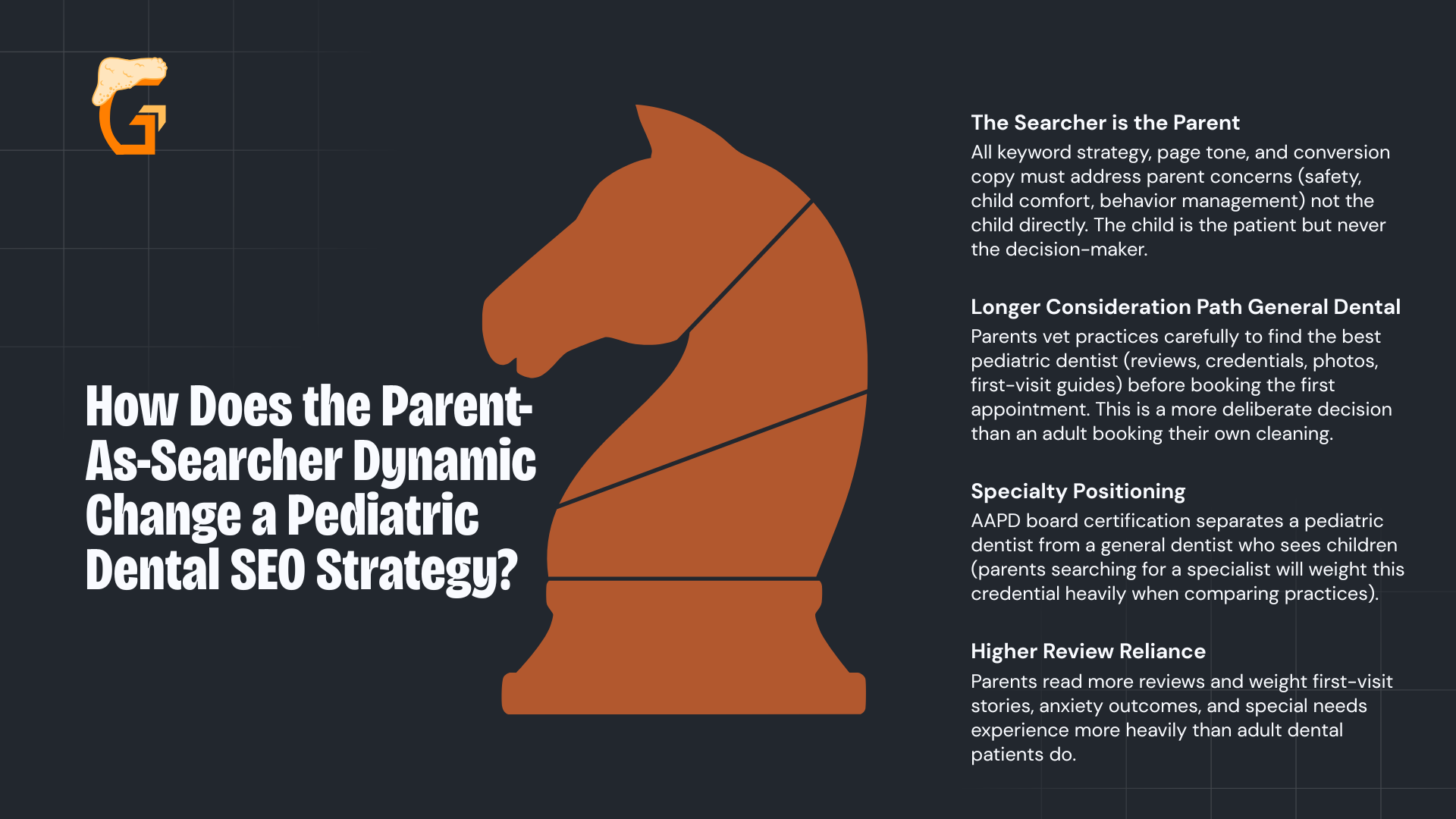
In general dental SEO the searcher is the patient, but pediatric dental patients are children whose parents do the searching.
In pediatric dental SEO the searcher is always the parent – every keyword, page tone, and conversion element must address the parent’s concerns, not the child’s.
Several dynamics separate pediatric dental SEO from general dental SEO:
- The searcher is the parent: all keyword strategy, page tone, and conversion copy must address parent concerns (safety, child comfort, behavior management) not the child directly – the child is the patient but never the decision-maker
- Longer consideration path than general dental: parents vet practices carefully to find the best pediatric dentist (reviews, credentials, photos, first-visit guides) before booking the first appointment (this is a more deliberate decision than an adult booking their own cleaning)
- Specialty positioning: AAPD board certification separates a pediatric dentist from a general dentist who sees children; parents searching for a specialist will weight this credential heavily when comparing practices
- Higher review reliance: parents read more reviews and weight first-visit stories, anxiety outcomes, and special needs experience more heavily than adult dental patients do
The practical result is that pediatric dental SEO requires different content, different conversion copy, and different trust signals than a general dental site (pages written for adult patients who are making their own decisions will not convert searching parents whose first job is to protect their child).
Why Does Children’s Health Content Face Google’s Highest SEO Quality Standards?
Content about children’s dental care is classified as YMYL healthcare content – Google’s quality rater guidelines apply their highest scrutiny because errors or misinformation can affect a child’s health and safety.
That classification raises the bar in several ways:
- YMYL implications: content about children’s health is evaluated under Google’s highest quality standards (E-E-A-T requirements are stricter than for general adult content). A page that would rank easily for adult dental content may be deprioritized for children’s dental content if it lacks clinical credibility.
- Clinical accuracy is required: pediatric-specific clinical accuracy (age-appropriate treatments, safety protocols, sedation guidance) is an E-E-A-T requirement, not optional. Generic dental copy that isn’t adapted for pediatric contexts fails the expertise signal.
- Author attribution: clinical pages (including those describing a pediatric dental exam) must be attributed to a named, AAPD-credentialed pediatric dentist to pass expertise evaluation.
The practical effect is that generalist SEO providers who don’t build YMYL/E-E-A-T infrastructure into their workflow often produce pediatric dental content that ranks for a few months before a quality update deprioritizes it.
Specialist credential proof and clinical accuracy are the signals that make organic search rankings durable.
Local SEO for Pediatric Dentists: GBP, Reviews, and Map Pack Visibility
For pediatric dentists, Google Business Profile optimization is the single highest-impact local SEO asset.
Setting the primary GBP category to “Pediatric Dentist” (not “Dentist”) determines which map pack searches the listing is eligible for.
Systematic review acquisition asking parents to mention the child’s age, first-visit experience, or anxiety outcomes produces the procedure-specific social proof that converts local families.
The map pack is what parents see in local search results before any organic website result, so listing your dental services completely is what makes the profile eligible for more of those searches.
A practice with local listings that aren’t properly categorized and reviewed is invisible for the most valuable local searches.
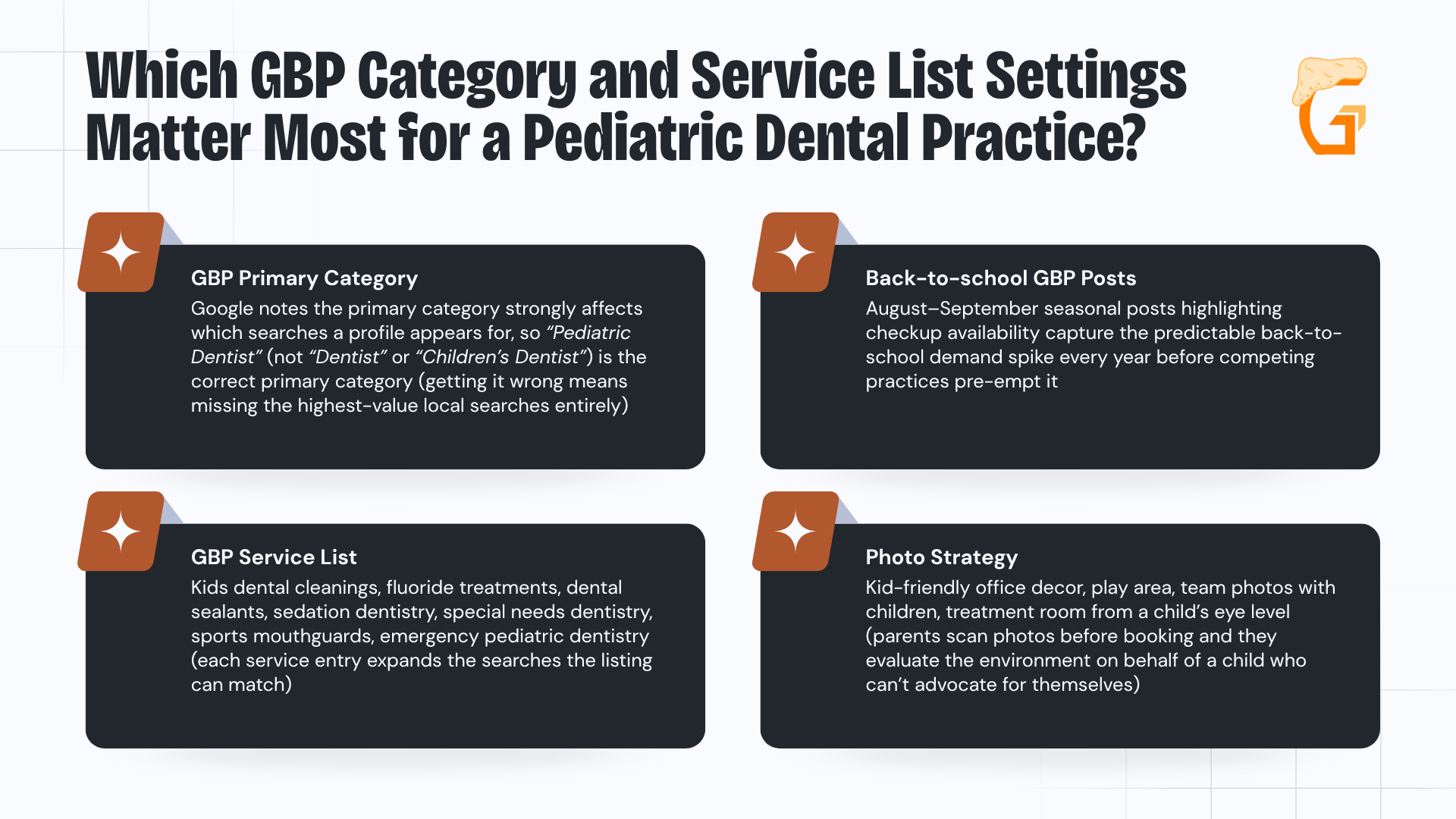
Which GBP Category and Service List Settings Matter Most for a Pediatric Dental Practice?

Parents using voice search for “pediatric dentist near me” or “kids dentist [city]” see GBP listings before any organic website results – the practice with the right category, complete services, and recent parent reviews wins the click before a website is ever seen.
These GBP settings decide whether the listing competes:
- GBP primary category: Google notes the primary category strongly affects which searches a profile appears for, so “Pediatric Dentist” (not “Dentist” or “Children’s Dentist”) is the correct primary category; getting it wrong means missing the highest-value local searches entirely
- GBP service list: kids dental cleanings, fluoride treatments, dental sealants, sedation dentistry, special needs dentistry, sports mouthguards, emergency pediatric dentistry (each service entry expands the searches the listing can match)
- Back-to-school GBP posts: August–September seasonal posts highlighting checkup availability capture the predictable back-to-school demand spike every year before competing practices pre-empt it
- Photo strategy: kid-friendly office decor, play area, team photos with children, treatment room from a child’s eye level (parents scan photos before booking and they evaluate the environment on behalf of a child who can’t advocate for themselves)
A pediatric practice listed under the generic “Dentist” category will miss the map pack entirely for “pediatric dentist near me” searches (the single highest-value query for a specialty children’s practice) because Google uses primary category to gate which searches each listing can appear in.
What Review Acquisition Strategy Works Best for a Pediatric Dental Practice?
Patient reviews mentioning “my 4-year-old’s first visit” or “they were amazing with my anxious 6-year-old” convert other searching parents far more effectively than a generic five-star rating with no detail.
A few habits produce reviews with that kind of detail:
- Review acquisition timing: request reviews immediately after positive appointments while the experience is fresh (not days later when the emotional memory has faded)
- Prompt specificity: ask parents to mention the child’s age, whether it was a first visit, and how the team handled any anxiety (these details are exactly what convert other searching parents who have the same concerns)
- Review platform priority: Google reviews are the primary platform; Healthgrades and Yelp are secondary (don’t split parent attention across too many platforms at once)
A string of positive online reviews mentioning specific ages and anxiety outcomes carries more local ranking and conversion weight than the same number of generic five-star ratings with no text (because both Google and searching parents evaluate whether reviews reflect real, specific experiences).
Growth Saloon optimizes a pediatric practice’s GBP and parent reviews to win the local searches that become qualified new patient inquiries – not just clicks.
Contact our team today to find out how our dental marketing services can lower your cost per new patient and grow your practice.
Content That Converts: First Visit Pages, Anxiety Reduction, and Seasonal Campaigns
The highest-converting content on a pediatric dental website addresses parent anxiety before the first visit and turns researching parents into booked patient appointments.
Pages and blog posts answering “what to expect at my child’s first dental visit,” “how to prepare a toddler for the dentist,” and “back-to-school dental checkup” rank for the informational queries parents search months before booking and funnel those visitors toward an appointment.
Most pediatric dental sites publish service overviews but skip the SEO techniques that reach researching parents.
The larger audience is the group of parents still in research mode (anxious, planning ahead, not yet ready to call) who can be reached with the right content long before they’re ready to book.
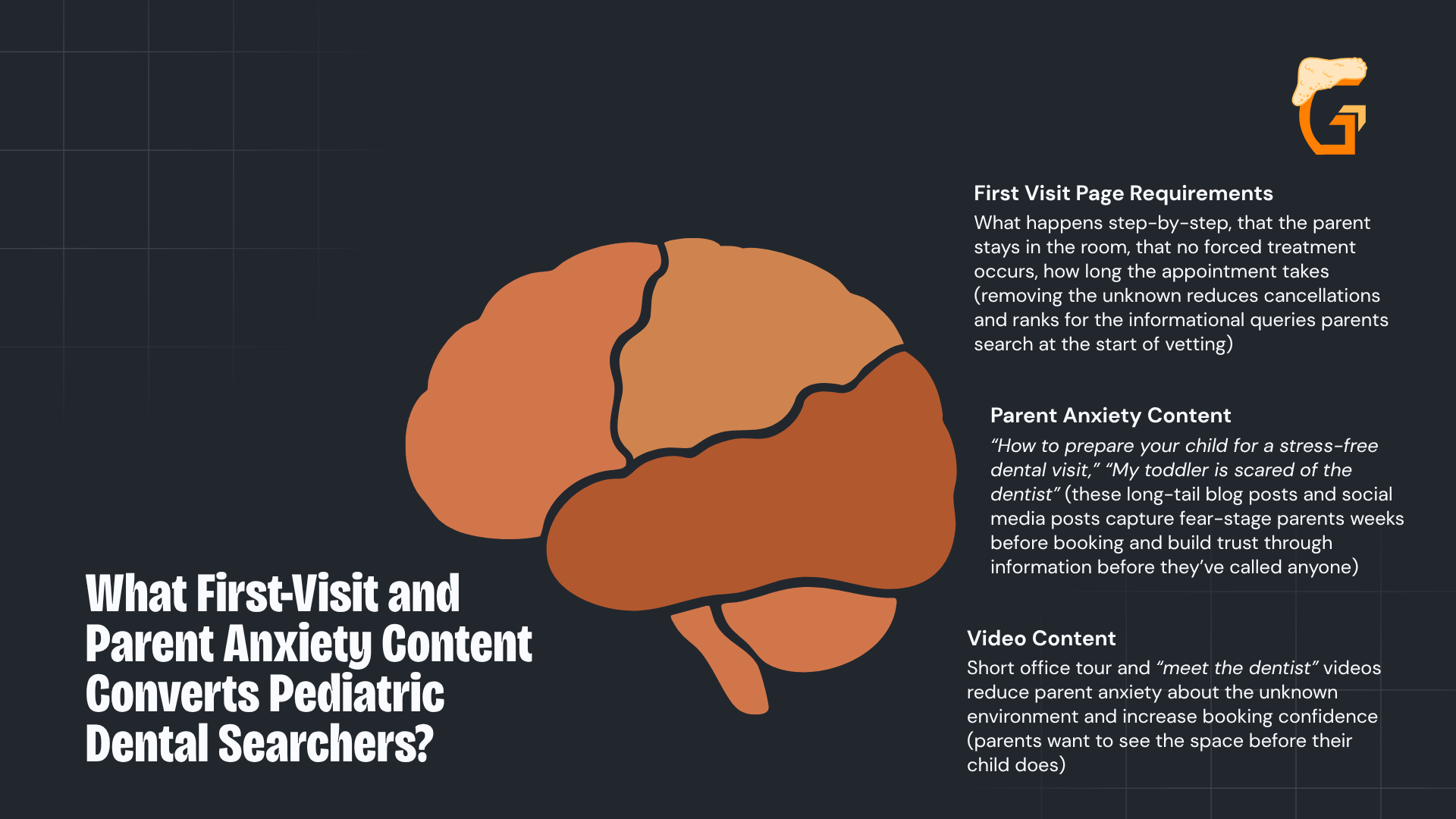
What First-Visit and Parent Anxiety Content Converts Pediatric Dental Searchers?

Most pediatric dental sites publish service overviews but miss the larger group of parents who are researching anxiety management, first-visit prep, and seasonal checkups weeks before they’re ready to book (that early-research traffic is highly convertible with the right content).
A few content types reach parents in that research stage:
- First visit page requirements: what happens step-by-step, that the parent stays in the room, that no forced treatment occurs, how long the appointment takes (removing the unknown reduces cancellations and ranks for the informational queries parents search at the start of vetting)
- Parent anxiety content: “How to prepare your child for a stress-free dental visit,” “My toddler is scared of the dentist” (these long-tail blog posts and social media posts capture fear-stage parents weeks before booking and build trust through information before they’ve called anyone)
- Video content: short office tour and “meet the dentist” videos reduce parent anxiety about the unknown environment and increase booking confidence (parents want to see the space before their child does)
A dedicated first-visit page is one of the highest-ROI SEO efforts for a pediatric practice – it reduces cancellations by eliminating the unknown, and it ranks for the informational queries parents search at the beginning of their vetting process.
How Do Seasonal Campaigns and Mobile Optimization Convert More Pediatric Dental Appointments?
The August–September back-to-school period is a predictable annual demand spike for pediatric dental checkups.
A dedicated landing page and GBP posts for “back-to-school dental checkup [city]” capture parents searching for a checkup before school starts.
Here is how to convert that seasonal and mobile traffic:
- Back-to-school seasonal campaign: dedicated landing page and GBP posts in July–August for “back-to-school dental checkup [city]” and “school dental form dentist [city]” (this demand spike happens every year, and the practice that publishes content in advance captures it before competitors do)
- Mobile-first conversion: most parents search on phones (click-to-call, online booking for appointment requests, and location/hours above the fold are the highest-priority conversion elements; burying the phone number in a footer is a conversion failure)
Mobile-first conversion is not optional for pediatric dental – the majority of parent searches happen on phones, and a site that makes parents hunt for the phone number or booking button will lose appointments to competitors whose mobile UX makes it easy to call.
Growth Saloon builds the first-visit, anxiety, and seasonal content that reaches researching parents and converts into qualified new patient inquiries – not just clicks.
Contact our team today to find out how our dental marketing services can lower your cost per new patient and grow your practice.
How’s your SEO going?
Enter your website URL below to get a free comprehensive SEO audit.
The audit includes:
- A scan of your entire website for technical issues
- A list of your top opportunities to target immediately
- Your highest priority fixes to make
High-Intent Service Pages: Sedation, Special Needs, and Insurance Acceptance
Parents searching “sedation dentistry for kids,” “pediatric dentist for autistic child,” “emergency dentist for my child,” or “Medicaid pediatric dentist” are ready to book with the first practice that clearly answers their question.
Dedicated pages for each of these high-intent local services (not a single grouped “services” page) capture the parents who have a specific, non-negotiable need and will switch practices to find it.
When a parent has a child with specific needs, they filter aggressively.
Among pediatric dental clinics, the practice with a dedicated, detailed answer to that specific need gets the call.
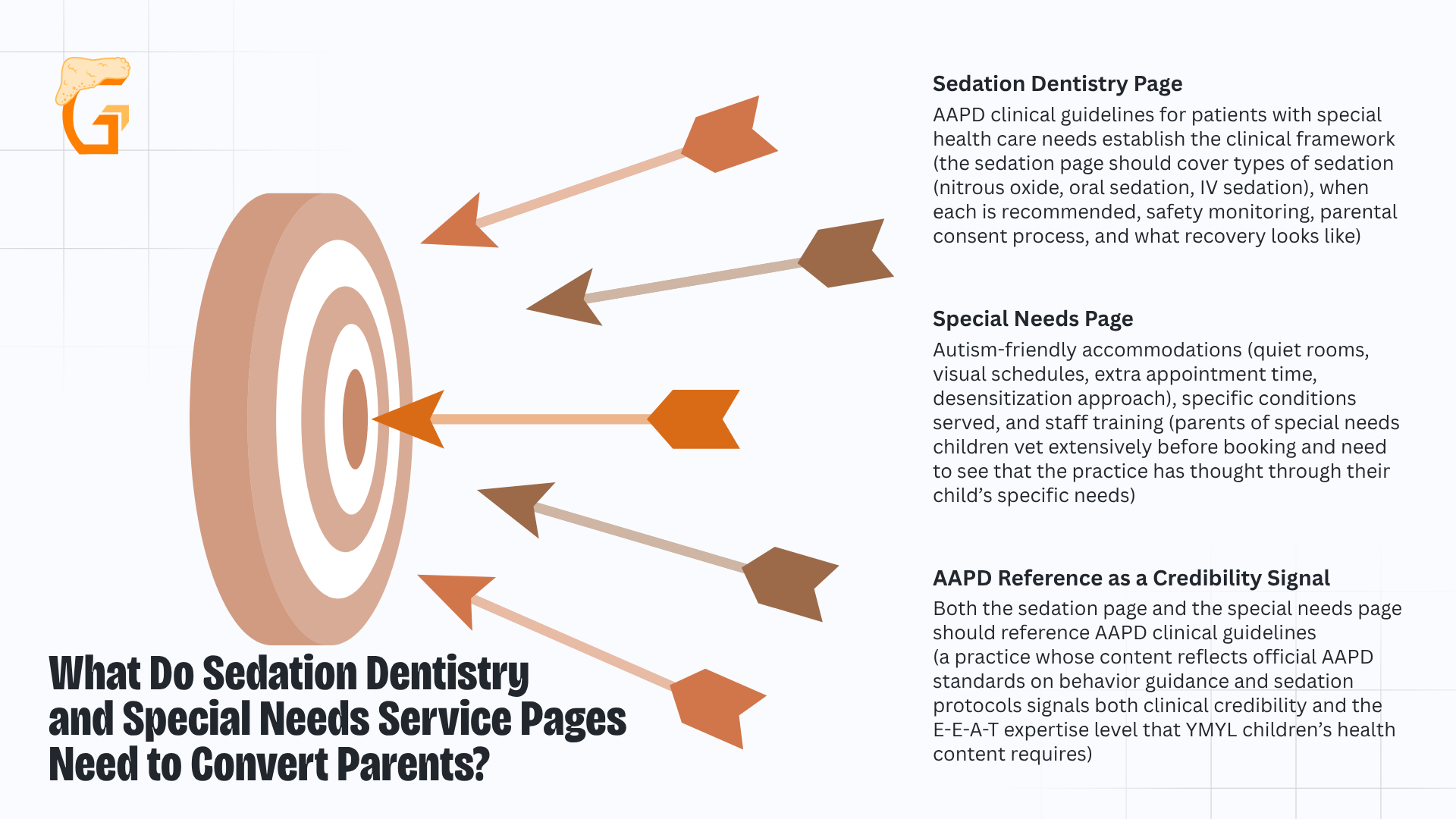
What Do Sedation Dentistry and Special Needs Service Pages Need to Convert Parents?

A parent searching “pediatric dentist for autistic child near me” has a non-negotiable requirement.
The practice with a dedicated, detailed page answering that exact need gets the call – the practice without one loses the patient to whoever does.
Each high-intent page needs to cover specific ground:
- Sedation dentistry page: AAPD clinical guidelines for patients with special health care needs establish the clinical framework (the sedation page should cover types of sedation (nitrous oxide, oral sedation, IV sedation), when each is recommended, safety monitoring, parental consent process, and what recovery looks like)
- Special needs page: autism-friendly accommodations (quiet rooms, visual schedules, extra appointment time, desensitization approach), specific conditions served, and staff training (parents of special needs children vet extensively before booking and need to see that the practice has thought through their child’s specific needs)
- AAPD reference as a credibility signal: both the sedation page and the special needs page should reference AAPD clinical guidelines (a practice whose content reflects official AAPD standards on behavior guidance and sedation protocols signals both clinical credibility and the E-E-A-T expertise level that YMYL children’s health content requires)
Why Does a Medicaid and Insurance Acceptance Page Need Its Own URL for Pediatric Dental SEO?
Parents filter on insurance before reading anything else – a practice that clearly lists accepted insurance plans and Medicaid/CHIP acceptance on a dedicated page captures the searches that most competing practices handle with “call for details.”
Two rules make these high-intent pages rank:
- Insurance and Medicaid page: list every accepted insurance plan by name, explicitly state Medicaid/CHIP acceptance, include financing options (parents with non-negotiable insurance filters will not call a practice that makes them guess about coverage)
- One keyword per page: /sedation-dentistry-for-kids-[city], /special-needs-pediatric-dentist-[city], /medicaid-pediatric-dentist-[city] (one keyword per page, not grouped on a services overview)
Grouping sedation, special needs, and insurance on a single “services” overview guarantees that none of them rank on the search engine results pages.
Each of these terms has distinct search intent and parent vetting behavior that a dedicated page can satisfy, but a grouped page cannot.
Growth Saloon builds the dedicated sedation, special needs, and insurance pages that capture high-intent parents as qualified new patient inquiries – not just clicks.
Contact our team today to find out how our dental marketing services can lower your cost per new patient and grow your practice.
Authority Building for Pediatric Dental Practices: AAPD, Schema, and Early Ortho Content
Long-term pediatric dental SEO authority comes from three sources:
- AAPD board certification and directory listings that earn quality backlinks;
- Schema markup that tells Google the site covers children’s clinical dental content; and
- Early orthodontic evaluation content that extends topical authority beyond cleanings and fillings into the oral development questions parents search for years before a child needs braces.
A practice that builds all three has compounding online visibility that a general dentist who sees children cannot replicate.
AAPD credentials, schema markup, and early ortho content together make the practice the recognized children’s dental authority in the local market.
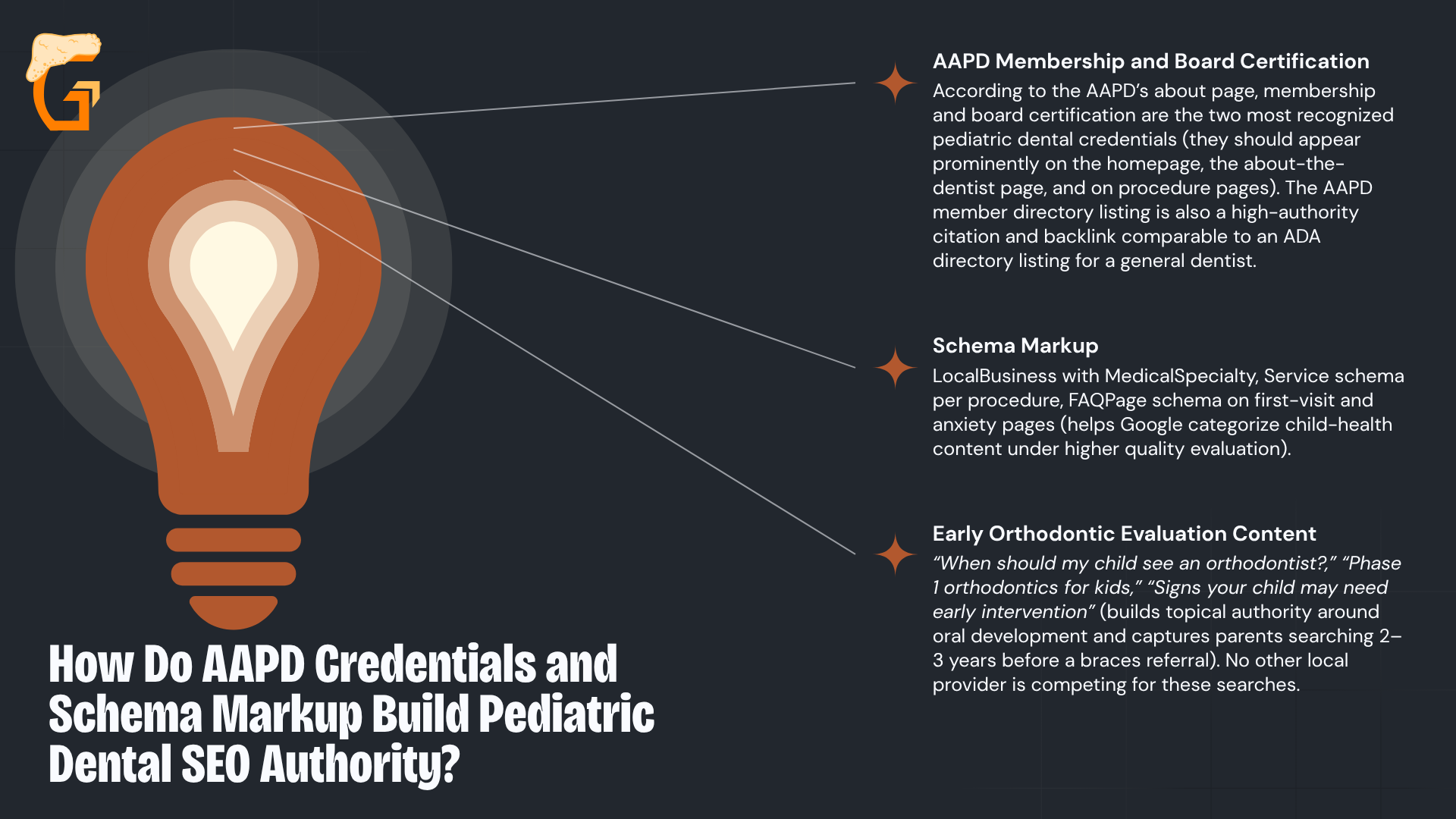
How Do AAPD Credentials and Schema Markup Build Pediatric Dental SEO Authority?

A pediatric dental practice that displays AAPD board certification, gets listed in the AAPD member directory, and applies technical SEO like child-health schema becomes recognized by Google as a credentialed healthcare entity (not just a local business).
These authority signals build that recognition:
- AAPD membership and board certification: according to the AAPD’s about page, membership and board certification are the two most recognized pediatric dental credentials (they should appear prominently on the homepage, the about-the-dentist page, and on procedure pages). The AAPD member directory listing is also a high-authority citation and backlink comparable to an ADA directory listing for a general dentist.
- Schema markup: LocalBusiness with MedicalSpecialty, Service schema per procedure, FAQPage schema on first-visit and anxiety pages (helps Google categorize child-health content under higher quality evaluation).
- Early orthodontic evaluation content: “When should my child see an orthodontist?,” “Phase 1 orthodontics for kids,” “Signs your child may need early intervention” (builds topical authority around oral development and captures parents searching 2–3 years before a braces referral). No other local provider is competing for these searches.
The AAPD member directory listing is not just a credential display – it is one of the highest-authority local citations and dental specialty backlinks available for local SEO purposes.
Which Local Backlinks and Citation Practices Build the Strongest Pediatric Dental Authority?
Pediatric practices have a unique local backlink and online reputation opportunity that general dental practices don’t – school PTAs, youth sports leagues, and parenting blogs are natural community link sources that signal local authority in the parent community.
Two off-site signals turn that opportunity into authority:
- Local backlinks: pediatric practices can earn links from local school PTAs, youth sports leagues, and parenting blogs (these local authority signals outperform generic healthcare directory links because they place the practice inside the community networks parents already trust)
- NAP consistency: name, address, and phone identical across all directories (Healthgrades, Yelp, Zocdoc, AAPD member directory, and local parenting resource sites)
Citations only compound as authority signals for effective local SEO when NAP is character-for-character identical across every directory – inconsistent NAP (old phone numbers, misspelled street addresses) creates entity ambiguity that erodes the off-site authority signals that local pediatric dental SEO depends on.
Growth Saloon helps pediatric dental practices build the kind of digital presence that consistently generates qualified new patient inquiries – not just clicks.
Contact our team today to find out how our dental marketing services can lower your cost per new patient and grow your practice.
How Can Growth Saloon Help Your Dental Practice Grow?
Growth Saloon is a Chicago-based digital marketing agency built to help dental practices attract more patients and grow their practice through performance-driven digital marketing.
Mike Lowe and the Growth Saloon team specialize in pediatric dental SEO services, web design, conversion rate optimization, and effective marketing strategies – working alongside your practice to build a measurable digital presence that generates qualified patient inquiries, not just website traffic.
From ranking for high-intent local search terms to converting site visitors into booked appointments, Growth Saloon focuses on results at every stage of the patient acquisition funnel.
Practice owners and marketing managers get clear visibility into exactly which channels are driving new patient growth.
We know that every open appointment slot has a real cost.
Every decision we make is built around one outcome – helping pediatric dentists fill more of their open appointment slots.
Meet the Founder of Growth Saloon
Meet the founder and lead strategist at Growth Saloon – Mike Lowe:
- As founder and CEO of Growth Saloon, Mike brings years of hands-on experience in SEO strategy, CRO, web design, and marketing attribution for service-based businesses competing in local and regional markets.
- Based in Chicago and working with practices across the country, Mike has built and managed digital growth campaigns for businesses competing in some of the most contested search markets in the country.
- Growth Saloon’s data-driven approach to local SEO, reputation management, and patient acquisition helps dental practices turn their websites into their highest-performing new patient channel.
What Does Working With Growth Saloon Look Like?
Growth Saloon operates as a dedicated extension of your marketing team, combining hands-on strategists with AI tools – not a vendor that disappears after onboarding.
Every engagement includes direct access to Mike and the team, transparent reporting tied to actual patient acquisition outcomes, and strategies tailored to your specific services and local market.
Whether you’re looking to rank for high-value procedures, improve your site’s appointment conversion rate, or finally get clarity on where your new patients are actually coming from, Growth Saloon builds the strategy and does the work.
Growth Saloon helps dental practices build the kind of digital presence that consistently generates qualified new patient inquiries – not just clicks.
Contact our team today to find out how our dental marketing services can lower your cost per new patient and grow your practice.
How's your SEO going?
Get your free comprehensive SEO audit.
Enter your website URL below to get a free comprehensive SEO audit.
- Scan entire website for technical issues
- Get a list of your top opportunities
- See your highest priority fixes to make
-
Expect early ranking movement at three to six months and consistent new family bookings from organic search at six to twelve months.
The first ninety days are foundation work for the key SEO strategies – verifying the Google Business Profile category as “Pediatric Dentist,” building the core service pages, and establishing baseline keyword rankings.
Practices in lower-competition suburban markets often see faster results from SEO strategies for pediatric dentists; practices in dense metro areas with established competitors should plan for a longer runway before organic search becomes a primary acquisition channel.
No provider can guarantee results by a specific date – these are typical ranges, not guaranteed outcomes.
-
The primary category.
Setting the primary category to “Pediatric Dentist” rather than “Dentist” or “Dental Clinic” is the single highest-impact GBP change for pediatric SEO success.
Google uses the primary category to determine which local searches your listing is eligible to appear in.
A pediatric dentist listed under the generic “Dentist” category will miss the map pack for “pediatric dentist near me” searches – the highest-value query for a specialty children’s practice.
-
Yes. In pediatric dental SEO services, sedation dentistry deserves its own dedicated page – not a paragraph on a general services overview.
Parents searching “sedation dentistry for kids near me” or “is dental sedation safe for my child” have a specific concern that a dedicated page can fully address:
- What types of sedation are offered;
- When each is recommended;
- How safety is monitored;
- What parents should expect, and
- How to prepare their child.
A practice with a thorough sedation page ranks for these specific searches and converts parents who would otherwise keep looking.
-
Ask immediately after a positive appointment (while the experience is fresh) to collect more positive reviews.
You should also prompt the parent specifically to mention their child’s age, whether it was a first visit, and how the team handled any anxiety.
These details turn reviews into patient success stories that are more authentic and more useful to other searching parents.
A string of reviews mentioning “my 3-year-old’s first visit” or “great with my anxious 7-year-old” carries more local ranking and conversion weight than the same number of generic five-star ratings with no detail.
-
Yes, in two ways.
First, keyword research shows that parents searching “Medicaid pediatric dentist [city]” or “kids dentist that takes CHIP near me” are high-intent searchers with a non-negotiable filter.
A dedicated insurance and Medicaid acceptance page captures this patient pool that most competing practices lose to a “call for details” note.
Second, clearly listing accepted insurance plans on the website, in social media marketing, and in the Google Business Profile removes a friction point that prevents parents from calling (the practice that answers the insurance question immediately converts more site visitors than one that doesn’t).
-
AAPD (American Academy of Pediatric Dentistry) membership and board certification are the two most recognized pediatric dental credentials and should appear prominently on the website homepage, the about-the-dentist page, and on procedure pages.
Board certification by the American Board of Pediatric Dentistry signals two to three years of specialty residency beyond dental school and strengthens pediatric dentists’ local SEO (something parents searching for a specialist over a general dentist will weight heavily).
The AAPD member directory also provides a high-authority citation and backlink for local SEO purposes.
Most agencies sell traffic. We sell actual growth. That’s the Growth Saloon difference.
Are you looking to grow?
Recent blogs
Enter your website URL below to get free comprehensive SEO audit.
- Scan entire website for technical issues
- Get a list of your top opportunities
- See your highest priority fixes to make