


Updated:August 13th, 2026

Local Citations for Dentists: Where to List

Written by

Mike Lowe

Reviewed by

Taylor Coteus

Why Do Local Citations Matter for Dentists?

Local citations for dentists are one of the most direct ways Google determines whether your practice deserves a spot in the local map pack (and most dental practices either haven’t built them properly or have years of inconsistent NAP data quietly working against them).

When potential patients search “dentist near me” or “emergency dentist in [city],” Google’s local ranking system cross-references your Name, Address, and Phone number across dozens of directories to verify your practice is:

  • Real;
  • Established; and
  • Located where you claim.

That verification process is why citation consistency matters as much as citation volume for local search visibility.

SEO for Dentists How It Works, What It Costs & Who to Hire

A practice with 80 accurate, consistent listings across Google Business Profile, healthcare directories, insurance networks, and local community sites signals far more trust than one with 200 listings where the phone number changed three years ago and never got updated on half of them.

If you’d like a head start, request a free SEO audit from our team at Growth Saloon – we’ll show you exactly where your practice stands and what it would take to build local citations and close the gap.

Contact our team today to find out how our local citations for dentists services can lower your cost per new patient and grow your dental clinic.

What Are Local Citations for Dentists?

Local citations for dentists are online mentions of your practice’s core business information that signal trust to Google (Name, Address, and Phone number on Google Business Profile, Yelp, Healthgrades, and dental directories).

According to Moz’s local SEO glossary, a local citation is any online mention of NAP for a local business, and they can appear on directories, websites, apps, and social platforms.

This section covers two things: what counts as a citation, and the NAP-consistency rule that determines whether your citations help or hurt.

What is a local citation in dental SEO?

A local citation is any online mention of your practice’s NAP – whether on formal online directories or buried in a local news article.

Structured citations appear in formal listings such as local business directories; unstructured citations appear in less formal content like blog posts, “Best Dentists in [City]” roundups, and local press.

It’s worth keeping the distinction clear:

  • All backlinks that contain your NAP are citations, but not all citations are backlinks
  • A directory listing without a hyperlink still contributes citation value

What is NAP and why does consistency matter?

Google’s local ranking is built on three factors:

  1. Relevance
  2. Distance
  3. Prominence

Citations primarily reinforce prominence by verifying your business’s legitimacy and stability at its claimed location.

For that signal to work, your Name, Address, and Phone Number (NAP) must match exactly across every listing: no abbreviations mixed with spelled-out words, no suite numbers dropped on some platforms.

Before touching any directory, create a Master NAP Document and implement LocalBusiness/Dentist schema markup on your website to maintain NAP consistency – that becomes the source of truth every listing must mirror.

Building a consistent citation profile starts with the right strategy – Growth Saloon helps dental practices get their local SEO foundation right from day one.

Contact us to learn how our local citations for dentists services can strengthen local SEO and your practice’s online presence.

Where Should a Dentist List Their Practice?

Dentists should first list their practice on the following platforms, which feed Google Maps and other major search surfaces:

  • Google Business Profile
  • Bing Places
  • Apple Maps
  • Facebook
  • Yelp
  • Yellow Pages

Then, after those major directories have been setup, dentists should list their practice on:

  • Healthgrades
  • Zocdoc
  • Vitals
  • ADA Find-a-Dentist
  • Active insurance-provider directories

BrightLocal’s curated dental citation list confirms this tiered stack for healthcare providers (general local business directories at the foundation, healthcare and dental-specific platforms above them, insurance directories at the top).

Tier 1: Which core directories should every dentist claim?

Every dental practice needs six citation sites claimed before anything else:

  • Google Business Profile
  • Bing Places
  • Apple Maps
  • Facebook Business Page
  • Yelp
  • Yellow Pages

Google Business Profile carries the most weight in local pack results by a substantial margin.

Apple Maps, Bing, Yelp, and Facebook reinforce prominence at the next tier (the same tier where other businesses in your local market also build presence) but don’t substitute for a fully built GBP.

All six are free to claim.

Complete every field (business hours, category, photos, and website URL) – not just NAP.

Tier 2–3: Which healthcare and dental-specific directories matter?

Tier 2 sits above the general business directories and includes the major healthcare directories:

  • Healthgrades
  • Zocdoc
  • Vitals
  • RateMDs
  • WebMD
  • Doctor.com

Basic profiles are generally free, paid upgrades exist as well.

These platforms mirror the role of public healthcare locators like the HHS dental care finder, funneling patients from local search results toward verified providers.

Tier 3 is dental-specific:

Specialty association directories that cover specific dental services work the same way (AAO, AAP, AAE, AAPD, and your state dental society all come with membership).

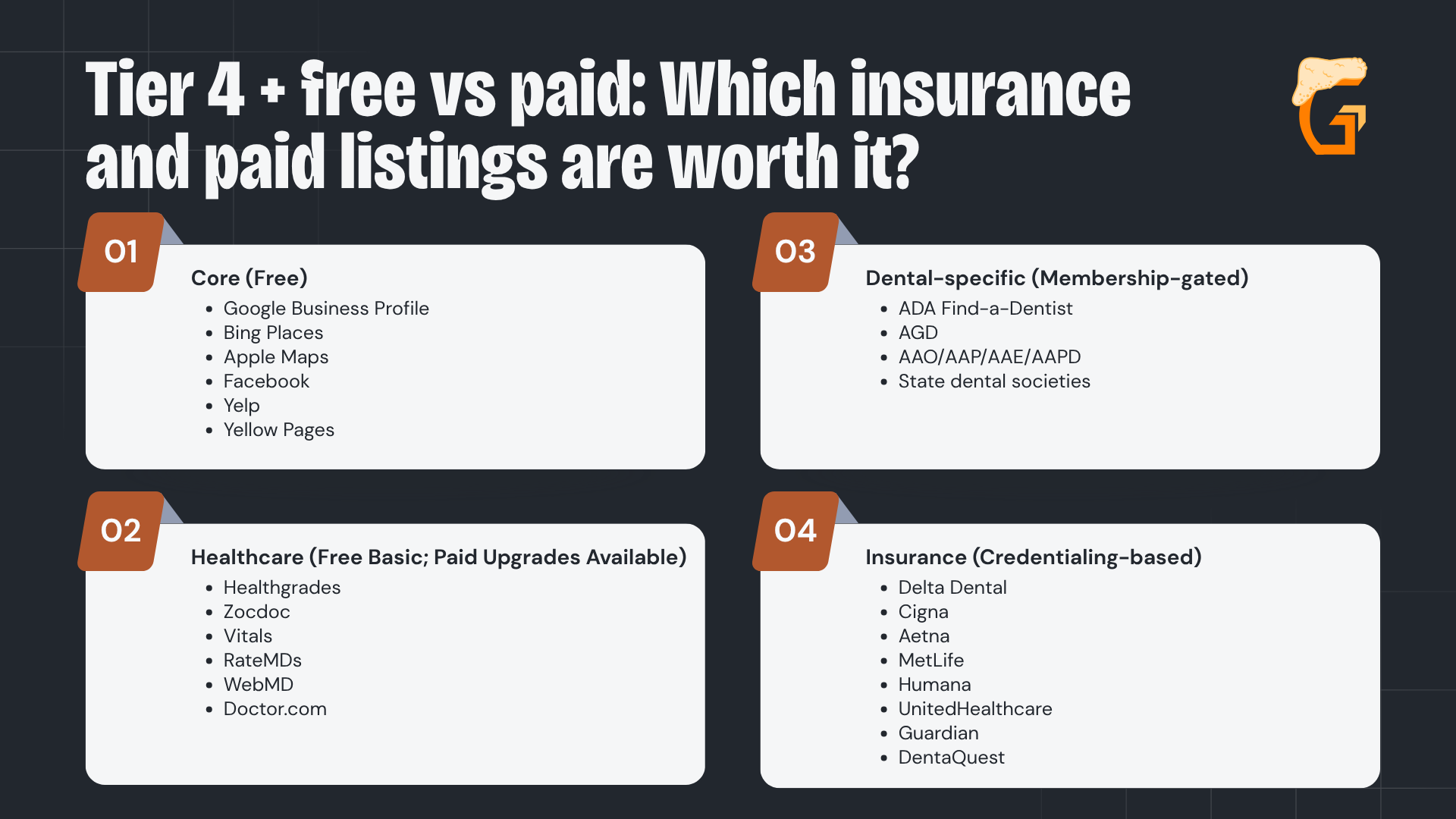
Tier 4 + free vs paid: Which insurance and paid listings are worth it?

Tier 4 is your insurance-provider directories:

  • Delta Dental
  • Cigna
  • Aetna
  • MetLife
  • Humana
  • UnitedHealthcare
  • Guardian
  • DentaQuest

Listings here come from in-network credentialing, not ad spend (and they cross-reference the National Provider Identifier (NPI) assigned to every covered dentist by CMS, which is also publicly searchable) – adding local relevance for insured patients in your service area.

Here’s how each tier works:

  • Tier 1 – Core (Free): Google Business Profile, Bing Places, Apple Maps, Facebook, Yelp, Yellow Pages
  • Tier 2 – Healthcare (Free basic; paid upgrades available): Healthgrades, Zocdoc, Vitals, RateMDs, WebMD, Doctor.com
  • Tier 3 – Dental-specific (Membership-gated): ADA Find-a-Dentist, AGD, AAO/AAP/AAE/AAPD, state dental societies
  • Tier 4 – Insurance (Credentialing-based): Delta Dental, Cigna, Aetna, MetLife, Humana, UnitedHealthcare, Guardian, DentaQuest

Claiming and optimizing listings across all four tiers takes time – Growth Saloon can handle the full directory submission process for your dental practice.

Get in touch to explore our dental marketing and citation management packages and free up your team’s time.

Which Local and Regional Citations Should You Add?

Beyond national directories, dentists need local citations from chambers of commerce, neighborhood business associations, local news sites, and city-specific directories (each of these regional directories is a vote for geographic legitimacy).

Moz identifies citations from local chambers, local news sites, and city-specific directories as signals of geographic relevance that national directories alone can’t replicate.

This is the layer most dental SEO guides skip.

Which local citations should you build first?

Start your local citation building with your local Chamber of Commerce listing (the SBA itself recommends chambers of commerce, the Better Business Bureau, yellow pages, and niche directories as foundational local marketing channels) and pair it with a BBB directory listing (free to submit, separate from accreditation) as the foundational two.

From there, add Rotary club listings, neighborhood business associations, and community organization directories as additional local search citations.

Unstructured citations from local newspaper mentions and community blog features carry real authority – a single “Top Dentists in [City]” feature outweighs a dozen generic national directories.

How do you find local citation opportunities?

The two main discovery tools are Whitespark Local Citation Finder and BrightLocal – both surface directories your top-ranking competitors appear on that you haven’t claimed yet.

The free version of the same tactic: search your city’s top-ranking dental practices and note which local directories and regional citation sites appear in their profiles.

Prioritize one high-authority local citation over ten low-authority national ones.

Finding the right citation opportunities in your local area takes local market knowledge – Growth Saloon specializes in uncovering these high-value placements for dental practices.

Reach out to see how our local SEO strategies for dental practices can give your office a competitive edge.

How’s your SEO going?

Enter your website URL below to get a free comprehensive SEO audit.

The audit includes:

How Do You Build, Audit, and Clean Up Dental Citations?

Build dental citations by working through the master directory list manually for top 30–50 sites, then audit quarterly for NAP mismatches and duplicate business listings that split ranking signals across search engines.

BrightLocal recommends a hybrid approach: manual submissions for the most important sites where you want full profile control, plus data aggregator submissions for broader distribution to hundreds of downstream directories.

How do you build dental citations from scratch?

Start with a Master NAP Document – you can’t submit to a single directory until your canonical name, address, and phone format is locked.

The build workflow from there:

  • Manual submissions for the top 30–50 high-impact directories (5–20 minutes per listing)
  • Aggregator submission for the long tail via Data Axle, Neustar/Localeze, and Foursquare

Hybrid manual plus aggregator is the practitioner default for online visibility because pure-aggregator is too slow to impact your top citations, and pure-manual leaves too much long-tail coverage on the table.

How do you audit citations and fix duplicate listings?

Run a citation audit quarterly as part of your search engine optimization workflow (or immediately after any NAP change).

Pull your listings via BrightLocal, Whitespark, Moz Local, or the free Yext business listing scan, then supplement with manual Google searches for your practice name.

For duplicates that fragment your practice’s visibility, the fix is straightforward: keep the oldest established listing (it usually has the reviews), then mark or close newer duplicates.

On Google Business Profile, use “Suggest an edit” to flag duplicates as Closed or moved.

Treat your citation profile and broader digital presence as a living document – a quarterly calendar reminder is the only system that keeps it clean long-term.

Which Citation Management Tools Should Dentists Use?

BrightLocal and Moz Local handle most single-location dental practices and their local SEO ranking needs for under $100/month; Yext is faster for multi-location groups; pure-manual works if you have under 20 citations to maintain.

The four tools overlap in function but differ in automation depth, price, and what happens when you stop paying.

How do BrightLocal, Whitespark, Yext, and Moz Local compare?

BrightLocal’s pricing tiers cover manual submission service plus a flat annual aggregator fee with no forced renewal (the most flexible option for practices that want control over the citations driving their website traffic).

Whitespark focuses on citation discovery and done-for-you manual cleanup.

Yext syncs to directories that feed Google search results in real time at a higher subscription cost, but listings can revert if the subscription lapses.

Moz Local handles automated distribution and ongoing sync at a moderate price point.

When does a dental practice need a paid citation tool?

Single-location practices with under 20 citations can manage the DIY path through manual submissions and Google Search Console (the free always-on tracking surface that shows how your site performs in search engine results).

Upgrade to a paid tool when you’re managing multiple locations, after a NAP change, when sustained inconsistencies surface in audits, or when office-manager time on citations exceeds the subscription cost.

If your practice is past the DIY threshold and you want a local SEO citations audit scoped to your specific city, Growth Saloon can run that for you.

If your dental practice needs help building and maintaining a clean citation profile, Growth Saloon offers hands-on local SEO services tailored to your market.

Use the link above to learn more about our dental citation building services and request a free consultation today.

Conclusion

This comprehensive guide boils a working citation profile for a dental practice down to three things:

  • The curated directory list from tier-1 platforms through insurance directories
  • Local citations from your city’s own ecosystem
  • A quarterly audit cadence that keeps NAP clean

The directory list and workflow behind these local SEO strategies are here for you to improve search engine rankings.

What’s still on you: claim the tier-1 listings, run a baseline audit against your Master NAP Document, and set a quarterly calendar reminder.

If your practice is past the DIY threshold, Growth Saloon can run a full citation audit and cleanup scoped to your specific market.

Whether you’re starting from scratch or cleaning up years of inconsistent listings to attract more patients, Growth Saloon can handle your citation audit and ongoing management.

Reach out today to get a free citation audit for dentists scoped to your specific market.

FAQ
Author

Who is Mike Lowe?

Mike Lowe is a digital marketing strategist and the founder of Growth Saloon, where he specializes in helping businesses cut through the noise with high-converting email strategies and SEO.

With a focus on “organic storytelling,” Mike combines over a decade of agency experience with a passion for helping brands build genuine trust with their audience.

When he’s not optimizing subject lines or scaling SaaS companies, he’s likely sharing insights on how to transform cluttered inboxes into meaningful connection points for online marketers.

Related content
Resources for Dentists

Every resource we’ve published for Dentists, in one place:

Ready to turn your website traffic into real growth?

You’ve read the strategy now let Growth Saloon help you put it into action.

Get a free SEO audit and see what’s holding your website back from ranking, converting, and growing. 

Let's Chat

Let’s discuss your online marketing goals! We’re quick to respond, so we’ll be in touch shortly to set up a time to chat.