

Key takeaways
- A dental SEO audit reviews five areas, technical health, on-page structure, local signals, content quality, and backlinks, weighting local and YMYL content quality more heavily than a generic site audit would.
- You can run a solid foundational audit with free tools like Google Search Console and PageSpeed Insights, confirming crawlability, HTTPS, and Core Web Vitals thresholds of LCP at or under 2.5 seconds and CLS under 0.1.
- Fix findings in tier order, technical blockers first, then GBP and NAP, on-page, content, and backlinks last, and chase quick wins from pages already ranking in positions 11 to 20.
What Can a Dental SEO Audit Tell You About Your Practice?
A dental SEO audit tells you exactly why your website isn’t bringing in the new patients it should be – and where to focus first to fix it.
A dental website can look polished, load quickly, and still be invisible to the patients in your local area searching for a new dentist right now.
The audit surfaces what Google actually sees about your online visibility, not just what you see.
Most of the practices the Growth Saloon team works with come in feeling overwhelmed and thinking they have a content problem or a Google Business Profile problem.
More often, it’s a combination of technical gaps, thin service pages, and inconsistent local signals that quietly suppress every page on the site at once.
A proper audit maps all five layers – technical health, on-page structure, local signals, content quality, and backlinks – so you’re not patching one area while three others hold performance back.
The step-by-step checklist below walks through each layer in the order it should be worked, with the tools and thresholds you need to make real decisions at each stage.
Growth Saloon helps dental practices build the kind of digital presence that consistently generates qualified new patient inquiries – not just clicks.
Contact our team today to find out how our dental marketing services can lower your cost per new patient and grow your practice.
What Does a Dental SEO Audit Cover?
A dental SEO audit covers five areas (technical site health, on-page optimization, local SEO, content quality, and backlinks/analytics) and produces a prioritized action list, not a static report.
The value is in turning findings into a content strategy that fixes what matters most, not just surfacing a list nobody acts on.
What Are the Five Areas a Dental SEO Audit Reviews?
Each of the five audit areas catches a different category of problem.
Together, they give a complete picture of why a dental site does or does not drive traffic.
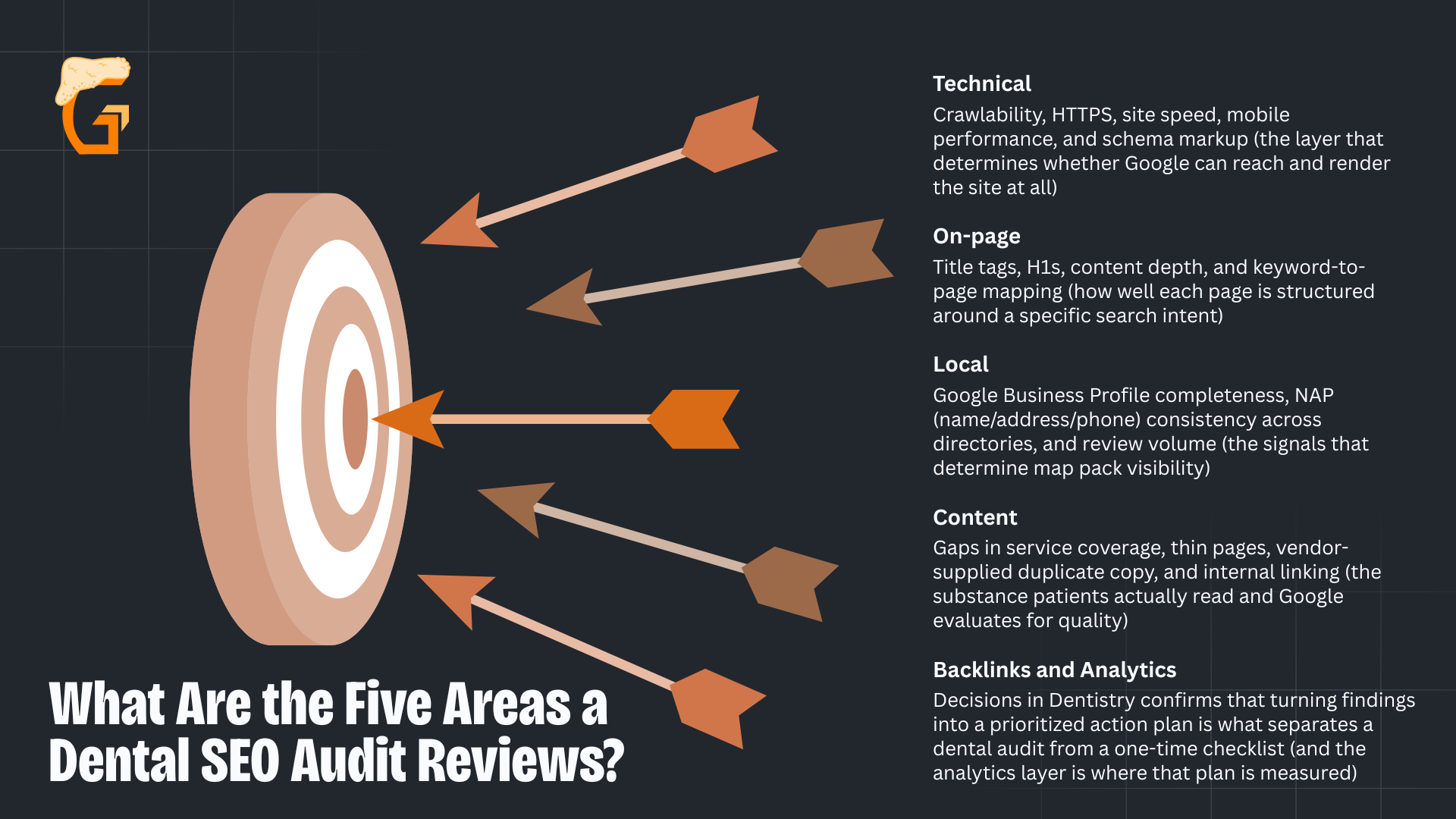
A dental SEO audit reviews these areas:
- Technical: crawlability, HTTPS, site speed, mobile performance, and schema markup (the layer that determines whether Google can reach and render the site at all)
- On-page: title tags, H1s, content depth, and keyword-to-page mapping (how well each page is structured around a specific search intent)
- Local: Google Business Profile completeness, NAP (name/address/phone) consistency across directories, and review volume (the signals that determine map pack visibility)
- Content: gaps in service coverage, thin pages, vendor-supplied duplicate copy, and internal linking (the substance patients actually read and Google evaluates for quality)
- Backlinks and analytics: Decisions in Dentistry confirms that turning findings into a prioritized action plan is what separates a dental audit from a one-time checklist (and the analytics layer is where that plan is measured)
Most audits can start with free tools.
Google Search Console and PageSpeed Insights surface the majority of high-impact technical and performance issues without a paid subscription.
Why Is a Dental SEO Audit Different from a Generic One?
A dental audit weights two things more heavily than a generic site audit – local signals and content quality.
Here is why each one matters for a dental practice:
- Local signals: patients search with geographic intent (“dentist near me,” “dentist in [city]”) and a large share of clicks go to the map pack at the top of local search results, not organic listings; local factors like GBP completeness, NAP consistency, and reviews carry outsized weight for a practice
- YMYL content quality: dental pages fall under Google’s Your Money or Your Life classification, meaning health-related content must be accurate, trustworthy, and authored by qualified clinicians (not generic filler text)
A generic audit misses both of these.
You cannot fix what you have not measured – and a dental-specific baseline shows exactly which of the five areas is holding the practice back.
Technical SEO Checks Every Dental Website Needs
The technical layer is where every audit starts – a perfectly written dental page is invisible to Google if crawl blocks, HTTPS gaps, slow mobile performance, or missing schema get in the way.
Technical issues suppress search rankings silently – a practice can invest in content for months without knowing a crawl block is preventing those pages from indexing.
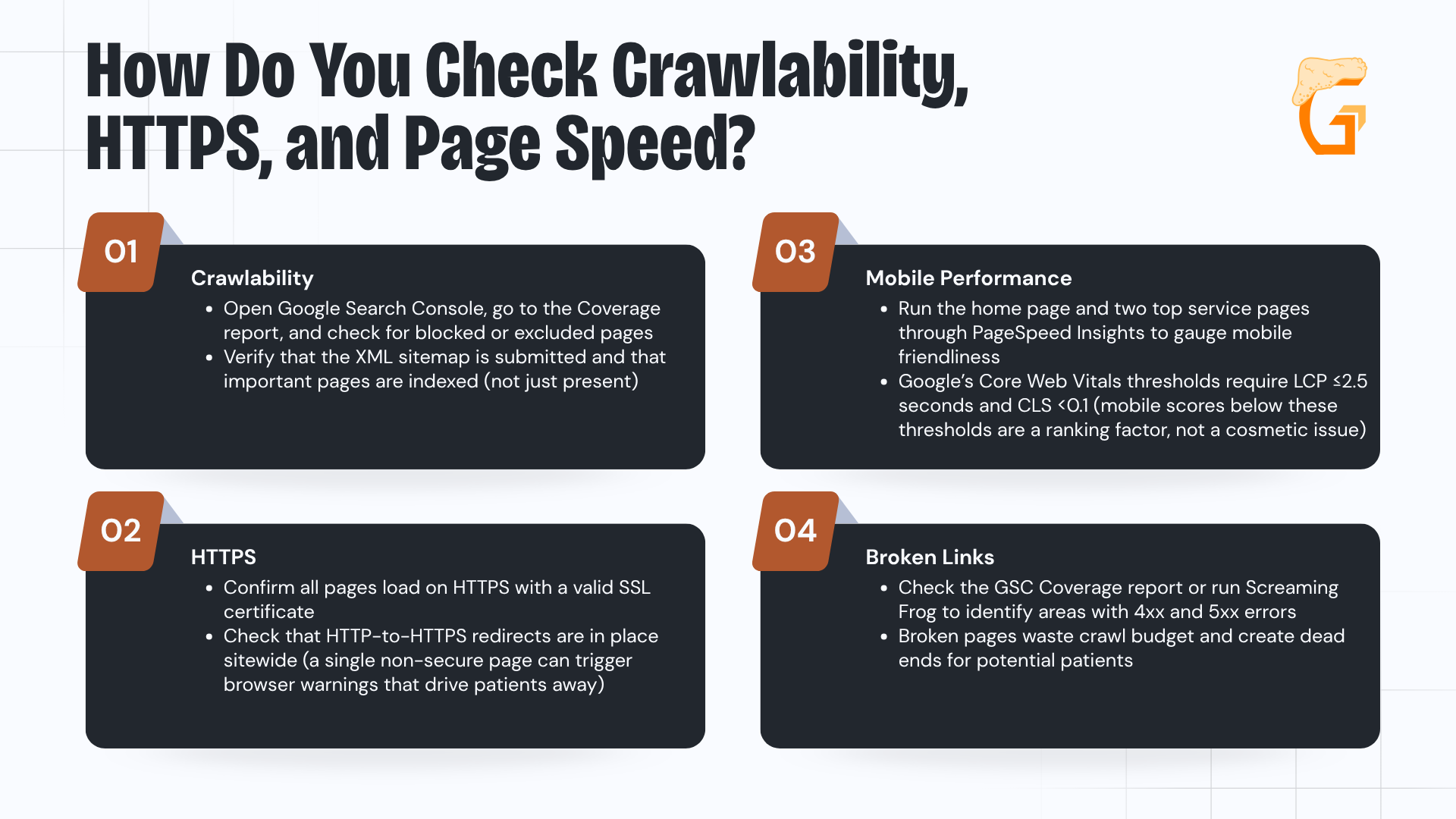
How Do You Check Crawlability, HTTPS, and Page Speed?
Crawlability, HTTPS, and mobile performance are the three technical checks determining whether Google can reach a dental site at all, ultimately leading to whether it ranks.
Work through each one in order:
- Crawlability: open Google Search Console, go to the Coverage report, and check for blocked or excluded pages; verify that the XML sitemap is submitted and that important pages are indexed, not just present
- HTTPS: confirm all pages load on HTTPS with a valid SSL certificate; check that HTTP-to-HTTPS redirects are in place sitewide (a single non-secure page can trigger browser warnings that drive patients away)
- Mobile performance: run the home page and two top service pages through PageSpeed Insights to gauge mobile friendliness; Google’s Core Web Vitals thresholds require LCP ≤2.5 seconds and CLS <0.1 (mobile scores below these thresholds are a ranking factor, not a cosmetic issue)
- Broken links: check the GSC Coverage report or run Screaming Frog to identify areas with 4xx and 5xx errors; broken pages waste crawl budget and create dead ends for potential patients
Fix technical blockers before any on-page or content work.
A service page rewritten with perfect copy still does not rank if Google cannot crawl it or if it is not mobile friendly enough to pass performance thresholds.
Which Schema and URL Structure Should a Dental Site Have?
Schema markup and URL structure form the layer that helps search engines understand what a dental site is and where each page belongs.
Audit each before moving on:
- Schema markup: implement Dentist and LocalBusiness schema (these are the two primary types for dental websites; validate both with Google’s Rich Results Test before the audit moves to the next tier; Service and FAQ schema are secondary and worth adding to high-value pages)
- URL structure: each page URL should use short, descriptive file names that are keyword-relevant (a user friendly URL like `/dental-implants-chicago/` outperforms `/page?id=47`; also confirm the XML sitemap is submitted in GSC and that URL paths match the site’s content architecture)
Clean URLs and valid schema make pages machine-readable.
The technical audit closes here so everything built on top of it (on-page fixes, content additions, link building) lands on a crawlable, indexable foundation.
Growth Saloon runs the technical audit and fixes the foundation so a dental practice’s content earns qualified new patient inquiries – not just clicks.
Contact our team today to find out how our dental marketing services can lower your cost per new patient and grow your practice.
On-Page and Content Audit for a Dental Website
The most common on-page failure for dental sites is vendor-supplied template content that reads identically to hundreds of other practice websites – Google sees it as duplicate content, and it is a top reason dental sites underperform despite regular SEO efforts.
On-page issues compound – one bad title tag on one page is a minor problem; six service pages with the same template copy is a systemic one.
How Should Keywords, Title Tags, and H1s Be Mapped per Page?
Keyword-to-page mapping is the on-page foundation.
Each major page should own its most relevant keywords plus a city, and no two pages should compete for the same search term.
Audit the on-page elements against that mapping:
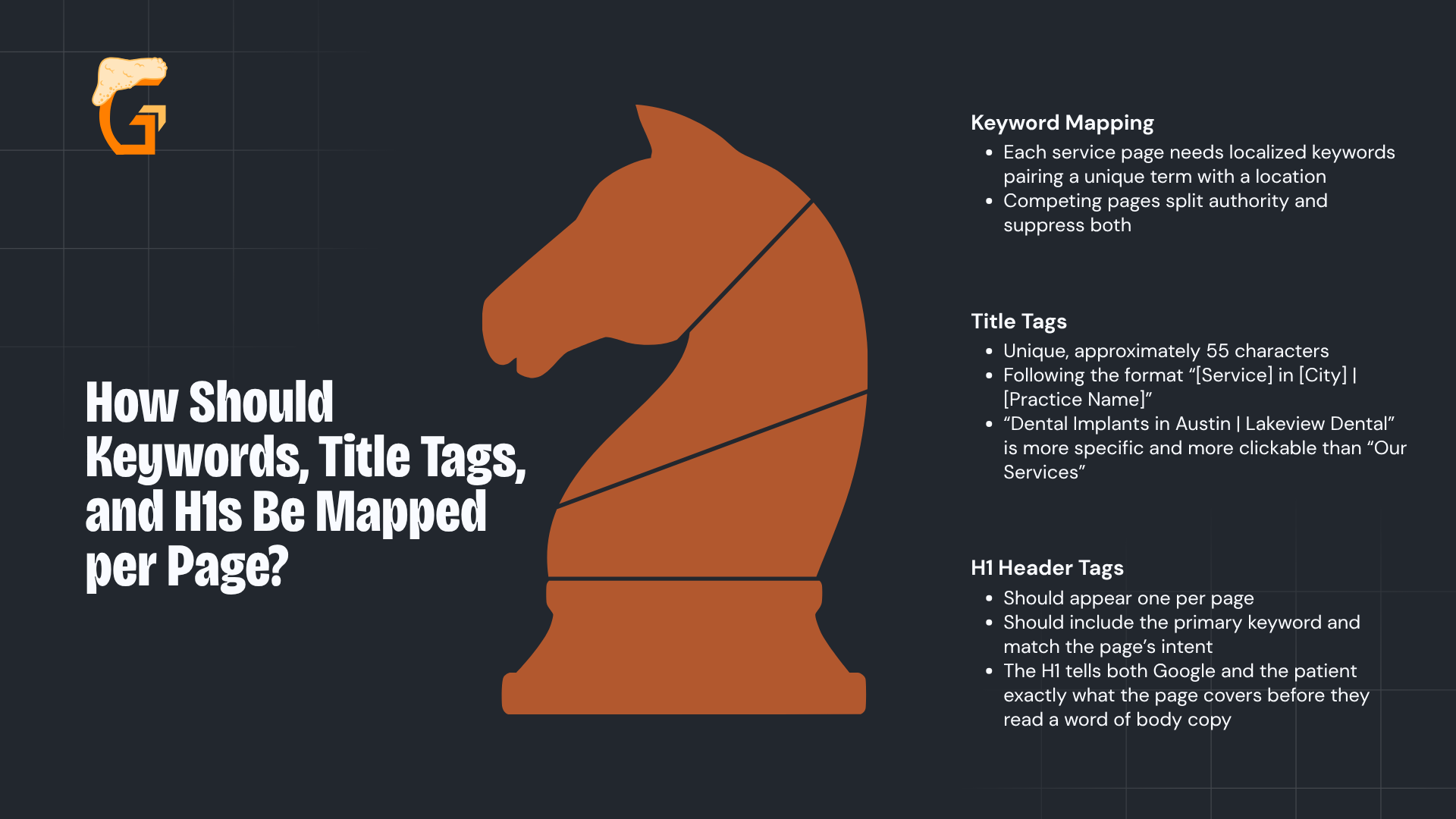
- Keyword mapping: each service page needs localized keywords pairing a unique term with a location (competing pages split authority and suppress both)
- Title tags: unique, approximately 55 characters, following the format `[Service] in [City] | [Practice Name]` (“Dental Implants in Austin | Lakeview Dental” is more specific and more clickable than “Our Services”)
- H1: header tags should appear one per page, including the primary keyword and matching the page’s intent (the H1 tells both Google and the patient exactly what the page covers before they read a word of body copy)
Getting the keyword-to-page map right first prevents the duplicate-title and competing-page problems that surface later.
This map becomes the reference point the rest of the on-page audit is measured against.
How Do You Catch Thin Content, Duplicate Copy, and Orphan Pages?
Thin content, vendor-template duplicate copy, and orphan pages are the three content-quality failures that suppress otherwise well-optimized dental sites.
Check each failure mode on every page:
- Thin content: service pages under 400 words for high-value treatments (implants, Invisalign, veneers) need expansion; each page should cover the procedure, candidacy, recovery, cost range, and FAQs to deliver valuable content that satisfies patient intent and signals depth to Google
- Duplicate content: vendor-supplied template pages must be rewritten with unique, practice-specific copy (text that appears on hundreds of other dental sites is duplicate content regardless of how it was sourced – every page needs a clear CTA (schedule an appointment, call the practice, contact form)
Internal linking closes the loop – each service page should link to related pages covering other services and to the appointment page.
The audit should also flag orphan pages – pages with no internal links pointing to them are effectively invisible to crawlers regardless of how well they are written.
Growth Saloon rewrites thin and duplicate dental pages into content that ranks and converts into qualified new patient inquiries – not just clicks.
Contact our team today to find out how our dental marketing services can lower your cost per new patient and grow your practice.
How’s your SEO going?
Enter your website URL below to get a free comprehensive SEO audit.
The audit includes:
- A scan of your entire website for technical issues
- A list of your top opportunities to target immediately
- Your highest priority fixes to make
Local SEO Audit: Google Business Profile, Citations, and Reviews
Most dental practices lose local rankings not because of bad on-page SEO, but because their Google Business Profile is incomplete, their citations have inconsistent addresses, or they have fewer recent online reviews than the top-ranked competitors (so the local audit is often where the biggest wins are).
Map pack visibility starts with the GBP and NAP layer; everything else in local SEO builds from that foundation.
How Do You Audit Google Business Profile and NAP Consistency?
GBP completeness and NAP consistency are the local foundation – if either is wrong, map pack visibility is capped regardless of how strong the on-page work is.
Audit these signals against the top map pack competitors:
- GBP completeness: confirm the profile is claimed and verified; check the primary category (should be “Dentist,” not “Health and wellness” or a generic substitute); verify all services are listed, recent photos are published, hours are accurate, and an appointment link is active
- NAP consistency: BrightLocal defines NAP consistency as business name, address, and phone being identical across every online mention (website, GBP, Yelp, Healthgrades, Zocdoc, and all directories; mismatches confuse Google’s entity matching and hold a practice out of the local pack even when the GBP itself is complete)
GBP optimization (categories, services, photos, posts) is the primary lever for map pack visibility.
A complete, consistent profile is the prerequisite before the audit turns to reviews or schema.
How Do Reviews and Local Schema Affect Dental Rankings?
Review volume, review velocity, and local schema are the trust-and-signal layer that decides ties between practices with otherwise equal profiles.
Here is what to check in this layer:
- Review audit: compare total review count and monthly velocity against the top three map pack competitors; also check that the practice responds to all reviews (addressing concerns promptly is a trust signal in local SEO)
- Local schema: implement Dentist schema on the homepage with full NAP, hours, and service area to help Google match the on-site entity to the GBP and directory listings
A competitor with 200 reviews receiving 10 new reviews per month is building a compound advantage in online reputation.
Closing a review gap takes months – so the audit should surface it immediately so a process for getting patients to leave reviews can start before the gap widens further.
Growth Saloon optimizes the GBP, NAP, and review signals that decide map pack visibility and drive qualified new patient inquiries – not just clicks.
Contact our team today to find out how our dental marketing services can lower your cost per new patient and grow your practice.
How to Prioritize What to Fix After a Dental SEO Audit
Fix technical blockers first, then local SEO, then on-page, then content gaps, then backlinks – not everything found in an audit has equal impact, and trying to fix everything at once means fixing nothing well.
The tier order is not arbitrary – each layer compounds the next in an ongoing process, so working out of sequence wastes effort.
What Order Should You Fix Dental SEO Audit Findings In?
Prioritization is a sequence, not a checklist.
The order matters as much as the fixes.
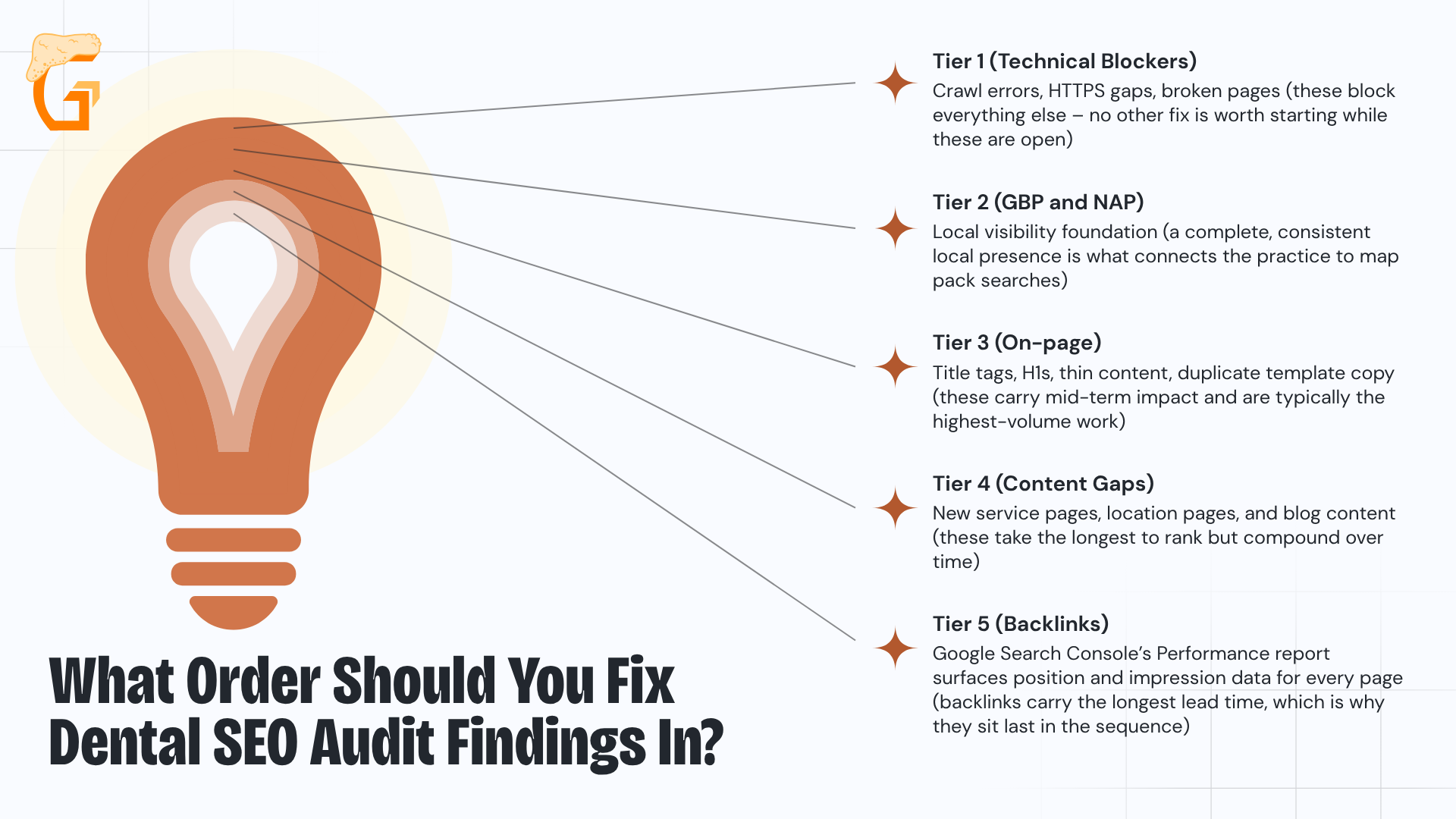
Fix findings in tiers, top to bottom:
- Tier 1 (Technical blockers): crawl errors, HTTPS gaps, broken pages (these block everything else; no other fix is worth starting while these are open)
- Tier 2 (GBP and NAP): local visibility foundation; a complete, consistent local presence is what connects the practice to map pack searches
- Tier 3 (On-page): title tags, H1s, thin content, duplicate template copy (these carry mid-term impact and are typically the highest-volume work)
- Tier 4 (Content gaps): new service pages, location pages, and blog content (these take the longest to rank but compound over time)
- Tier 5 (Backlinks): Google Search Console’s Performance report surfaces position and impression data for every page (backlinks carry the longest lead time, which is why they sit last in the sequence)
There is no point earning links or writing new pages Google cannot crawl or that are not anchored to a complete local profile.
Technical and local work first.
Which Quick Wins Move Dental Rankings Fastest, and How Do You Track Them?
The fastest movement in organic traffic comes from pages already on the edge of page one – not from brand-new pages with no history.
There is one repeatable method for finding them:
- Quick-win method: export the GSC Performance report, filter for pages ranking in positions 11–20, sort by impressions; rewrite title tags and expand content on the top three (those pages are closest to page one and respond fastest); high impressions + low click through rates + position 11–20 is the highest-ROI combination in any dental audit, and managing your search engine listing is among the local marketing moves the SBA recommends for small service businesses
Use keyword tracking to follow each targeted page’s position in GSC weekly for four weeks after changes.
A move from position 14 to 7 confirms the fix worked and signals applying the same approach to similar pages.
Consistent weekly tracking builds the feedback loop that turns an audit from a one-time document into a process of continuous improvement.
Growth Saloon helps dental practices build the kind of digital presence that consistently generates qualified new patient inquiries – not just clicks.
Contact our team today to find out how our dental marketing services can lower your cost per new patient and grow your practice.
How Can Growth Saloon Help Your Dental Practice Grow?
Growth Saloon is a Chicago-based digital marketing agency built to help dental practices attract more patients and build a strong online presence through performance-driven digital marketing.
Mike Lowe and the Growth Saloon team specialize in search engine optimization, web design, conversion rate optimization, and marketing attribution – working alongside your practice to build a measurable digital presence that generates qualified patient inquiries, not just website traffic.
From ranking for high-intent local search terms to converting site visitors into booked appointments, Growth Saloon helps dental professionals get results at every stage of the patient acquisition funnel.
Practice owners and marketing managers get clear visibility into exactly which channels are driving new patient growth.
We know that every open appointment slot has a real cost.
Every decision we make is built around one outcome – helping your practice fill more of them.
Meet the Founder of Growth Saloon
Meet the founder and lead strategist at Growth Saloon – Mike Lowe:
- As founder and CEO of Growth Saloon, Mike brings years of hands-on experience in SEO strategy, CRO, web design, and marketing attribution for service-based businesses competing in local and regional markets.
- Based in Chicago and working with practices across the country, Mike has built and managed digital growth campaigns for businesses competing in some of the most contested search markets in the country.
- Growth Saloon’s data-driven approach to local SEO and patient acquisition helps dental practices turn their websites into their highest-performing new patient channel.
What Does Working With Growth Saloon Look Like?
Growth Saloon operates as a dedicated extension of your marketing team – not a vendor that disappears after onboarding.
Every engagement includes direct access to Mike and the team, transparent reporting tied to actual patient acquisition outcomes and satisfied patients, and strategies tailored to your specific services and local market.
Whether you’re looking to rank for high-value procedures, improve your site’s appointment conversion rate, or finally get clarity on the key performance indicators behind your new patients, Growth Saloon builds the strategy and does the work.
Growth Saloon helps dental practices build the kind of digital presence that consistently generates qualified new patient inquiries – not just clicks.
Contact our team today to find out how our dental marketing services can lower your cost per new patient and grow your practice.
How's your SEO going?
Get your free comprehensive SEO audit.
Enter your website URL below to get a free comprehensive SEO audit.
- Scan entire website for technical issues
- Get a list of your top opportunities
- See your highest priority fixes to make
-
A basic but thorough SEO audit using Google Search Console, PageSpeed Insights, and a manual GBP review takes two to four hours.
A comprehensive SEO audit covering technical crawl, on-page, local signals, content quality, and backlink analysis takes one to two days.
Professional audits from an SEO provider typically take three to five business days and produce a detailed findings report with a prioritized action plan.
-
You can run a solid foundational audit yourself using free tools – Google Search Console for ranking and indexation data, Google Business Profile Insights for local SEO performance, and PageSpeed Insights for speed.
Where DIY audits fall short is in technical crawl analysis, backlink comparison, and keyword gap research – those require audit tools like Screaming Frog, Ahrefs, or Semrush.
Start with the free tools; they’ll surface most of your highest-impact issues.
-
Run a full audit annually and a lighter review every six months.
Google releases several algorithm updates per year, competitors publish new content, and your site accumulates technical issues over time.
After a major Google core update, run an audit within 30 days to check for ranking changes or new crawl issues.
Practices that audit only once and never revisit typically lose ground to practices that monitor consistently.
-
The most common issue is duplicate or thin content from vendor-supplied templates.
Many dental websites use website content provided by a company that serves hundreds of other practices – the copy is not unique to Google’s eyes.
The second most common issue is an incomplete or inconsistent Google Business Profile, followed by title tags that don’t include the service and city.
These three problems together account for most dental ranking underperformance.
-
Yes, a baseline audit before you hire gives you a point of reference to measure how much the provider actually improves SEO.
It also protects you from providers who run an audit as a sales tool and inflate findings to justify their fees.
If you have your own audit data, as the website owner, you can ask specific questions during the sales conversation – “Our GBP is missing these services – how will you fix that?”
It changes the dynamic from passive to one of informed decisions.
-
Free – Google Search Console, Google Business Profile dashboard, Google PageSpeed Insights, and Google’s Rich Results Test.
Paid – Screaming Frog for technical crawl, Ahrefs or Semrush for keyword and backlink analysis, BrightLocal or Whitespark for citation audits.
For most practices, the free tools alone will surface the highest-priority issues.
Add paid tools if you want competitor benchmarking or a full technical crawl.
Most agencies sell traffic. We sell actual growth. That’s the Growth Saloon difference.
Are you looking to grow?
Recent blogs
Enter your website URL below to get free comprehensive SEO audit.
- Scan entire website for technical issues
- Get a list of your top opportunities
- See your highest priority fixes to make