


Key takeaways
- A healthy marketing return lands between 3:1 and 5:1, where a 3:1 ratio covers overhead and 5:1 signals real growth, against an industry budget norm of 4 to 7% of annual revenue.
- For most dental practices, ROI is hard to measure because treatment cycles run 12 to 18 months and lifetime value varies widely, from $3,000 to $6,300 in general dentistry up to $8,000 to $15,000 for implant and cosmetic cases.
- Most practices cannot track ROI because only about 3% use call tracking, so most practices treat installing call tracking, form attribution, and an intake question as the prerequisite to comparing SEO, PPC, and social spend.
What Should You Expect from Dental Marketing ROI?
Dental marketing ROI is the number most practice owners are chasing but few are actually tracking (and that gap is what turns a reasonable marketing budget into a frustrating expense with no clear story attached to it).
You may be running paid ads, investing in SEO, and posting consistently, yet still unable to say with confidence which channel is bringing in new patients and whether the return justifies the spend.
The problem isn’t the marketing investment itself.
It’s the absence of a framework for reading it.
Most practices lack the call tracking, attribution setup, and lifetime value benchmarks needed to connect a marketing dollar to a booked appointment (let alone to the full revenue a patient generates over time).
Without those inputs, dental marketing ROI becomes a guess rather than a number you can act on.
This guide walks through what a healthy dental marketing ROI looks like, how to calculate the key metrics that anchor every decision (patient lifetime value and acquisition cost), how returns compare across channels, and how long you should realistically wait before drawing conclusions.
Growth Saloon helps dental practices build the kind of digital presence that consistently generates qualified new patient inquiries – not just clicks.
Contact our team today to find out how our dental marketing services can lower your cost per new patient and grow your practice.
What Is Dental Marketing ROI and What Does a Good Result Look Like?
Dental marketing ROI is the lifetime value of the patients a campaign brings in measured against what it cost to acquire them (a good result lands between a 3:1 and 5:1 return).
These are directional benchmarks used across the dental industry (not a single authoritative standard), but they anchor the math every practice needs to run before spending another dollar on marketing.
What Counts as a Good Dental Marketing ROI Benchmark?
Dental marketing ROI measures how much revenue a practice earns over a patient’s lifetime for every dollar spent acquiring that patient.
The two reference points used across the industry:
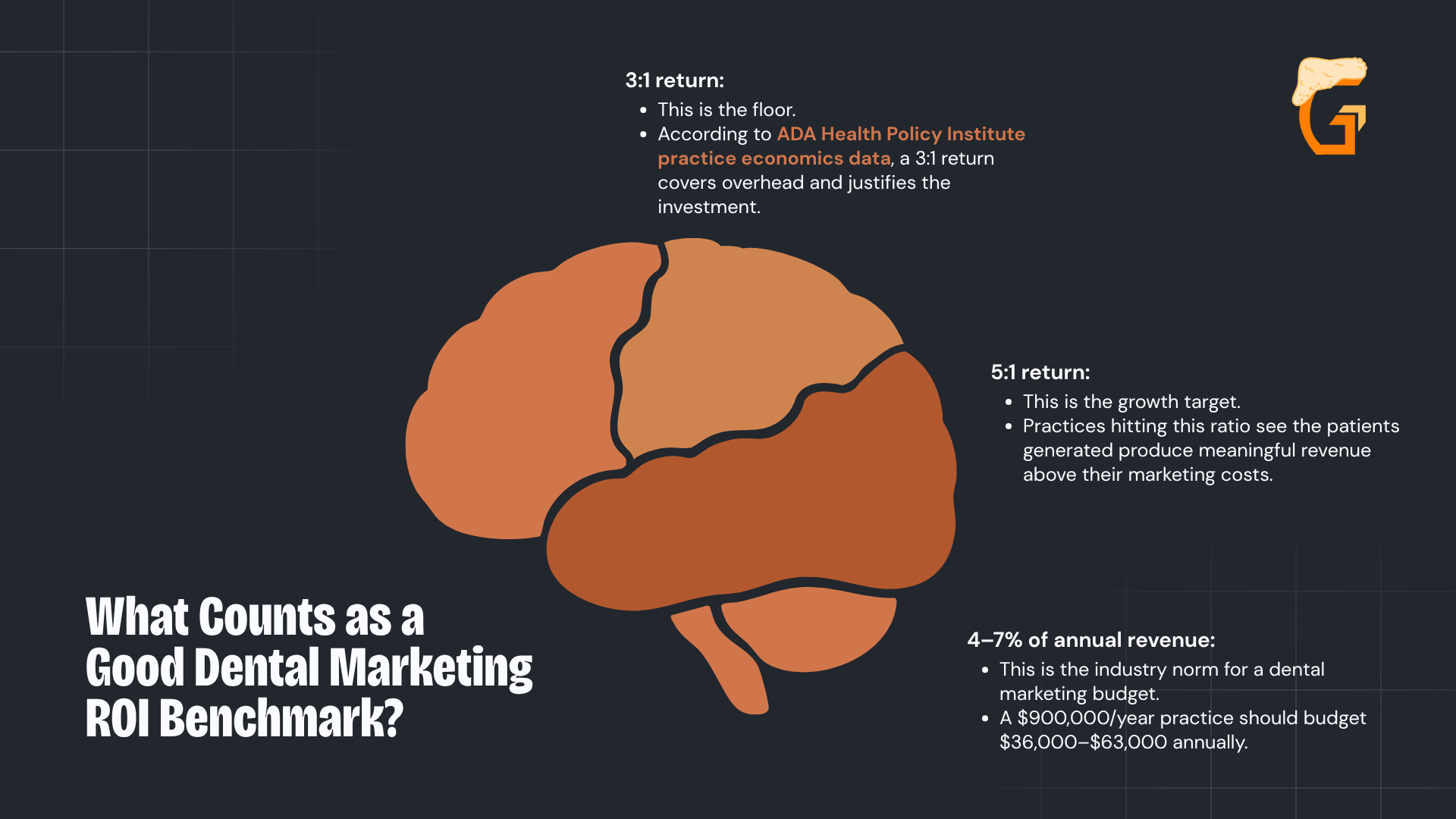
- 3:1 return:
- This is the floor.
- According to ADA Health Policy Institute practice economics data, a 3:1 return covers overhead and justifies the investment.
- 5:1 return:
- This is the growth target.
- Practices hitting this ratio see the patients generated produce meaningful revenue above their marketing costs.
- 4–7% of annual revenue:
- This is the industry norm for a dental marketing budget.
- A $900,000/year practice should budget $36,000–$63,000 annually.
These ratios are directional industry benchmarks.
The actual result for any practice varies by market, procedure mix, and how many high value patients come in for treatments like implants or cosmetic work.
Present them as targets to aim for, not guaranteed outcomes.
Why Is Dental ROI Harder to Measure than Retail ROI?
Retail sells a product – the transaction closes immediately.
Dental ROI resists a clean read for three structural reasons:
- Treatment cycles:
- A patient whose initial visit is a cleaning may not start implants or orthodontics for 12–18 months.
- That conversion is invisible in a single-month ROI snapshot.
- Insurance reimbursement lag:
- Treatment acceptance and actual revenue collection are separate events (sometimes separated by weeks of insurance processing).
- Procedure-specific variation:
- General dentistry LTV runs $3,000–$5,000 on average.
- Implant and cosmetic patients can produce $8,000–$15,000 or more in lifetime treatment (so the same patient acquisition cost produces very different ROI depending on case mix).
A 30-day ROI read from new marketing campaigns can mislead.
A 12-month view is the standard for an honest read on what each marketing channel actually costs per patient.
How Do You Calculate Patient Lifetime Value and Acquisition Cost?
Calculate patient lifetime value by multiplying average annual revenue per patient by retention years, and patient acquisition cost by dividing total marketing spend by the number of new patients you can attribute to it.
Average patient lifetime value and acquisition cost are the two numbers every dental marketing decision should rest on (and most practices have neither calculated).
How Do You Calculate Patient Lifetime Value?

Patient lifetime value (LTV) is the total revenue a practice expects from the entire relationship with one patient over their time at the practice.
The formula: average annual revenue per active patient × average years retained
Dentistry Today’s LTV analysis confirms it is a straightforward but underused metric (most practices have the data in their practice management software but rarely run the calculation):
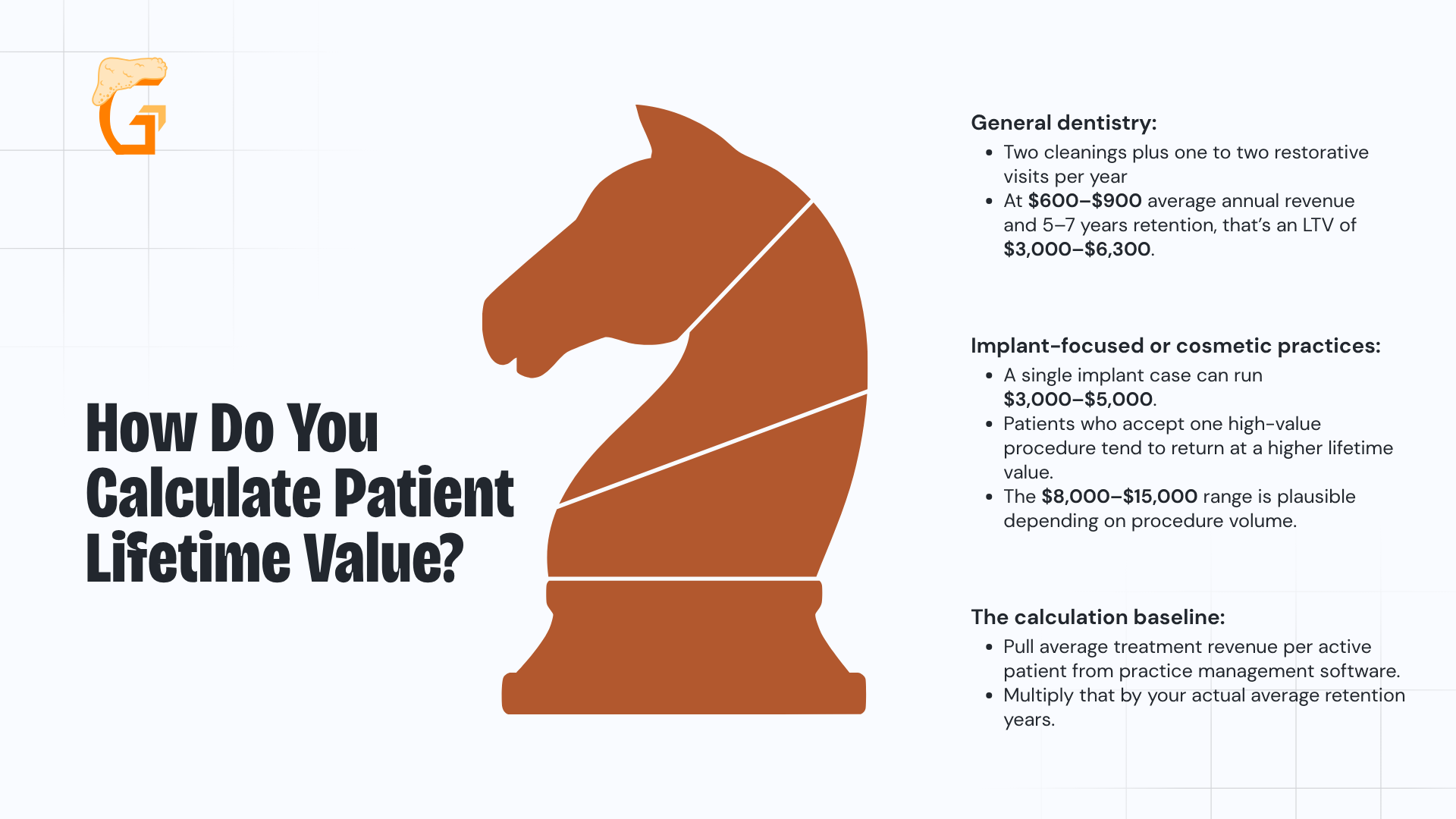
- General dentistry:
- Two cleanings plus one to two restorative visits per year
- At $600–$900 average annual revenue and 5–7 years retention, that’s an LTV of $3,000–$6,300.
- Implant-focused or cosmetic practices:
- A single implant case can run $3,000–$5,000.
- Patients who accept one high-value procedure tend to return at a higher lifetime value.
- The $8,000–$15,000 range is plausible depending on case volume.
- The calculation baseline:
- Pull average treatment revenue per active patient from practice management software.
- Multiply that by your actual average retention years.
Most practices can run this calculation in a single afternoon.
The result gives every marketing channel a real profit ceiling tied to the revenue generated per patient (the maximum you can spend to acquire one and still hit the 3:1 floor).
How Do You Calculate Patient Acquisition Cost?
Patient acquisition cost (PAC) is total marketing spend divided by new patients attributed to that spend.
It is the harder number to produce (not because the basic formula is difficult, but because most practices can’t reliably attribute new patients to specific channels).
The formula: total marketing spend ÷ new patients attributed
Industry PAC benchmarks by procedure focus:
- General dentistry: $150–$300 PAC is well-supported as a healthy range across multiple channel types
- Implants and cosmetic: $400–$800 PAC is typical (higher click costs and a longer conversion path push the number up)
Spend is knowable from invoices, but paying patients are harder to trace back to a channel.
New-patient source is the hard part (it requires call tracking software and CRM tagging that most practices do not have in place).
Without it, PAC is not a calculation for many practices; it is a guess.
Growth Saloon ties every marketing dollar to qualified new patient inquiries, so a practice knows its true cost per new patient – not just a guess.
Contact our team today to find out how our dental marketing services can lower your cost per new patient and grow your practice.
How Does ROI Compare Across Dental Marketing Channels?
Across channels:
- SEO produces the lowest long-term cost per patient after a 6–12 month ramp;
- Paid campaigns buy immediate patients at a higher cost per click; and
- Social media earns its keep on retention and brand rather than primary acquisition.
The right answer for most practices is not a single channel – it is a mix timed to when each channel delivers.
Which Costs Less per Patient: Dental SEO or Google Ads?

SEO produces the lowest long-term cost per patient for dental practices (but only after the initial 6–12 month authority-building period).
Paid search costs more per click but delivers patients immediately:
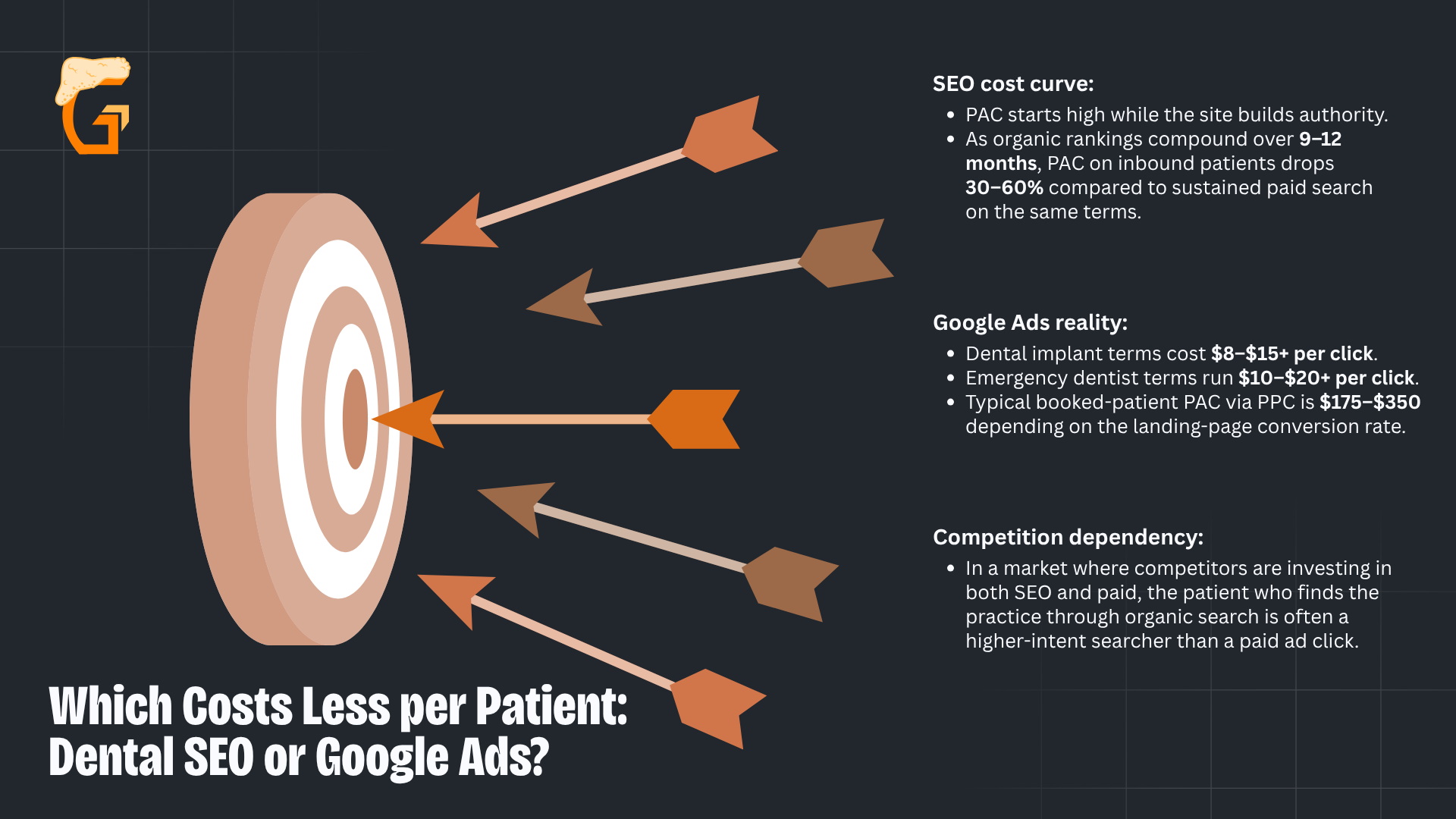
- SEO cost curve:
- PAC starts high while the site builds authority.
- As organic rankings compound over 9–12 months, PAC on inbound patients drops 30–60% compared to sustained paid search on the same terms.
- Google Ads reality:
- Dental implant terms cost $8–$15+ per click.
- Emergency dentist terms run $10–$20+ per click.
- Typical booked-patient PAC via PPC is $175–$350 depending on the landing-page conversion rate.
- Competition dependency:
- In a market where competitors are investing in both SEO and paid, the patient who finds the practice through organic search is often a higher-intent searcher than a paid ad click.
Across the entire patient journey, PPC looks expensive in month one.
SEO looks like a slow burn in month three.
At month 12, the practice that ran both has lower blended PAC than the practice that ran either alone (paid covered the ramp, SEO built the floor).
What Role Does Social Media Play and How Should I Split the Budget?
Social media is a brand and retention channel, not a primary acquisition engine for most dental practices.
Here is where it fits and how to fund it:
- Social’s role:
- Roughly 17% of patients cite social media as part of their discovery path.
- The primary value is keeping the practice visible to potential patients and their networks (not first-touch acquisition).
- Budget allocation guide (adjust based on actual channel performance data):
- 30–40% to website and SEO
- 25–35% to paid search (PPC)
- 15–20% to social
- 10–15% to content creation and site maintenance
An integrated SEO + PPC + social budget allocation lowers blended PAC over a full year more than any single channel can achieve.
The channels are complementary:
- SEO builds long-term patient volume;
- Paid advertising provides coverage while SEO ramps; and
- Social maintains the relationship with the patients already in the practice.
Contact our team today to find out how our dental marketing services can lower your cost per new patient and grow your practice.
How’s your SEO going?
Enter your website URL below to get a free comprehensive SEO audit.
The audit includes:
- A scan of your entire website for technical issues
- A list of your top opportunities to target immediately
- Your highest priority fixes to make
Why Can't Most Dental Practices Measure Their Marketing ROI?
Most dental practices can’t measure marketing ROI because they know their spend but not which actual patients each channel produced (very few use call tracking systems, so attribution is missing).
For many dental practices, spend optimization without attribution is the equivalent of adjusting a recipe without knowing which ingredient caused the problem.
Why Does Asking Patients How They Found You Fail?

The attribution gap starts at the front desk (practices rely on verbal questions that capture only a fraction of true referral sources):
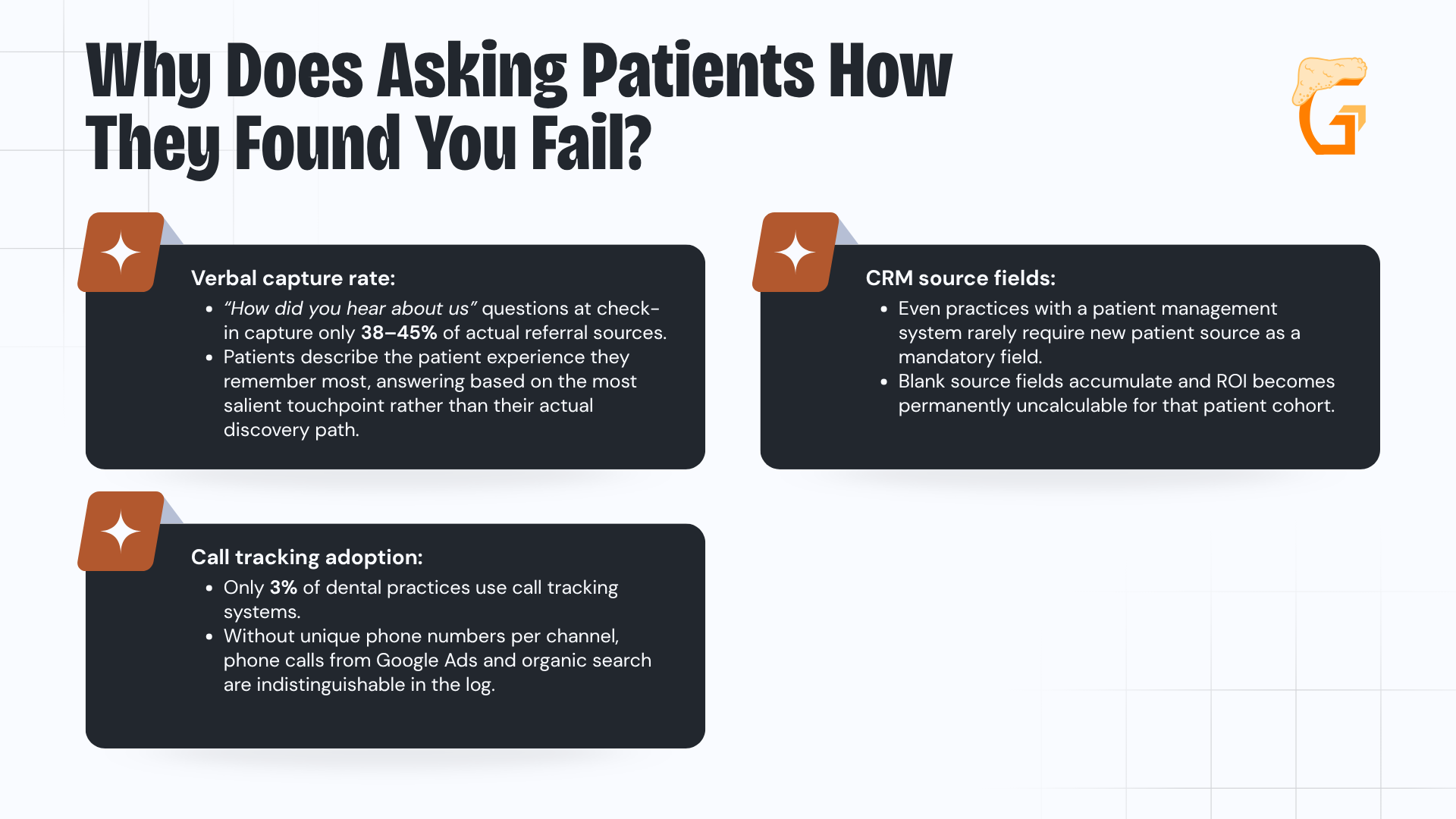
- Verbal capture rate:
- “How did you hear about us” questions at check-in capture only 38–45% of actual referral sources.
- Patients describe the patient experience they remember most, answering based on the most salient touchpoint rather than their actual discovery path.
- Call tracking adoption:
- Only 3% of dental practices use call tracking systems.
- Without unique phone numbers per channel, phone calls from Google Ads and organic search are indistinguishable in the log.
- CRM source fields:
- Even practices with a patient management system rarely require new patient source as a mandatory field.
- Blank source fields accumulate and ROI becomes permanently uncalculable for that patient cohort.
Without reliable attribution, spend optimization is blind.
A practice could be cutting the one channel that accounts for half its new patients and have no data to catch it.
What Tracking Does a Practice Need to Fix Attribution?
The tracking stack is the prerequisite for any ROI calculation:
- Call tracking:
- Platforms like CallRail or WhatConverts assign unique phone numbers to each marketing channel (SEO gets its own number, Google Ads gets its own number, direct mail gets its own number).
- Inbound calls are automatically attributed at the channel level.
- Form tracking:
- UTM parameters on all paid and organic links feed into Google Analytics goal completions (creating a web-source record for every form submission).
- These records can then be matched to patient IDs in the CRM.
- HIPAA compliance:
- Any tracking software handling patient name, contact information, or appointment data must meet HIPAA requirements.
- Verify compliance before deploying any call tracking or analytics platform.
The call-tracking investment typically pays back within a single correctly attributed new patient.
Attribution is not a cost center – it is the infrastructure that makes all of a practice’s marketing dollars defensible.
Growth Saloon sets up the tracking that makes qualified new patient inquiries measurable, so a practice can see its real cost per new patient – not just clicks.
Contact our team today to find out how our dental marketing services can lower your cost per new patient and grow your practice.
How Long Before Dental Marketing ROI Becomes Measurable?
Dental marketing ROI becomes measurable at different speeds by channel:
- PPC within 30–60 days;
- SEO reliably at 6–12 months; and
- Social as an ongoing retention metric rather than a primary acquisition timeline.
Channel selection is partly a cash-flow question.
Practices need to know how long they are investing before cost per lead becomes meaningful.
How Long Does Each Channel Take to Show ROI?

Each channel follows a distinct timeline:
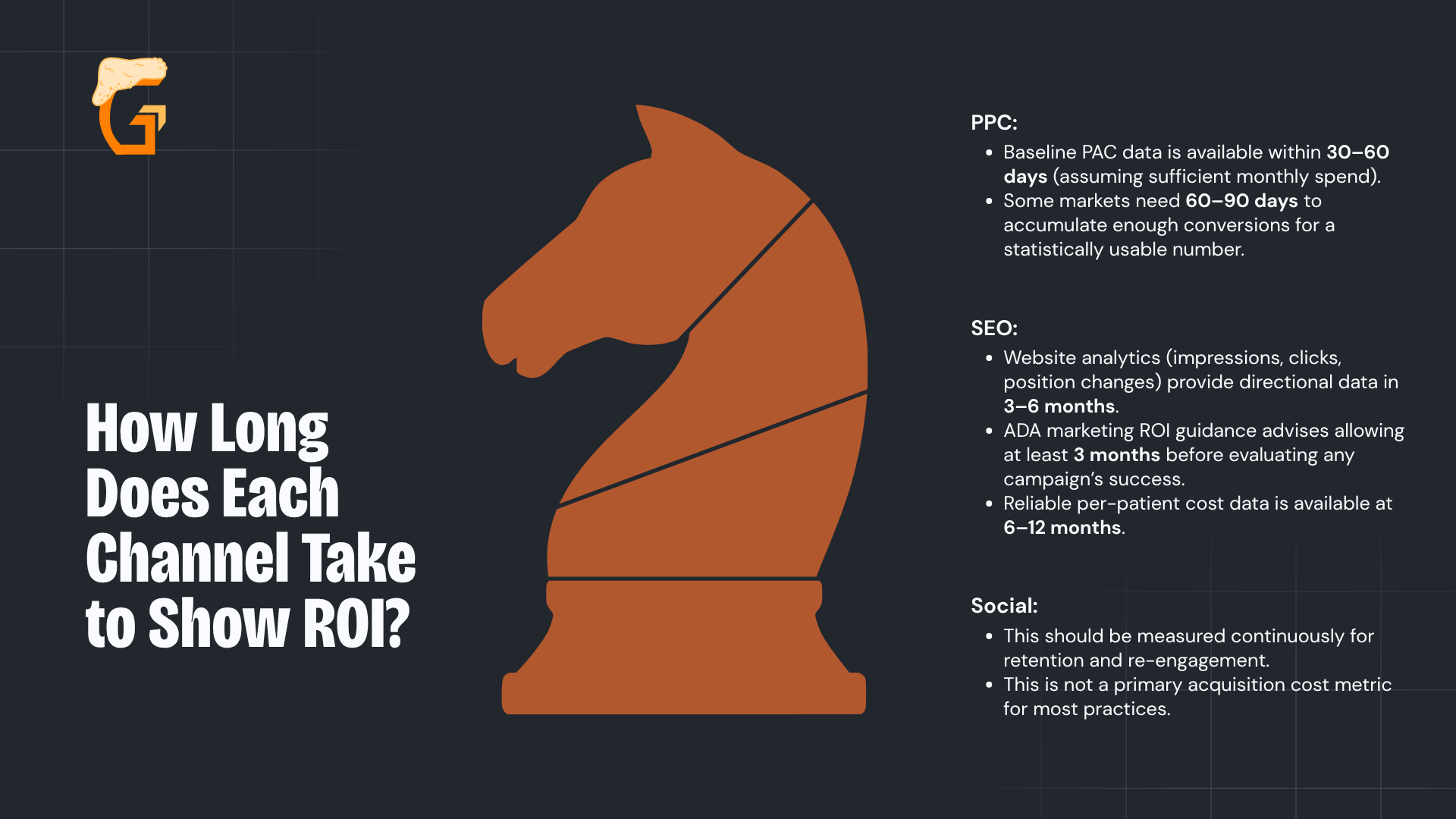
- PPC:
- Baseline PAC data is available within 30–60 days (assuming sufficient monthly spend).
- Some markets need 60–90 days to accumulate enough conversions for a statistically usable number.
- SEO:
- Website analytics (impressions, clicks, position changes) provide directional data in 3–6 months.
- ADA marketing ROI guidance advises allowing at least three months before evaluating any campaign’s success.
- Reliable per-patient cost data is available at 6–12 months.
- Social:
- This should be measured continuously for retention and re-engagement.
- This is not a primary acquisition cost metric for most practices.
The ADA notes that marketing is a long-term investment that grows in effectiveness as it matures over time.
Cutting an SEO investment at month four (before the return on investment is reliably visible) is one of the most common and most costly errors in dental marketing.
Why Does Tracking from Day One Decide Whether You Ever See ROI?
Retention ROI compounds differently than acquisition ROI.
A patient acquired through paid search costs roughly 5–7x more to win than an existing one costs to keep (a directional benchmark supported across marketing literature).
Retention belongs in any honest ROI picture:
- The 12-month advantage:
- Practices that install attribution tracking before spending are measuring success clearly by month 12.
- Those that wait 6 months to set up tracking can never retroactively attribute the patients acquired during that period.
- The compounding argument:
- An acquired patient from month 1 reaches year 3 of retention while you are still running the same campaign.
- That compounding value is invisible if you never built the source record in the CRM.
Practices that measure and optimize their marketing efforts consistently outperform those that set budgets and revisit them annually.
The discipline of weekly attribution review (even a simple channel-to-patient-count tally rather than raw website traffic) is what separates a marketing program from a marketing expense.
Growth Saloon helps dental practices build the kind of digital presence that consistently generates qualified new patient inquiries – not just clicks.
Contact our team today to find out how our dental marketing services can lower your cost per new patient and grow your practice.
How Can Growth Saloon Help Your Dental Practice Grow?
Growth Saloon is a Chicago-based digital marketing agency built to help dental practices attract more patients and grow revenue through performance-driven digital marketing.
Mike Lowe and the Growth Saloon team specialize in SEO, web design, website optimization, and marketing attribution – working alongside your practice to build a measurable digital presence that generates qualified patient inquiries, not just clicks.
From ranking on search engines for high-intent local terms to converting site visitors into booked appointments, Growth Saloon focuses on results at every stage of the patient acquisition funnel.
Practice owners and marketing managers get clear visibility into exactly which channels are driving new patient growth.
We know that sustainable growth depends on filling every open appointment slot, because each one has a real cost.
Every decision we make is built around one outcome – helping your practice fill more of them and become a thriving practice.
Meet the Founder of Growth Saloon
Meet the founder and lead strategist at Growth Saloon – Mike Lowe:
- As founder and CEO of Growth Saloon, Mike brings years of hands-on experience in SEO strategy, CRO, web design, and marketing attribution for service-based businesses competing in local and regional markets.
- Based in Chicago and working with practices across the country, Mike has built and managed digital growth campaigns for businesses competing in some of the most contested search markets in the country.
- Growth Saloon’s data-driven approach to local SEO and patient acquisition helps dental practices turn website visitors into their highest-performing new patient channel.
What Does Working With Growth Saloon Look Like?
Growth Saloon operates as a dedicated extension of your marketing team – not a vendor that disappears after onboarding.
Every engagement includes direct access to Mike and the team, transparent reporting tied to actual new patient inquiries and acquisition outcomes, and strategies tailored to your specific services and local market.
Whether you’re looking to rank for high-value procedures, improve your site’s appointment conversion rate, or finally get clarity on where your new patients are actually coming from, Growth Saloon builds the marketing strategies and does the work.
Growth Saloon helps dental practices build the kind of digital presence that consistently generates qualified new patient inquiries – not just clicks.
Contact our team today to find out how our dental marketing services can lower your cost per new patient and grow your practice.
How's your SEO going?
Get your free comprehensive SEO audit.
Enter your website URL below to get a free comprehensive SEO audit.
- Scan entire website for technical issues
- Get a list of your top opportunities
- See your highest priority fixes to make
-
A 3:1 return ($3 in lifetime patient revenue for every $1 in marketing spend) covers overhead and justifies the investment.
A 5:1 return is the target for meaningful practice growth.
These ratios are calculated using lifetime patient value ($3,000–$5,000 on average for routine general dentistry care) divided by patient acquisition cost.
Practices running high-value procedures like implants or full-mouth rehabilitation can sustain higher acquisition costs and still hit strong ROI ratios.
-
Multiply the average annual revenue per active patient by the average number of years a patient stays with the practice.
Even if the first visit value is modest, if your patients average $800/year in treatment and stay for 6 years, your LTV is $4,800.
Practices that record treatment revenue per patient inside practice management software can pull this number directly.
If data is unavailable, industry benchmarks of $3,000–$5,000 per patient over 5 years are a reasonable starting point.
-
Most dental practices rely on verbal “how did you hear about us” questions at the front desk, but research shows this method captures only 38–45% of actual referral sources.
Accurate attribution requires:
- Call tracking software (which assigns unique numbers to each marketing channel);
- UTM-tagged URLs for web forms; and
- A CRM or practice management system where new patient source is a required field.
Without these systems, ROI calculation is a guess.
-
Dental SEO typically produces measurable positive ROI between months 9 and 12 for practices in competitive markets (and as early as months 4–6 in low-competition areas).
The ROI curve is back-loaded (you invest for 6–9 months before patient volume is consistent enough to calculate a reliable cost-per-patient figure).
Practices that abandon SEO before month 9 often give up just before the compounding returns kick in.
-
SEO delivers higher ROI over a 12-month-plus horizon.
A Google Ads campaign delivers faster but more expensive results in the short term.
Dental PPC keywords are among the most expensive in Google Ads (terms for dental implants cost $8–$15+ per click).
Once organic results produce a consistent long-term patient volume, the per-patient cost of SEO drops well below paid channels.
Most practices benefit from running both for long-term value (ads for immediate coverage, SEO for compounding efficiency).
-
The standard benchmark is 4–7% of total revenue collected annually.
A dental practice collecting $800,000/year should budget $32,000–$56,000 annually (or roughly $2,700–$4,700/month).
Growth-oriented practices or those in competitive markets often invest toward the higher end of patient acquisition spend.
New practices building a patient base from the ground up typically invest closer to 10–15% of projected revenue in the first one to two years.
Tracking data by channel lets you shift spend toward what converts most efficiently over time.
Most agencies sell traffic. We sell actual growth. That’s the Growth Saloon difference.
Are you looking to grow?
Recent blogs
Enter your website URL below to get free comprehensive SEO audit.
- Scan entire website for technical issues
- Get a list of your top opportunities
- See your highest priority fixes to make