

Key takeaways
- E-E-A-T stands for Experience plus Expertise, Authoritativeness, and Trustworthiness, and dental sites face Google's highest scrutiny because health content is classified as YMYL (Your Money or Your Life).
- Technical SEO is the floor, not the ceiling, so a technically sound site can still lose rankings to a competitor whose content better demonstrates clinical expertise and real patient experience.
- Build all four pillars together with credentialed dentist bios, first-hand proof like before and after cases, off-site authority such as ADA and association listings, and on-site trust signals like HTTPS and a visible privacy policy.
How Does E-E-A-T for Dental Websites Actually Affect Your Practice's Rankings?
E-E-A-T for dental websites isn’t a checkbox.
It’s the lens Google uses to decide whether your practice’s content is worth putting in front of patients who are actively searching for care.
Dental sites face the highest scrutiny of any local business category because health content falls under Google’s YMYL (Your Money or Your Life) classification.
This means quality evaluators hold every clinical page to a standard that most non-specialist SEO providers don’t build for.
The four pillars (Experience, Expertise, Authoritativeness, and Trustworthiness) each require distinct on-site and off-site signals.
A technically sound website can still lose search visibility to a competitor whose pages better demonstrate clinical credibility, real patient proof, and third-party endorsement.
Getting all four pillars working together drives the SEO success that separates a dental site generating qualified new patient inquiries from one that simply exists online.
Growth Saloon helps dental practices build the kind of digital presence that consistently generates qualified new patient inquiries – not just clicks.
Contact our team today to find out how our dental marketing services can lower your cost per new patient and grow your practice.
What E-E-A-T Means for Dental Websites
E-E-A-T stands for Experience, Expertise, Authoritativeness, and Trustworthiness (Google’s framework for evaluating content quality).
Dental websites face higher scrutiny because they are YMYL (Your Money or Your Life) content.
A dental website that fails E-E-A-T evaluation by Google’s quality raters can lose search engine rankings even with good technical SEO.
The framework is drawn from the Search Quality Rater Guidelines (a human-reviewer document that trains the algorithms determining rankings, not a direct algorithmic score).
Applying the E-E-A-T principles at the pillar level is the starting point for building it systematically.
What Do the Four E-E-A-T Pillars Mean for a Dental Practice?
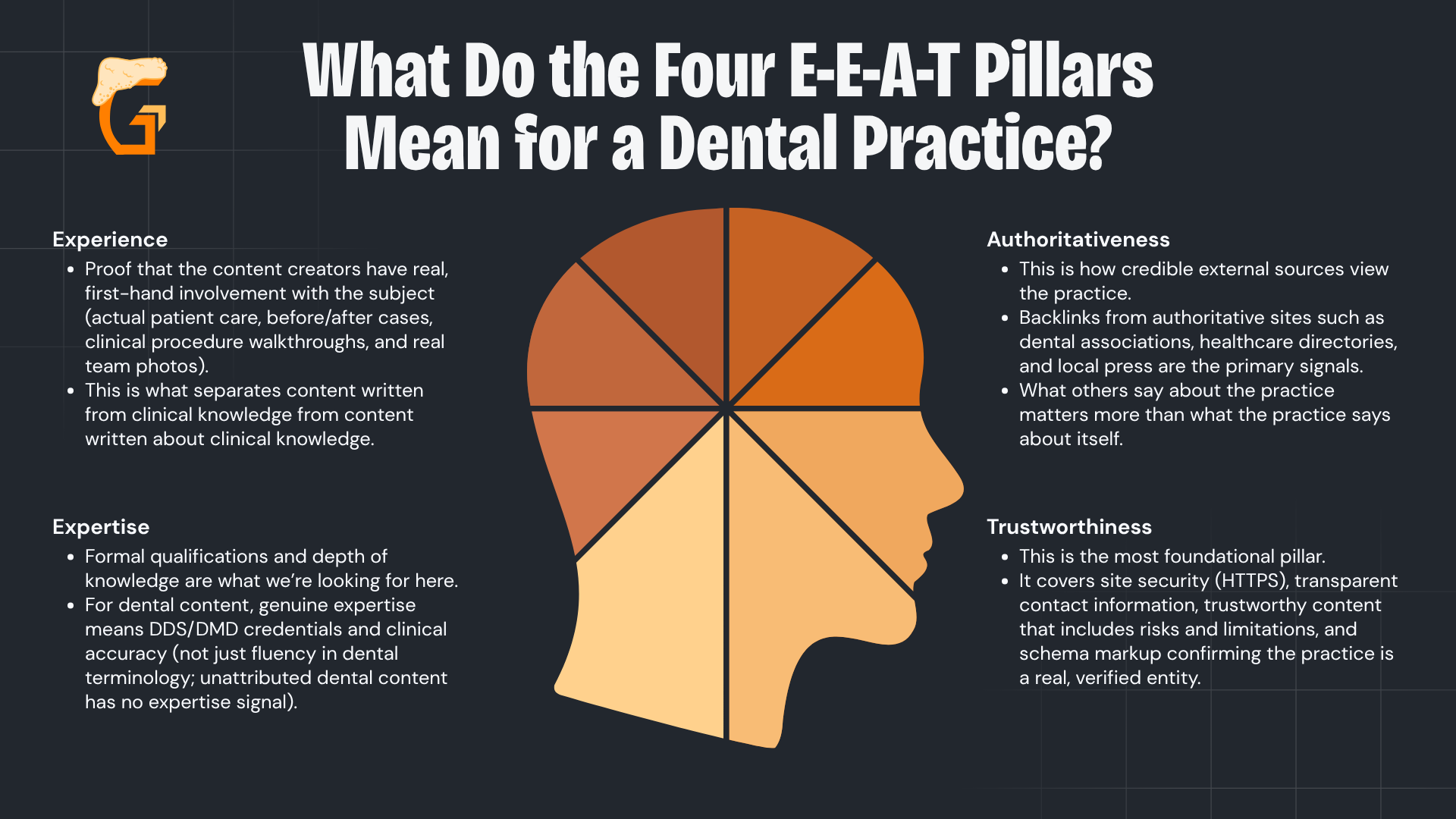
Google’s E-E-A-T guidance (drawn from its own helpful-content documentation) defines the framework as experience, expertise, authoritativeness, and trustworthiness.
Each pillar requires distinct signals in a dental context:
- Experience:
- Proof that the content creators have real, first-hand involvement with the subject (actual patient care, before/after cases, clinical procedure walkthroughs, and real team photos).
- This is what separates content written from clinical knowledge from content written about clinical knowledge.
- Expertise:
- Formal qualifications and depth of knowledge are what we’re looking for here.
- For dental content, genuine expertise means DDS/DMD credentials and clinical accuracy (not just fluency in dental terminology; unattributed dental content has no expertise signal).
- Authoritativeness:
- This is how credible external sources view the practice.
- Backlinks from authoritative sites such as dental associations, healthcare directories, and local press are the primary signals.
- What others say about the practice matters more than what the practice says about itself.
- Trustworthiness:
- This is the most foundational pillar.
- It covers site security (HTTPS), transparent contact information, trustworthy content that includes risks and limitations, and schema markup confirming the practice is a real, verified entity.
High quality content is not a scoreboard, it’s a quality threshold.
A page can pass every technical SEO check and still fail quality review if the content lacks adequate expertise or the author has no listed credentials.
Why Do Dental Websites Face a Higher E-E-A-T Standard than Most Businesses?
Dental content about treatments, costs, risks, and recovery directly affects patient health decisions (Google’s quality guidelines classify it as YMYL and apply their highest scrutiny):
- Lowest-quality risk:
- For YMYL topics, content that is inaccurate or untrustworthy can be rated as the worst possible quality designation (regardless of how it was produced.
- The algorithms trained on this feedback deprioritize pages that fail the quality standard.
- Higher bar than most local businesses:
- A restaurant can rank with anonymous content, but a dental page about implant risks or root canal procedures must have credential-backed authorship to compete at the same quality tier.
- Generalist providers routinely miss this:
- Most non-specialist SEO providers don’t create quality content with YMYL/E-E-A-T infrastructure (author attribution, clinical accuracy reviews, bio pages with credentials) built into their standard workflow.
The practical effect: a dental practice’s clinical pages compete not just against other local practices but against any page on that topic (and the YMYL bar is set by the best-credentialed content in the search engine results pages).
Expertise: How to Show Google Your Dentists Are Qualified
Google evaluates dental subject matter expertise through content authorship, credential visibility, and author bio quality.
Every clinical page should be attributed to a named dentist with DDS/DMD credentials, specialty, and ADA membership.
Well researched content in an unattributed dental article is a weaker signal than the same article credited to a licensed clinician.
Author attribution is the single highest-impact E-E-A-T change most dental websites can make to improve their search rankings.
It converts anonymous web content into credentialed healthcare content (one byline at a time).
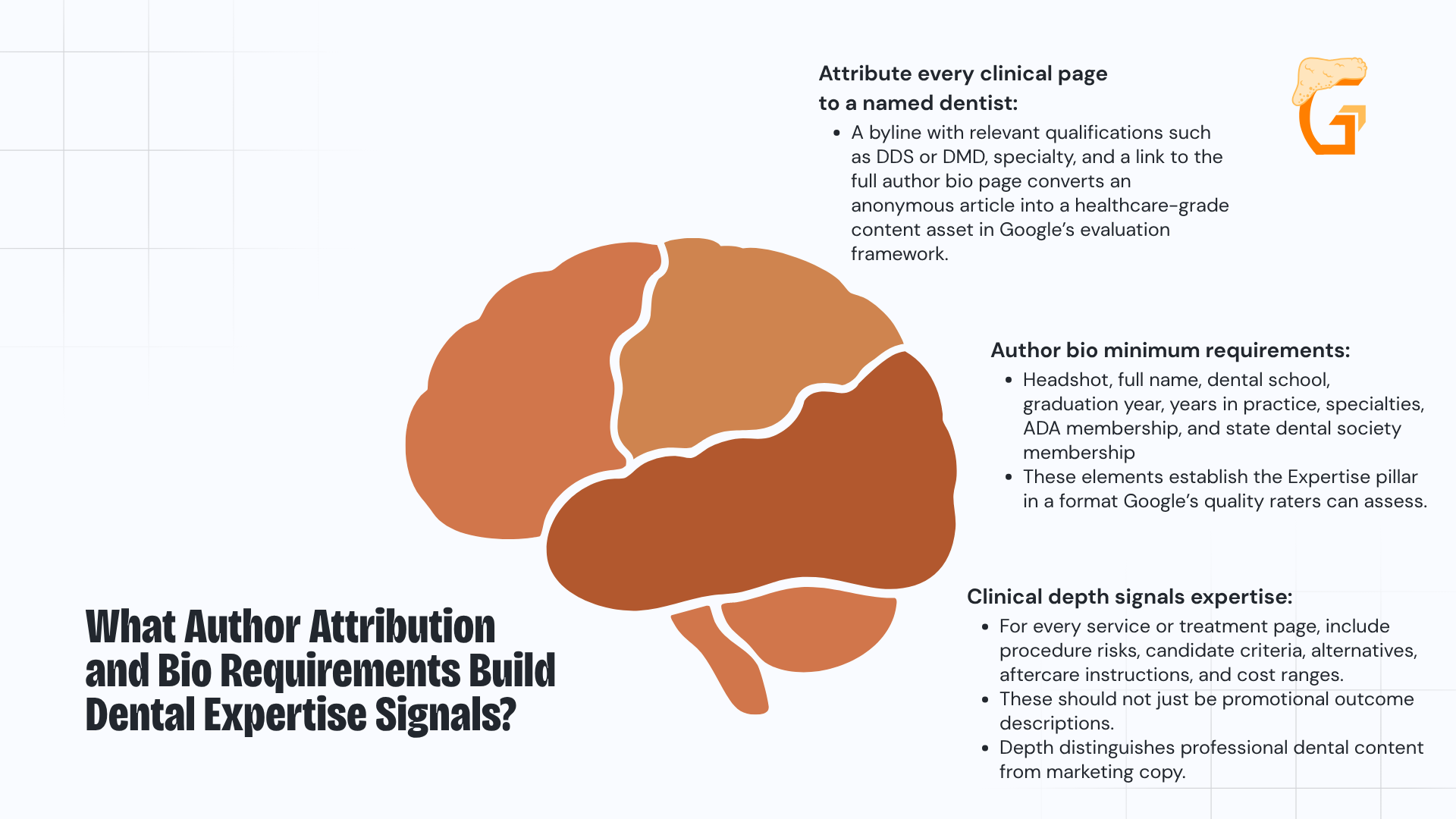
What Author Attribution and Bio Requirements Build Dental Expertise Signals?

Adding a credentialed dentist byline to your own content on every clinical page is the highest-impact E-E-A-T action available because it is the foundational expertise signal:
- Attribute every clinical page to a named dentist:
- A byline with relevant qualifications such as DDS or DMD, specialty, and a link to the full author bio page converts an anonymous article into a healthcare-grade content asset in Google’s evaluation framework.
- Author bio minimum requirements:
- Headshot, full name, dental school, graduation year, years in practice, specialties, ADA membership, and state dental society membership
- These elements establish the Expertise pillar in a format Google’s quality raters can assess.
- Clinical depth signals expertise:
- For every service or treatment page, include procedure risks, candidate criteria, alternatives, aftercare instructions, and cost ranges.
- These should not just be promotional outcome descriptions.
- Depth distinguishes professional dental content from marketing copy.
For site owners, every clinical page that lacks a credentialed dentist byline is a missed expertise signal.
Fixing this on the five most-visited clinical pages is the fastest E-E-A-T improvement available to most practices.
How Should Dental Practices Handle Medical Review Labeling and AI Content?
Medical review labeling is standard practice for helpful content (used by WebMD, Healthline, and dental trade publications because it signals clinical accuracy oversight):
- Medical review label for writer-produced content:
- “Medically reviewed by Dr. [Name], DDS, [Specialty]” on writer-produced or professionally edited content is rewarded by Google’s quality evaluation and signals that a licensed clinician has verified the accuracy.
- AI content policy:
- AI generated content must be reviewed for clinical accuracy and attributed to a licensed dentist before publishing.
- Unreviewed AI dental content is anonymous YMYL content with no expertise signal (the weakest possible quality designation for a healthcare page)
The human expert contributes what AI generated material cannot (real clinical experience, judgment about patient-specific risks, and first-hand knowledge that makes the content genuinely authoritative rather than just well-written).
Growth Saloon builds the expertise and experience signals that turn dental content into qualified new patient inquiries – not just clicks.
Contact our team today to find out how our dental marketing services can lower your cost per new patient and grow your practice.
Experience: Real-World Proof That Sets Your Practice Apart
The ‘Experience’ addition to E-E-A-T rewards first-hand clinical proof and real-life experience treating patients.
For dental websites, relevant content means before/after case studies, real patient testimonials, behind-the-scenes photos of the clinic and team, and procedure walkthroughs (anything that demonstrates the practice has actually treated patients, not just described treatments).
The distinction matters.
A social media post claiming “we’ve been practicing for 20 years” is not demonstrating experience.
A gallery of actual implant cases with clinical commentary is.
How Do Before/After Case Studies and Original Photography Build Experience Signals?

First-hand clinical proof is what separates experience from claimed experience:
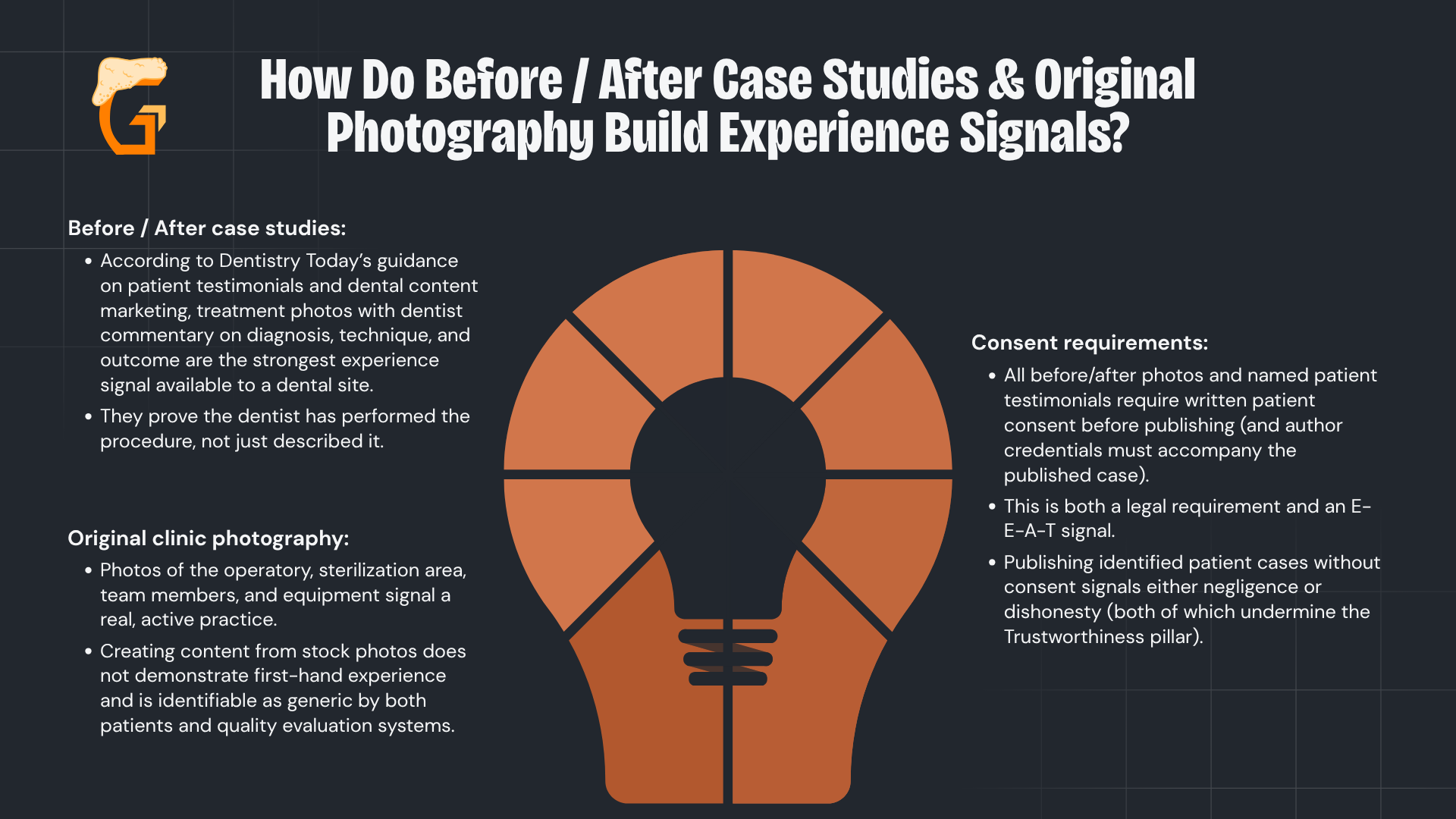
- Before/after case studies:
- According to Dentistry Today’s guidance on patient testimonials and dental content marketing, treatment photos with dentist commentary on diagnosis, technique, and outcome are the strongest experience signal available to a dental site.
- They prove the dentist has performed the procedure, not just described it.
- Original clinic photography:
- Photos of the operatory, sterilization area, team members, and equipment signal a real, active practice.
- Creating content from stock photos does not demonstrate first-hand experience and is identifiable as generic by both patients and quality evaluation systems.
- Consent requirements:
- All before/after photos and named patient testimonials require written patient consent before publishing (and author credentials must accompany the published case).
- This is both a legal requirement and an E-E-A-T signal.
- Publishing identified patient cases without consent signals either negligence or dishonesty (both of which undermine the Trustworthiness pillar).
How Do Patient Testimonials and Procedure Walkthrough Content Demonstrate Experience?
Specificity is the standard in content creation (generic praise reads as less authentic than procedure-specific accounts):
- Patient testimonials with procedure specifics:
- “[Name] and the recovery was exactly as described” is more credible than “Great dentist!” because it signals in depth knowledge and authentic first-hand experience.
- Procedure specifics confirm that real treatments were performed.
- Procedure walkthrough content:
- Step-by-step patient experience for common treatments written from clinical knowledge rather than textbook description
- eg. what happens during an implant consultation, what the extraction process feels like, what to expect post-crown placement, etc.
- Video content:
- Short clips of the practice environment, dentist introductions, and patient education provide users with a trust and engagement signal that Google surfaces in local results (and it builds patient confidence efficiently).
Procedure walkthrough content is a particularly high-value experience signal because it can only be written accurately from practical knowledge of real cases (and patients searching “what happens during a root canal” are high-intent research users ready to evaluate providers).
Growth Saloon produces the first-hand, procedure-level content that proves real clinical experience and converts high-intent searchers into qualified new patient inquiries – not just clicks.
Contact our team today to find out how our dental marketing services can lower your cost per new patient and grow your practice.
How’s your SEO going?
Enter your website URL below to get a free comprehensive SEO audit.
The audit includes:
- A scan of your entire website for technical issues
- A list of your top opportunities to target immediately
- Your highest priority fixes to make
Authoritativeness: Off-Site Signals That Build Google's Trust in Your Practice
Authoritativeness comes primarily from off-site signals:
- Backlinks from authoritative websites (such as dental associations and healthcare directories);
- Consistent NAP citations;
- Patient reviews on Google and health platforms; and
- Mentions in local news or dental media.
A dental practice with strong GBP reviews and ADA directory listings signals authority that on-site content alone cannot create.
Authoritativeness cannot be built unilaterally on the practice’s own website (it must be earned when an authoritative or trustworthy source vouches for the practice).
The on-site content strategy in Sections 2 and 3 establishes expertise and experience; this section is about building the third pillar from outside the site.
Which GBP, Directory, and Review Actions Build the Strongest Dental Authority?

The most effective off-site authority actions for a dental practice start with the GBP and the dental professional directory ecosystem:
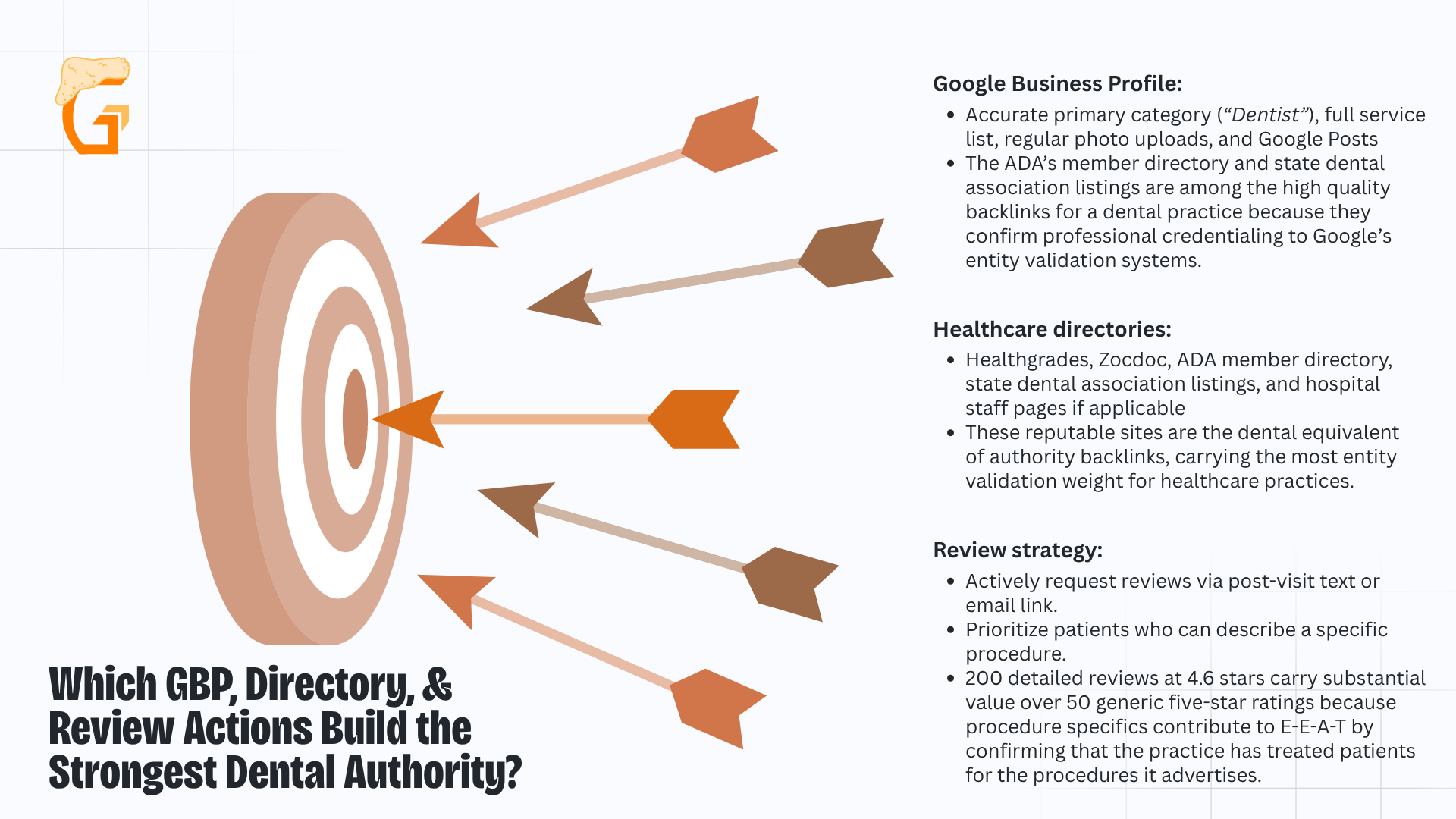
- Google Business Profile:
- Accurate primary category (“Dentist”), full service list, regular photo uploads, and Google Posts
- The ADA’s member directory and state dental association listings are among the high quality backlinks for a dental practice because they confirm professional credentialing to Google’s entity validation systems.
- Healthcare directories:
- Healthgrades, Zocdoc, ADA member directory, state dental association listings, and hospital staff pages if applicable
- These reputable sites are the dental equivalent of authority backlinks, carrying the most entity validation weight for healthcare practices.
- Review strategy:
- Actively request reviews via post-visit text or email link.
- Prioritize patients who can describe a specific procedure.
- 200 detailed reviews at 4.6 stars carry substantial value over 50 generic five-star ratings because procedure specifics contribute to E-E-A-T by confirming that the practice has treated patients for the procedures it advertises.
Reviews like “[Name] placed my implants” appear in search results and contribute to E-E-A-T by confirming that real treatments have been performed at the practice (a clinical credibility signal that generic praise cannot provide).
How Do Local Backlinks and NAP Consistency Build Dental Authoritativeness?
Local backlinks from non-dental sources expand a practice’s authority footprint beyond the dental directory ecosystem:
- Local backlinks:
- Contribute expert quotes to local news health stories, write a guest blog post for community health sites, or get listed as a dental resource on school or employer wellness pages.
- These links carry local relevance authority that dental directories alone cannot provide.
- NAP consistency:
- Practice name, address, and phone number must be identical character-for-character across the GBP, website, and every directory listing.
- Any variation creates conflicting entity signals.
NAP inconsistency (different phone numbers, misspelled addresses, old location data from a previous office) creates entity ambiguity.
Google cannot confidently associate conflicting citations with a single verified practice, which dilutes rather than builds the positive reputation and off-site authority signals that authoritativeness depends on.
Growth Saloon builds the off-site authority and consistent citations that turn a dental practice’s reputation into qualified new patient inquiries – not just clicks.
Contact our team today to find out how our dental marketing services can lower your cost per new patient and grow your practice.
Trustworthiness: On-Site Signals That Tell Google Your Site Is Safe and Honest
Trustworthiness for dental websites comes from:
- HTTPS encryption;
- Clear contact information on every page;
- Transparent privacy and HIPAA policies;
- Schema markup that identifies the practice and its dentists as real entities; and
- Honest content that includes risks and limitations alongside benefits.
Schema markup is the highest-leverage technical trust action because it surfaces existing credentials in machine-readable format (it doesn’t create E-E-A-T, but it ensures Google’s algorithms can efficiently parse the qualifications already present).
Which Schema Markup and Technical Signals Does a Dental Site Need for Trust?
Schema markup makes existing credentials machine-readable (a credentialed practice without schema loses the algorithmic advantage that structured data provides):
- The three (3) Dentist/MedicalBusiness schema types that most directly support E-E-A-T trust for a dental practice are:
- Dentist schema on the homepage and contact web pages;
- Person schema on each dentist’s bio page (with hasCredential, alumniOf, and jobTitle fields); and
- AggregateRating schema for review scores.
- HTTPS:
- Every page served over HTTPS must have a valid SSL certificate.
- Unencrypted dental pages fail both the trust test and the technical SEO minimum.
- For SEO, Google has treated HTTPS as a ranking signal since 2014.
Schema markup, internal links, and HTTPS are baseline technical requirements.
A dental site missing either has not cleared the minimum trust bar across the entire site, regardless of how strong its clinical content is.
How Do Contact Transparency, Privacy, and Honest Content Build Dental Trust?

Contact transparency, privacy policy visibility, and honest content are the on-site signals that build user trust and that patients and quality raters both evaluate:
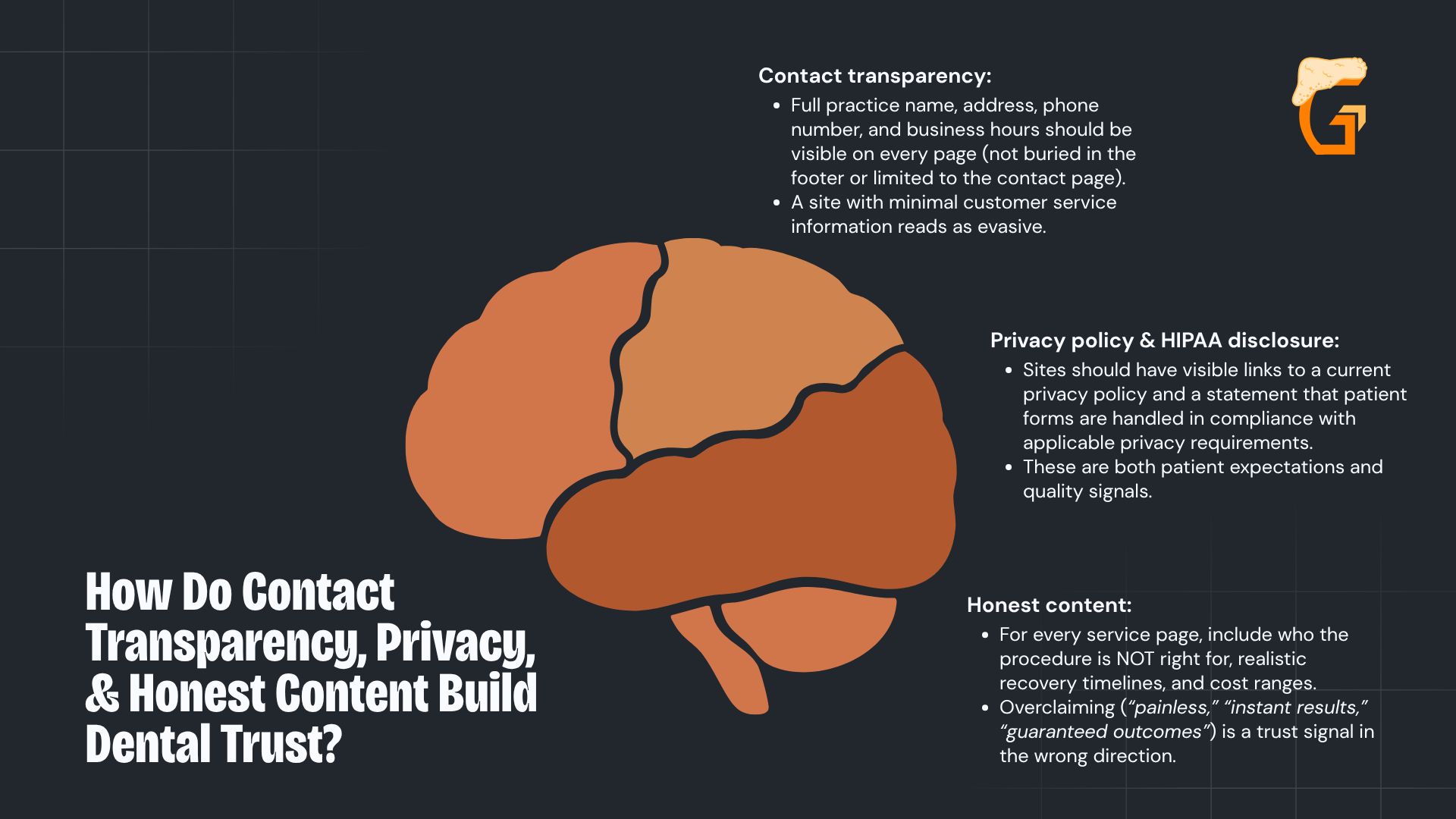
- Contact transparency:
- Full practice name, address, phone number, and business hours should be visible on every page (not buried in the footer or limited to the contact page).
- A site with minimal customer service information reads as evasive.
- Privacy policy and HIPAA disclosure:
- Sites should have visible links to a current privacy policy and a statement that patient forms are handled in compliance with applicable privacy requirements.
- These are both patient expectations and quality signals.
- Honest content:
- For every service page, include who the procedure is NOT right for, realistic recovery timelines, and cost ranges.
- Overclaiming (“painless,” “instant results,” “guaranteed outcomes”) is a trust signal in the wrong direction.
Dental sites that publish valuable content including procedure contraindications, realistic recovery timelines, and cost ranges alongside benefits are rated more trustworthy by Google quality raters (because that level of clinical honesty is what a real practitioner provides).
Growth Saloon helps dental practices build the kind of digital presence that consistently generates qualified new patient inquiries – not just clicks.
Contact our team today to find out how our dental marketing services can lower your cost per new patient and grow your practice.
How Can Growth Saloon Help Your Dental Practice Grow?
Growth Saloon is a Chicago-based digital marketing agency built to help dental practices attract more patients and grow their practice through performance-driven digital marketing.
Mike Lowe and the Growth Saloon team specialize in search engine optimization, web design, conversion rate optimization, and marketing attribution – working alongside your practice to build a measurable digital presence that generates qualified patient inquiries, not just website traffic.
From ranking for high-intent local search terms to converting site visitors into booked appointments, Growth Saloon’s digital marketing focuses on results at every stage of the patient acquisition funnel.
Practice owners and marketing managers get clear visibility, through reporting tools like Google Search Console, into exactly which channels are driving new patient growth.
We know that every open appointment slot has a real cost.
Every decision we make is built around one outcome – helping your practice fill more of them.
Meet the Founder of Growth Saloon
Meet the founder and lead strategist at Growth Saloon – Mike Lowe:
- As founder and CEO of Growth Saloon, Mike brings years of hands-on experience in SEO strategy, CRO, web design, and marketing attribution for service-based businesses competing in local and regional markets.
- Based in Chicago and working with practices across the country, Mike has built and managed digital growth campaigns for businesses competing in some of the most contested search markets in the country.
- Growth Saloon’s data-driven approach to local SEO and patient acquisition helps dental practices turn their websites into their highest-performing new patient channel.
What Does Working With Growth Saloon Look Like?
Growth Saloon operates as a dedicated extension of your marketing team – not a vendor that disappears after onboarding.
Every engagement includes direct access to Mike and the team, transparent reporting tied to actual patient acquisition outcomes, and strategies tailored to your specific services, local market, and target audience.
Whether you’re looking to rank for high-value procedures that match patient search intent, improve your site’s appointment conversion rate, or finally get clarity on where your new patients are actually coming from, Growth Saloon builds the strategy and does the work.
Growth Saloon helps dental practices build the kind of digital presence that consistently generates qualified new patient inquiries – not just clicks.
Contact our team today to find out how our dental marketing services can lower your cost per new patient and grow your practice.
How's your SEO going?
Get your free comprehensive SEO audit.
Enter your website URL below to get a free comprehensive SEO audit.
- Scan entire website for technical issues
- Get a list of your top opportunities
- See your highest priority fixes to make
-
E-E-A-T is not a direct ranking factor with a single score Google plugs into its algorithm.
It is a framework from Google’s Search Quality Rater Guidelines that human evaluators use to assess content quality.
That feedback trains the ranking algorithms that do determine placement.
For dental websites (which are classified as YMYL healthcare content) weak E-E-A-T signals hurt search performance because pages are more likely to be deprioritized by the same algorithms, even if technical SEO is otherwise sound.
-
Attribute every clinical page to a named, credentialed dentist with a linked author bio.
An unattributed dental article (whether written by staff, a copywriter, or AI tools) has no expertise signal.
Adding a byline with DDS credentials, specialty, and a bio that includes detailed information about dental school and professional memberships converts a generic page into a healthcare-grade content asset in Google’s evaluation framework.
-
Schema markup does not create E-E-A-T.
It surfaces existing E-E-A-T signals in a format Google’s algorithms can read efficiently.
Dentist schema identifies the practice as a medical business entity.
Person schema on each dentist’s bio page communicates credentials, alma mater, and specialties through structured data.
Aggregate Rating schema surfaces review scores.
Together they make your existing qualifications machine-readable for search engines, which supports how Google evaluates the page rather than adding new information.
-
AI-generated content is not automatically a problem for E-E-A-T.
The issue is unreviewed AI content published without dentist attribution or clinical accuracy checks.
If a dental practice publishes content created by AI without having a licensed dentist review it for accuracy and adding a credentialed byline, the result is anonymous health content with no expertise signal.
Google’s quality guidelines specifically flag anonymous YMYL content as potentially low quality.
-
There is no threshold number, but the pattern that signals authenticity is consistent volume, recency, and specificity.
A practice with 200 reviews averaging 4.6 stars, with reviews that mention specific procedures and experiences, reads as more authoritative than a practice with 20 identical five-star reviews with no text.
The quality and detail of individual reviews matter as much as the total count (Google and patients both evaluate whether the reviews reflect genuine patient experiences).
-
NAP (name, address, and phone number) is a trust and authoritativeness signal.
When your practice information is identical across your website, Google Business Profile, dental directories, and healthcare listings, Google can confidently associate all those citations with a single verified entity.
Inconsistent NAP (different phone numbers, misspelled street addresses, old location data) creates entity ambiguity that erodes the off-site authority signals and brand reputation you’re trying to build.
Most agencies sell traffic. We sell actual growth. That’s the Growth Saloon difference.
Are you looking to grow?
Recent blogs
Enter your website URL below to get free comprehensive SEO audit.
- Scan entire website for technical issues
- Get a list of your top opportunities
- See your highest priority fixes to make