


Updated:July 22nd, 2026

Content Marketing for Dentists in 2026

Written by

Mike Lowe

Reviewed by

Taylor Coteus

Key takeaways

  • Content marketing for dentists works by publishing educational blog posts, video content, social media, and email on a consistent calendar tied to one outcome (booked appointments), rather than posting sporadically with no measurable goal.
  • Dental content marketing typically costs $1,000 to $3,000 per month within a broader marketing budget, with the American Dental Association citing a 3:1 to 5:1 return as the benchmark for a successful campaign, measured by new patients acquired and cost per new patient.
  • Any identifiable patient information used in dental marketing, including before-and-after photos and testimonials, requires a written HIPAA authorization that is separate from treatment consent, names the specific content and channels, and grants the patient the right to revoke at any time.

Does Content Marketing for Dentists Actually Bring in New Patients?

Content marketing for dentists works, but most practices never see that payoff because they treat it as random acts of posting rather than a system built around one outcome – booked appointments.

A blog here, a social update there, a video when inspiration strikes.

The content goes out, nothing measurable comes back, and the whole effort gets written off as a time sink that does not fill the schedule.

The practices that actually see results build something different.

Content Marketing for Dentists

They publish relevant content that answers the questions patients type into search engines before they ever call a dentist, and they do it consistently enough that trust compounds over months.

That combination (the right topics, the right formats, and a publishing cadence the team can actually sustain) is what turns a dental website from a digital brochure into a patient acquisition channel.

This guide covers what that system looks like in practice: what content marketing and content creation involve, how they differ from SEO, what they cost, what return to expect, and the compliance and strategy mistakes that quietly stall most practices.

Growth Saloon helps dental practices build the kind of digital presence that consistently generates qualified new patient inquiries – not just clicks.

Contact our team today to find out how our dental marketing services can lower your cost per new patient and grow your practice.

What Is Content Marketing for Dentists?

Content marketing for dentists is creating educational blog, video, social, and email content that attracts potential patients, builds trust, and turns website visitors into booked appointments.

The logic behind it is well-supported – a review published in the National Library of Medicine found that effective dentist-patient communication educates patients, increases confidence, reduces dental anxiety, and improves treatment adherence (precisely the outcomes a well-built content system delivers before a new patient walks through the door).

What Are the Four Core Types of Dental Content?
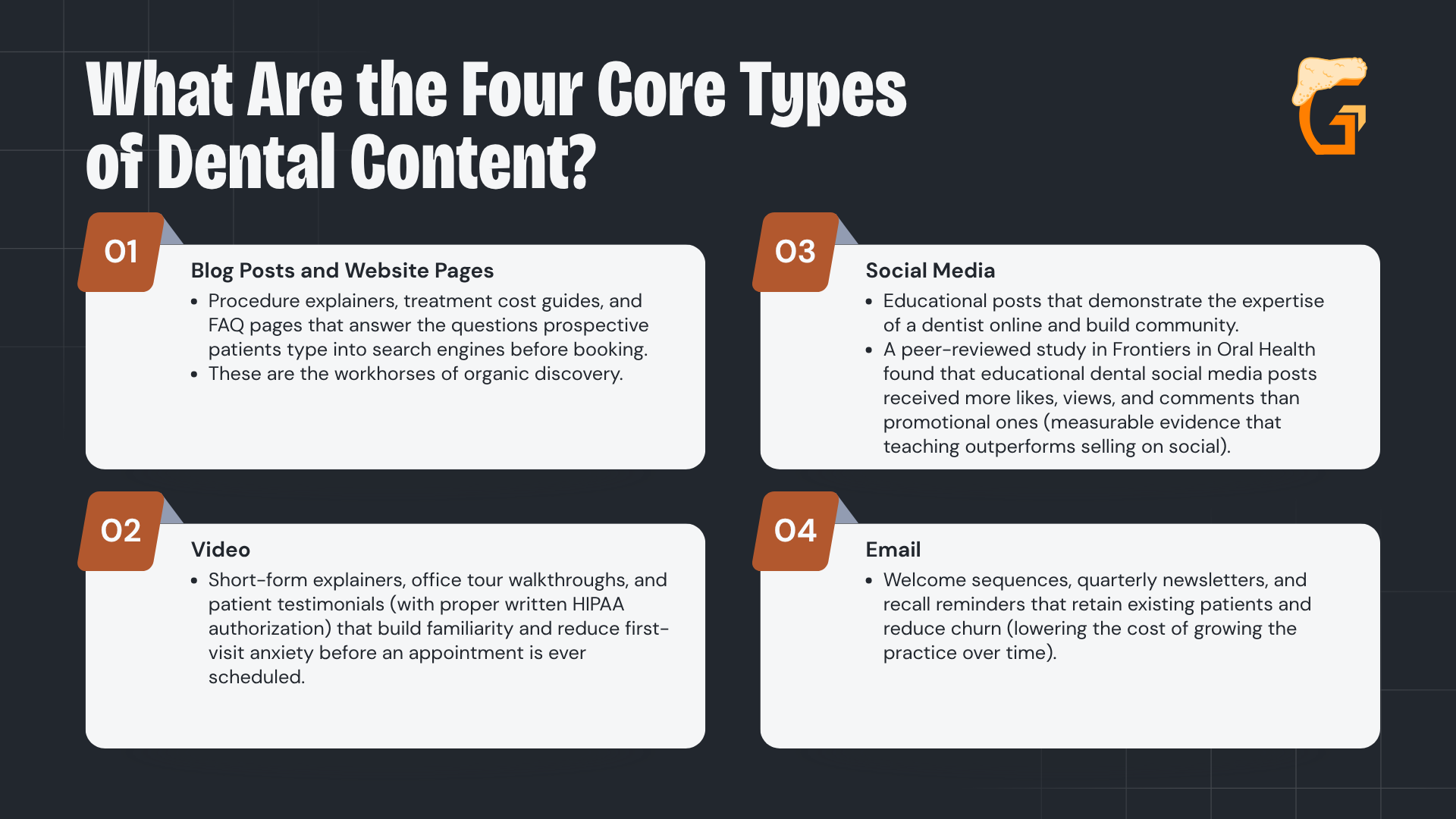
Dental content marketing centers on four formats, each serving a distinct role in attracting and retaining local patients:

  • Blog posts and website pages: Procedure explainers, treatment cost guides, and FAQ pages that answer the questions prospective patients type into search engines before booking. These are the workhorses of organic discovery.
  • Video: Short-form explainers, office tour walkthroughs, and patient testimonials (with proper written HIPAA authorization) that build familiarity and reduce first-visit anxiety before an appointment is ever scheduled.
  • Social media: Educational posts that demonstrate the expertise of a dentist online and build community. A peer-reviewed study in Frontiers in Oral Health found that educational dental social media posts received more likes, views, and comments than promotional ones – measurable evidence that teaching outperforms selling on social.
  • Email: Welcome sequences, quarterly newsletters, and recall reminders that retain existing patients and reduce churn, lowering the cost of growing the practice over time.

In practice, “doing” content marketing means building a content calendar and publishing consistently across a focused set of channels – not posting when inspiration strikes and going quiet for six weeks.

A dentist does not need to be on every platform.

The goal is reliable output on the social platforms that their target audience actually uses.

Educational content compounds – a well written blog post or FAQ page keeps attracting new patients long after it is published, without additional spend.

Why Does Content Marketing Matter for a Dental Practice?

Content marketing builds the trust that converts informed patients into booked appointments.

It does that at every stage of the patient journey – not just at the moment of discovery:

  • Awareness: Office tours, oral-health tips, and dentist-authored explainers introduce the practice to future patients who do not yet know it exists.
  • Evaluation: FAQs, treatment comparisons, and procedure cost posts help patients weigh their options and move from “considering it” to scheduling.
  • Conversion: Before-and-after galleries from satisfied patients and a clear next step (a direct booking link or phone number) close the gap between interest and action.
  • Retention: Recall reminders and patient education newsletters keep existing patients returning on schedule, reducing the ongoing cost of chair time.

Dentistry is a health decision, placing it squarely in Google’s YMYL (Your Money or Your Life) category.

The American Dental Association puts it plainly – patients need to trust their dentist as they would any of their healthcare providers, feel able to ask questions, and receive explanations in plain language.

Content marketing operationalizes that expectation at scale.

When the measure of success shifts from site visits to new patients and booked appointments, content becomes one of the highest-return channels a dental practice can invest in – especially when paired with the SEO fundamentals for dentists that make every published piece findable in the first place.

Growth Saloon helps dental practices build a content system that attracts local patients and converts them into booked appointments.

Reach out today to learn how our dental practice marketing expertise can put your content to work.
How Does Content Marketing Differ From SEO for Dentists?

SEO is the technical and on-page work behind search engine rankings that helps patients find you; content marketing is the educational material that earns their trust and converts them into appointments.

The two are complementary, not competing.

Google’s SEO Starter Guide defines SEO as the work that helps search engines read your content and helps users find your site – which means content is the fuel SEO needs to perform, and together they form one patient-acquisition system, not two separate channel choices.

How Do SEO and Content Marketing Each Work?

Search engine optimization covers the technical and structural work that makes a dental website discoverable in the first place.

A dental website’s visibility depends on three layers working together – and content marketing is the one patients actually read:

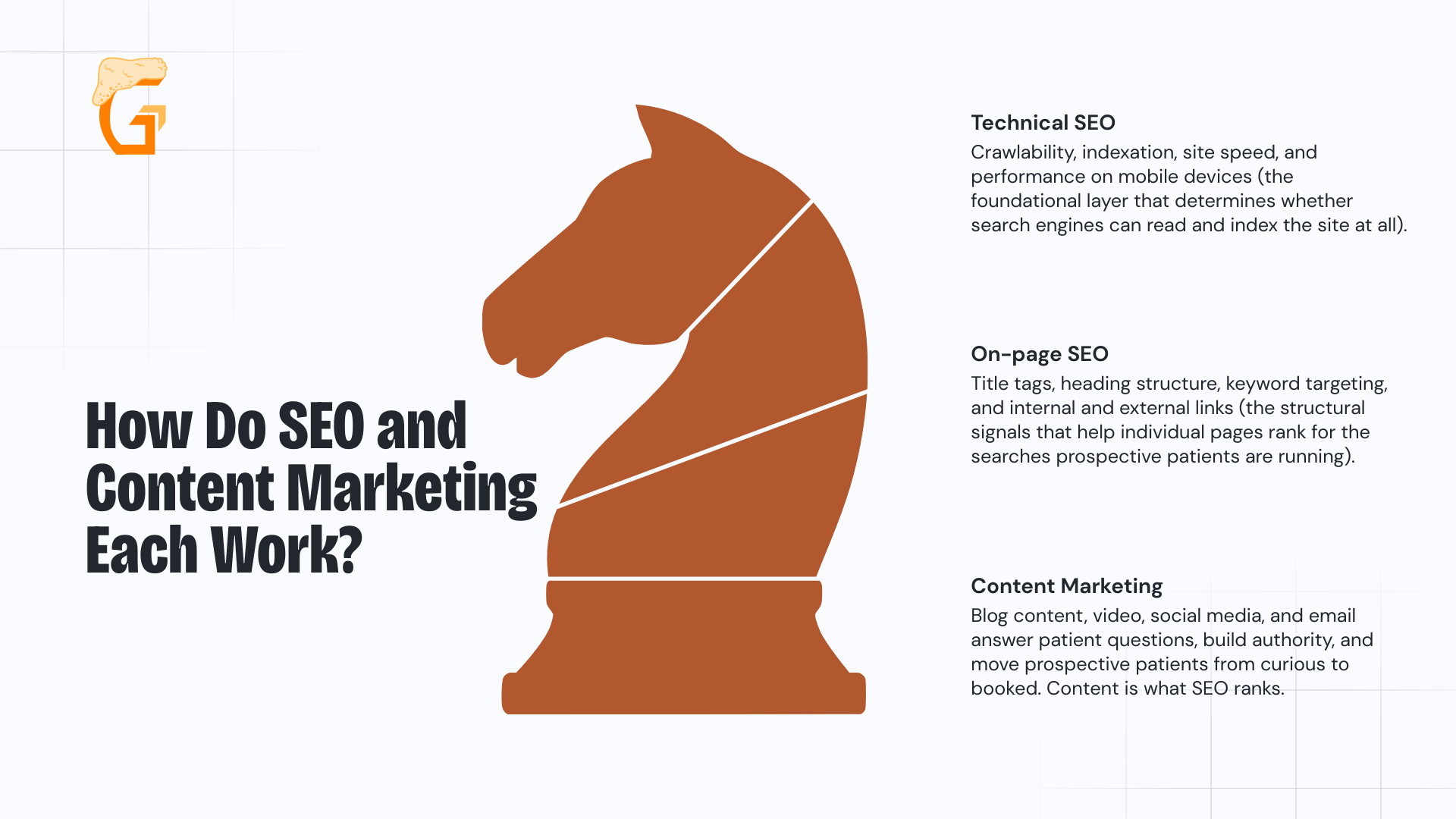
  • Technical SEO: Crawlability, indexation, site speed, and performance on mobile devices – the foundational layer that determines whether search engines can read and index the site at all.
  • On-page SEO: Title tags, heading structure, keyword targeting, and internal and external links – the structural signals that help individual pages rank for the searches prospective patients are running.
  • Content marketing: Blog content, video, social media, and email answer patient questions, build authority, and move prospective patients from curious to booked. Content is what SEO ranks.

The success metrics differ.

SEO is judged by organic discovery – whether the right patients can find the practice when they search.

Content marketing is judged by what happens after – engagement, call volume, form submissions, and new patients booked.

Keeping the shared goal focused on new-patient acquisition, rather than on search position alone, keeps both efforts oriented toward practice growth rather than vanity metrics.

Should Dentists Choose Content Marketing or SEO?

Both (and in sequence).

SEO and content marketing are not the same thing – but they are built to work together.

Here is how they differ across four dimensions:

  • Focus: SEO on discoverability; content marketing on trust and conversion
  • Scope: SEO covers technical and on-page work; content covers blog, video, social platforms, and email
  • Success metric: SEO measured by organic discovery; content marketing measured by new patients booked
  • Time horizon: Both compound over months – neither delivers results overnight

Treating them as an either/or choice is the most common failure mode.

A technically sound site for your dental services with thin, generic pages does not convert new patients.

A practice of publishing strong content that no one can find wastes the effort.

The payoff comes when SEO for dentists and content work in concert – a compounding pipeline of booked appointments from organic search, without depending on paid ads to keep the schedule full.

How Do You Tailor Content Marketing to Your Practice and Local Market?

Content marketing works best when specifically tailored to your specialty and local market – cosmetic, pediatric, and general practices each need different topics, formats, and patient segments.

Generic content rarely converts new patients because it does not speak to the specific person a practice is trying to reach.

Local search research shows that 76% of nearby smartphone searchers visit a related business within a day, so tightly targeted content captures the highest-intent patients while generic posts get scrolled past.

How Should Content Differ by Dental Specialty?

Before producing any content, dental professionals should define the ideal patient – who they are, what they are worried about, and what questions they ask before booking.

The right content strategy starts with knowing exactly who the practice is trying to reach.

Topic, format, and channel decisions all follow from there – and they look very different depending on the type of practice:

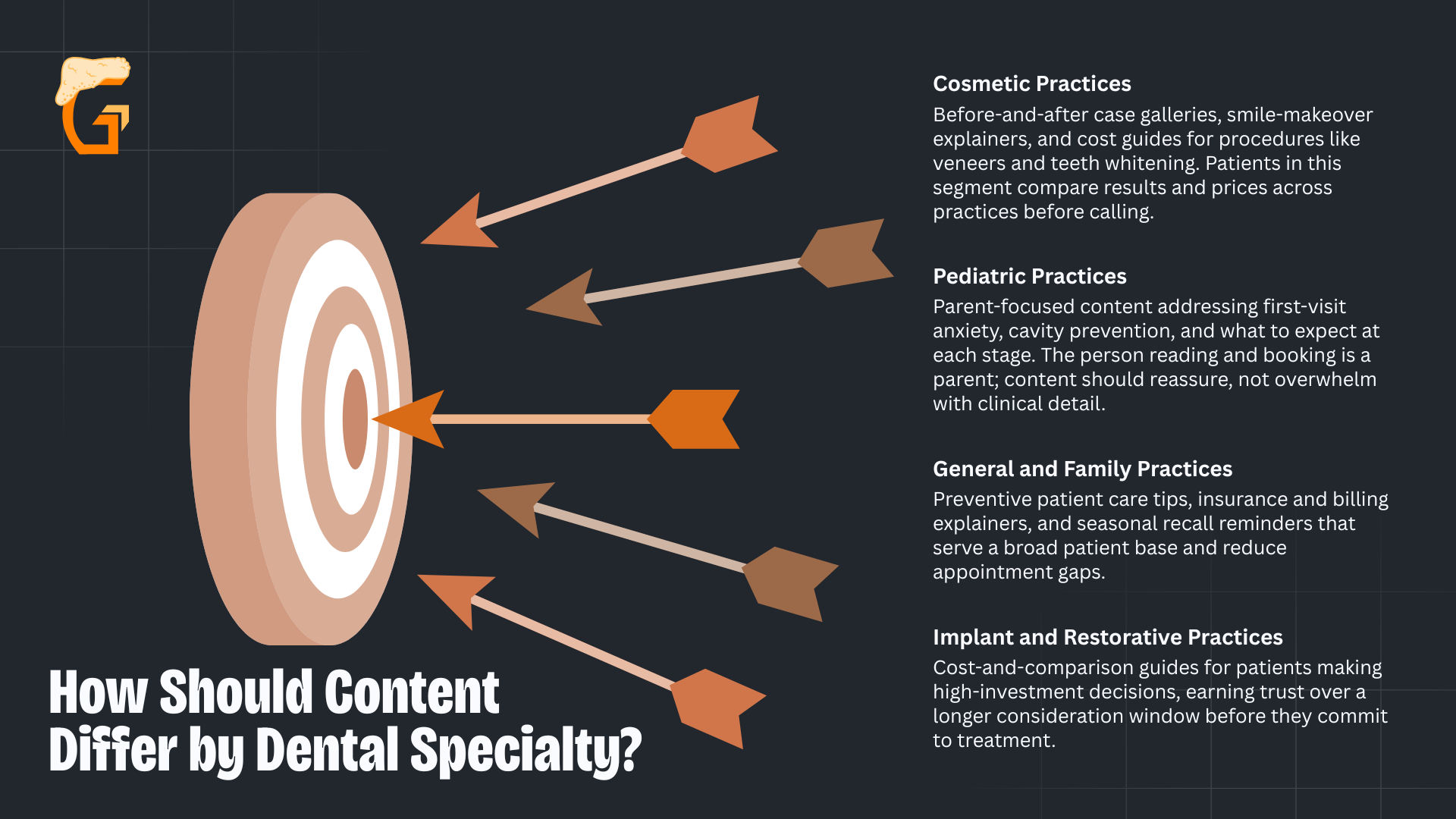
  • Cosmetic practices: Before-and-after case galleries, smile-makeover explainers, and cost guides for procedures like veneers and teeth whitening. Patients in this segment compare results and prices across practices before calling.
  • Pediatric practices: Parent-focused content addressing first-visit anxiety, cavity prevention, and what to expect at each stage. The person reading and booking is a parent; content should reassure, not overwhelm with clinical detail.
  • General and family practices: Preventive patient care tips, insurance and billing explainers, and seasonal recall reminders that serve a broad patient base and reduce appointment gaps.
  • Implant and restorative practices: Cost-and-comparison guides for patients making high-investment decisions, earning trust over a longer consideration window before they commit to treatment.

The American Dental Association advises that dentists tailor explanations to each patient’s level of comfort and ability to ask questions.

That principle applies directly to content – the tone and format that converts a cosmetic-dentistry prospect is not what converts the parent of a nervous six-year-old.

Matching content to the patient segment separates material that books appointments from posts that get views and produce nothing.

How Do You Make Dental Content Work Locally?

Near-me dental searches convert fast.

Dental patients search with location in mind – and content built around that intent converts at a higher rate than generic educational material.

Local search research finds that 76% of nearby smartphone searchers visit a related business within a day, which makes locally tailored content one of the highest-intent patient acquisition channels a practice can invest in.

That means building content around four local signals:

  • Location-specific pages and posts: Content naming the city, neighborhood, or service area draws a local audience searching with intent to book, not just browsing.
  • Seasonal and community content: Back-to-school checkup posts, sports-mouthguard guides ahead of fall seasons, and local event tie-ins signal community involvement and that the practice is part of the community it serves.
  • Local search intent alignment: Tying topics to what patients in the specific market are actually searching for, rather than competing against national dental keywords, lowers ranking difficulty in local search results and increases relevance.
  • Google Business Profile connection: Content that reinforces the GBP listing and online reputation (answering common patient questions, confirming specialty and location, and directing patients to book) ties website content to near-me discovery.

Local content and well-maintained local SEO efforts for dentists work in tandem – the content earns trust on the site while the profile and reviews drive the nearby visibility that fills the schedule, compounding into a lower cost per new patient without ongoing ad spend.

Growth Saloon builds locally targeted content strategies that help dental practices win in their specific market.

Contact us to find out how our content marketing strategies for dentists can turn your local search presence into a steady stream of new patient inquiries.

How’s your SEO going?

Enter your website URL below to get a free comprehensive SEO audit.

The audit includes:

What Does Dental Content Marketing Cost and What ROI Should You Expect?

Dental content marketing typically runs roughly $1,000–$3,000 per month within a larger marketing budget, and the American Dental Association cites a 3:1 to 5:1 return as the benchmark for a successful campaign.

The honest starting point is the return side of that equation, not the sticker price.

What matters is how many new patients a practice acquires from its content marketing efforts and what each one costs to bring through the door.

In-House, Freelance, or Partner: What Are the Options and Costs?

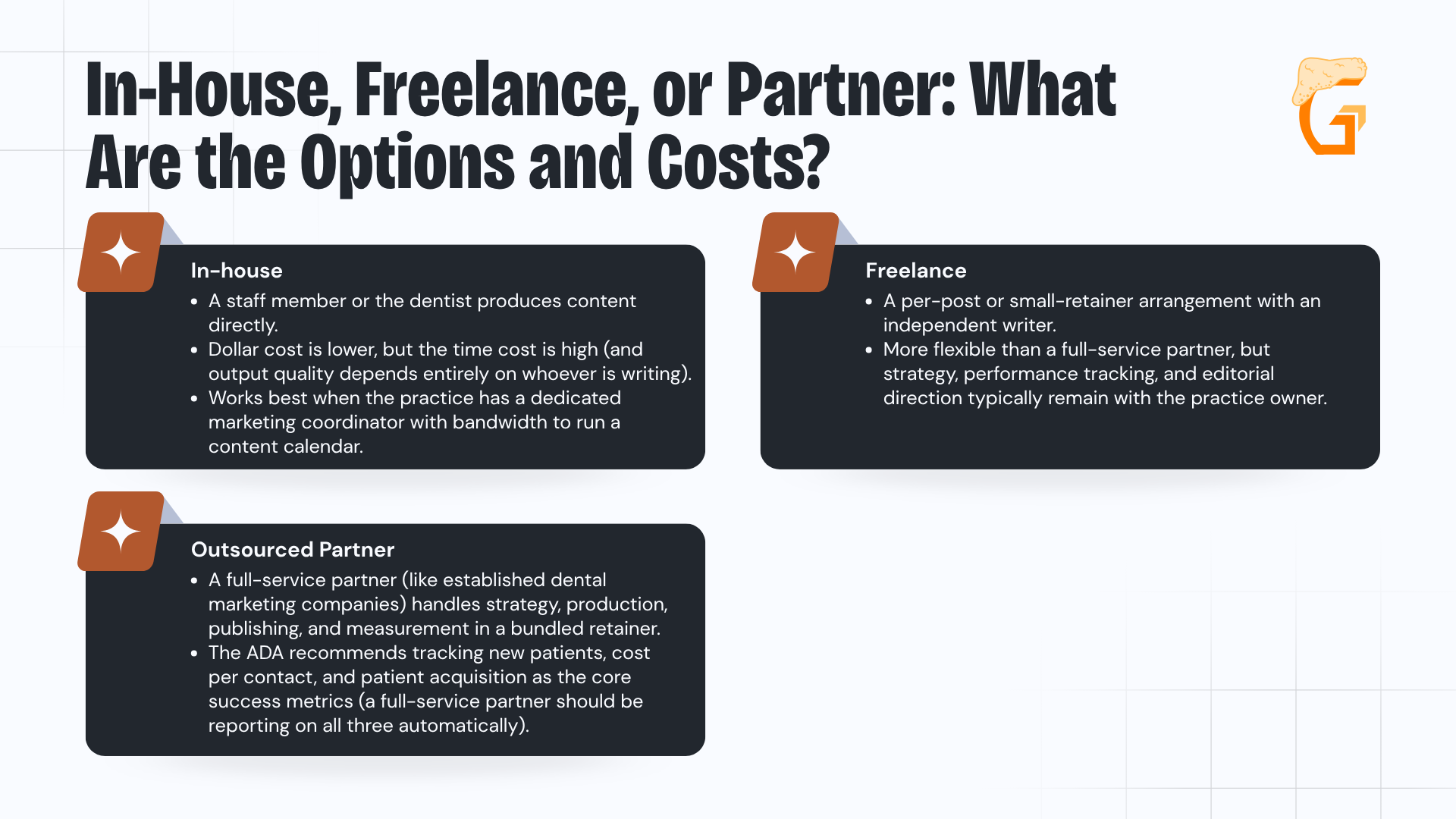
Three delivery models exist for dental content marketing, and the right one depends on practice size, available owner time, and how much strategic oversight the practice can provide internally:

  • In-house: A staff member or the dentist produces content directly. Dollar cost is lower, but the time cost is high, and output quality depends entirely on whoever is writing. Works best when the practice has a dedicated marketing coordinator with bandwidth to run a content calendar.
  • Freelance: A per-post or small-retainer arrangement with an independent writer. More flexible than a full-service partner, but strategy, performance tracking, and editorial direction typically remain with the practice owner.
  • Outsourced partner: A full-service partner, like established dental marketing companies, handles strategy, production, publishing, and measurement in a bundled retainer. The ADA recommends tracking new patients, cost per contact, and patient acquisition as the core success metrics – a full-service partner should be reporting on all three automatically.

Established practices commonly allocate roughly 5–6% of collections to digital marketing strategies overall, with content representing one portion of that budget.

The figures above are directional, not precise – there is no single published benchmark for dental content pricing.

A practical approach (budget based on the delivery model that fits the practice’s current size and available time, then evaluate return on the metrics that actually matter) new patients acquired and cost per new patient, not output volume.

How Do You Measure Content Marketing ROI for a Dental Practice?

Measuring content marketing performance means tracking the key performance indicators that connect directly to practice growth – not vanity numbers.

The ADA sets a 3:1 to 5:1 return as the benchmark for a successful marketing campaign – which means the metrics that matter are new patients acquired, the cost to acquire each one, and the lifetime value they represent.

Six numbers tell that story:

  • New patients by source: Which content pieces, search terms, and channels drove patients to call or book an appointment.
  • Cost per new patient: Total content marketing spend divided by new patients attributed to that channel over the same period.
  • Patient lifetime value: The long-term revenue a new patient represents across their relationship with the practice, not just the first appointment.
  • Call and form tracking: Attribution tools (Google Analytics, call tracking software, practice-management CRM) that connect content to actual patient contact.
  • Revenue by treatment type: Which content drove patients booking higher-value treatments versus routine hygiene, relevant to evaluating ROI by content type.
  • Monthly and quarterly review cycles: Regular check-ins to confirm which topics and formats are driving new-patient bookings and where to adjust.

Set honest expectations on timeline – early movement in search visibility typically appears within 30–90 days, with meaningful new-patient results at three to six months.

Evaluating lifetime value accurately requires 12 or more months of data.

Content is a compounding channel that supports sustainable growth – what you publish today keeps generating new patients next year.

If you want to know what that return looks like for your specific practice, Growth Saloon’s team can walk you through the numbers.

What Dental Content Marketing Mistakes Should You Avoid?

The biggest mistakes are HIPAA violations like posting patient photos or patient testimonials without written consent, generic off-target content, inconsistent publishing, and chasing short-term discount inquiries instead of compounding trust.

HIPAA pitfalls carry the highest stakes, but strategic and operational failures are more common and just as damaging to new-patient growth over time.

What HIPAA Rules Apply to Dental Content and Reviews?

Dental content marketing operates under HIPAA, and the rules apply to every channel – social media channels, email, blog comments, and online review responses.

Any identifiable patient information used in marketing requires written authorization before it appears anywhere online.

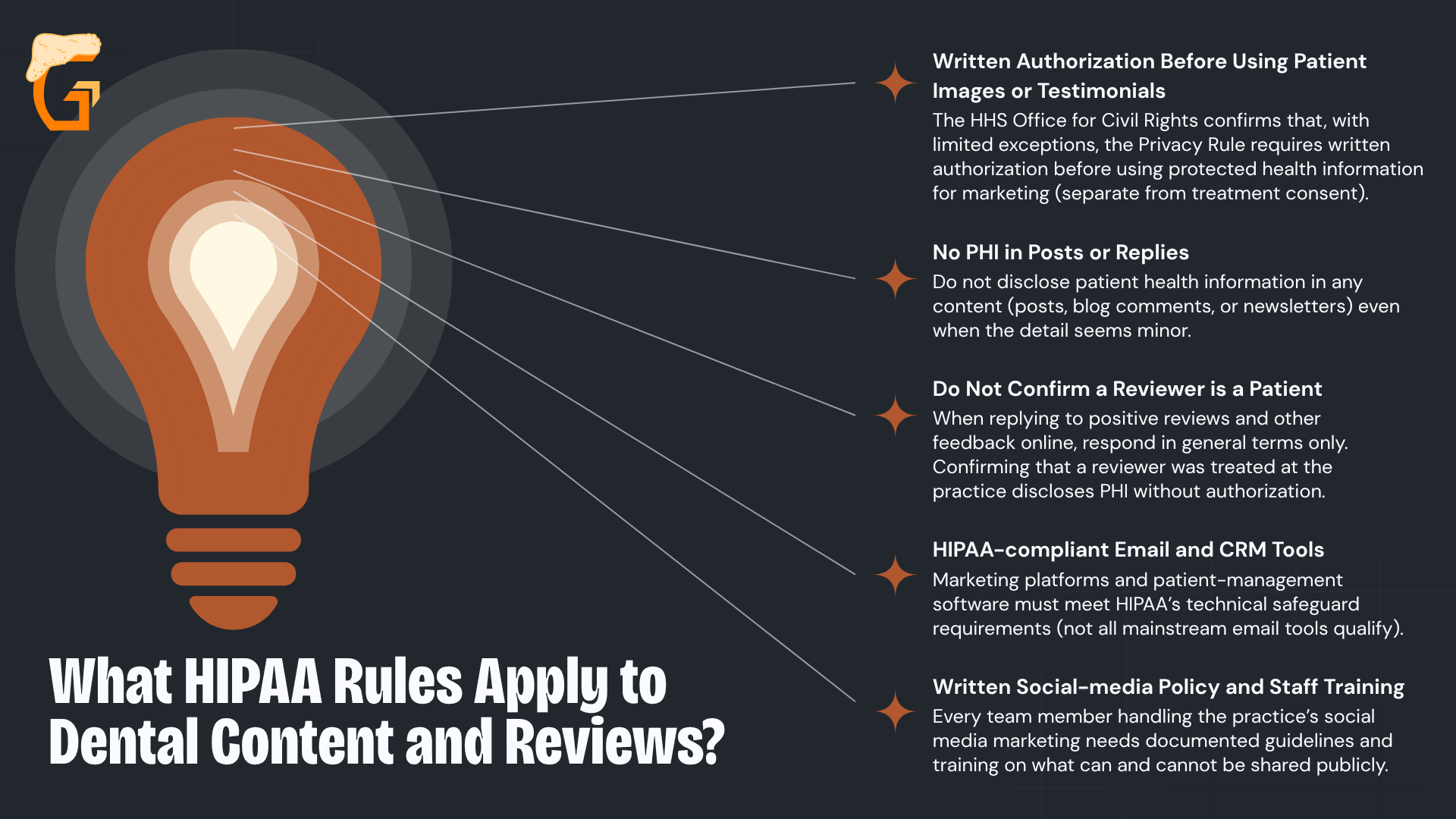
Five compliance requirements every practice needs to have in place:

  • Written authorization before using patient images or testimonials: The HHS Office for Civil Rights confirms that, with limited exceptions, the Privacy Rule requires written authorization before using protected health information for marketing – separate from treatment consent.
  • No PHI in posts or replies: Do not disclose patient health information in any content – posts, blog comments, or newsletters – even when the detail seems minor.
  • Do not confirm a reviewer is a patient: When replying to positive reviews and other feedback online, respond in general terms only. Confirming that a reviewer was treated at the practice discloses PHI without authorization.
  • HIPAA-compliant email and CRM tools: Marketing platforms and patient-management software must meet HIPAA’s technical safeguard requirements; not all mainstream email tools qualify.
  • Written social-media policy and staff training: Every team member handling the practice’s social media marketing needs documented guidelines and training on what can and cannot be shared publicly.

A compliant authorization form names the specific content, channels, duration, and the patient’s right to revoke at any time.

For review responses, a general acknowledgment avoids confirming patient status.

This is informational only – not legal advice.

Have a healthcare attorney review all authorization forms and review-response policies before use.

Why Do Patient Reviews and Content Often Fail to Attract New Patients?

Most dental content fails not from lack of effort but from lack of strategy and consistency.

The most common dental content marketing failures share the same pattern (content that speaks to everyone, says nothing specific to anyone, and stops the moment publishing gets inconvenient).

Five mistakes account for most of it:

  • No defined audience: Content aimed at every possible patient converts no specific one. Without an ideal-patient profile, it is hard to create engaging content, so topics stay generic and engagement stays low.
  • Thin content that answers nothing: Posts describing a service without addressing what patients actually want to know (cost, recovery, success stories, whether they qualify) do not move anyone toward booking.
  • “Random acts of content”: Sporadic publishing with no calendar means the practice goes quiet for weeks at a time. Consistency matters more than volume.
  • Operational leak: Content that generates inquiries still fails if the front desk does not follow up promptly. In the digital age, content attracts the patient; the practice has to convert them.
  • Chasing short-term discounts: Discount-driven posts attract price-sensitive patients and undermine the trust-building that produces booked appointments over 6–12 months.

Define the ideal patient, commit to a realistic publishing calendar, and make sure the front desk converts the interest content generates.

Measure by new patients booked and cost per new patient – not post volume or impressions.

Growth Saloon helps dental practices avoid the strategy and compliance pitfalls that quietly stall new patient growth.

Get in touch today to see how our dental marketing solutions keep your content plan on track and your schedule full.

How Do You Build a Dental Content Marketing Plan?

Build a successful content marketing strategy by setting goals, defining your ideal patient, choosing a focused channel mix, mapping topics to the patient funnel, and committing to a consistent publishing calendar.

Each step builds on the last.

How Do You Set Goals and Choose Your Channels?

Building a dental content strategy starts with a concrete, measurable practice goal – not “publish more content” but something like “book 10 new cosmetic consultations per month from organic.”

That goal, paired with a defined ideal-patient profile, drives every channel and topic decision in a successful marketing strategy.

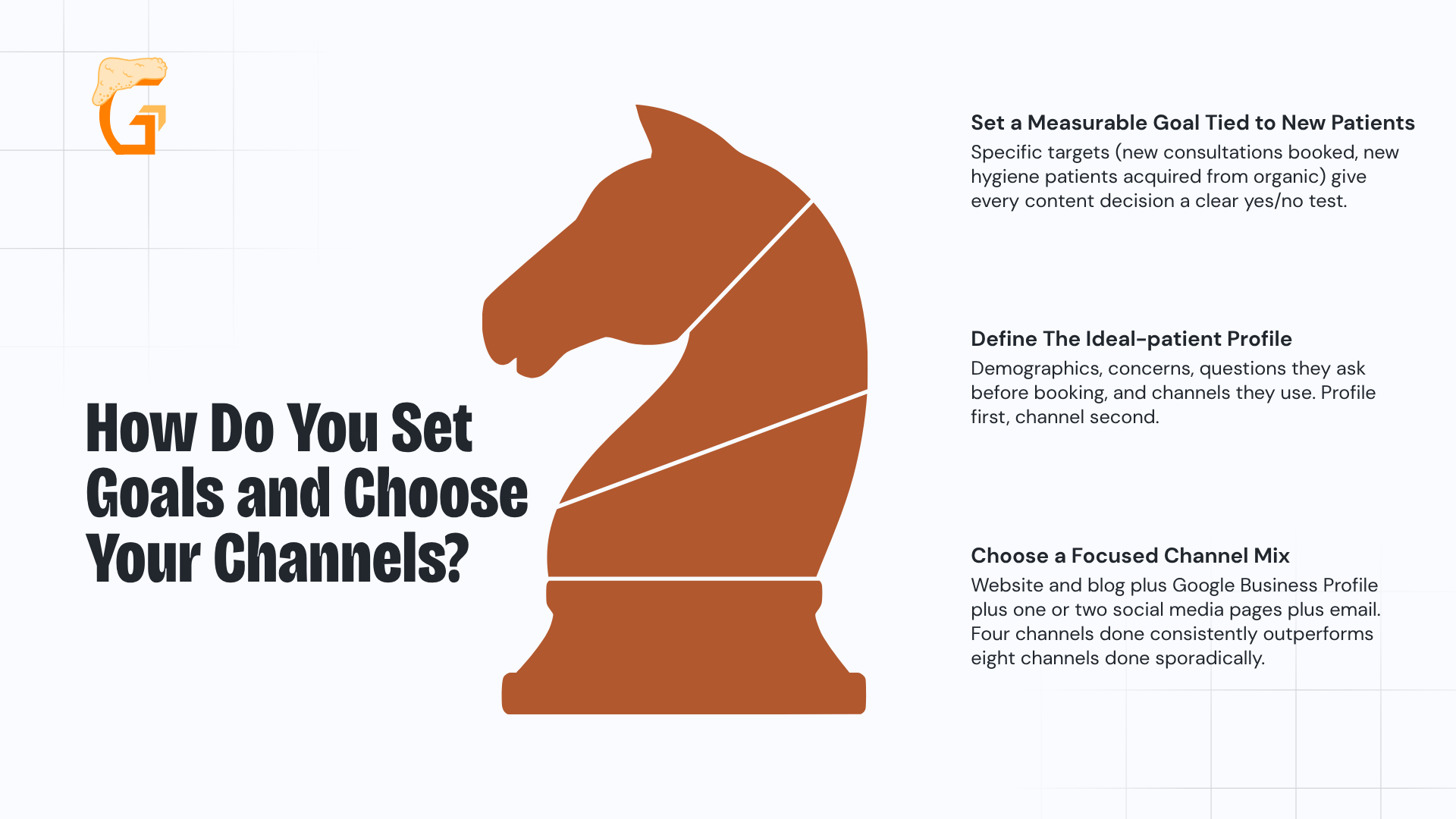
Three steps to get the foundation right:

  • Set a measurable goal tied to new patients: Specific targets (new consultations booked, new hygiene patients acquired from organic) give every content decision a clear yes/no test.
  • Define the ideal-patient profile: Demographics, concerns, questions they ask before booking, and channels they use. Profile first, channel second.
  • Choose a focused channel mix: Website and blog plus Google Business Profile plus one or two social media pages plus email. Four channels done consistently outperforms eight channels done sporadically.

A few channels executed consistently will out-produce being everywhere occasionally – especially for a time-strapped practice where the dentist or a small dental team handles production.

Tie every goal to booked appointments, not impressions, and channel selection becomes straightforward.

A content mapping framework from CausalFunnel recommends building the audience persona and goals before assigning content to any channel.

How Do You Map Topics to the Patient Funnel and Calendar?

A content calendar built around the patient journey produces better results than one built around publishing frequency alone.

Map topics to the four journey stages first, then assign them to a cadence the practice can actually sustain.

Each stage has a distinct job:

  • Awareness: Oral-health tips, office tours, and dentist-authored posts that introduce the practice to patients who do not yet know it exists.
  • Evaluation: FAQs, treatment comparisons, and procedure cost guides that help patients move from “considering it” to scheduling.
  • Conversion: Case galleries, first-visit explainers, and a clear booking step that close the gap between interest and action.
  • Retention: Recall reminders and patient education newsletters that keep existing patients returning on schedule.
  • Calendar structure: Date, topic, format, funnel stage, channel, status, and the KPI for each piece. A StoryChief content calendar guide recommends treating this as a living document reviewed against results regularly.

A realistic starting cadence – two to four blog posts per month, two to three short videos per month, two to three social posts per week, and a quarterly newsletter.

Consistency over volume, every time.

How Do You Produce Content Efficiently and Measure It?

Consistency is the output that matters most – and for a small practice team, it comes from working smarter, not publishing more.

Batch production and deliberate repurposing make a regular cadence achievable.

Measurement should track new patients, not output volume.

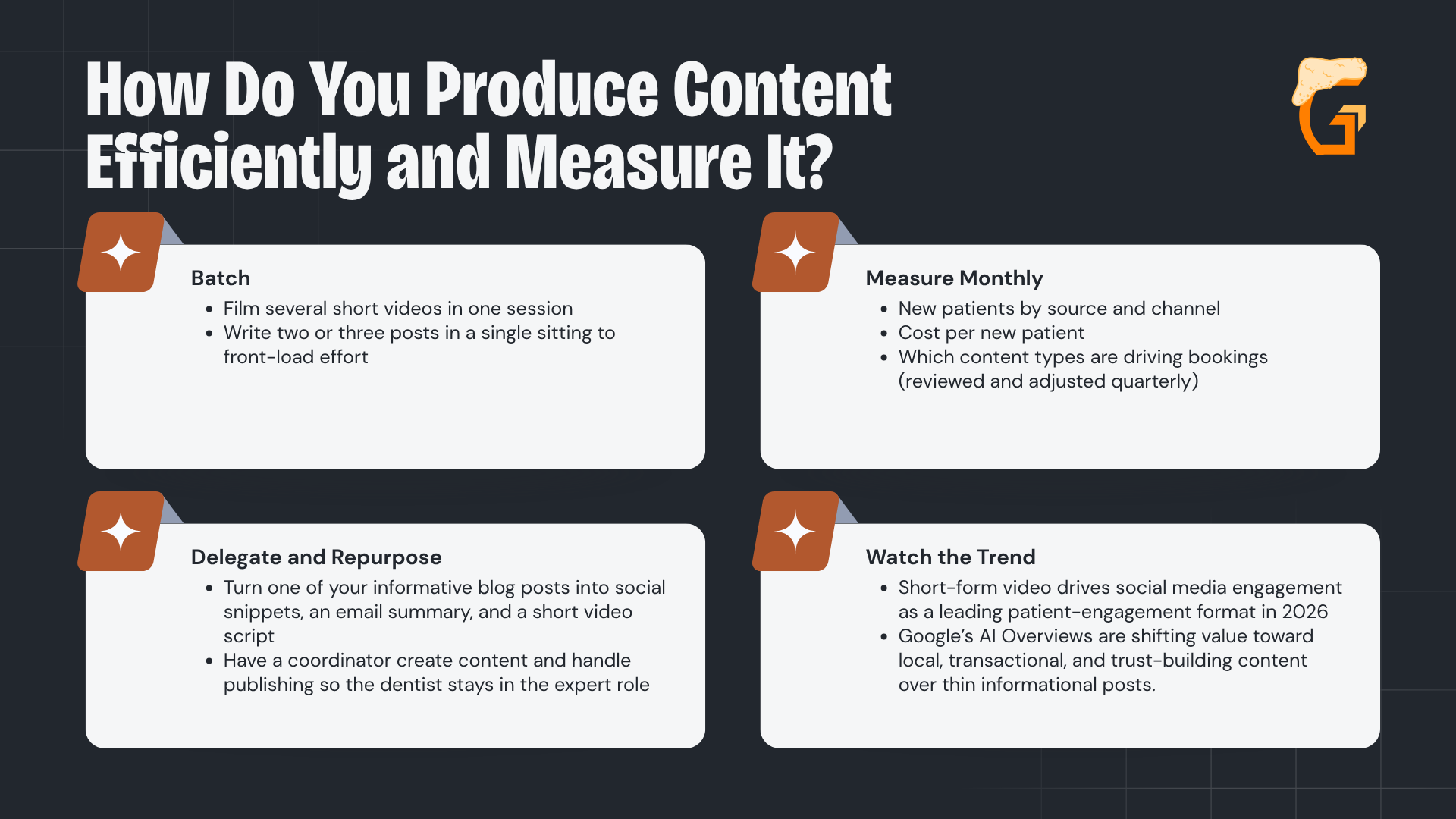
Four principles to run by:

  • Batch: Film several short videos in one session; write two or three posts in a single sitting to front-load effort.
  • Delegate and repurpose: Turn one of your informative blog posts into social snippets, an email summary, and a short video script. Have a coordinator create content and handle publishing so the dentist stays in the expert role.
  • Measure monthly: New patients by source and channel, cost per new patient, and which content types are driving bookings – reviewed and adjusted quarterly.
  • Watch the trend: Short-form video drives social media engagement as a leading patient-engagement format in 2026, and Google’s AI Overviews are shifting value toward local, transactional, and trust-building content over thin informational posts.

Repurposing one asset across formats keeps a small practice consistent without burning out the team.

Measuring by new patients, patient loyalty, and cost per new patient (rather than page views) keeps the plan pointed at the outcomes that actually matter.

How Can Growth Saloon Help Your Dental Practice Grow?

Growth Saloon is a Chicago-based digital marketing agency built to help practices in the dental industry attract more patients and grow through performance-driven digital marketing.

Mike Lowe and the Growth Saloon team specialize in dental digital marketing, including SEO, web design, conversion rate optimization, and marketing attribution – working alongside your practice to build a measurable digital presence that generates qualified patient inquiries, not just website traffic.

From ranking for high-intent local search terms to converting site visitors into booked appointments, Growth Saloon focuses on results that make a practice stand out at every stage of the patient acquisition funnel.

Practice owners and marketing managers get clear visibility into exactly which channels are driving new patient growth.

We know that every open appointment slot has a real cost.

Every decision we make is built around one outcome – helping your practice fill more of them.

Meet the Founder of Growth Saloon

Meet the founder and lead strategist at Growth Saloon – Mike Lowe:

  • As founder and CEO of Growth Saloon, Mike brings years of hands-on experience in SEO strategy, CRO, web design, and marketing attribution for service-based businesses competing in local and regional markets.
  • Based in Chicago and working with practices across the country, Mike has built and managed digital growth campaigns for businesses competing in some of the most contested search markets in the country.
  • Growth Saloon’s data-driven approach to local SEO and patient acquisition helps dental practices turn their websites into their highest-performing new patient channel.

What Does Working With Growth Saloon Look Like?

Growth Saloon operates as a dedicated extension of your marketing team – not a vendor that disappears after onboarding.

Every engagement includes direct access to Mike and the team, transparent reporting tied to actual patient acquisition outcomes, and digital marketing strategies tailored to your specific services and local market.

Whether you’re looking to rank for high-value procedures, improve your site’s appointment conversion rate, or finally get clarity on where your new patients are actually coming from, Growth Saloon builds the strategy and does the work.

Growth Saloon helps dental practices build the kind of digital presence that consistently generates qualified new patient inquiries – not just clicks.

Contact our team today to find out how our dental marketing services can lower your cost per new patient and grow your practice.

FAQ
Author

Who is Mike Lowe?

Mike Lowe is a digital marketing strategist and the founder of Growth Saloon, where he specializes in helping businesses cut through the noise with high-converting email strategies and SEO.

With a focus on “organic storytelling,” Mike combines over a decade of agency experience with a passion for helping brands build genuine trust with their audience.

When he’s not optimizing subject lines or scaling SaaS companies, he’s likely sharing insights on how to transform cluttered inboxes into meaningful connection points for online marketers.

Related content
Resources for Dentists

Every resource we’ve published for Dentists, in one place:

Ready to turn your website traffic into real growth?

You’ve read the strategy now let Growth Saloon help you put it into action.

Get a free SEO audit and see what’s holding your website back from ranking, converting, and growing. 

Let's Chat

Let’s discuss your online marketing goals! We’re quick to respond, so we’ll be in touch shortly to set up a time to chat.