

Updated:July 14th, 2026

How to Earn Dental Backlinks in 2026

Written by

Mike Lowe

Reviewed by

Taylor Coteus

Key takeaways

  • Dental backlinks are links from other websites that act as third-party endorsements, and BrightLocal's 2026 Local Search Ranking Factors confirms they account for roughly 15% of local ranking weight, making them one of the top off-page signals for map pack and organic placement.
  • A high-quality dental backlink comes from a topically or locally relevant site with real editorial context, and a single link from a regional health publication or local news outlet typically outperforms dozens of generic directory links because it satisfies every quality signal at once.
  • Most dental practices reach page one with 20 to 40 quality referring domains in less competitive cities and 60 to 100 or more in larger markets, with a practical monthly target of 3 to 5 new links to build a strong referring-domain profile over time.

Why Don't Dental Backlinks Get the Attention They Deserve?

Dental backlinks are one of the most consistently underinvested areas in dental SEO – and practices that ignore them are often the ones wondering why a competitor with a weaker website still outranks them in local search.

Most dentists invest in their site design and Google Business Profile to strengthen the dental practice’s online presence, do everything they’re told to do on-page, and still sit behind less polished competitors in the map pack.

The gap is almost always off-page authority: the web of incoming links that lifts your standing in local search results and tells Google other sites vouch for yours.

How to Earn Dental Backlinks

The challenge is that link building for dental practices doesn’t work the way most providers sell it.

Cheap directory spam moves the needle briefly, if at all.

What actually builds lasting local authority is acquiring quality backlinks through foundational citation work, genuinely linkable content, and real outreach to local and industry publications – executed consistently over time.

This guide covers what separates a high-quality dental backlink from a weak one, how much building them costs in 2026, a step-by-step playbook for earning links, how local backlinks feed near-me rankings, and how to spot toxic links before they become a problem.

Growth Saloon helps dental practices build the kind of digital presence that consistently generates qualified new patient inquiries – not just clicks.

Contact our team today to find out how our dental marketing services can lower your cost per new patient and grow your practice.

What Are Dental Backlinks and Why Do They Matter?

Dental backlinks are links from other websites to your dental practice’s site.

Search engines treat them as trust signals that raise authority and local rankings.

Every backlink for your dental site is a third-party endorsement your practice cannot give itself.

Google uses those external links and endorsements to gauge how trustworthy and relevant your site is relative to every other dental practice competing for the same local positions.

Google Search Central – Search Essentials confirms that links are the mechanism Google uses to discover and evaluate pages across the web – and inbound links from other sites are how your practice earns that external credibility.

What Is a Dental Backlink in Plain Terms?
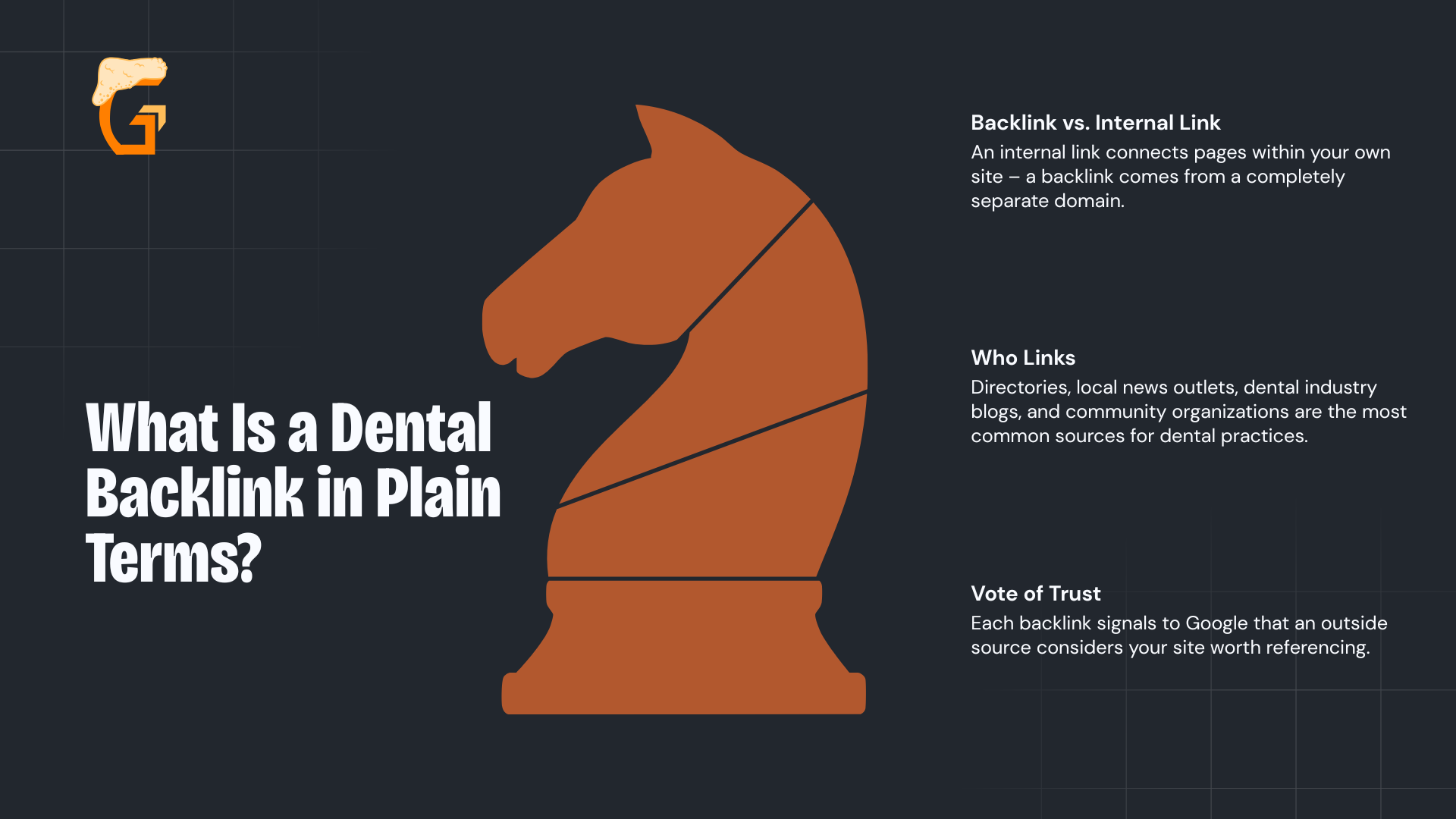
A dental backlink is a link from another website pointing to your practice site – and the activity of earning those links is called link building.

The core distinctions:

  • Backlink vs. internal link: An internal link connects pages within your own site – a backlink comes from a completely separate domain.
  • Who links: Directories, local news outlets, dental industry blogs, and community organizations are the most common sources for dental practices.
  • Vote of trust: Each backlink signals to Google that an outside source considers your site worth referencing.

That outside endorsement carries weight precisely because it is not self-generated – it takes a third party’s judgment to link to your practice, and Google treats that as meaningful evidence of authority.

Why Do Backlinks Matter for Dental SEO Rankings?

Backlinks are among the strongest off-page signals for a dental website’s SEO and where a practice appears in local and organic results.

The ranking mechanics:

  • Map pack and organic results: Links feed both the Google Maps pack and the standard organic listings on search engine results pages below it.
  • Top ranking factor: Links rank alongside content and on-page optimization as one of the leading signals search engines evaluate.
  • Compounding authority: Quality links build a dental website’s authority over time, meaning early investment keeps paying off months later.

BrightLocal’s 2026 Local Search Ranking Factors weights links at roughly 15% of local ranking importance (meaningful on its own, and most effective when paired with strong on-page work and a complete Google Business Profile).

Growth Saloon helps dental practices build the off-page authority that moves them past competitors in local search – and keeps them there.

Contact our team today to learn how our dental backlink building services can generate more qualified new patient inquiries for your practice.
What Makes a High-Quality Dental Backlink?

A high-quality dental backlink is topically and locally relevant, comes from an authoritative referring domain, and sits in editorial content rather than a low-trust list.

Not all backlinks carry equal weight.

A link from relevant websites like a regional health publication or a local news site tells Google something different than a link from a generic directory with thousands of unrelated listings.

Ahrefs identifies relevance as the single most important quality signal (a link from a page on a similar topic is worth more than one from an unrelated source, regardless of that source’s overall size).

What Signals Make a Backlink High Quality?

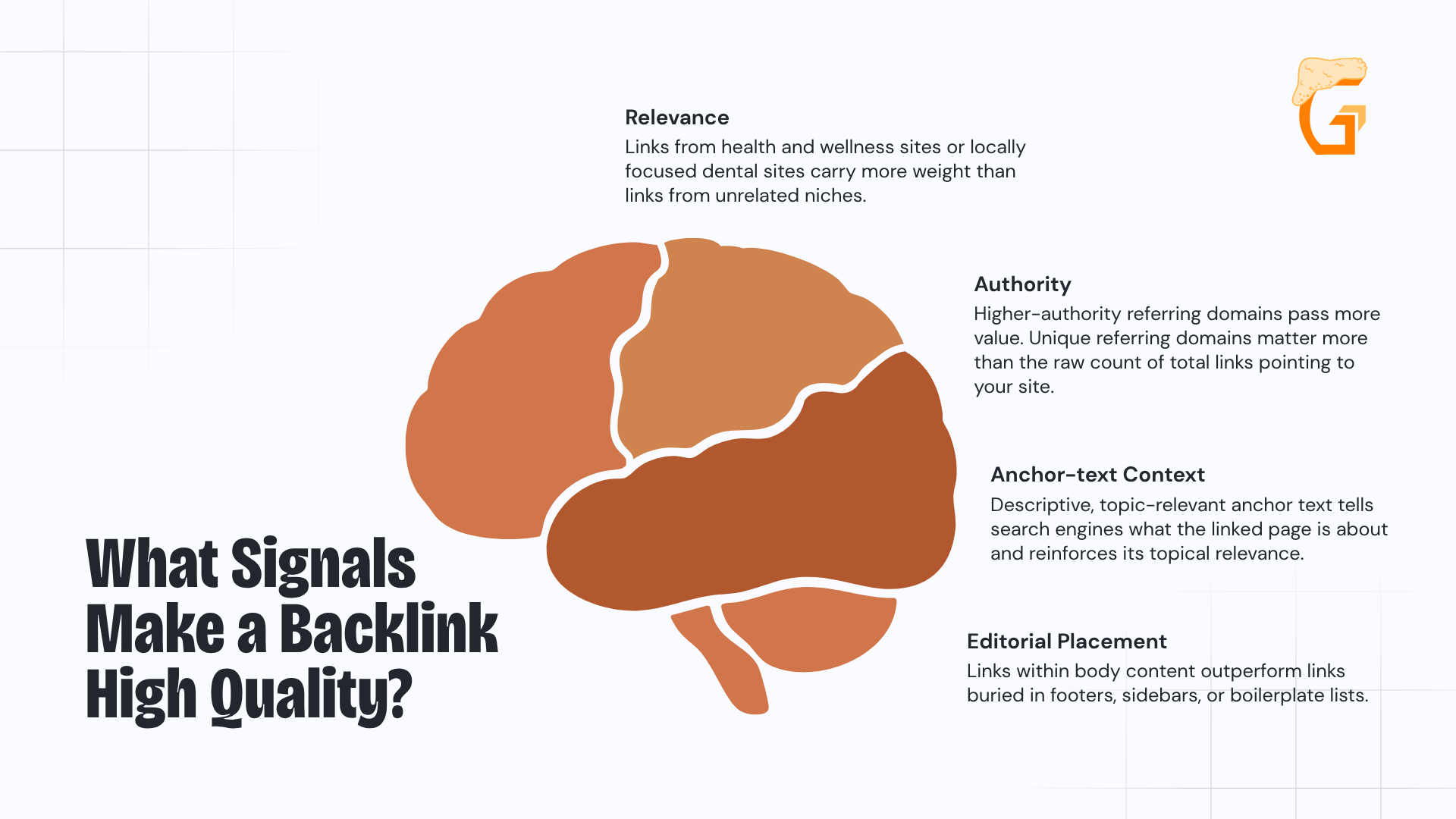
Four signals grade a dental backlink: relevance, referring-domain authority, anchor-text context, and editorial placement.

The four quality signals:

  • Relevance: Links from health and wellness sites or locally focused dental sites carry more weight than links from unrelated niches.
  • Authority: Higher-authority referring domains pass more value. Unique referring domains matter more than the raw count of total links pointing to your site.
  • Anchor-text context: Descriptive, topic-relevant anchor text tells search engines what the linked page is about and reinforces its topical relevance.
  • Editorial placement: Links within body content outperform links buried in footers, sidebars, or boilerplate lists.

In dentistry, a single link from a regional health publication or local news outlet typically outperforms dozens of generic directory links because it satisfies every quality signal at once: relevant topic, authoritative domain, real editorial context.

Are Directory Citations or Editorial Links Better?

Both have a role (citations build the local foundation, editorial links drive domain authority) and neither is a direct Google scoring metric on its own.

How each type works:

  • Directory citations: Reinforce local relevance and NAP (name, address, phone) consistency, which feeds the Google map pack directly.
  • Editorial in-content links: Pass more authority because a real publisher placed them voluntarily inside actual content.
  • Domain Authority: Moz’s Domain Authority score is a third-party predictive metric (not a Google ranking factor) and is only useful as a comparative tool when evaluating link prospects.

The practical sequence: secure the citation base first so local trust signals are solid, then invest in earning editorial links from health, community, and local media sites.

Use Domain Authority to compare prospects against each other, not as a number to chase.

How Much Does Dental Link Building Cost?

Dedicated dental link building runs roughly $200 to $1,500+ per month, while broader dental SEO packages that include links typically cost $750 to $2,000 monthly.

Pricing spans a wide range because spend should scale with local competition, and dental clients in denser markets typically commit more.

A single-location practice in a mid-size city has different needs than a multi-location group competing in a top-ten metro.

The figures below are 2026 market estimates (not guaranteed outcomes) and serve as a planning baseline, not a price floor or ceiling.

How Much Should Dentists Budget for Link Building?

Link-building retainers and broader SEO packages sit in distinct cost bands worth knowing before committing to a program.

The 2026 cost landscape:

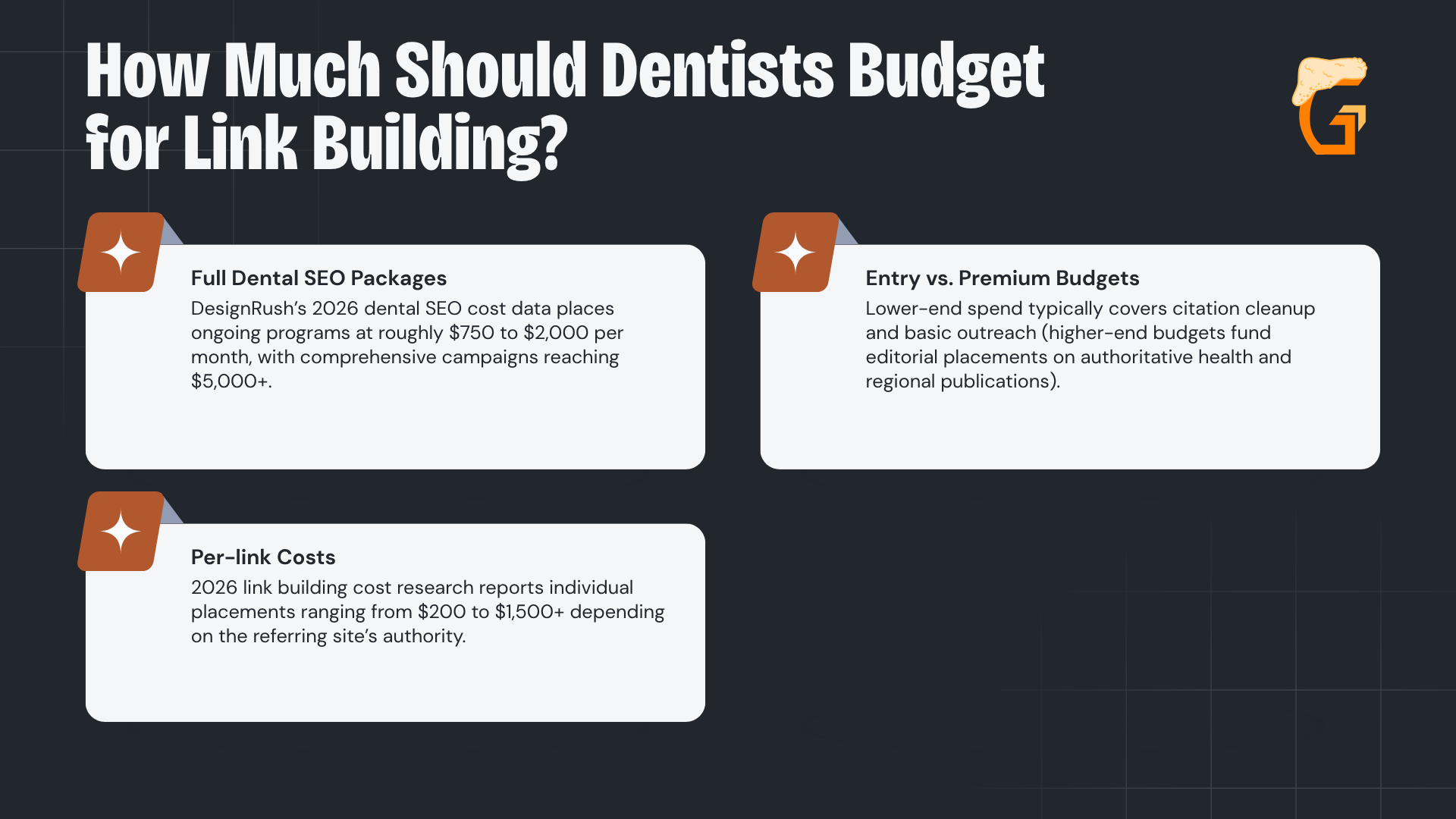
  • Full dental SEO packages: DesignRush’s 2026 dental SEO cost data places ongoing programs at roughly $750 to $2,000 per month, with comprehensive campaigns reaching $5,000+.
  • Per-link costs: 2026 link building cost research reports individual placements ranging from $200 to $1,500+ depending on the referring site’s authority.
  • Entry vs. premium budgets: Lower-end spend typically covers citation cleanup and basic outreach – higher-end budgets fund editorial placements on authoritative health and regional publications.

Budget should map to how competitive your local market is.

A practice in a smaller city can make real progress at the lower end of these ranges – practices competing in dense metro areas generally need sustained investment to move the needle.

Is Cheap Link Building Worth It?

A few high quality backlinks consistently outperform hundreds of low-quality ones – and bargain bulk-link packages carry real risk.

Google’s spam policies explicitly prohibit buying or selling links that pass PageRank, meaning cheap link schemes can trigger algorithmic devaluation or a manual penalty rather than a rankings lift.

For practices in less competitive markets, a staffer handling citations, local outreach, and sponsorship requests in-house is a viable starting point.

Once you plateau or move into a competitive market, scaling your link building efforts justifies bringing in a dedicated partner.

Growth Saloon works with dental practices to build link profiles that drive real new patient growth – not just rankings movement.

Reach out today to find out how our dental SEO link-building programs are structured and what results practices in your market are seeing.

How’s your SEO going?

Enter your website URL below to get a free comprehensive SEO audit.

The audit includes:

How Do You Earn Dental Backlinks Step by Step?

Earn dental backlinks by claiming directory citations, creating linkable content, pitching guest posts and expert quotes, and replicating competitors’ best links.

The playbook follows a sequence: lock the local business directories foundation first, then build content assets worth linking to, then scale outreach.

Skipping straight to outreach without the foundation in place means pitching for links that land on a thin domain – reducing how much authority each new link actually transfers to the pages that matter.

How Do You Build Foundational Directory Citations?

Foundational local business citations are the first and easiest links any practice can secure, and getting them right sets up every tactic that follows.

The core citation layer:

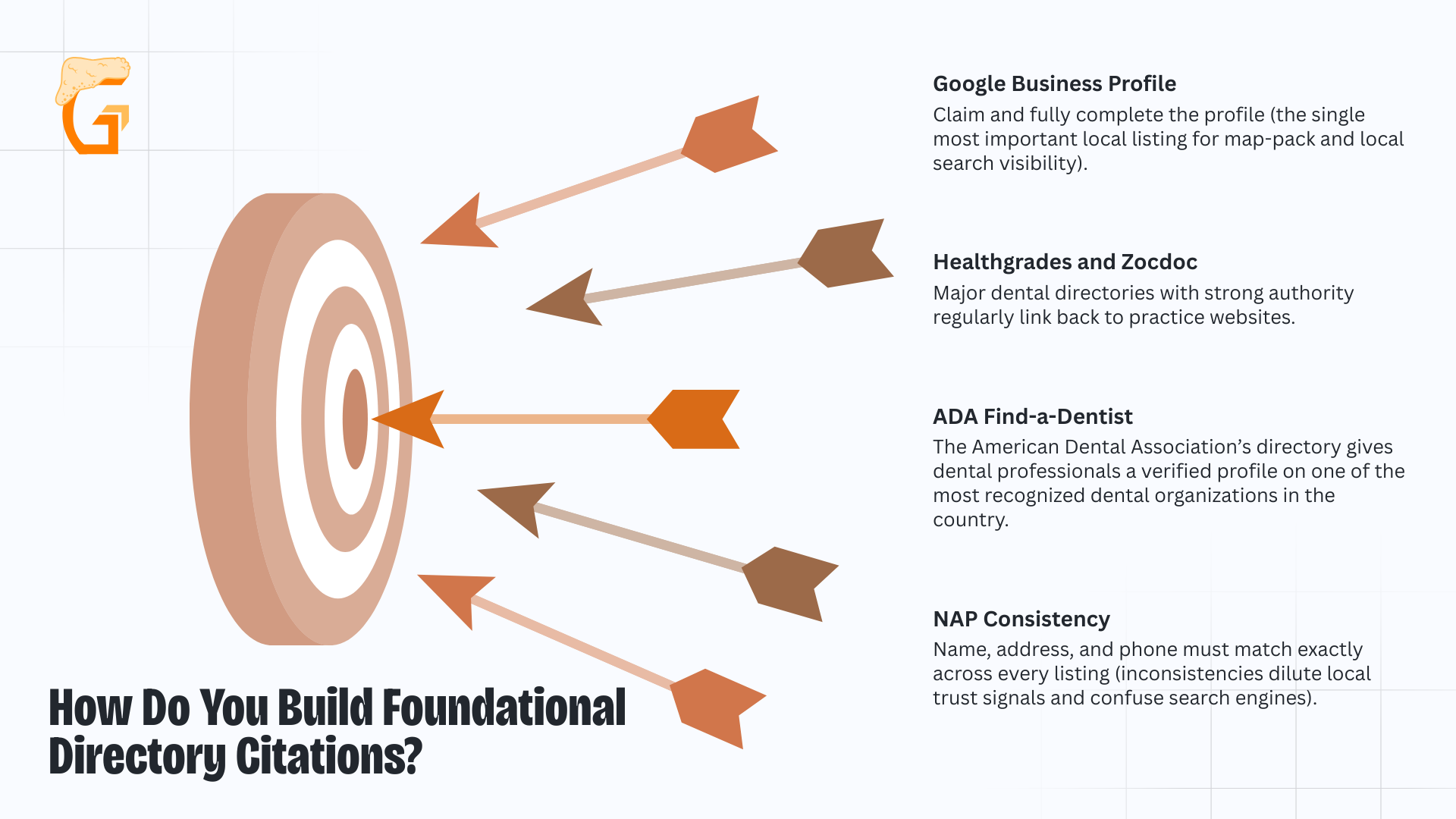
  • Google Business Profile: Claim and fully complete the profile (the single most important local listing for map-pack and local search visibility).
  • Healthgrades and Zocdoc: Major dental directories with strong authority regularly link back to practice websites.
  • ADA Find-a-Dentist: The American Dental Association’s directory gives dental professionals a verified profile on one of the most recognized dental organizations in the country.
  • NAP consistency: Name, address, and phone must match exactly across every listing – inconsistencies dilute local trust signals and confuse search engines.

Consistent profiles across these core directories build the local trust base that makes every subsequent editorial link more effective.

Get this layer right before launching any outreach campaign.

What Content Earns Dental Backlinks Naturally?

No link campaign sustains itself unless you create link worthy content other sites actually want to reference.

Assets that attract links:

  • Linkable content types: Treatment cost guides, emergency care guides, printable patient checklists, and pieces on dental health trends give journalists, bloggers, and community sites something concrete to cite.
  • Guest posting: Health, wellness, and oral health blogs regularly accept contributor articles – Ahrefs’ guest blogging guide recommends pitching genuinely useful, non-promotional content matched to the host site’s audience.
  • Internal links: A well-structured internal linking architecture distributes authority from newly earned backlinks across the practice site.

Original, useful content earns editorial links passively over time and gives every outreach pitch something worth linking to – shifting the ask from “please link to us” to “here’s a resource your readers will find useful.”

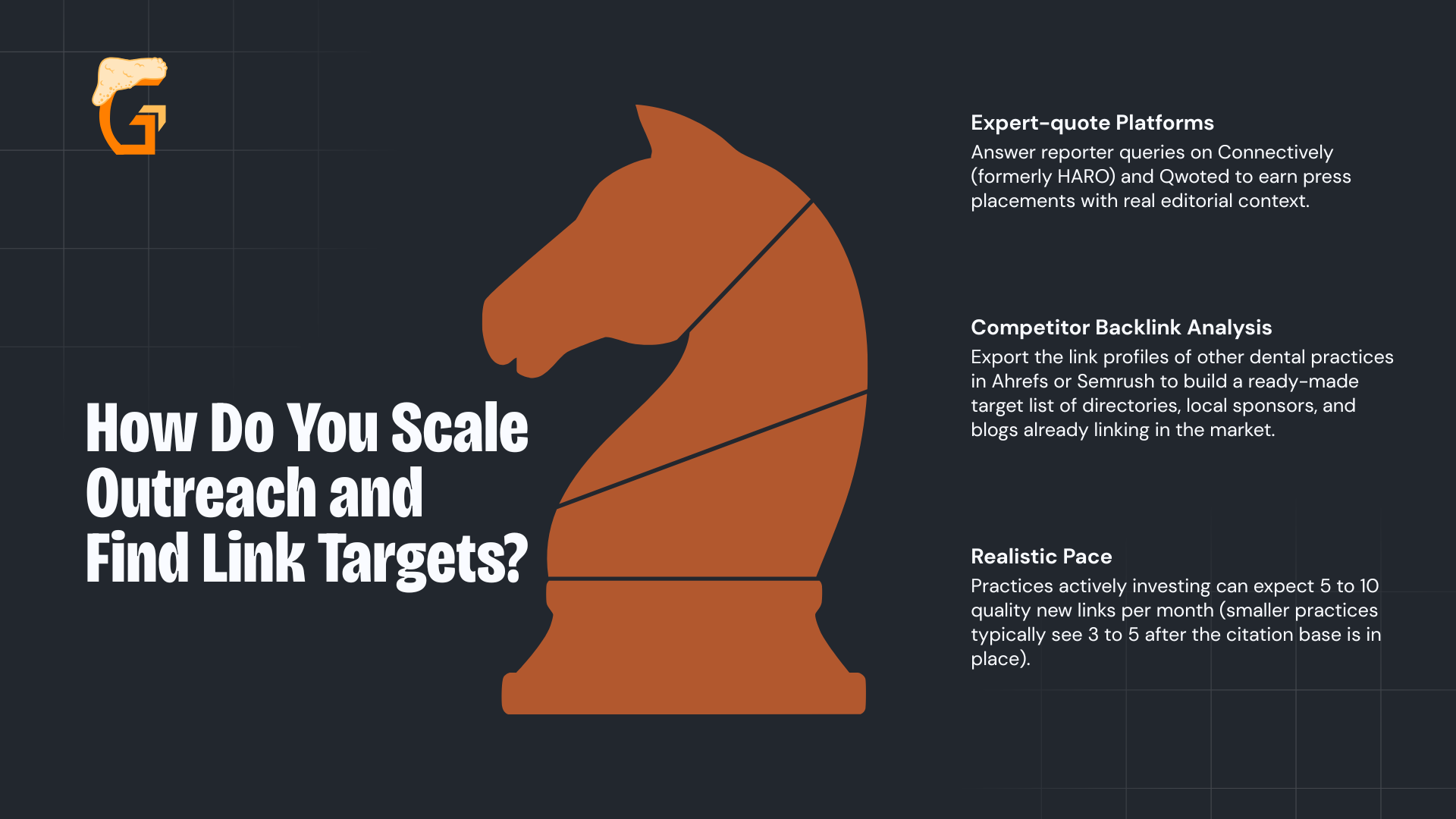
How Do You Scale Outreach and Find Link Targets?

Scaling outreach comes down to two moves: feeding journalist platforms and mining competitors’ existing link profiles.

The scaling toolkit:

  • Expert-quote platforms: Answer reporter queries on Connectively (formerly HARO) and Qwoted to earn press placements with real editorial context.
  • Competitor backlink analysis: Export the link profiles of other dental practices in Ahrefs or Semrush to build a ready-made target list of directories, local sponsors, and blogs already linking in the market.
  • Realistic pace: Practices actively investing can expect 5 to 10 quality new links per month – smaller practices typically see 3 to 5 after the citation base is in place.

Competitor link mining removes the guesswork – it surfaces link building opportunities across local sponsorships, community blogs, and regional directories already open to linking to practices like yours.

Growth Saloon runs this full playbook for dental practices looking to accelerate that timeline – from citation foundation through editorial outreach.

Get in touch to see how working with a dental link-building partner can lower your cost per new patient and build lasting authority.

How Do You Build Local Backlinks for Near-Me Rankings?

Build local backlinks through community sponsorships, local media coverage, chamber of commerce membership, and partnerships with other local businesses to signal local relevance.

For a single-location practice, high quality local backlinks are the highest-leverage link type – they combine authority signals with geographic relevance, which feeds the map pack and near-me results directly.

BrightLocal’s expert research identifies sponsoring local charities and building relationships with nearby businesses as the top local link building tactics used by SEO experts.

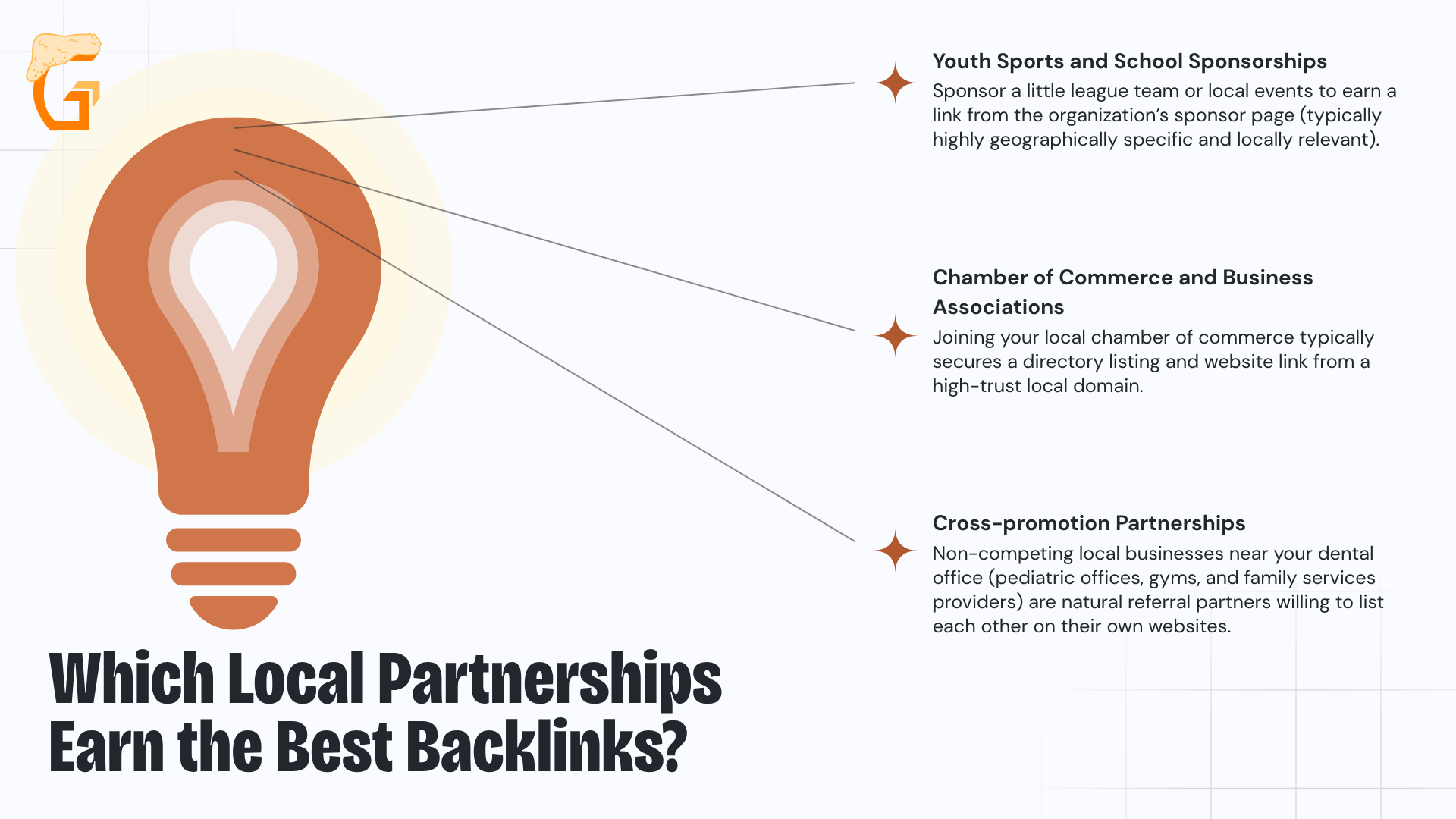
Which Local Partnerships Earn the Best Backlinks?

The strongest local links come from real ties to your local community, not purchased placements.

High-value local link sources:

  • Youth sports and school sponsorships: Sponsor a little league team or local events to earn a link from the organization’s sponsor page (typically highly geographically specific and locally relevant).
  • Chamber of commerce and business associations: Joining your local chamber of commerce typically secures a directory listing and website link from a high-trust local domain.
  • Cross-promotion partnerships: Non-competing local businesses near your dental office (pediatric offices, gyms, and family services providers) are natural referral partners willing to list each other on their own websites.

Each partnership should translate into a real listing, mention, or sponsor page that links back to the dental practice’s website.

The link is a byproduct of a genuine local relationship, which is exactly the pattern Google’s prominence signals are designed to reward.

How Do Local Links Boost Near-Me Visibility?

Local links feed the prominence signal Google uses to rank both the map pack and near-me search results.

How local links work in practice:

  • Local media outreach: Pitch city news outlets and community bloggers with seasonal hooks (back-to-school checkup guides, emergency dental care tips) to earn editorial links with real geographic context.
  • Near-me and map-pack lift: BrightLocal’s 2026 Local Search Ranking Factors places links at roughly 15% of local ranking weight, with geographically relevant sites strengthening map-pack positions in particular.
  • Google Business Profile compounding: Local backlinks from neighborhood news outlets and local blogs reinforce the same location signals already present in a well-optimized Google Business Profile, amplifying both.

A link from a city news outlet or neighborhood blog post tells Google the practice belongs to that location, strengthening the dental practice’s online visibility in a way no amount of internal optimization can replicate on its own.

Growth Saloon helps dental practices earn the local authority signals that push listings into the map pack and near-me results where new patients are searching.

Contact our team to find out how a targeted local dental backlink strategy can strengthen your visibility in the neighborhoods you serve.

What Are Toxic Backlinks and How Do You Avoid Penalties?

Toxic backlinks come from link schemes like bought links, PBNs, and exact-match anchor spam.

These trigger Google devaluation or manual actions visible in Search Console.

Most practices that stick to white-hat methods never encounter a penalty.

The risk comes from shortcuts: buying potentially harmful links, joining link networks, or hiring providers who use bulk tactics at scale.

Google’s spam policies define any links intended to manipulate rankings as link spam, regardless of how they are packaged or marketed by the provider offering them.

Which Backlinks Are Considered Toxic or Spammy?

Google’s spam framework defines link schemes as any attempt to manipulate PageRank through artificial linking – including buying or selling links that pass PageRank, participating in private blog networks (PBNs), link farms, and excessive reciprocal linking arrangements.

Repeating exact-match money-keyword anchor text across many referring pages (for example, “best dentist Chicago” on every site pointing to yours) – is an additional red flag that signals manipulation to Google’s algorithms.

How Do You Audit and Disavow Bad Links?

Google handles most junk links through algorithmic devaluation (meaning they are ignored rather than penalized) but a manual action is more serious and appears directly in Google Search Console.

Audit your backlink profile periodically using Search Console, Ahrefs, or Semrush to spot patterns like clusters of spammy referring domains, broken links, or sudden link spikes.

The disavow tool, per Google’s own guidance, is reserved for manual actions or self-initiated bad links that cannot be removed at the source.

Most practices running a consistent white-hat link building program never need it.

Growth Saloon builds clean, penalty-proof link profiles for dental practices that compound in value month over month – without the risk that cheap link schemes carry.

Reach out today to learn how our approach to earning quality dental backlinks translates into more new patient inquiries for your practice.
How Can Growth Saloon Help Your Dental Practice Grow?

Growth Saloon is a Chicago-based digital marketing agency built to help dental practices attract more patients and grow their practice through performance-driven digital marketing.

Mike Lowe and the Growth Saloon team specialize in search engine optimization, web design, conversion rate optimization, and marketing attribution – working alongside your practice to build a measurable digital presence that generates qualified patient inquiries, not just website traffic.

From ranking for high-intent terms like dental implants to converting site visitors into booked appointments, Growth Saloon focuses on results at every stage of the patient acquisition funnel.

Practice owners and marketing managers get clear visibility into exactly which channels are driving potential patients and new patient growth.

We know that every open appointment slot has a real cost.

Every decision we make is built around one outcome – helping your practice fill more of them.

Meet the Founder of Growth Saloon

Meet the founder and lead strategist at Growth Saloon – Mike Lowe:

  • As founder and CEO of Growth Saloon, Mike brings years of hands-on experience in SEO strategy, CRO, web design, and marketing attribution for service-based businesses competing in local and regional markets.
  • Based in Chicago and working with practices across the country, Mike has built and managed digital growth campaigns for businesses competing in some of the most contested search markets in the country.
  • Growth Saloon’s data-driven approach to local SEO and patient acquisition helps dental practices turn their websites into their highest-performing new patient channel.

What Does Working With Growth Saloon Look Like?

Growth Saloon operates as a dedicated extension of your marketing team – not a vendor that disappears after onboarding.

Every engagement includes direct access to Mike and the team, transparent reporting tied to actual patient acquisition outcomes, and strategies tailored to your specific dental services and local market.

Whether you’re looking to rank for high-value dental procedures, improve your site’s appointment conversion rate, or finally get clarity on where your new patients are actually coming from, Growth Saloon builds the strategy and does the work.

Growth Saloon helps dental practices build the kind of digital presence that consistently generates qualified new patient inquiries – not just clicks.

Contact our team today to find out how our dental marketing services can lower your cost per new patient and grow your practice.

FAQ
Author

Who is Mike Lowe?

Mike Lowe is a digital marketing strategist and the founder of Growth Saloon, where he specializes in helping businesses cut through the noise with high-converting email strategies and SEO.

With a focus on “organic storytelling,” Mike combines over a decade of agency experience with a passion for helping brands build genuine trust with their audience.

When he’s not optimizing subject lines or scaling SaaS companies, he’s likely sharing insights on how to transform cluttered inboxes into meaningful connection points for online marketers.

Related content
Resources for Dentists

Every resource we’ve published for Dentists, in one place:

Ready to turn your website traffic into real growth?

You’ve read the strategy now let Growth Saloon help you put it into action.

Get a free SEO audit and see what’s holding your website back from ranking, converting, and growing. 

Let's Chat

Let’s discuss your online marketing goals! We’re quick to respond, so we’ll be in touch shortly to set up a time to chat.