

Updated:July 22nd, 2026

AI SEO for Dentists in 2026

Written by

Mike Lowe

Reviewed by

Taylor Coteus

Key takeaways

  • AI SEO is about earning citations inside Google's AI Overviews, where an Ahrefs study found only 38% of citations now come from top-ten pages, down from 76% in July 2025, so page-one ranking no longer guarantees visibility.
  • Pages cited inside AI Overviews earn roughly 35% more organic clicks than non-cited competitors, which makes answer-first content, FAQPage schema, and 134 to 167 word answer passages worth prioritizing.
  • AI-generated dental content is safe to publish only when a licensed dentist reviews it for clinical accuracy and the page carries a named DDS byline and a last-reviewed date, because dental topics fall under Google's YMYL scrutiny.

Why Does AI SEO for Dentists Demand a Different Strategy Than What You've Been Doing?

AI SEO for dentists is not a rebranded version of the SEO you already know – it targets a fundamentally different result on the page.

Where traditional SEO chased a spot in the top-ten blue links, AI SEO targets a citation inside Google’s AI Overview panel, which now loads above maps, above ads, and above every organic listing for common dental queries.

A practice can rank #1 organically and still be absent from the answer patients read when they search to find dentists.

AI SEO for Dentists

That gap matters because the stakes on either side of it are not equal.

Pages cited inside AI Overviews earn roughly 35% more organic clicks than non-cited competitors on the same query – while practices left out of the panel see their organic click-through rate drop by more than half.

For a practice that has spent years building page-one rankings, that reality changes the calculation on almost every content and technical decision going forward.

The good news is that the same foundational work that built your organic presence – content depth, Google Business Profile quality, schema markup, review volume – is the same work that builds AI citation eligibility.

What’s new is how that content needs to be structured and how entity signals need to be maintained across the web.

Growth Saloon helps dental practices build the kind of digital presence that consistently generates qualified new patient inquiries – not just clicks.

Contact our team today to find out how our dental marketing services can lower your marketing costs per new patient and grow your practice.

What Is AI SEO for Dentists and How Is It Different From Traditional SEO?

AI SEO for dentists means optimizing to be cited in AI-generated answers, not just ranking in blue links – a shift driven by Google AI Overviews sitting above all organic results.

Where traditional SEO targeted a spot in the top-ten, AI SEO targets a citation inside the panel that now sits above everything else.

The two H3s below cover what AI SEO for dentists actually is and how its signals overlap with the fundamentals you already know.

What Does AI SEO Mean for a Dental Practice?
Traditional SEO focuses practices on one target – ranking in the top-ten blue links.

AI SEO points at a different target than traditional search engines did – a citation inside the AI-generated answer panel that loads above the map pack, above ads, and above every organic listing.

Google AI Overviews now occupy the most prominent SERP space returned for common dental queries.

Consider what this means in practice:

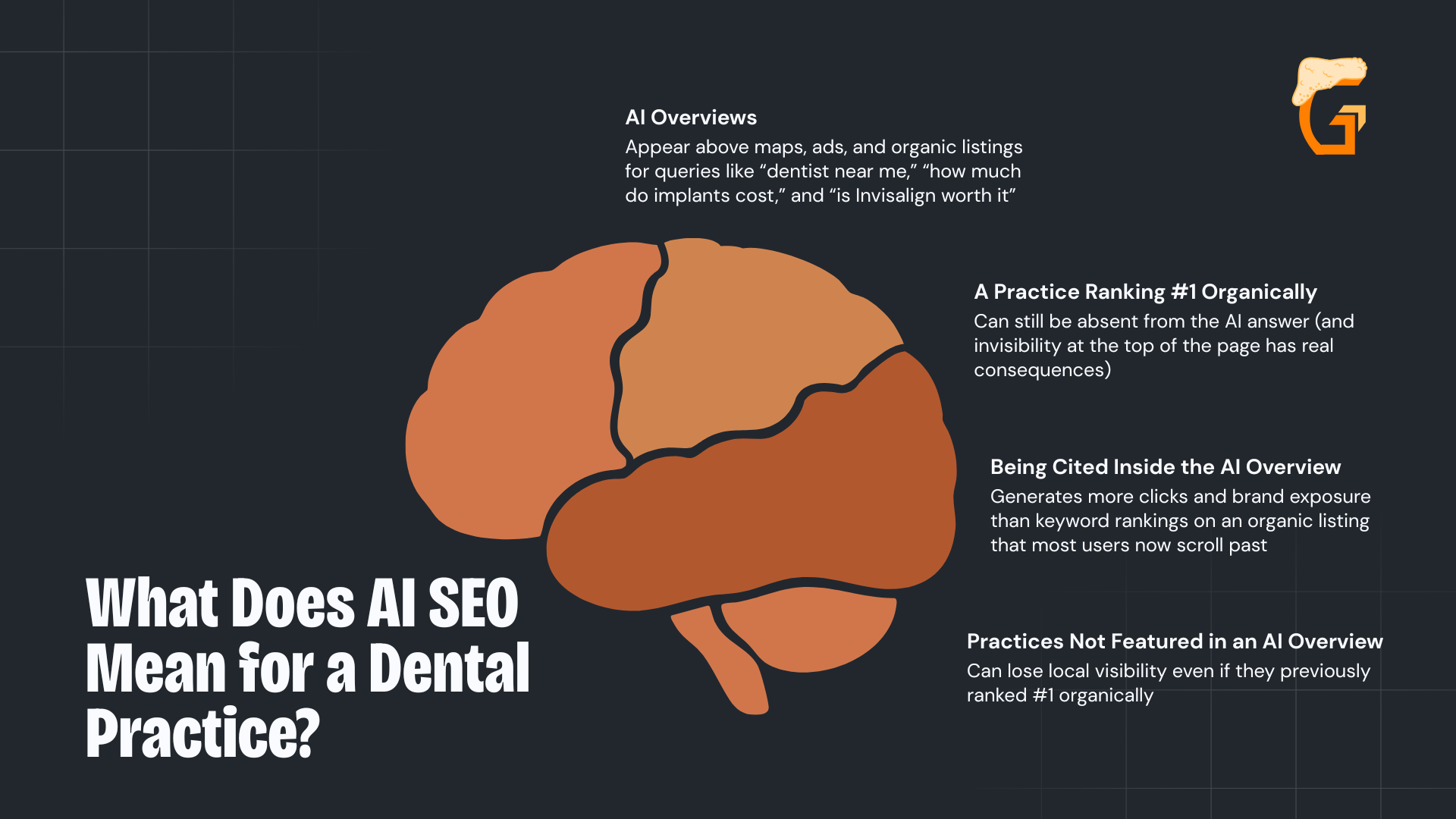
  • AI Overviews appear above maps, ads, and organic listings for queries like “dentist near me,” “how much do implants cost,” and “is Invisalign worth it”
  • A practice ranking #1 organically can still be absent from the AI answer (and invisibility at the top of the page has real consequences)
  • Being cited inside the AI Overview generates more clicks and brand exposure than keyword rankings on an organic listing that most users now scroll past
  • Practices not featured in an AI Overview can lose local visibility even if they previously ranked #1 organically

The industry term increasingly used for this discipline is GEO – Generative Engine Optimization, sometimes called answer engine optimization.

GEO and “AI SEO” describe the same shift – optimizing to be cited by AI systems, not just ranked by them.

Both terms appear across dental marketing literature; they’re interchangeable.

How Do AI Citation Signals Differ from Traditional Ranking Signals?

AI citation signals overlap heavily with the fundamentals of search engine optimization – content depth, structured data, GBP quality, review profile, entity consistency, and technical accessibility.

The same work that builds organic authority also builds AI citation eligibility.

What’s new is the machine-extraction requirement:

  • Content depth: thorough, well-sourced website content that fully answers a query earns citations; thin pages don’t
  • Structured data: schema markup lets AI parse location, the specific services mentioned on a page, and hours without guessing
  • GBP completeness: a fully built Google Business Profile is an entity signal AI systems read
  • Review profile: volume and recency confirm the practice is active and trusted
  • Entity consistency: the same name, address, phone, and services on the dental practice’s website and everywhere else AI might look
  • Machine-extractable answers: content must deliver a clear, complete answer in a self-contained passage (burying the answer in paragraph five means AI skips it)

The key implication – page-one ranking does not equal AI citation.

A practice on page one can be absent from the AI answer while web pages ranking below position five get cited – because the lower-ranked page answered the question more directly.

GEO reframes the same search optimization fundamentals around being cited by AI, not just ranked by it.
How Do Google AI Overviews Work (and What Do They Mean for Your Practice)?

Google AI Overviews generate answers above organic results using multiple sources; being included boosts practice exposure, but page-one rankings do not guarantee AI citation.

The mechanism behind that disconnect matters, because understanding it tells you exactly what to change.

This section covers how AI Overviews select sources and what the business stakes look like for practices that are cited versus those that aren’t.

How Does Google Choose Which Pages to Cite in an AI Overview?

AI Overviews, powered by Google Gemini, are AI-generated summaries that appear at the top of Google results (above maps, ads, and organic listings) and they are triggered for common dental queries including cost, candidacy, and procedure questions.

The selection mechanism is called query fan-out.

Rather than pulling from the standard ranking order, Google expands one query into multiple related sub-queries and scans the results of each.

Pages appearing most frequently across those sub-query result sets get cited.

According to an Ahrefs study corroborated by Search Engine Journal:

  • Only 38% of AI Overview citations come from top-ten pages as of February 2026 (down from 76% in July 2025)
  • 47% of citations come from pages ranking below position #5
  • The drop confirms AI Overviews operate on fundamentally different logic than the search algorithms behind traditional organic ranking
  • A page about dental implants doesn’t need to rank first (it needs to answer the query most completely and directly)

AI Overviews prioritize self-contained answer passages of roughly 134–167 words.

There is no paid path to inclusion.

Citation is earned, not bought.

What Are the Stakes of Being Cited (or Not Cited) in AI Overviews?

AI Overview citation is a high-stakes, zero-or-one outcome for a dental practice’s visibility on a given query.

The performance gap between cited and non-cited pages is significant:

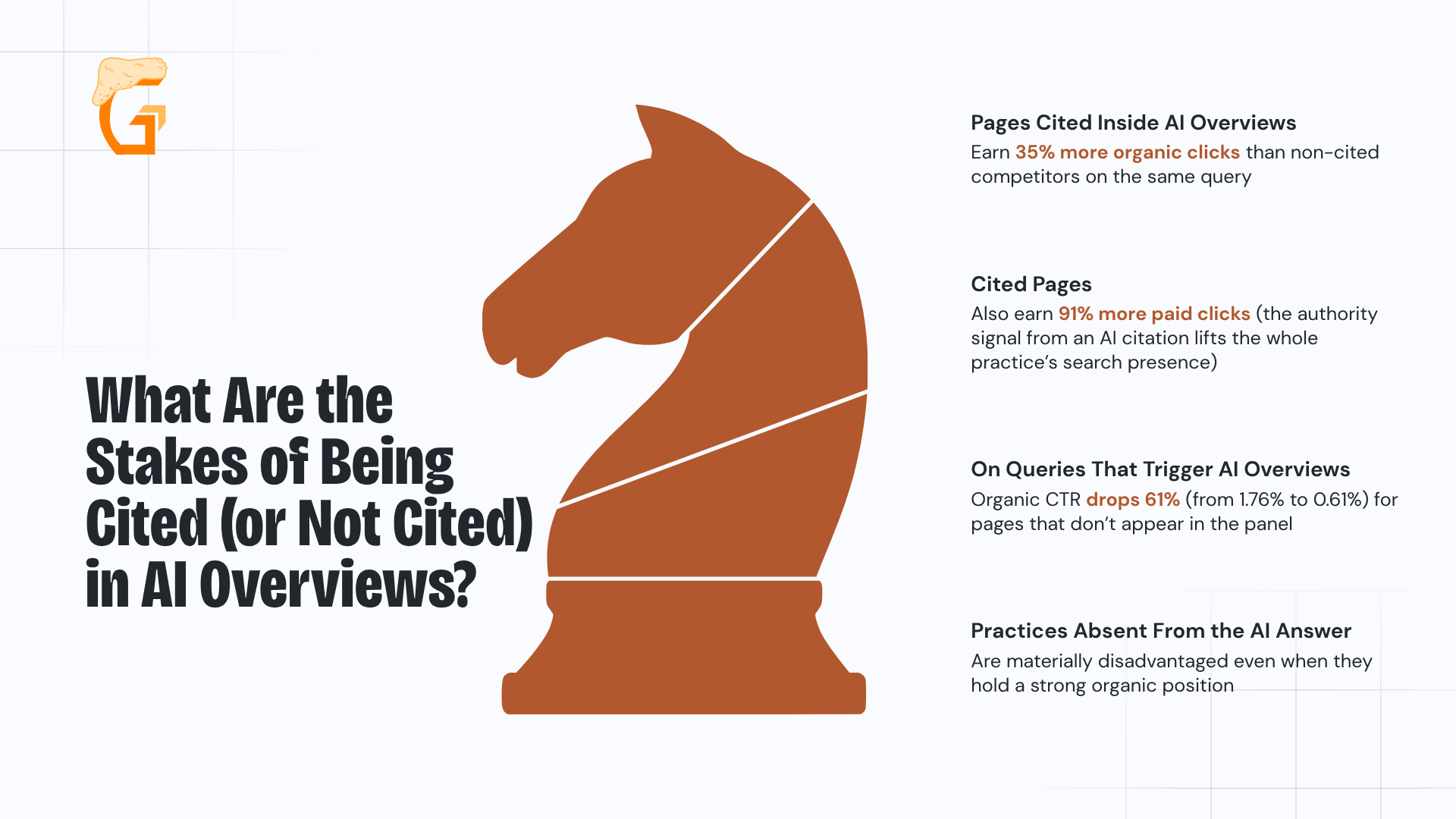
  • Pages cited inside AI Overviews earn 35% more organic clicks than non-cited competitors on the same query
  • Cited pages also earn 91% more paid clicks (the authority signal from an AI citation lifts the whole practice’s search presence)
  • On queries that trigger AI Overviews, organic CTR drops 61% (from 1.76% to 0.61%) for pages that don’t appear in the panel
  • Practices absent from the AI answer are materially disadvantaged even when they hold a strong organic position

If you’re not in the AI Overview, you’re competing for a fraction of the clicks that used to go to position one.

There is no ad spend that changes this.

Citation is earned through content quality, entity clarity, and structured data markup – which is exactly what the next two sections address.

Growth Saloon helps dental practices earn AI Overview citations through content and entity signals that generate qualified new patient inquiries – not just clicks.

Contact our team today to find out how our dental marketing services can lower your cost per new patient and grow your practice.

How Should Dental Website Content Be Structured for AI Search?

Dental content optimized for AI search leads each page with direct answers, uses question-based H2/H3 headings, includes FAQ blocks, and builds topic clusters per service.

Getting cited by AI search engines isn’t just about what you say – it’s about how quickly and clearly the machine can extract it.

This section covers the formatting rules that make pages machine-readable and the content depth strategy that builds citation authority.

How Should Each Dental Page Be Formatted for AI Extraction?

Service pages and blog posts should each open with a plain-language answer to the implicit patient question.

AI extracts the most concise complete answer it can find – content that buries the answer five paragraphs down is not extracted.

Pages with FAQPage schema markup are 3.2x more likely to appear in Google AI Overviews – a single formatting decision with a measurable citation payoff.

The full formatting checklist:

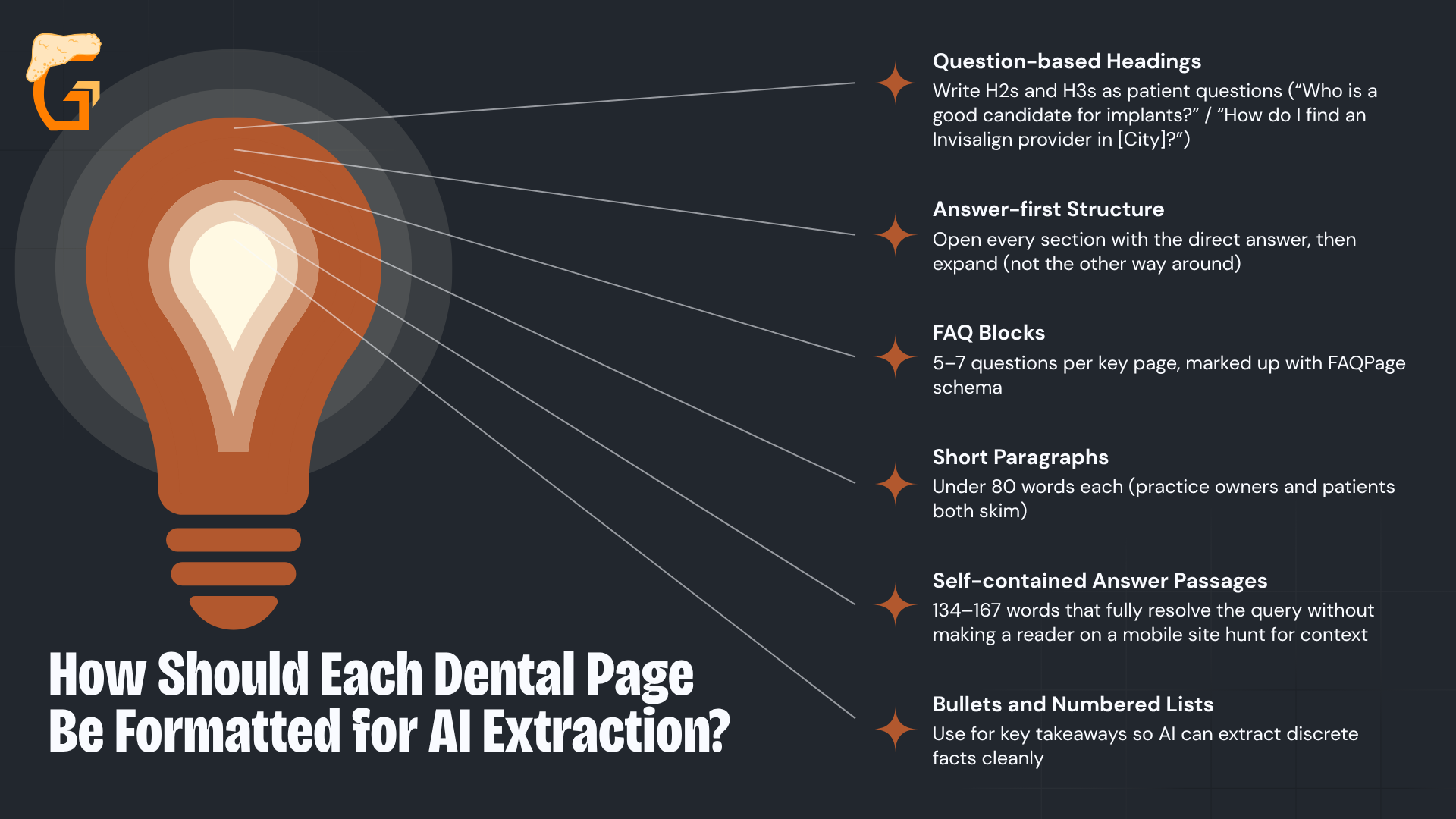
  • Question-based headings: write H2s and H3s as patient questions (“Who is a good candidate for implants?” / “How do I find an Invisalign provider in [City]?”)
  • Answer-first structure: open every section with the direct answer, then expand (not the other way around)
  • FAQ blocks: 5–7 questions per key page, marked up with FAQPage schema
  • Short paragraphs: under 80 words each; practice owners and patients both skim
  • Self-contained answer passages: 134–167 words that fully resolve the query without making a reader on a mobile site hunt for context
  • Bullets and numbered lists: use for key takeaways so AI can extract discrete facts cleanly

AI-powered search engines (Perplexity, ChatGPT, Bing Copilot) reward the same structured, question-driven format.

One formatting standard serves all of them.

How Do Topic Clusters and Local References Improve AI Citation?

Topic clusters give a service like cosmetic dentistry one pillar page plus cluster articles for costs, recovery, comparisons, and candidacy – all clearly interlinked.

AI systems trust demonstrated depth.

Depth, local references, and internal links earn that trust:

  • AI systems weight demonstrated expertise (ten well-written teeth whitening guides outperform a single thin page for citation probability)
  • Local references belong throughout service pages, so a cosmetic dentist names city and region in headings, body copy, and schema (dental AI queries carry a strong local component)
  • Internal links between the pillar and cluster pages signal topical authority to both Google and the AI systems that select citations

The self-audit method – paste any service page into an AI model and ask a patient question using only that page.

Gaps in the AI’s answer are exactly the content gaps keeping that page from being cited.

Fix those gaps and re-run the test.

Growth Saloon structures dental content so AI systems can extract and cite it, turning depth into qualified new patient inquiries – not just clicks.

Contact our team today to find out how our dental marketing services can lower your cost per new patient and grow your practice.

How’s your SEO going?

Enter your website URL below to get a free comprehensive SEO audit.

The audit includes:

What Technical and Entity Signals Affect Dental AI Search Visibility?

Search engine visibility for dental practices depends on schema markup, consistent entity signals across GBP and citations, a strong review profile, and JSON-LD structured data.

Content quality gets you in the door – technical SEO signals are what let the machine read and trust what it finds.

This section covers the schema types every dental site needs and the entity footprint that AI systems cross-reference to verify authority.

Which Schema Markup Do Dental Practices Need for AI Search?

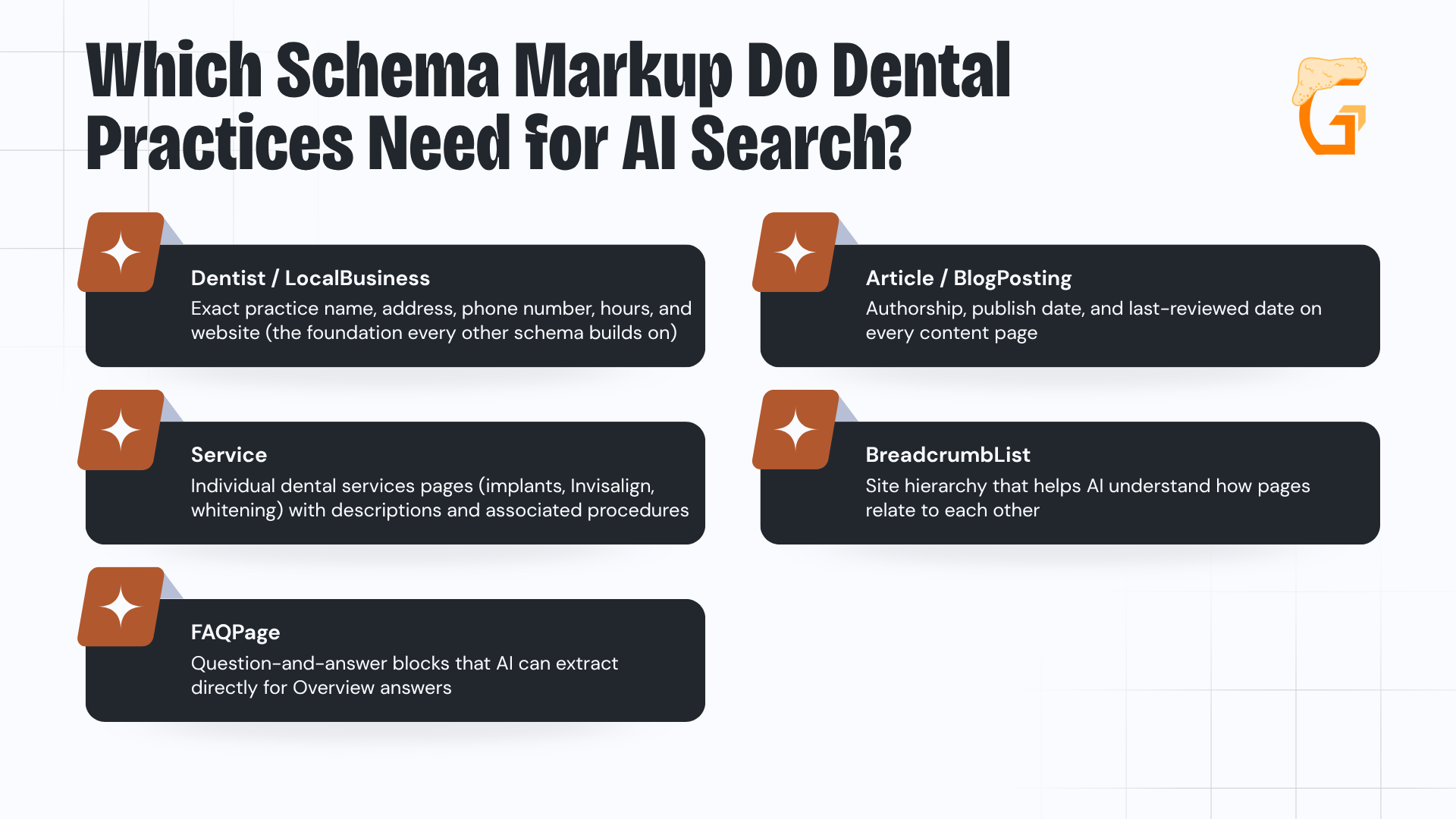
JSON-LD is Google’s preferred schema format, placed in a script tag in the page head – easy to implement, easy to maintain, and the standard every dental site should use.

The essential schema types for a dental practice, each telling Google something different:

  • Dentist / LocalBusiness: exact practice name, address, phone number, hours, and website (the foundation every other schema builds on)
  • Service: individual dental services pages (implants, Invisalign, whitening) with descriptions and associated procedures
  • FAQPage: question-and-answer blocks that AI can extract directly for Overview answers
  • Article / BlogPosting: authorship, publish date, and last-reviewed date on every content page
  • BreadcrumbList: site hierarchy that helps AI understand how pages relate to each other

Implement all of these using JSON-LD structured data and validate with Google’s Rich Results Test before publishing.

Rich results (star ratings, hours, and address displayed directly in the SERP) can increase click-through rate by up to 35%, and machine-readable facts let AI parse and cite the practice accurately across all query types.

How Do Entity Consistency, Reviews, and Voice Search Affect AI Visibility?

Entity SEO means consistent NAP and service descriptions across the Google Business Profile, Healthgrades, Yelp, Zocdoc, and dental association directories.

AI systems cross-reference these signals to validate a practice’s authority.

The practical checklist:

  • GBP: complete service categories (both “Dentist” and “Emergency Dental Service” where applicable), an attributes note where the practice accepts Delta Dental, current photos, answered Q&A, and NAP that exactly matches your website schema
  • Reviews: aim for 50+ Google reviews at a 4.5+ rating, and respond to them in patient-friendly language (specificity and recency both strengthen the entity signal)
  • Directory consistency: mismatched addresses or phone numbers across directories create entity ambiguity that AI systems resolve by citing someone else

Voice search results run on the same signals.

When a patient asks Google Assistant “find an emergency dentist near me open now,” the practice with clear entity data (consistent NAP, complete GBP, schema-marked hours) is the one that gets named.

One investment in entity clarity feeds AI Overviews, voice results, and the Google map pack simultaneously.

Growth Saloon builds the schema and entity consistency that make a dental practice visible across AI search, voice, and the map pack – not just one channel.

Contact our team today to find out how our dental marketing services can lower your cost per new patient and grow your practice.

Is AI-Generated Content Safe for Dental Websites? YMYL and E-E-A-T Rules

AI-generated dental content carries YMYL risk – medical inaccuracies, missing author credentials, and thin generic copy can all damage E-E-A-T and reduce AI citation eligibility.

This isn’t a reason to avoid AI tools.

It’s a reason to use them with a clear workflow.

This section covers why dental content triggers Google’s highest scrutiny and exactly what makes AI content safe to publish.

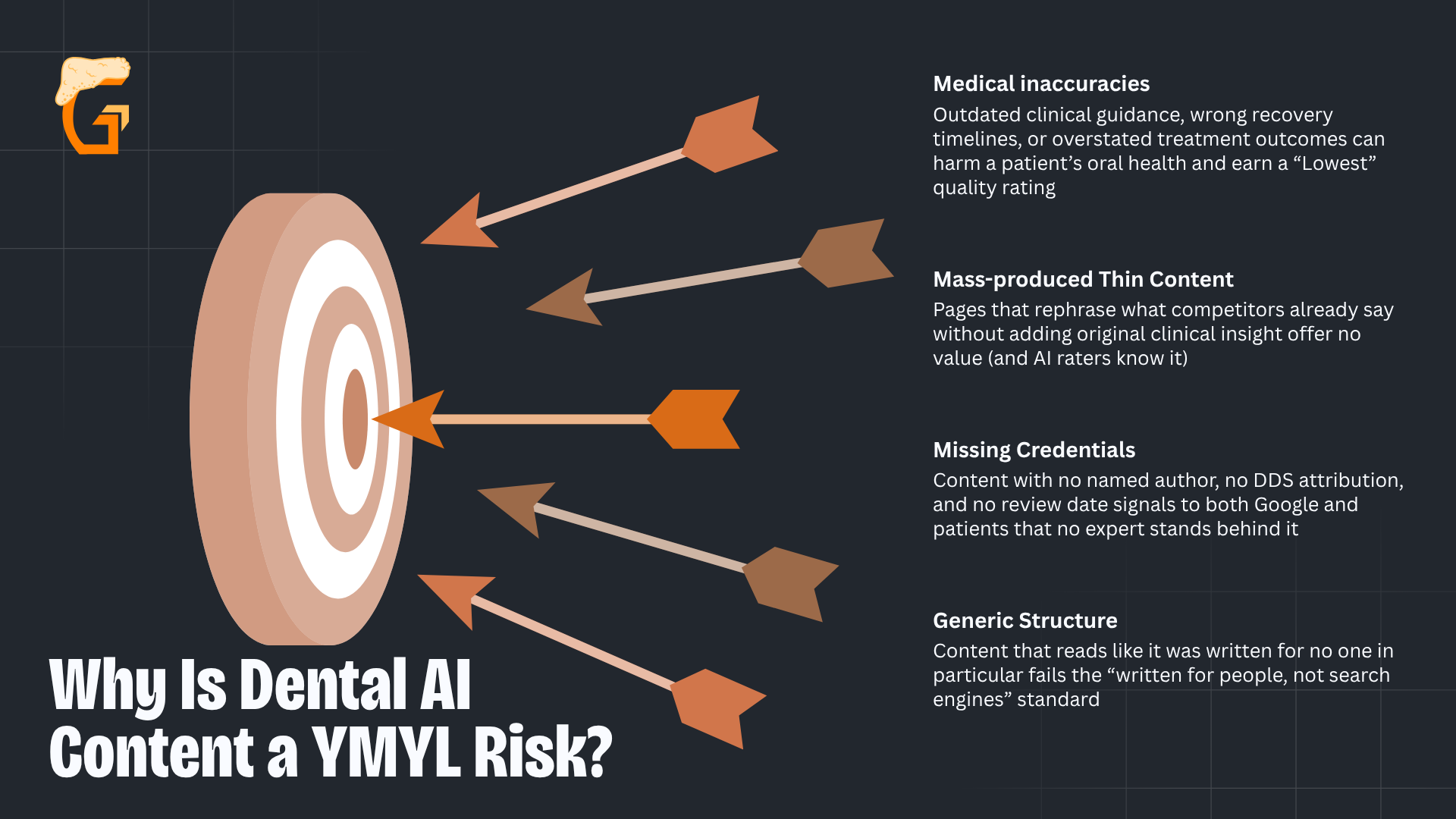
Why Is Dental AI Content a YMYL Risk?

Dental content about treatments, costs, risks, and recovery directly affects dental patients’ health and finances.

Google’s guidelines give even more weight to E-E-A-T for YMYL topics – and dental websites fall explicitly within that category.

What makes AI content problematic on dental sites isn’t the tool – it’s the output quality:

  • Medical inaccuracies: outdated clinical guidance, wrong recovery timelines, or overstated treatment outcomes can harm a patient’s oral health and earn a “Lowest” quality rating
  • Mass-produced thin content: pages that rephrase what competitors already say without adding original clinical insight offer no value (and AI raters know it)
  • Missing credentials: content with no named author, no DDS attribution, and no review date signals to both Google and patients that no expert stands behind it
  • Generic structure: content that reads like it was written for no one in particular fails the “written for people, not search engines” standard

Google’s Quality Rater Guidelines were updated in 2025 to explicitly address AI content requirements for YMYL categories including healthcare.

Unverified or untrustworthy YMYL claims are rated “Lowest” (the worst possible outcome) regardless of whether AI or a human wrote them.

What E-E-A-T and Review Workflow Keeps Dental AI Content Safe?

Every dental content page needs a named DDS/specialist author with credentials linked to a bio page, a “last reviewed” date, and training and membership details.

These are not optional for YMYL content.

First-hand experience signals are what AI cannot generate on its own:

  • “In our practice, we typically see patients return to normal activity within 48 hours” (specific, clinical, earned)
  • Case examples with patient outcomes (appropriately anonymized) that demonstrate actual treatment experience
  • Patient-facing explanations that come from years of answering the same questions chairside (not from rephrasing a WebMD article)

The safe workflow is straightforward – AI drafts the page in plain patient-friendly language → a licensed dentist reviews for clinical accuracy and adds first-hand context → an editor refines for readability and style → the page publishes with a named DDS byline, credential link, and “last reviewed” date.

Every page ends with disclaimer framing (“consult your dentist”) that positions content as educational, not advisory.

How Can Dentists Use AI Tools for Keyword Research and Content Creation?

Dentists can use AI tools to surface patient question clusters, draft content outlines and FAQ sections, and audit existing pages for answer clarity – always with dentist review before publishing.

AI tools rely on a human in the loop to stay compliant, even as they accelerate the work.

This section covers the research workflow and the drafting and audit process that makes AI tools safe and effective for dental content.

How Can AI Tools Speed up Dental Keyword Research?

Keyword clustering with AI starts with relevant keywords gathered in SEO tools like Surfer, SEMrush, or Ahrefs, then uses AI to group them by patient intent into service pages, blog topics, and FAQ sections.

Search algorithms now understand context, meaning, and patient intent behind each query – which means intent-based clustering produces better topic maps than exact-match keyword lists ever did:

  • Group related queries by the patient’s underlying question (“what does an emergency tooth extraction involve,” “how much will this cost,” “am I a candidate”) rather than by keyword similarity
  • Depth-first wins: AI Overviews now appear for 10.4% of U.S. desktop keywords and many local searches, jumping 119% in mobile frequency in March 2025 (practices with ten well-written guides on a service topic outperform those with one thin page)
  • Use AI to identify the questions patients search for that your site doesn’t yet answer (these are citation gaps, not just content gaps)

The output of this keyword research is a prioritized content roadmap organized by service, intent, and local modifier – built in a fraction of the time manual analysis takes.

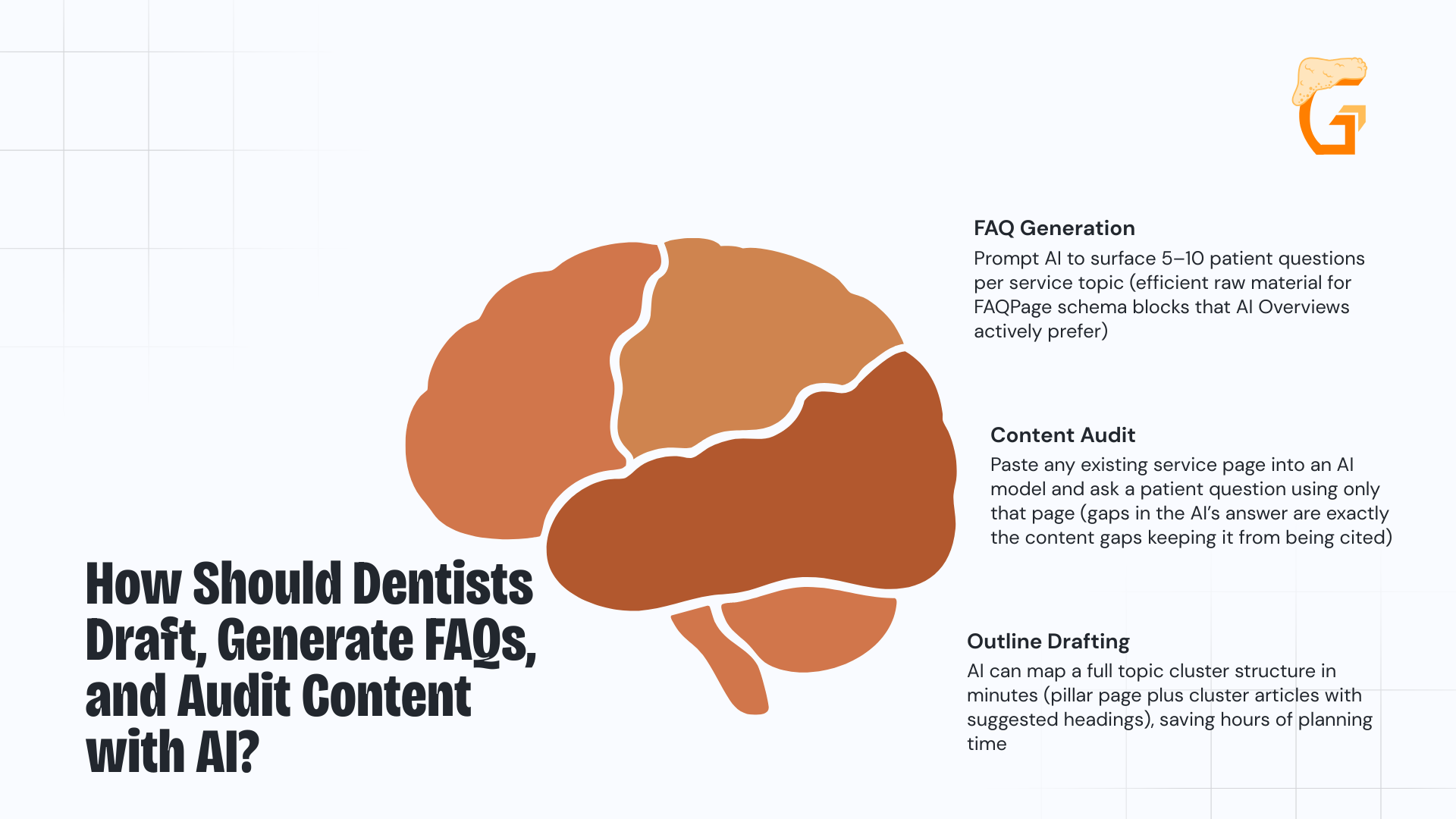
How Should Dentists Draft, Generate FAQs, and Audit Content with AI?

The draft-and-refine split – AI writes patient-friendly first drafts; a human editor refines for clinical accuracy, local specificity, and practice voice.

That split is what keeps YMYL compliance intact.

Specific use cases where AI tools add the most value:

  • FAQ generation: prompt AI to surface 5–10 patient questions per service topic (efficient raw material for FAQPage schema blocks that AI Overviews actively prefer)
  • Content audit: paste any existing service page into an AI model and ask a patient question using only that page – gaps in the AI’s answer are exactly the content gaps keeping it from being cited
  • Outline drafting: AI can map a full topic cluster structure in minutes (pillar page plus cluster articles with suggested headings), saving hours of planning time

The non-negotiable – dentist clinical review and approval before any health content publishes.

Every page needs a DDS byline with linked credentials and a “last reviewed” date.

AI handles the drafting and other repeatable SEO tasks; the dentist is the authority that makes the content trustworthy enough to cite.

Growth Saloon helps dental practices build the kind of digital presence that consistently generates qualified new patient inquiries – not just clicks.

Contact our team today to find out how our dental marketing services can lower your cost per new patient and grow your practice.

How Can Growth Saloon Help Your Dental Practice Grow?

Growth Saloon is a Chicago-based digital marketing agency built to help dental practices attract more local patients and grow their practice through performance-driven digital marketing.

Mike Lowe and the Growth Saloon team specialize in the digital marketing disciplines of SEO, web design, conversion rate optimization, and marketing attribution – working alongside your practice to build a measurable presence that generates qualified patient inquiries, not just website traffic.

From ranking for high-intent local search terms to converting site visitors into booked appointments, Growth Saloon’s dental SEO services focus on results at every stage of the patient acquisition funnel.

Practice owners and marketing managers get clear visibility into exactly which channels are driving potential patients to the practice.

We know that every open appointment slot has a real cost.

Every decision we make is built around one outcome – helping your practice fill more of them.

Meet the Founder of Growth Saloon

Meet the founder and lead strategist at Growth Saloon – Mike Lowe:

  • As founder and CEO of Growth Saloon, Mike brings years of hands-on experience in SEO strategy, CRO, web design, and marketing attribution for service-based businesses competing in local and regional markets.
  • Based in Chicago and working with practices across the country, Mike has built local SEO strategies for businesses competing in some of the most contested search markets in the country.
  • Growth Saloon’s data-driven approach to local SEO and patient acquisition helps dental practices turn their websites into their highest-performing new patient channel.

What Does Working With Growth Saloon Look Like?

Growth Saloon operates as a dedicated extension of your marketing team – not a vendor that disappears after onboarding.

Every engagement includes direct access to Mike and the team, transparent reporting tied to actual patient acquisition outcomes, and strategies tailored to your specific services and local market.

Whether you’re looking to rank for high-value procedures, convert more patients from the appointments your site already drives, or finally get clarity on where new patients are coming from, Growth Saloon builds the strategy and does the work.

Growth Saloon helps dental practices build the kind of digital presence that consistently generates qualified new patient inquiries – not just website traffic.

Contact our team today to find out how our dental marketing services can lower your cost per new patient and grow your practice.

FAQ
Author

Who is Mike Lowe?

Mike Lowe is a digital marketing strategist and the founder of Growth Saloon, where he specializes in helping businesses cut through the noise with high-converting email strategies and SEO.

With a focus on “organic storytelling,” Mike combines over a decade of agency experience with a passion for helping brands build genuine trust with their audience.

When he’s not optimizing subject lines or scaling SaaS companies, he’s likely sharing insights on how to transform cluttered inboxes into meaningful connection points for online marketers.

Related content
Resources for Dentists

Every resource we’ve published for Dentists, in one place:

Ready to turn your website traffic into real growth?

You’ve read the strategy now let Growth Saloon help you put it into action.

Get a free SEO audit and see what’s holding your website back from ranking, converting, and growing. 

Let's Chat

Let’s discuss your online marketing goals! We’re quick to respond, so we’ll be in touch shortly to set up a time to chat.