

Key takeaways
- Full dental SEO services bundle GBP management, citations, content, technical SEO, link building, and reporting, with patient-attribution reporting being the deliverable most commonly missing.
- Match the budget to practice size, roughly $1,000 to $2,500 per month for a single location, $500 to $1,500 more per added location, and $3,000 to $10,000+ for DSO and multi-location programs.
- Treat full-service pricing under $750 per month, guaranteed rankings, and keyword-only reporting as red flags, and remember one new implant or cosmetic patient a month can cover a $1,500 to $2,000 retainer.
What Do Dental SEO Services Actually Deliver for Your Practice?
A dental SEO agency operates in one of the most searched and least clearly defined categories in dental marketing – most providers promise more patients, and most monthly reports deliver a keyword ranking table that tells you nothing about whether a single new patient walked through your door.
The gap between what gets sold and what gets measured is where most practice owners lose time, money, and trust in the channel.
The Growth Saloon team works exclusively with dental clients, which means this guide is built around the questions practice owners and marketing managers actually face when evaluating providers: what the service should include, how dental SEO differs from general local SEO, how to spot the red flags before signing, and what a reasonable budget looks like at your practice size.
Every section below is written to help you make a better hiring decision that brings prospective patients to your practice – not to sell you on a particular provider before you’ve read anything.
Growth Saloon helps dental practices build the kind of digital presence that consistently generates qualified new patient inquiries – not just clicks.
Contact our team today to find out how our dental marketing services can lower your cost per new patient and grow your practice.
What Do Dental SEO Services Actually Include?
SEO for dental services covers six distinct areas – GBP management, local citation building, on-page content, technical SEO, link building, and patient-attribution reporting.
Providers who only track keyword positions are delivering less than half the service.
A practice owner evaluating providers should request an SEO audit and confirm all six areas in writing before signing.
Vague contracts that don’t specify deliverables in each category are a setup for paying retainer fees while the foundational work behind search visibility goes undone.
What Are the Core Deliverables in a Dental SEO Service Package?
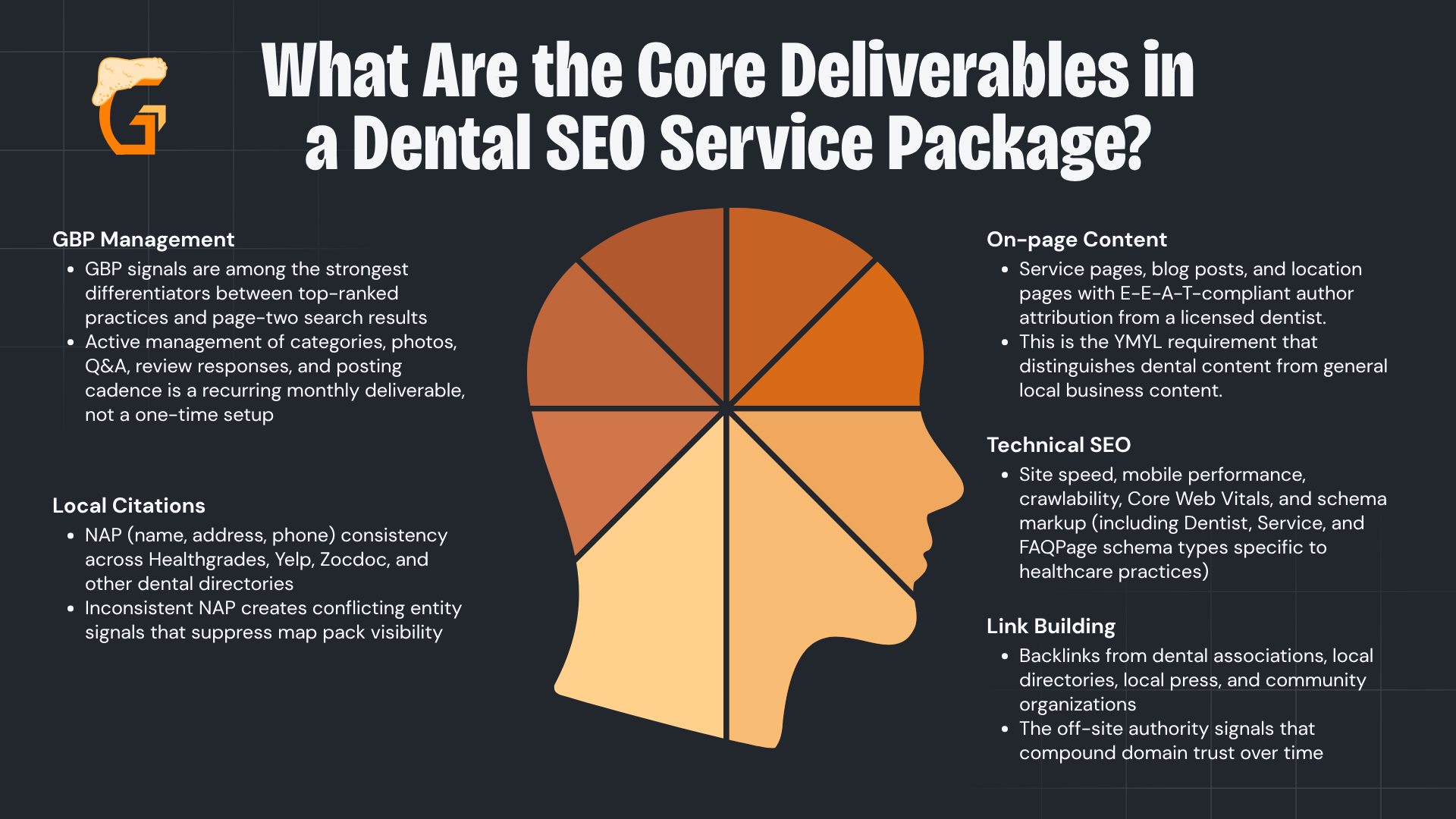
Dental SEO is not just keyword tracking – a legitimate provider covers five core delivery areas that, together, drive the GBP visibility and content authority that produce appointment bookings:
- GBP management: according to BrightLocal’s local rankings investigation for dentists, GBP signals are among the strongest differentiators between top-ranked practices and page-two search results (active management of categories, photos, Q&A, review responses, and posting cadence is a recurring monthly deliverable, not a one-time setup)
- Local citations: NAP (name, address, phone) consistency across Healthgrades, Yelp, Zocdoc, and other dental directories (inconsistent NAP creates conflicting entity signals that suppress map pack visibility)
- On-page content: service pages, blog posts, and location pages with E-E-A-T-compliant author attribution from a licensed dentist (this is the YMYL requirement that distinguishes dental content from general local business content)
- Technical SEO: site speed, mobile performance, crawlability, Core Web Vitals, and schema markup (including Dentist, Service, and FAQPage schema types specific to healthcare practices)
- Link building: backlinks from dental associations, local directories, local press, and community organizations (the off-site authority signals that compound domain trust over time)
If a provider cannot articulate all five areas in their written scope, they are running a partial dental SEO service – likely charging as if they’re delivering the full set.
Why Is Patient-Attribution Reporting the Most Commonly Missing Deliverable?
Reporting is the sixth deliverable and the one most commonly reduced to a keyword position table – which tells a practice owner nothing about whether SEO is producing new patient leads:
- Call tracking: unique tracked phone numbers on the website and GBP attribute inbound organic calls to SEO, separating them from Google Ads calls or direct referrals
- Form submission tracking: organic contact form submissions tagged in Google Analytics connecting online searches to appointment requests
- GBP actions: calls, direction requests, website clicks, and Google reviews from the GBP listing (the most direct local SEO signal available)
- Keyword rankings and organic sessions: the leading indicators that precede call and booking volume (tracked by service term and geography)
Keyword positions alone don’t measure SEO performance or fill the schedule.
A practice that accepts monthly reports showing only search rankings without call volume, GBP action data, or form submission counts has no evidence that SEO is producing more patient inquiries.
Demand patient-attribution reporting from day one.
How Is Dental SEO Different From General Local SEO?
SEO for dentists is different from general local SEO because dental content is YMYL – Google applies heightened quality scrutiny that requires licensed-author attribution, clinical accuracy, and E-E-A-T signals that are not optional for a dental practice.
A plumber’s website does not face the same quality standards as a dentist’s.
Content on a dental website about treatments, recovery, and clinical procedures directly affects patient health decisions.
That classification drives specific search engine requirements that most generalist providers don’t know to build in.
What YMYL and E-E-A-T Requirements Apply Specifically to Dental SEO?
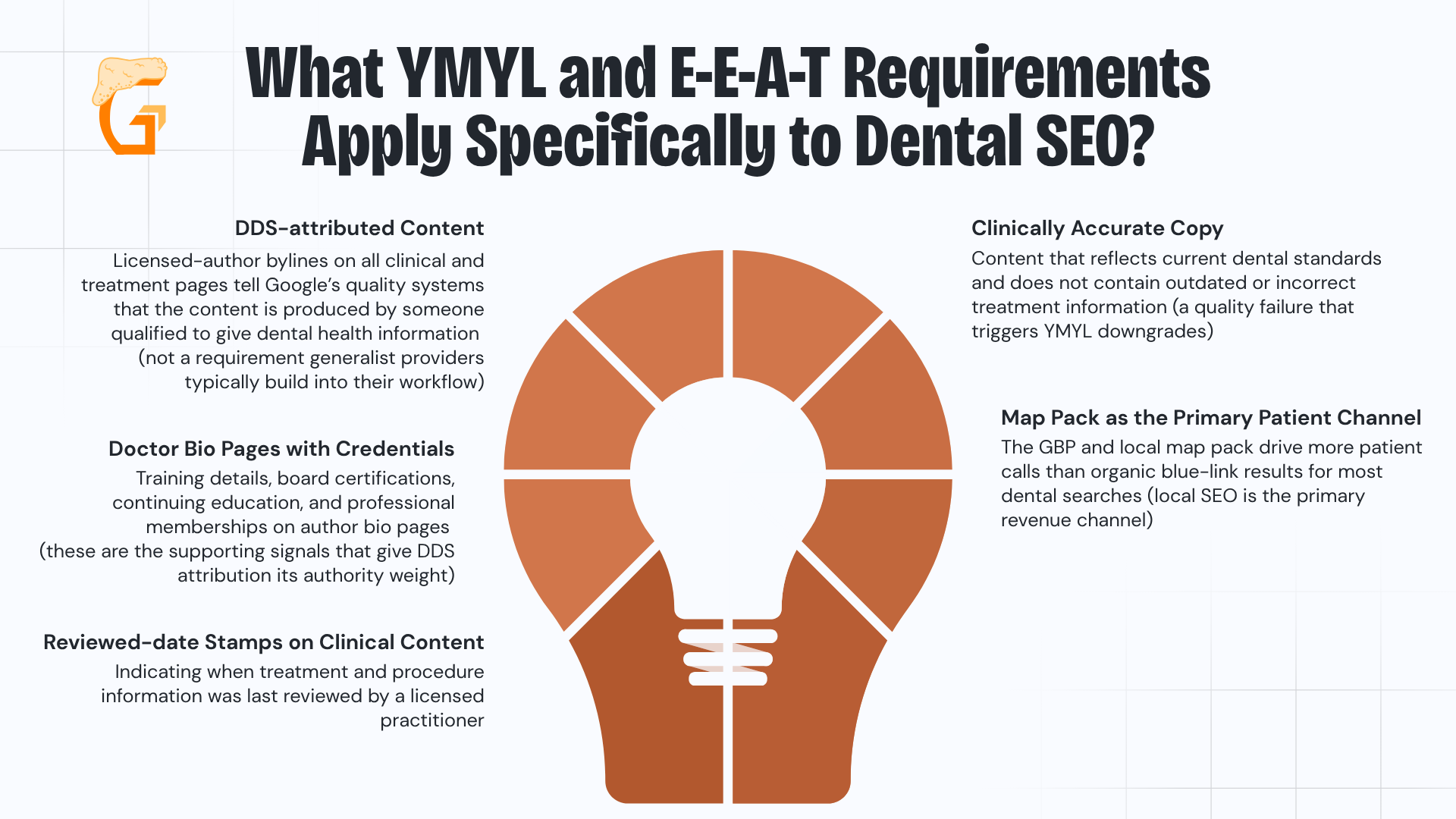
According to Google Search Central’s helpful content documentation, dental content falls under YMYL standards – Google’s systems give even more weight to strong E-E-A-T (experience, expertise, authoritativeness, and trustworthiness) for topics that can significantly affect health, so dental content is evaluated with heightened scrutiny:
- DDS-attributed content: licensed-author bylines on all clinical and treatment pages tell Google’s quality systems that the content is produced by someone qualified to give dental health information (not a requirement generalist providers typically build into their workflow)
- Doctor bio pages with credentials: training details, board certifications, continuing education, and professional memberships on author bio pages (these are the supporting signals that give DDS attribution its authority weight)
- Reviewed-date stamps on clinical content: indicating when treatment and procedure information was last reviewed by a licensed practitioner
- Clinically accurate copy: content that reflects current dental standards and does not contain outdated or incorrect treatment information (a quality failure that triggers YMYL downgrades)
- Map pack as the primary patient channel: the GBP and local map pack drive more patient calls than organic blue-link results for most dental searches (local SEO is the primary revenue channel)
Generalist providers rarely build YMYL/E-E-A-T infrastructure into their standard workflow.
Dental specialist providers treat YMYL infrastructure and dental keywords as a baseline requirement.
What Compliance Considerations Make Dental SEO Different from General Local SEO?
Beyond E-E-A-T, the way patients search creates compliance considerations that general local SEO doesn’t encounter – and providers unfamiliar with these constraints create liability risk, not just quality risk:
- HIPAA considerations on patient-specific materials: applicability of HIPAA to marketing activities varies by workflow and jurisdiction (a dental SEO provider should weigh these considerations on before/after photos and review responses, but they are not universal rules covering all marketing contexts)
- FTC guidelines on testimonials: disclosures are required for incentivized patient reviews (a dental SEO provider running a reputation management or review acquisition program should build FTC-compliant disclosure language into the process)
- Healthcare-specific schema types: Dentist, LocalBusiness, Service, and FAQPage schema markup that helps a practice surface in Google Maps is not typically built by generalist providers who apply the same schema to plumbers and dentists
The risk of using a generalist provider for dental search engine optimization is not just slow progress.
Content that lacks clinical accuracy or licensed-author attribution can trigger Google’s quality evaluation systems in a YMYL context – reducing site authority rather than building it.
Growth Saloon delivers dental SEO services built around YMYL-compliant content that earns qualified new patient inquiries – not just clicks.
Contact our team today to find out how our dental marketing services can lower your cost per new patient and grow your practice.
What Should You Look for When Choosing a Dental SEO Provider?
When choosing a dental SEO provider, evaluate on four axes (dental industry experience, transparent written deliverables, patient-attribution reporting, and contract flexibility), not price alone.
These four axes separate an SEO agency with a real, repeatable dental process from those who sound credible on a sales call but improvise after signing.
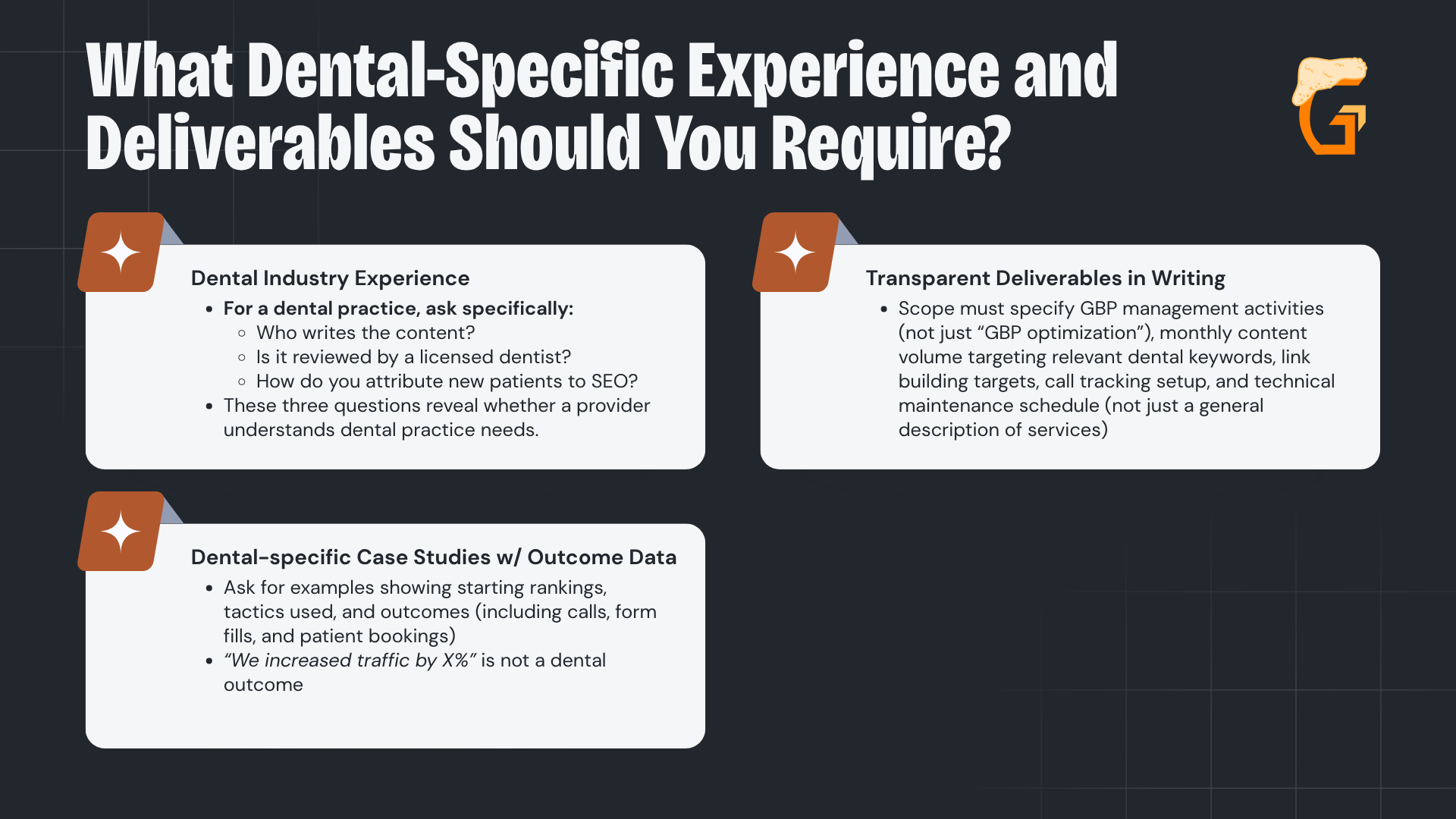
What Dental-Specific Experience and Deliverables Should You Require?
Generic SEO experience and vague contracts are the two patterns that most often separate dental SEO experts from poor outcomes:
- Dental industry experience: HubSpot’s guide to questions to ask a local SEO agency recommends pressing on content creation and how success is measured (for a dental practice, ask specifically: who writes the content, is it reviewed by a licensed dentist, and how do you attribute new patients to SEO – these three questions reveal whether a provider understands dental practice needs)
- Transparent deliverables in writing: scope must specify GBP management activities (not just “GBP optimization”), monthly content volume targeting relevant dental keywords, link building targets, call tracking setup, and technical maintenance schedule (not just a general description of services)
- Dental-specific case studies with outcome data: ask for examples showing starting rankings, tactics used, and outcomes including calls, form fills, and patient bookings (“we increased traffic by X%” is not a dental outcome)
A provider who can’t show dental-specific case studies with actual new patient acquisition data hasn’t done this at a meaningful level.
Logos and “we work with dental practices” language without outcome data signals the same gap.
What Reporting Standard and Contract Terms Should You Require?
The last two evaluation axes (reporting and contract flexibility) are where practices most often get locked into underperforming providers:
- Reporting standard: monthly reports must include call volume and patient inquiries from organic search results, not just keyword positions (ask for a sample report before signing any contract; a good report shows GBP actions, organic calls, and form submissions)
- Contract flexibility: month-to-month is the most favorable contract structure for the practice; 6–12 month minimums are common in the market but must include agreed performance benchmarks and an exit process if those benchmarks aren’t met
- Patient attribution as the litmus test: any provider who cannot explain how they track whether a patient came from organic search cannot optimize spend or prove value (this single question separates data-driven providers from those operating on faith)
If a provider can’t explain patient attribution, they are not equipped to prove that the practice’s SEO investment is working.
Growth Saloon reports on qualified new patient inquiries and cost per new patient, so a practice always knows its dental SEO is working.
Contact our team today to find out how our dental marketing services can lower your cost per new patient and grow your practice.
How’s your SEO going?
Enter your website URL below to get a free comprehensive SEO audit.
The audit includes:
- A scan of your entire website for technical issues
- A list of your top opportunities to target immediately
- Your highest priority fixes to make
What Are the Red Flags When Hiring a Dental SEO Company?
The most reliable red flags when hiring a dental SEO company are – guaranteed rankings, vague contracts without written deliverables, reporting only on keyword positions rather than patient leads, pricing under $750/month for full-service, and no evidence of dental-specific work.
For a practice depending on search engine results to fill its schedule, these are not minor concerns.
Ownership traps and ranking guarantees produce the most financially damaging outcomes – practices either face Google penalties for black-hat tactics or lose their website and content history when they eventually leave the provider.
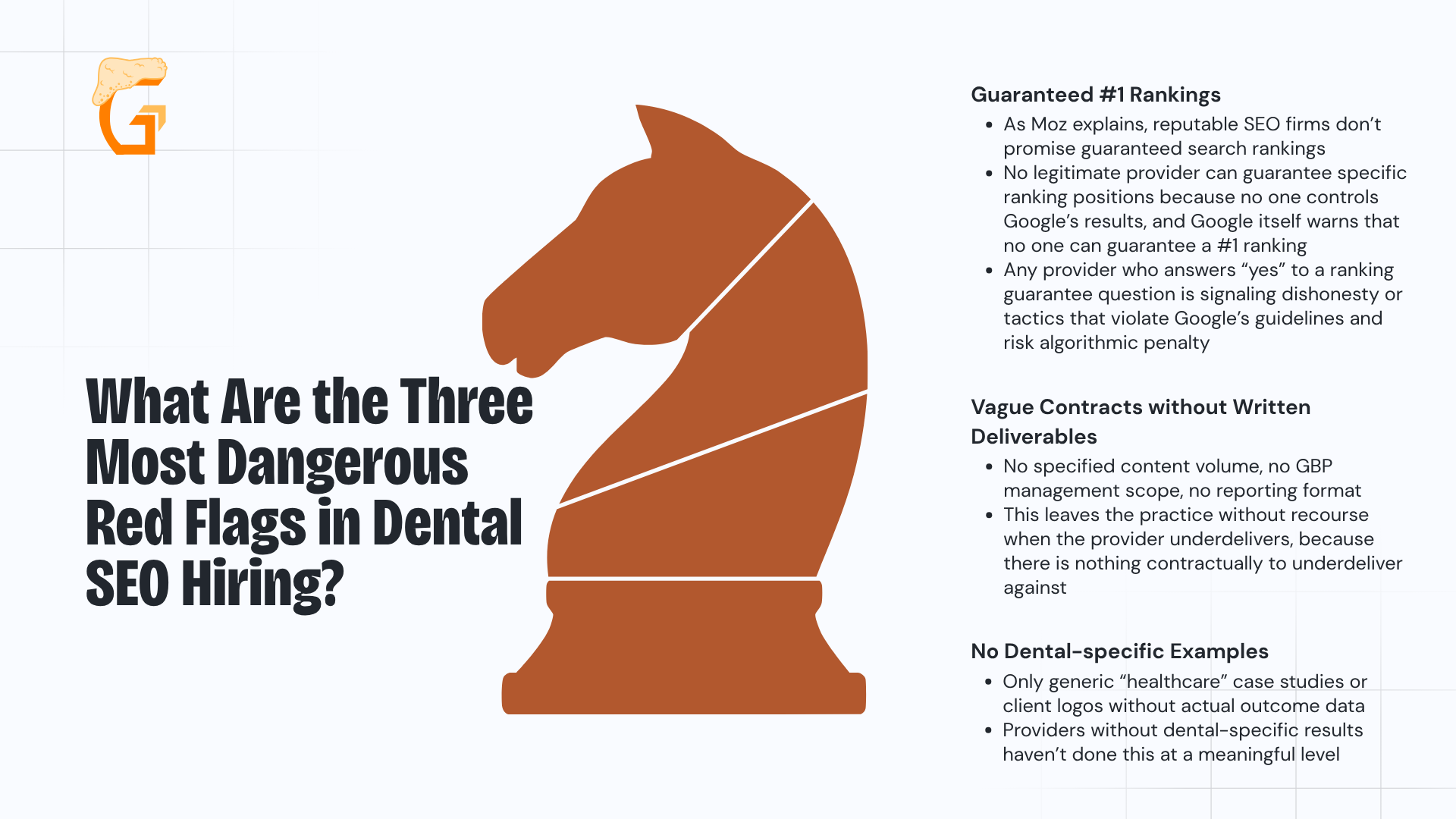
What Are the Three Most Dangerous Red Flags in Dental SEO Hiring?
The three red flags that produce the most expensive outcomes:
- Guaranteed #1 rankings: as Moz explains, reputable SEO firms don’t promise guaranteed search rankings (no legitimate provider can guarantee specific ranking positions because no one controls Google’s results, and Google itself warns that no one can guarantee a #1 ranking; any provider who answers “yes” to a ranking guarantee question is signaling dishonesty or tactics that violate Google’s guidelines and risk algorithmic penalty)
- Vague contracts without written deliverables: no specified content volume, no GBP management scope, no reporting format (this leaves the practice without recourse when the provider underdelivers, because there is nothing contractually to underdeliver against)
- No dental-specific examples: only generic “healthcare” case studies or client logos without actual outcome data (providers without dental-specific results haven’t done this at a meaningful level)
Guaranteed rankings and ownership traps are the most expensive outcomes.
Practices either get penalized for black-hat tactics or lose the dental practice’s website, domain, and content history when they eventually change providers – starting from zero is a costly mistake that advance confirmation prevents.
What Pricing and Contract Patterns Should Raise Concerns?
The low-price, long-contract combination is the most common trap in dental SEO marketing – and it’s designed to collect fees, not produce booked appointments:
- Under $750/month for full-service dental SEO: consistently flagged as the threshold below which real content creation, active link building, and ongoing optimization cannot be sustained (the business model at this price relies on automated tools and templated work)
- Rankings-only reporting: position tracking without call volume, GBP actions on local listings, or lead attribution (measuring activity rather than patient outcomes)
- Long lock-in with no performance benchmarks or exit terms: the most financially damaging combination (practices are stuck paying for underperforming service with no mechanism to hold the provider accountable)
- Full upfront payment required for a multi-month engagement: legitimate providers bill monthly; upfront payment requirements are a contract structure to avoid
Long lock-in plus no performance benchmarks plus no exit clause is not just ineffective SEO – it’s trapped spending on ineffective SEO.
Growth Saloon works to clear performance benchmarks tied to qualified new patient inquiries – not lock-in contracts with no accountability.
Contact our team today to find out how our dental marketing services can lower your cost per new patient and grow your practice.
How Do Dental SEO Service Needs Differ by Practice Size?
Dental SEO service scope and budget scale with practice size – solo practices need local fundamentals, group practices need per-location entity management, and DSOs need centralized strategy with per-location execution.
The same provider who delivers strong results for a solo practice or specialty practice in a mid-size city may not have the infrastructure for a DSO with 20+ locations.
Scope and capability need to match practice size.
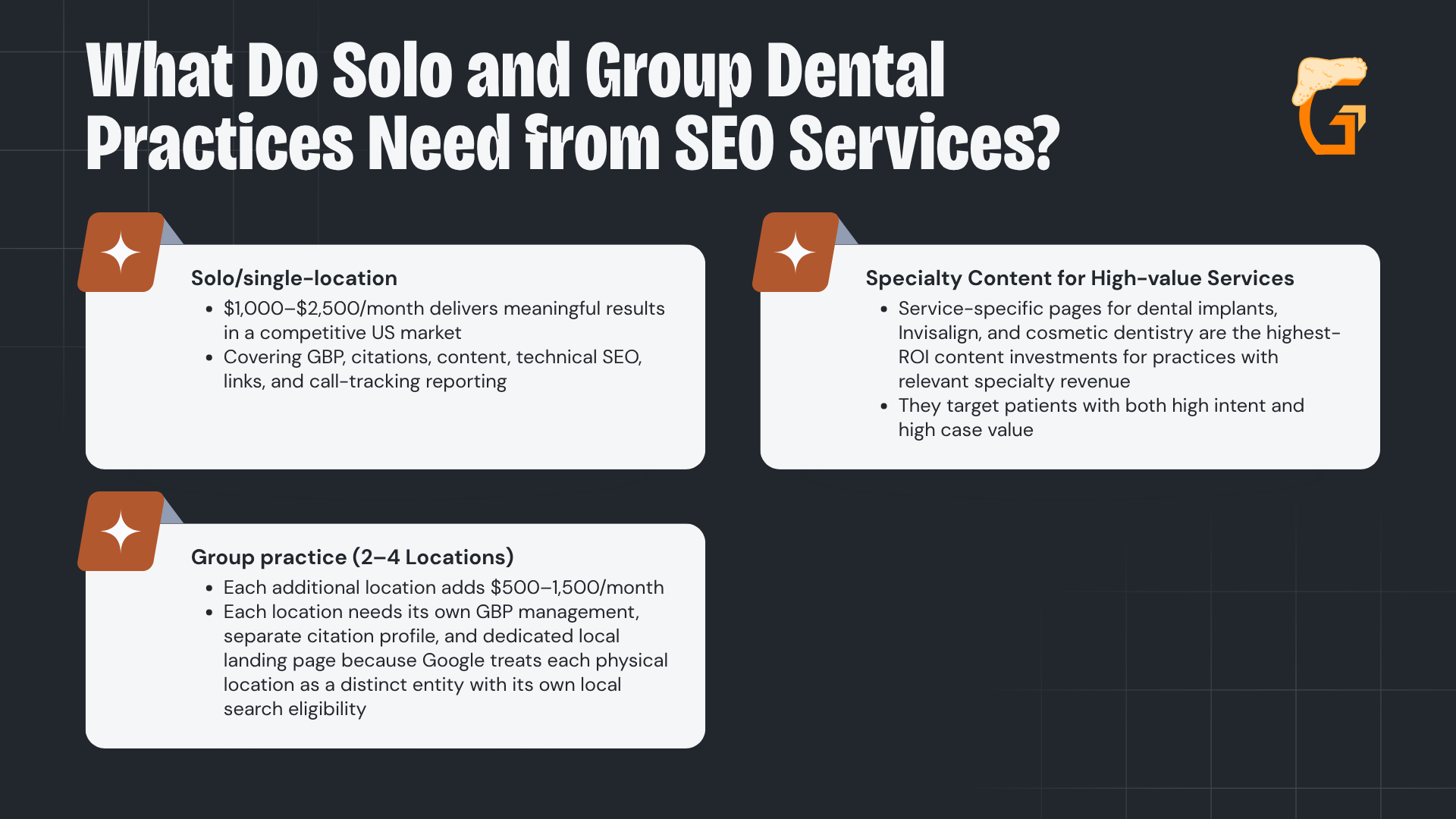
What Do Solo and Group Dental Practices Need from SEO Services?
Solo practices need the full foundational stack, calibrated to one market; group practices layer in per-location entity management:
- Solo/single-location: $1,000–$2,500/month delivers meaningful results in a competitive US market (covering GBP, citations, content, technical SEO, links, and call-tracking reporting)
- Group practice (2–4 locations): each additional location adds $500–$1,500/month (each location needs its own GBP management, separate citation profile, and dedicated local landing page because Google treats each physical location as a distinct entity with its own local search eligibility)
- Specialty content for high-value services: service-specific pages for dental implants, Invisalign, and cosmetic dentistry are the highest-ROI content investments for practices with relevant specialty revenue (they target patients with both high intent and high case value)
The ROI frame for solo practices: adding one new implant or cosmetic patient per month from SEO brings in high value patients that typically cover a $1,500–$2,000/month retainer in a single appointment.
What Do DSO and Multi-Location Dental Groups Need from SEO Services?
DSOs and multi-location groups need a different service architecture to compete in each market’s local search results – centralized content strategy with per-location execution:
- DSO/multi-location (5+ locations): each location managed as a separate SEO entity with its own GBP, citation profile, and local landing pages; centralized content strategy, brand authority, and domain-level technical maintenance; typical budgets run $3,000–$10,000+ per month depending on location count
- Enterprise tier additions: competitor analysis, digital PR, CRO testing, dedicated account teams, and custom reporting dashboards
- Compounding brand authority advantage: centralized content and domain authority benefit all locations simultaneously (the per-location SEO ROI improves as group size grows because the brand authority compounds across the entire location portfolio)
For DSOs, SEO patient acquisition cost (PAC) at scale is typically well below what paid digital channels deliver while bringing in more high value patients – a directional benchmark from dental SEO ROI guides, not a primary study.
The compounding nature of domain authority makes SEO a source of sustained growth that becomes increasingly ROI-positive as location count grows.
Growth Saloon helps dental practices build the kind of digital presence that consistently generates qualified new patient inquiries – not just clicks.
Contact our team today to find out how our dental marketing services can lower your cost per new patient and grow your practice.
How Can Growth Saloon Help Your Dental Practice Grow?
Growth Saloon is a Chicago-based digital marketing agency built to help dental practices attract more patients and drive practice growth through performance-driven digital marketing.
Mike Lowe and the Growth Saloon team specialize in SEO, web design, conversion rate optimization, and marketing attribution – working alongside your practice to build a measurable digital presence that generates qualified patient inquiries, not just website traffic.
From ranking for high-intent, competitive search terms to converting site visitors into booked appointments, Growth Saloon focuses on results at every stage of the patient acquisition funnel.
Practice owners and marketing managers get clear visibility into exactly which channels are driving new patient growth.
We know that every open appointment slot has a real cost.
Every decision we make is built around one outcome – helping your practice fill more of them.
Meet the Founder of Growth Saloon
Meet the founder and lead strategist at Growth Saloon – Mike Lowe:
- As founder and CEO of Growth Saloon, Mike brings years of hands-on experience in SEO strategy, CRO, web design, and marketing attribution for service-based businesses competing in local and regional markets.
- Based in Chicago and working with practices across the country, Mike has built and managed digital growth campaigns for businesses competing in some of the most contested search markets in the country.
- Growth Saloon’s data-driven approach to local SEO and patient acquisition helps dental practices turn the practice website into their highest-performing new patient channel.
What Does Working With Growth Saloon Look Like?
Growth Saloon operates as a dedicated extension of your marketing team – not a vendor that disappears after onboarding.
Every engagement includes direct access to Mike and the team, transparent reporting tied to actual patient acquisition outcomes, and strategies tailored to your specific services and local market.
Whether you’re looking to rank for high-value procedures, improve the website’s user experience and appointment conversion rate, or finally get clarity on where your new patients are actually coming from, Growth Saloon builds the strategy and does the work.
Growth Saloon helps dental practices build the kind of digital presence that consistently generates qualified new patient inquiries – not just clicks.
Contact our team today to find out how our dental marketing services can lower your cost per new patient and grow your practice.
How's your SEO going?
Get your free comprehensive SEO audit.
Enter your website URL below to get a free comprehensive SEO audit.
- Scan entire website for technical issues
- Get a list of your top opportunities
- See your highest priority fixes to make
-
Dental SEO follows the same local SEO foundations for queries with local intent (GBP optimization, citations, local content, and link building), but it also adds healthcare-specific requirements that general local SEO ignores.
Dental content is classified as YMYL, requiring E-E-A-T signals like licensed-author attribution, reviewed-date stamps, and clinically accurate copy.
Generalist providers rarely build this infrastructure, which is why dental-specialist providers tend to win more organic traffic on healthcare-specific queries.
-
Most dental practices see initial movement in their local map results within 3–6 months and consistent new-patient growth from 6–12 months of sustained effort.
Local pack visibility (the map results above organic links) often improves faster, sometimes within 60–90 days of GBP optimization and citation work.
Organic search traffic gains for competitive service terms take longer, typically 6–9 months in a mid-size market.
-
A dental SEO specialist is generally the better choice because dental content is YMYL and requires E-E-A-T compliance that most generalists do not build into their workflow.
The risk with generalist providers is content that lacks clinical accuracy or DDS author attribution – both of which can damage rather than improve Google’s quality assessment of the site.
Ask any provider you evaluate – who writes the dental content for service pages like emergency dentist, and is it reviewed by a licensed dentist before publishing?
-
A dental SEO monthly report should include organic call volume from tracked phone numbers, form submission counts, Google Business Profile views and actions, keyword ranking positions for target service terms, and new organic sessions by geography.
Reporting only on keyword positions is insufficient – a provider that cannot tie its SEO efforts to patient inquiries is not measuring what actually matters for a dental practice.
-
Yes, entry-tier dental SEO services that build local visibility start at $500–$1,000/month and cover GBP management, NAP citations, and basic on-page optimization.
In low-competition markets, this level of investment can meaningfully improve visibility among local patients.
The ROI question matters more than the cost – if one new patient researching dental implants cost is attributed to SEO and the average lifetime patient value is $3,000–$5,000, a $1,000/month investment can pay for itself within one patient relationship.
-
The most reliable red flags are – guaranteed #1 rankings (no provider can guarantee specific positions), reporting only on keyword positions rather than patient leads, pricing under $750/month for a claimed full-service campaign, vague contracts without written deliverables, and no evidence of dental-specific work in their portfolio.
A provider that signs you to a long-term contract without agreed performance benchmarks or exit terms is also a meaningful concern.
Most agencies sell traffic. We sell actual growth. That’s the Growth Saloon difference.
Are you looking to grow?
Recent blogs
Enter your website URL below to get free comprehensive SEO audit.
- Scan entire website for technical issues
- Get a list of your top opportunities
- See your highest priority fixes to make