
Updated:September 9th, 2026

Author Bio SEO for Dentists in 2026

Written by

Mike Lowe

Reviewed by

Taylor Coteus

Key takeaways

  • Author bios are an E-E-A-T trust signal rather than a direct ranking factor, and they carry the most weight on dental content because it falls under Google's YMYL standards for health information.
  • The fastest compliance win is adding a named, credentialed dentist byline to your top clinical pages and linking each to a dedicated author page, since anonymous health content reads as lower trust to both Google and patients.
  • A complete author page runs 150 to 250 words covering credentials, training, and clinical focus, and should use Person schema with sameAs links and consistent name presentation across every profile.

What Does Author Bio SEO for Dentists Actually Involve?

Author bio SEO for dentists is the practice of structuring who gets credited for dental content in a way that Google and potential patients can evaluate, trust, and reward with visibility.

It sits at the intersection of E-E-A-T compliance and entity optimization.

For dental practices, it carries more weight than it does for most industries because Google classifies dental content as YMYL (Your Money or Your Life), where the bar for demonstrated expertise is set considerably higher.

Most dental practices publish content without a named, credentialed author attached to it.

Author Bio SEO for Dentists

That gap costs more over time than it costs to close.

A competitor with a licensed clinician byline on every blog post is building a trust gap that compounds with every new piece of content they publish.

This guide covers what a complete author bio needs to include, how to set up a dedicated author page, and how to implement the schema markup that turns on-page credibility into a structured entity Google can connect across your entire site.

Growth Saloon helps dental practices build the kind of online presence that consistently generates qualified new patient inquiries – not just clicks.

Contact our team today to find out how our dental marketing services can lower your cost per new patient and grow your practice.

Do Author Bios Actually Help Dental Website SEO?

Author bios help dental website SEO indirectly (they are an E-E-A-T trust signal, not a standalone ranking factor).

Google evaluates who is behind health content, and dental pages fall under YMYL, where that evaluation carries the most weight.

The two subsections below cover how author bios actually move the needle and what anonymous content costs a practice.

How Do Author Bios Actually Move the Needle for Dental SEO?
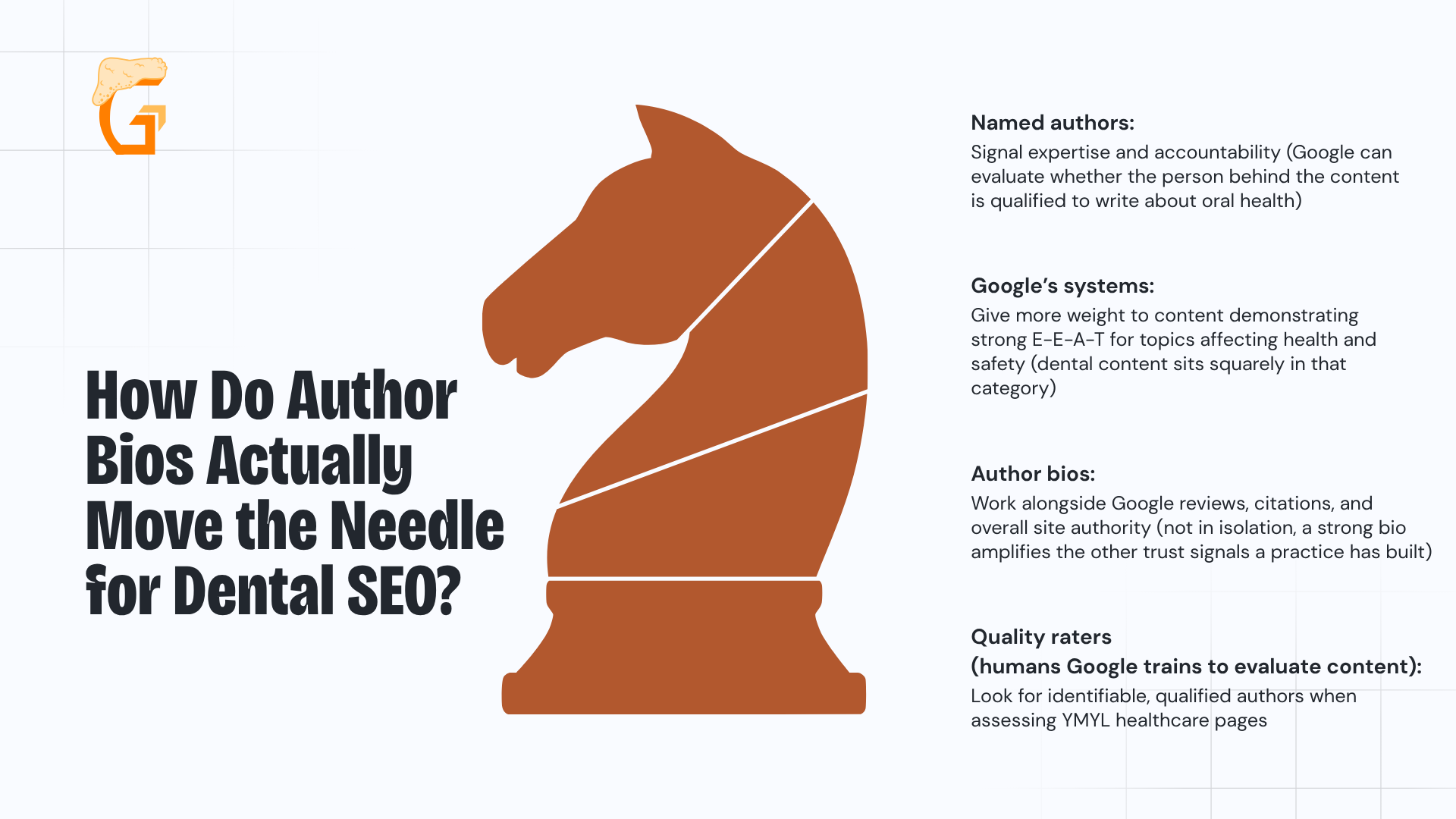
How Do Author Bios Actually Move the Needle for Dental SEO

Author bios are not a direct ranking factor.

They are a trust signal – one that tells Google and dental patients alike that a qualified person is accountable for the health information on the page.

The mechanism works through E-E-A-T evaluation:

  • Named authors signal expertise and accountability (Google can evaluate whether the person behind the content is qualified to write about oral health)
  • Google’s systems give more weight to content demonstrating strong E-E-A-T for topics affecting health and safety (dental content sits squarely in that category)
  • Author bios work alongside Google reviews, citations, and overall site authority (not in isolation, a strong bio amplifies the other trust signals a practice has built)
  • Quality raters (humans Google trains to evaluate content) look for identifiable, qualified authors when assessing YMYL healthcare pages

A named, credentialed author is one of the clearest signals a practice can send that real dental expertise stands behind its content.

What Does Anonymous Dental Blog Content Cost a Practice?

Publishing dental content with no byline is a missed trust opportunity (and quality raters notice it).

Here is what anonymous content costs in practice:

  • Practices without named authors risk weaker quality rater evaluations compared to competitors who attribute content to a qualified, named clinician.
  • Anonymous YMYL content reads as lower trust (when two pages cover the same topic, the one with a credentialed author is the stronger E-E-A-T signal).
  • There is no formal “anonymous content penalty” (the cost is relative, competitors who attribute their content to licensed dentists build an authority gap that grows over time).

The fix is low-effort and lasting.

Adding a named clinician byline to existing blog posts (linked to a dedicated author page) closes the credibility gap across the dental practice’s website at once.
What E-E-A-T Requires for Dental Author Pages

E-E-A-T (Experience, Expertise, Authoritativeness, and Trustworthiness) requires dental author pages to show a licensed clinician as author or reviewer, with credentials displayed prominently.

Because dental content is YMYL, Google holds the dental industry to a higher standard than lifestyle or entertainment content.

This section covers what each pillar demands for dental authors and how the writer-versus-reviewer split works in practice.

What Do the Four E-E-A-T Pillars Require for a Dental Author?

E-E-A-T stands for:

  • Experience;
  • Expertise;
  • Authoritativeness; and
  • Trustworthiness.

Dental content is YMYL (meaning the bar for all four pillars is materially higher than for lifestyle blogs or general information content).

What each pillar asks of a dental author page:

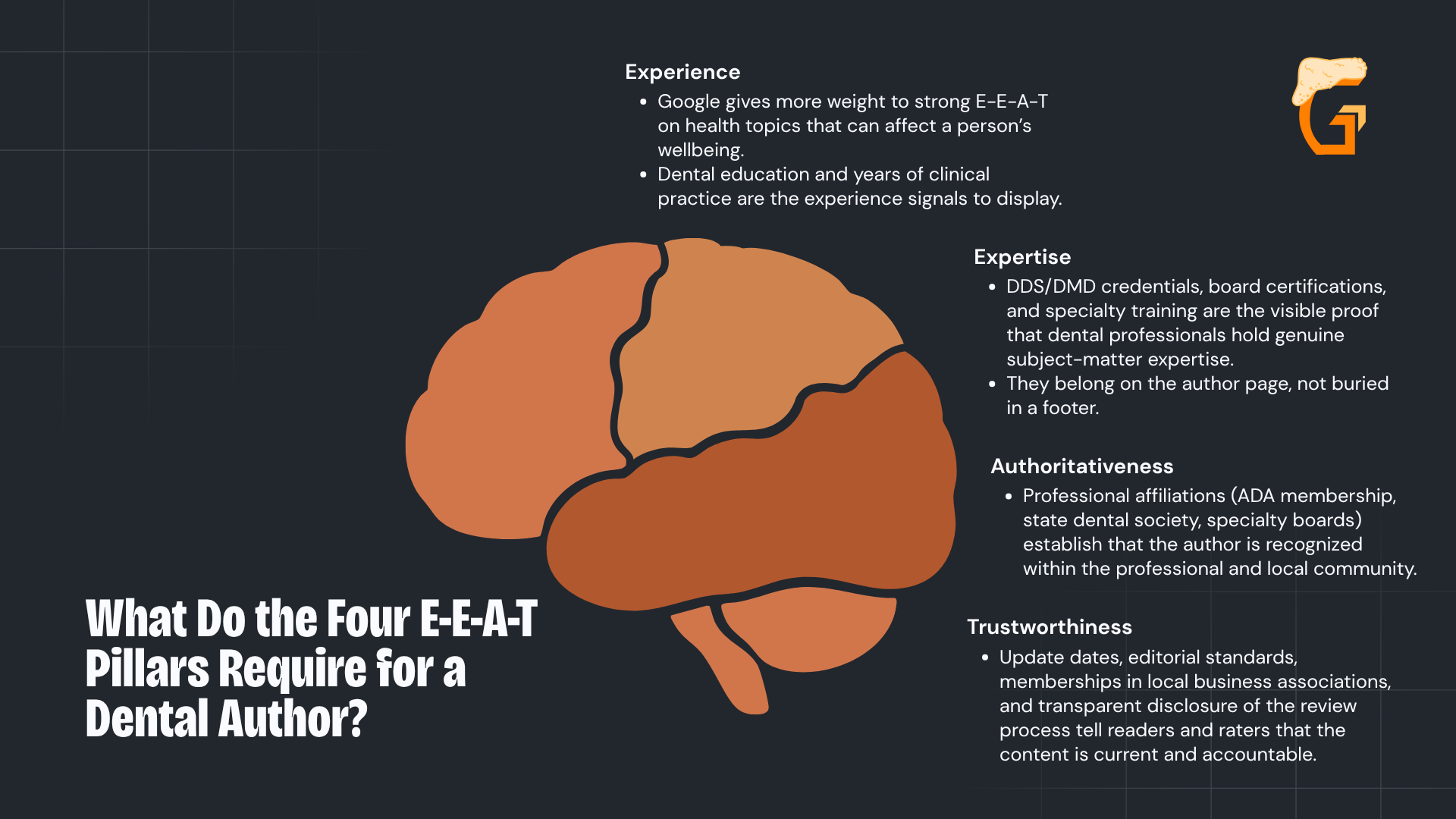
  • Experience:
  • Expertise:
    • DDS/DMD credentials, board certifications, and specialty training are the visible proof that dental professionals hold genuine subject-matter expertise.
    • They belong on the author page, not buried in a footer.
  • Authoritativeness:
    • Professional affiliations (ADA membership, state dental society, specialty boards) establish that the author is recognized within the professional and local community.
  • Trustworthiness:
    • Update dates, editorial standards, memberships in local business associations, and transparent disclosure of the review process tell readers and raters that the content is current and accountable.

Quality raters do not rank pages directly – they calibrate Google’s systems.

Aligning dental content with their evaluation criteria is how practices build search engine rankings that hold across algorithm updates.

Who Should Write Versus Review Dental Content, and Which Credentials Show?

The writer and the medical reviewer are two separate roles (and both can be displayed on the page).

This distinction matters because most dental practices work with a content writer who drafts in plain language for the target audience and a licensed clinician who reviews for clinical accuracy.

Display both clearly:

  • Writer:
    • Content professional, healthcare writer, or marketing team member
    • Listed as “written by” or “content by”
  • Medical reviewer:
    • The licensed dentist who reviewed and approved the content for clinical accuracy
    • Listed as “reviewed by” with DDS or DMD and any board certifications
  • Credentials to show:
    • Degree (DDS, DMD, BDS)
    • Board certifications
    • Specialty training
    • Specialized services
    • Years of clinical experience
    • Primary clinical focus
  • The floor:
    • A licensed dentist or reviewer byline is the baseline, not a bonus
    • YMYL pages without it are operating below the E-E-A-T minimum

Update dates and editorial standards (“reviewed for clinical accuracy as of [date]”) reinforce the trustworthiness pillar and demonstrate that the content is maintained, not published and forgotten.

Growth Saloon builds the credentialed authorship signals that lift a dental practice’s online visibility and turn dental content into qualified new patient inquiries – not just clicks.

Contact our team today to find out how our dental marketing services can lower your cost per new patient and grow your practice.

What Every Dental Author Bio Needs to Include

A dental author bio needs the full name, degree, specialty training, years in practice, clinical focus, a professional headshot, and a link to a dedicated author page.

That is the baseline that satisfies both patient trust and search engine entity signals.

This section covers each required element and the consistency rule that ties them together across every profile.

What Elements Does a Complete Dental Author Bio Require?

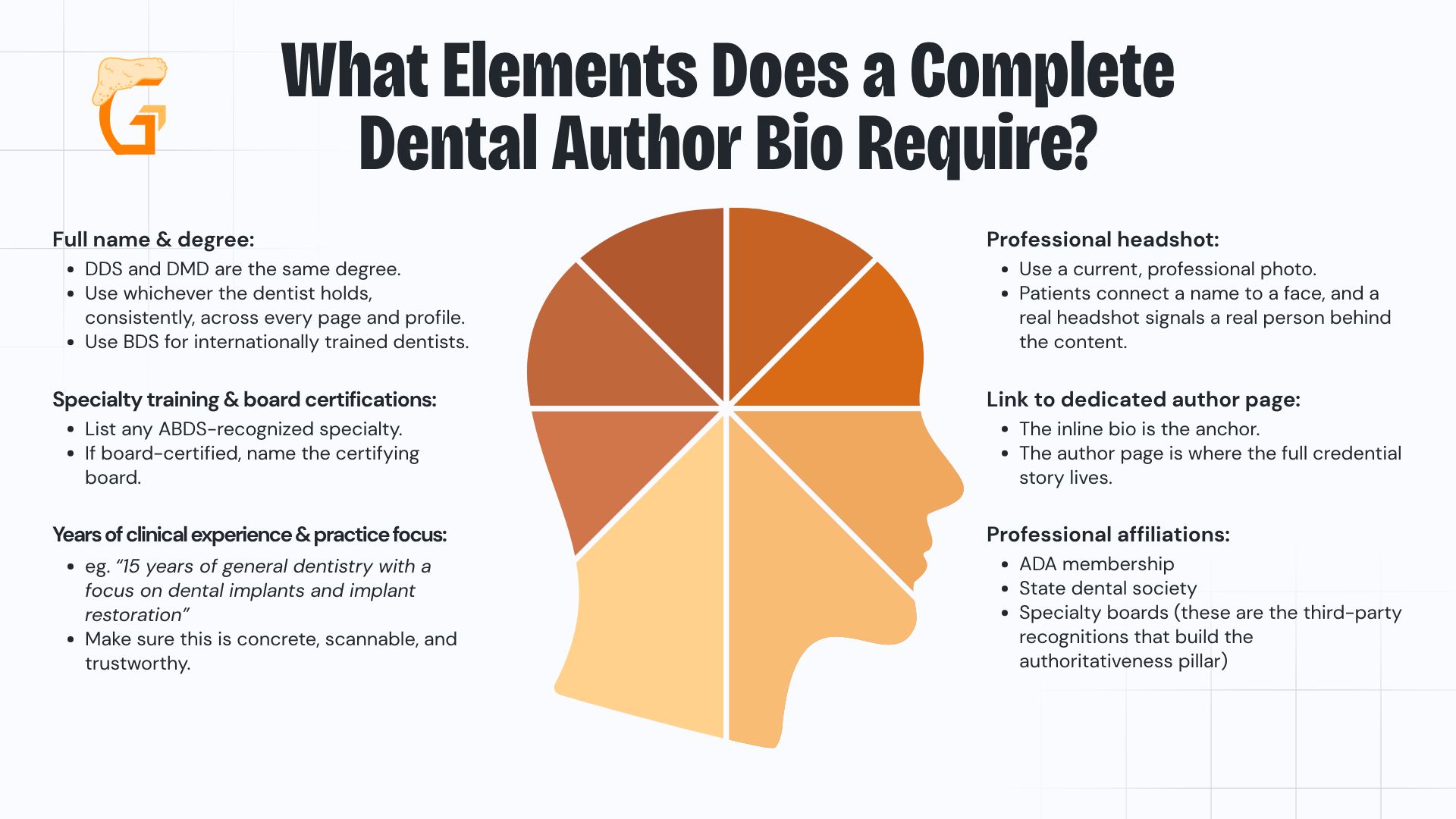
What Elements Does a Complete Dental Author Bio Require

A complete bio covers the credential stack, the specific dental services in its clinical context, and the visual anchor patients use to connect the name to a real person.

The required elements, in order of importance:

  • Full name and degree:
    • DDS and DMD are the same degree.
    • Use whichever the dentist holds, consistently, across every page and profile.
    • Use BDS for internationally trained dentists.
  • Specialty training and board certifications:
    • List any ABDS-recognized specialty.
    • If board-certified, name the certifying board.
  • Years of clinical experience and practice focus:
    • “15 years of general dentistry with a focus on dental implants and implant restoration”
    • Make sure this is concrete, scannable, and trustworthy.
  • Professional headshot:
    • Use a current, professional photo.
    • Patients connect a name to a face, and a real headshot signals a real person behind the content.
  • Link to dedicated author page:
    • The inline bio is the anchor.
    • The author page is where the full credential story lives.
  • Professional affiliations:
    • ADA membership
    • State dental society
    • Specialty boards (these are the third-party recognitions that build the authoritativeness pillar)

According to the American Dental Association, DDS and DMD are identical degrees representing the same education.

Board certification should be listed when applicable (it is one of the strongest expertise signals available to a dental author).

Why Does Consistent Name and Credential Presentation Matter?

Consistency is an entity-recognition issue.

Google builds an understanding of who a person is by cross-referencing the same name and credentials across multiple authoritative sources, including dental directories.

Where presentation must match exactly:

  • The website author page and bio
  • LinkedIn profile (name, credentials, practice name)
  • The ADA member directory
  • State dental board licensing records
  • Any specialty board listing or publication byline

Mismatches create entity ambiguity.

“Dr. Jane Smith, DDS” on the website and “Dr. J. Smith” on LinkedIn and “Jane M. Smith” in the ADA directory are three signals that do not clearly point to one person.

Google’s entity recognition improves when those signals align (and dilutes when they conflict).

Growth Saloon keeps a dental practice’s author and entity signals consistent everywhere they appear, so the authority you build converts into qualified new patient inquiries – not just clicks.

Contact our team today to find out how our dental marketing services can lower your cost per new patient and grow your practice.

How’s your SEO going?

Enter your website URL below to get a free comprehensive SEO audit.

The audit includes:

How to Set Up a Dental Author Bio Page That Ranks

Set up a dedicated author URL (not just the About page) and link it from every blog post the dentist authors.

A standalone author page is indexed separately and can be marked up with Person schema, which the About page cannot do as cleanly.

This section covers the page architecture and the internal-linking requirement that makes the page count.

How Do You Build a Dedicated Author Page That’s Different from the About Page?

The About Us page introduces the practice brand.

The author page introduces a specific local dentist as a content authority.

They serve different purposes and should be different URLs.

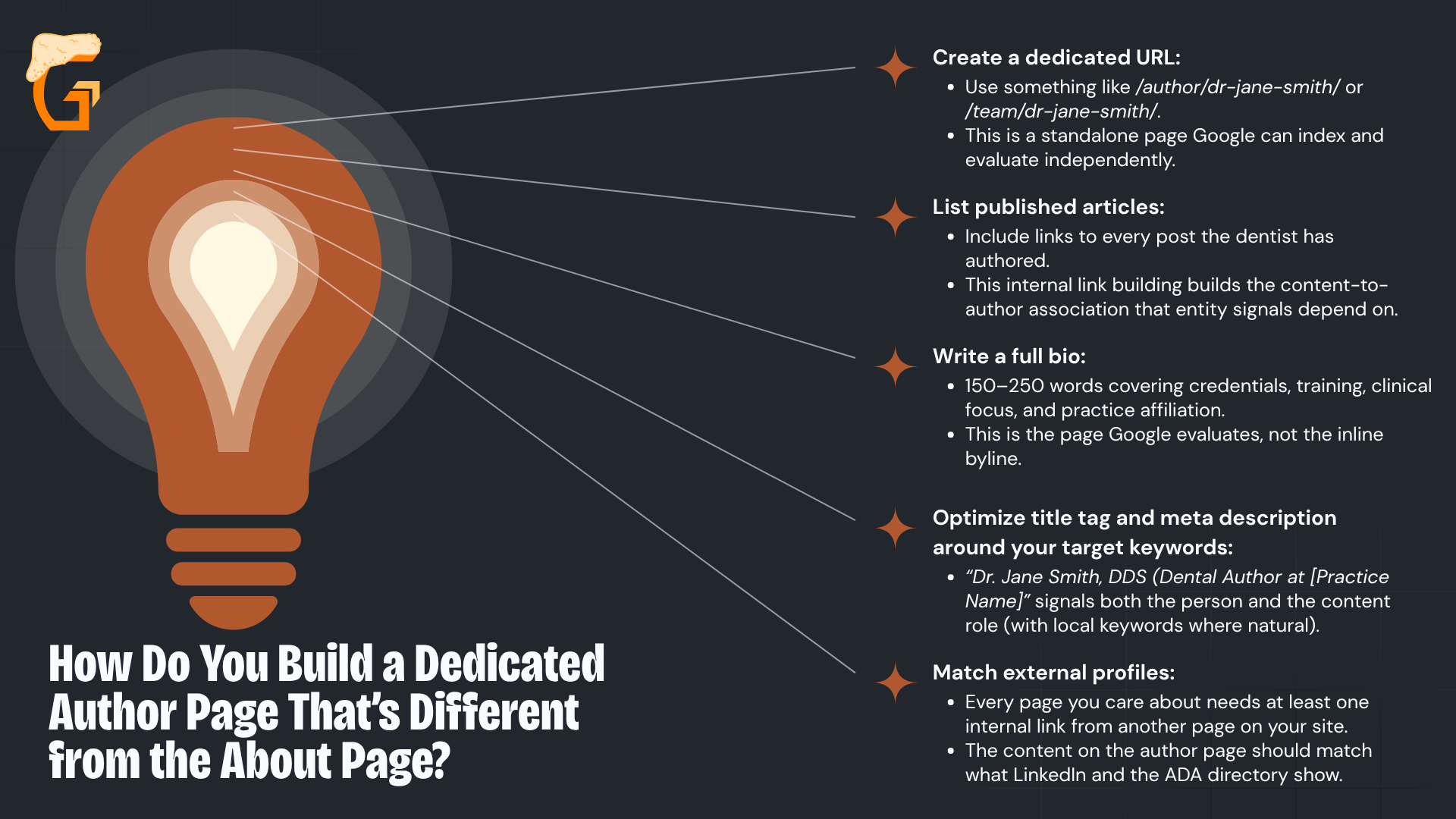
Setup steps and SEO tips for a dedicated author page:

  • Create a dedicated URL:
    • Use something like /author/dr-jane-smith/ or /team/dr-jane-smith/.
    • This is a standalone page Google can index and evaluate independently.
  • List published articles:
    • Include links to every post the dentist has authored.
    • This internal link building builds the content-to-author association that entity signals depend on.
  • Write a full bio:
    • 150–250 words covering credentials, training, clinical focus, and practice affiliation.
    • This is the page Google evaluates, not the inline byline.
  • Optimize title tag and meta description around your target keywords:
    • “Dr. Jane Smith, DDS (Dental Author at [Practice Name]” signals both the person and the content role (with local keywords where natural).
  • Match external profiles:

A dedicated author page is indexed and evaluated on its own merits.

Credentials buried inside a brand-level About Us page do not build the same focused author entity that a standalone page creates.

How Should You Link Blog Posts to the Author Page?

Every blog post the dentist authors should link back to the dedicated author page (through the byline, not buried in a sidebar widget or a footer note).

The inbound link structure the author page needs:

  • Byline on every post:
    • The author name in the byline is a hyperlink to the dedicated author page.
    • This is the primary internal link that connects content to author at scale.
  • Homepage:
    • A “meet the team” or “our dentists” section with a link to each author page signals to Google that these pages matter.
  • Main navigation or footer:
    • A persistent link ensures the author page is crawlable from anywhere on the site.

A page with no inbound links is effectively hidden.

Google’s crawling documentation confirms that every page you care about should have at least one internal link from another page on the site.

An isolated bio page (published but never linked) does not build entity signals.

Growth Saloon connects author pages, bylines, and internal links into one authority system that drives qualified new patient inquiries – not just clicks.

Contact our team today to find out how our dental marketing services can lower your cost per new patient and grow your practice.

How to Add Author Schema Markup to a Dental Website

Add JSON-LD Person schema on the author’s dedicated page, then connect every article to the author through Article schema’s author.url property.

This gives Google a structured entity graph linking the dentist to their content.

This section covers the Person schema properties and the sameAs links that strengthen entity recognition.

Which Person Schema Properties Should a Dental Author Page Use?

Use JSON-LD (not Microdata) for author schema on dental sites.

JSON-LD lives in a script tag and is easy to implement and maintain without touching visible page content.

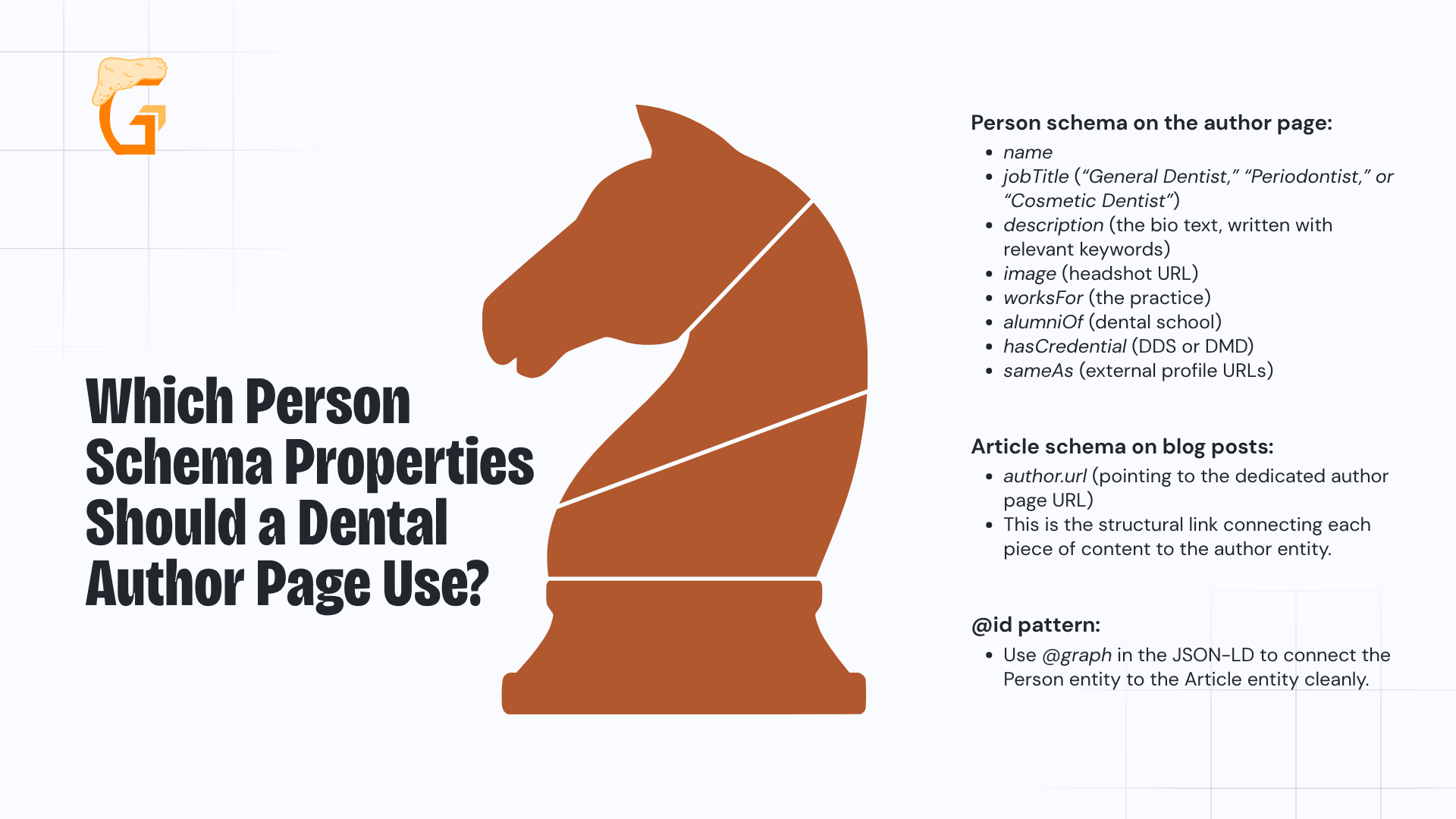
The key Article structured data properties to implement:

  • Person schema on the author page:
    • name
    • jobTitle (“General Dentist,” “Periodontist,” or “Cosmetic Dentist”)
    • description (the bio text, written with relevant keywords)
    • image (headshot URL)
    • worksFor (the practice)
    • alumniOf (dental school)
    • hasCredential (DDS or DMD)
    • sameAs (external profile URLs)
  • Article schema on blog posts:
    • author.url (pointing to the dedicated author page URL)
    • This is the structural link connecting each piece of content to the author entity.
  • @id pattern:
    • Use @graph in the JSON-LD to connect the Person entity to the Article entity cleanly.

Google’s explicit rule:

  • author.name should contain only the author’s name.
  • Do not embed credentials in the name field (“Dr. Jane Smith, DDS” in the name property is incorrect).

Validate the implementation with Google’s Rich Results Test and monitor it in Google Search Console before publishing.

How Do sameAs Links and Avoiding Common Mistakes Strengthen the Author Entity?

The sameAs property is where external entity signals connect.

It tells Google: “this on-site author is the same person as this LinkedIn profile, this listing in local directories, and this state board record.”

Target sameAs links for every dental author:

  • LinkedIn profile URL
  • ADA member directory profile
  • State dental board licensing record
  • Any published work in dental journals, local news outlets, or national publications

Common mistakes that weaken the author entity (and how to avoid them):

  • Missing image:
    • The image property is how Google connects a name to a real person.
    • Omitting it leaves the entity incomplete.
  • No URL in the author property:
    • Article schema without author.url breaks the link between content and author entity.
  • Credentials in the name field:
    • Google’s documentation explicitly prohibits embedding credentials in author.name.
    • Put them in jobTitle and hasCredential instead.

Google uses these cross-references to confirm the on-site author matches a real-world professional.

The schema setup is one-time work (implement it once across the author page and article template, and every future post inherits the entity connection automatically).

Growth Saloon helps dental practices build the kind of digital presence that consistently generates qualified new patient inquiries – not just clicks.

Contact our team today to find out how our dental marketing services can lower your cost per new patient and grow your practice.

How Can Growth Saloon Help Your Dental Practice Grow?

Growth Saloon is a Chicago-based digital marketing agency built to help dental practices attract more patients and grow their organic traffic through performance-driven digital marketing.

Mike Lowe and the Growth Saloon team specialize in search engine optimization, web design, conversion rate optimization, and marketing attribution – working alongside your practice to build a measurable digital presence that generates qualified patient inquiries, not just website traffic.

From climbing local search rankings for high-intent terms to converting site visitors into booked appointments, Growth Saloon focuses on targeted traffic and results at every stage of the patient acquisition funnel.

Practice owners and marketing managers get clear visibility, through tools like Google Analytics, into exactly which channels are driving new patient growth.

We know that every open appointment slot has a real cost.

Every decision we make is built around one outcome – helping your practice fill more of them.

Meet the Founder of Growth Saloon

Meet the founder and lead strategist at Growth Saloon – Mike Lowe:

  • As founder and CEO of Growth Saloon, Mike brings years of hands-on experience improving local search results through SEO strategy, CRO, web design, and marketing attribution for service-based businesses.
  • Based in Chicago and working with practices across the country, Mike has built digital growth campaigns that connect businesses with nearby patients in some of the most contested search markets in the country.
  • Growth Saloon’s data-driven approach to local SEO helps dental practices attract local patients and turn their websites into their highest-performing new patient channel.

What Does Working With Growth Saloon Look Like?

Growth Saloon operates as a dedicated extension of your marketing team for dental clients – not a vendor that disappears after onboarding.

Every engagement includes direct access to Mike and the team, transparent reporting tied to actual patient acquisition outcomes, and strategies tailored to your local search visibility and specific services.

Whether you’re looking to rank for high-value procedures, improve your site’s appointment conversion rate, or finally get clarity on where your new patients are actually coming from, Growth Saloon builds the marketing strategy and does the work.

Growth Saloon helps dental practices build the kind of digital presence that consistently generates qualified new patient inquiries – not just clicks.

Contact our team today to find out how our dental marketing services can lower your cost per new patient and grow your practice.

FAQ
Author

Who is Mike Lowe?

Mike Lowe is a digital marketing strategist and the founder of Growth Saloon, where he specializes in helping businesses cut through the noise with high-converting email strategies and SEO.

With a focus on “organic storytelling,” Mike combines over a decade of agency experience with a passion for helping brands build genuine trust with their audience.

When he’s not optimizing subject lines or scaling SaaS companies, he’s likely sharing insights on how to transform cluttered inboxes into meaningful connection points for online marketers.

Related content
Resources for Dentists

Every resource we’ve published for Dentists, in one place:

Ready to turn your website traffic into real growth?

You’ve read the strategy now let Growth Saloon help you put it into action.

Get a free SEO audit and see what’s holding your website back from ranking, converting, and growing. 

Let's Chat

Let’s discuss your online marketing goals! We’re quick to respond, so we’ll be in touch shortly to set up a time to chat.