

Key takeaways
- Orthodontist SEO competes against both other orthodontists and general dentists offering Invisalign, so ranking for braces and aligner terms that represent years of treatment revenue is a practice-economics decision.
- Start with the Gocogle Business Profile and map pack, where reviews, booking links, and accurate categories drive the local visibility patients see first, and a review request system can show results in 60 to 90 days.
- Build a keyword strategy around braces, Invisalign, and cost-intent searches on dedicated service pages, then expect 3 to 6 months for early movement and 6 to 12 months before organic becomes a primary patient channel.
Why Is Orthodontist SEO a Different Challenge Than Most Local Marketing?
Search engine optimization (SEO) for orthodontists sits in one of the most competitive corners of dental search.
You’re not just ranking against other orthodontists, but against general dentists offering Invisalign who are targeting the same high-intent searches your practice depends on.
If your website isn’t showing up when families search “braces near me” or “Invisalign [city],” those potential patients aren’t calling around – they’re booking with whoever appears at the top of the page.
The challenge goes deeper than just getting on page one.
Orthodontic treatment represents months of care and thousands of dollars per patient, which means every search query your practice misses has a real dollar value attached to it.
The practices that win in organic search do so by building specialist authority (credentials, case depth, and local signals) that general dentists running one Invisalign page simply can’t replicate, and that authority is what turns visibility into qualified traffic.
Growth Saloon helps dental practices build the kind of digital presence that consistently generates qualified new patient inquiries – not just clicks.
Contact our team today to find out how our dental marketing services can lower your cost per new patient and grow your practice.
What Makes Orthodontist SEO Different from General Dental SEO
Orthodontist SEO focuses on a narrow set of high-intent specialty terms (braces, Invisalign, clear aligners, and malocclusion treatments), rather than the broad service mix of a general dental practice.
An orthodontist competes with both other orthodontists and general dentists offering limited aligner treatment, which requires explicit specialty positioning and case-depth content about orthodontic services that generalists can’t match.
How Is Orthodontist SEO Different from General Dental SEO?
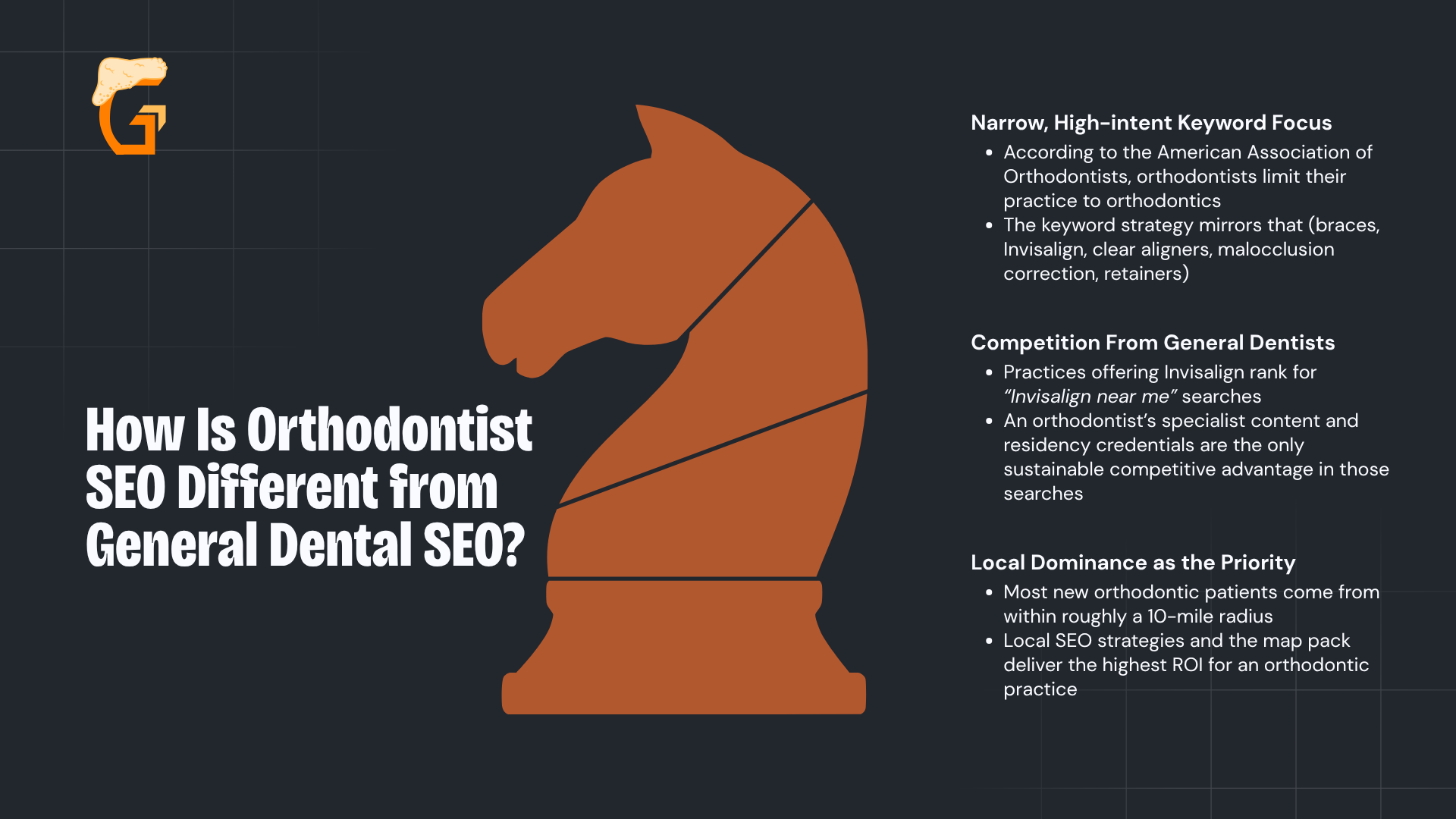
General dental practices target a wide set of relevant keywords (cleanings, fillings, implants, cosmetic work, pediatric dentistry).
An orthodontic practice targets a narrow specialty set, and that focus changes how the site is built and how campaigns are run:
- Narrow, high-intent keyword focus:
- According to the American Association of Orthodontists, orthodontists limit their practice to orthodontics.
- The keyword strategy mirrors that (braces, Invisalign, clear aligners, malocclusion correction, retainers).
- Competition from general dentists:
- Practices offering Invisalign rank for “Invisalign near me” searches.
- An orthodontist’s specialist content and residency credentials are the only sustainable competitive advantage in those searches.
- Local dominance as the priority:
- Most new orthodontic patients come from within roughly a 10-mile radius (local SEO strategies and the map pack deliver the highest ROI for an orthodontic practice)
Realistic timeline:
- 3–6 months for early ranking movement
- 6–12 months before organic search traffic becomes a primary new-patient channel
Why Do Orthodontist Credentials Matter More Under Google’s YMYL Standards?
Orthodontic treatment affects health outcomes (bite correction, jaw development, airway function).
Google evaluates orthodontist websites under its YMYL (Your Money or Your Life) quality standards, which apply higher scrutiny to healthcare content:
- Board-certified orthodontists have completed two to three years of residency training beyond dental school, focused specifically on diagnosis and correction of misaligned teeth and jaws (a clinical credential depth no general dentist offering limited Invisalign can match)
- E-E-A-T differentiator: that specialist training (plus complex case volume) should appear in author bios on treatment focused content, on treatment pages, in before/after case examples (not just buried in an About page)
Specialist credentials are the one signal a general dentist cannot replicate, and they help search engines understand the clinical authority behind the practice.
They belong throughout the site, on every page where clinical authority is relevant.
Local SEO for Orthodontists: Google Business Profile and the Map Pack
For orthodontists, local SEO is the highest-impact channel for improving local search rankings.
The Google Business Profile drives the majority of new patient calls from organic search and anchors the orthodontic practice online.
Optimizing the GBP with the correct primary category (Orthodontist), a complete service list, regular photo uploads, and a consistent review acquisition and reputation management strategy is the single most productive SEO investment for a local practice.
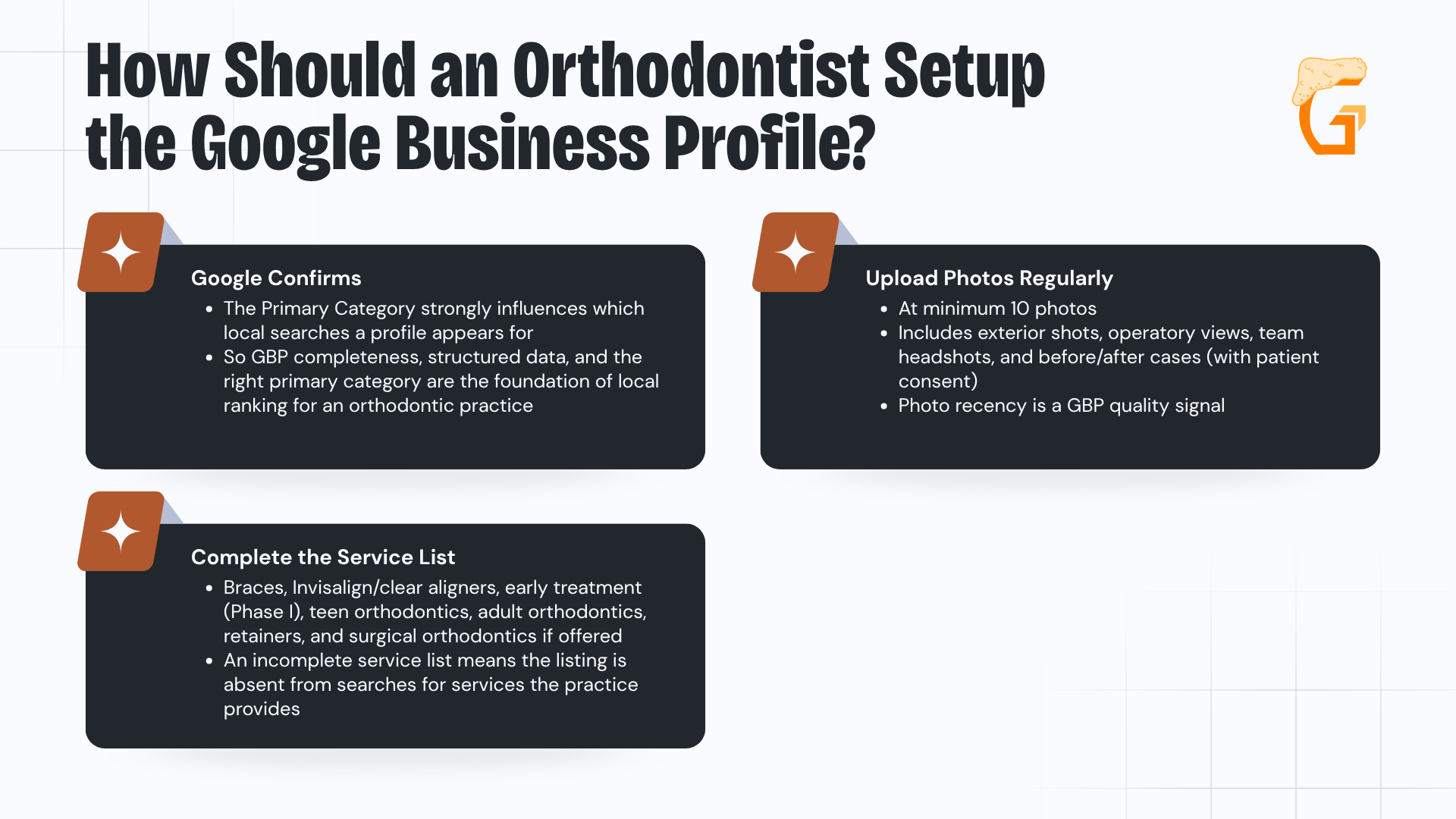
How Should an Orthodontist Set up the Google Business Profile?

The primary category setting is the single most consequential GBP configuration choice.
Setting it to “Orthodontist” (not “Dentist” or “Dental clinic”) determines which orthodontic searches the practice appears in:
- Google confirms the primary category strongly influences which local searches a profile appears for, so GBP completeness, structured data, and the right primary category are the foundation of local ranking for an orthodontic practice
- Complete the service list: braces, Invisalign/clear aligners, early treatment (Phase I), teen orthodontics, adult orthodontics, retainers, and surgical orthodontics if offered (an incomplete service list means the listing is absent from searches for services the practice provides)
- Upload photos regularly: at minimum 10 photos including exterior shots, operatory views, team headshots, and before/after cases with patient consent; photo recency is a GBP quality signal
For “orthodontist near me” searches, the top three GBP listings in the local search results map pack capture the overwhelming majority of clicks.
A complete, accurate profile is the prerequisite for appearing in that set.
How Do Reviews, Booking Links, and Multiple Locations Affect Map Pack Ranking?
A review acquisition process at peak satisfaction moments (deband day, the end of an initial consult, any high-satisfaction interaction) via text link is the most efficient way to build consistent online reviews velocity:
- Respond to every review: positive reviews and your responses reinforce the public trust signal; professional, empathetic responses to negative reviews demonstrate accountability (both are visible to patients considering the practice)
- Add a booking link and enable GBP messaging: patients who can book or message directly from the listing convert at higher rates than those who must find a phone number or click through to a website
- Multi-location practices: each physical office needs its own verified GBP, dedicated local citations, and a dedicated local landing page (sharing one listing across two or more locations dilutes map pack performance for each)
Growth Saloon optimizes an orthodontic practice’s Google Business Profile and map pack presence to drive qualified new patient inquiries – not just clicks.
Contact our team today to find out how our dental marketing services can lower your cost per new patient and grow your practice.
Orthodontist Keyword Strategy: Braces, Invisalign, and Cost-Intent Searches
Orthodontist keyword research covers three buckets:
- Location-intent searches (“orthodontist [city]”, “braces near me”);
- Treatment-comparison searches (“Invisalign vs braces”, “ceramic vs metal braces”); and
- Cost-intent searches (“braces cost [city]”, “Invisalign cost with insurance”).
Cost-intent keywords convert at high rates (often more efficiently than paid ads) because patients searching cost are close to booking.
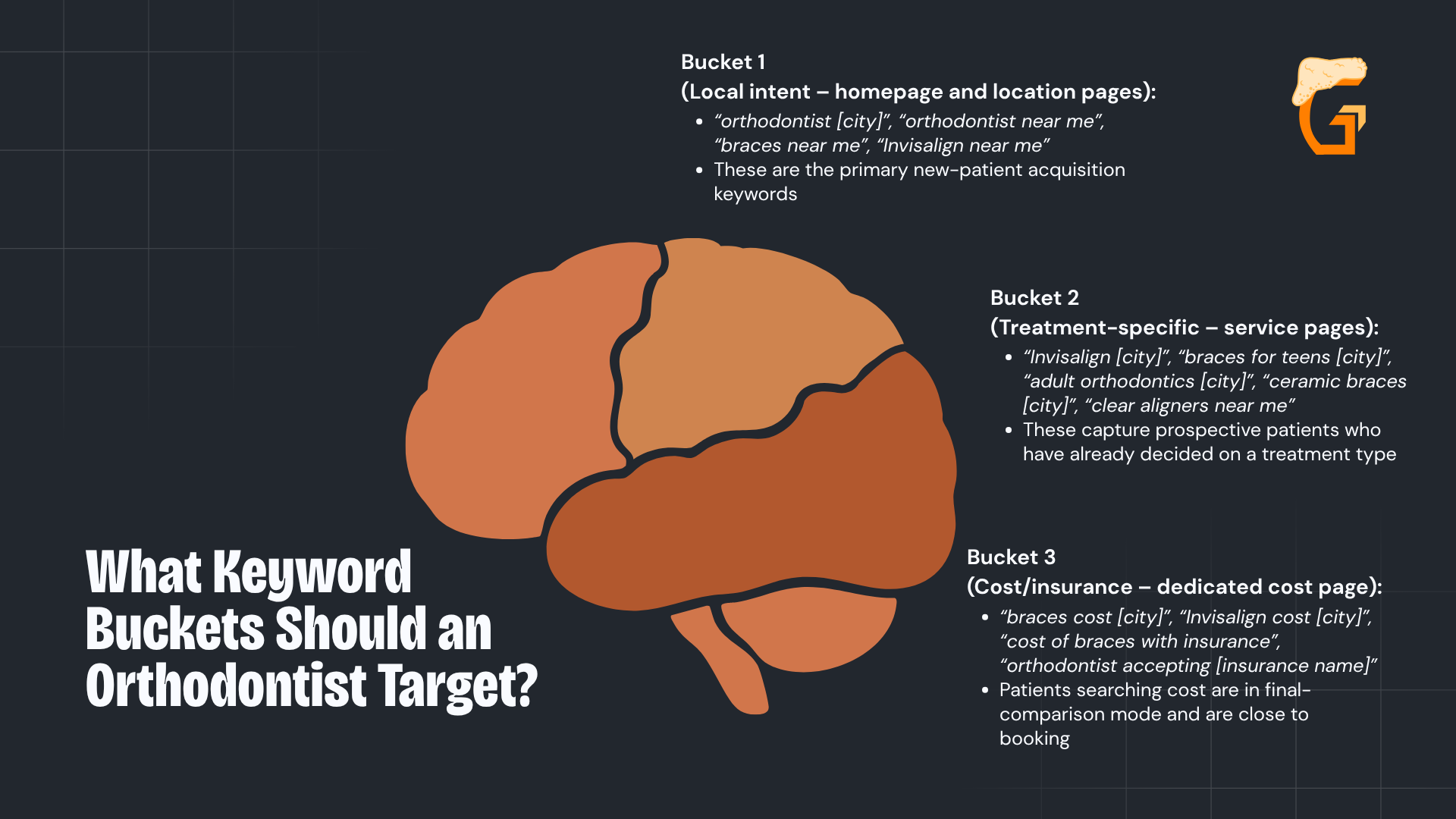
What Keyword Buckets Should an Orthodontist Target?

The three-bucket model is framed around search intent.
Most orthodontic practices optimize for the first bucket only and leave the highest-converting bucket entirely uncovered:
- Bucket 1 (local intent – homepage and location pages): “orthodontist [city]”, “orthodontist near me”, “braces near me”, “Invisalign near me” (the primary new-patient acquisition keywords)
- Bucket 2 (treatment-specific – service pages): “Invisalign [city]”, “braces for teens [city]”, “adult orthodontics [city]”, “ceramic braces [city]”, “clear aligners near me” (capture prospective patients who have already decided on a treatment type)
- Bucket 3 (cost/insurance – dedicated cost page): “braces cost [city]”, “Invisalign cost [city]”, “cost of braces with insurance”, “orthodontist accepting [insurance name]” (patients searching cost are in final-comparison mode – they are close to booking)
The cost bucket is the highest-converting group most orthodontist sites ignore entirely.
How Should Keywords Be Mapped One per Page?
Each page targets one primary keyword (this prevents pages from competing with each other for the same term):
- Homepage: targeting local keywords like “orthodontist [city]”
- Braces page: “braces [city]”
- Invisalign page: “Invisalign [city]”
- Cost page: “braces cost [city]” or “Invisalign cost [city]”
On page placement, the primary keyword appears in the:
- Title tag;
- H1;
- First 100 words;
- URL slug (/braces-city-name/); and
- Meta description.
No keyword stuffing (natural on page SEO placement in each location is sufficient).
Mapping one keyword per page is the on page optimization step that prevents keyword cannibalization, where two pages target the same term and split the ranking potential between them.
Growth Saloon builds the braces, Invisalign, and cost pages that rank for high-intent searches and convert into qualified new patient inquiries – not just clicks.
Contact our team today to find out how our dental marketing services can lower your cost per new patient and grow your practice.
How’s your SEO going?
Enter your website URL below to get a free comprehensive SEO audit.
The audit includes:
- A scan of your entire website for technical issues
- A list of your top opportunities to target immediately
- Your highest priority fixes to make
Orthodontist Website Content: Service Pages That Rank and Convert
The highest-impact orthodontist content pages are the braces page, the Invisalign page, and the cost/financing page.
Each should cover the treatment in depth (process, timeline, candidacy, cost ranges, and FAQ) not just a promotional overview.
Educational content marketing (Invisalign vs braces, care guides, cost explainers) ranks for informational keywords and funnels visitors to conversion pages.
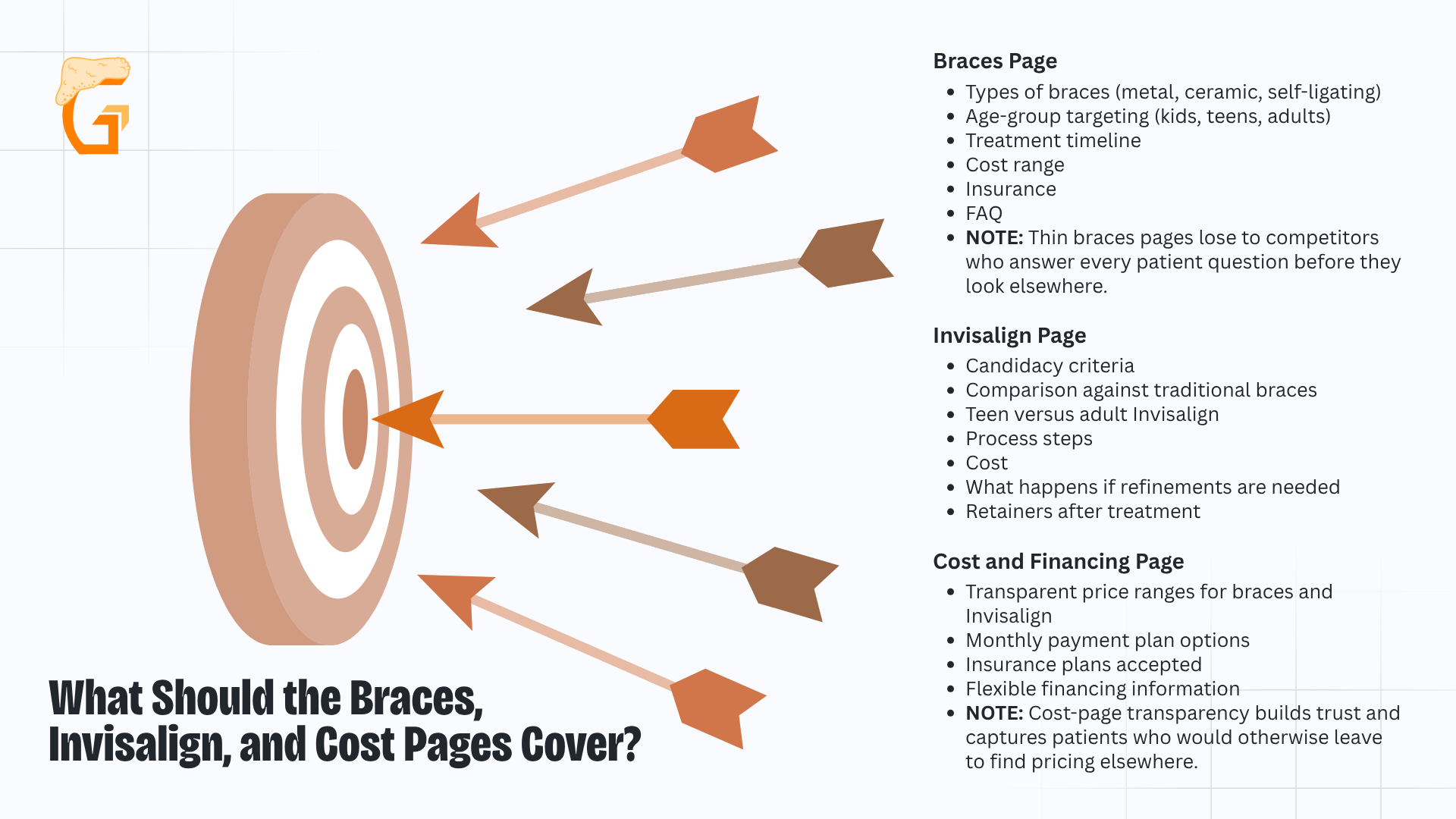
What Should the Braces, Invisalign, and Cost Pages Cover?

Comprehensive treatment pages outrank thin promotional overviews for competitive orthodontic searches.
A page under 600 words covering any of these three treatments is the highest-leverage page to expand:
- Braces page: types of braces (metal, ceramic, self-ligating), age-group targeting (kids, teens, adults), treatment timeline, cost range, insurance, and FAQ; thin braces pages lose to competitors who answer every patient question before they look elsewhere
- Invisalign page: candidacy criteria, comparison against traditional braces, teen versus adult Invisalign, process steps, cost, what happens if refinements are needed, and retainers after treatment
- Cost and financing page: transparent price ranges for braces and Invisalign, monthly payment plan options, insurance plans accepted, and flexible financing information (cost-page transparency builds trust and captures patients who would otherwise leave to find pricing elsewhere)
Any of the three pages under 600 words is the highest-leverage content expansion available to an orthodontic practice.
How Do Blog Content and Technical SEO Support the Service Pages?
Educational blog posts rank for informational queries (including broad oral health topics) and move visitors toward the conversion pages via internal links:
- Blog topics: Each post includes an internal link to the relevant service page.
- “Invisalign vs braces – which is better for adults”
- “How long do braces take”
- “Best age for orthodontic treatment”
- “Foods to avoid with braces”
- “How to clean aligners”
- Technical requirements:
- Page load under 3 seconds on mobile;
- Mobile optimization with responsive design;
- HTTPS;
- LocalBusiness/Orthodontist schema markup on the homepage and key pages; and
- Sitemap submitted to Google Search Console.
Blog posts capture informational searchers at the top of the funnel.
Technical health and up to date schema make the whole site machine-readable, indexable, and fast enough to compete.
Growth Saloon builds the reviews, links, and technical foundation that turn an orthodontic site into qualified new patient inquiries – not just clicks.
Contact our team today to find out how our dental marketing services can lower your cost per new patient and grow your practice.
Authority Building: Reviews, Backlinks, and Off-Site Trust Signals
A strong online presence and off-site authority for orthodontists come from three (3) sources:
- Google review volume and recency;
- Directory listings on health platforms (Healthgrades, Zocdoc, AAO member directory); and
- Local backlinks from community organizations, local news, and school partnerships.
Reviews are the highest-ROI authority action and a leading driver of SEO success because they directly influence map pack rankings and patient decisions simultaneously.
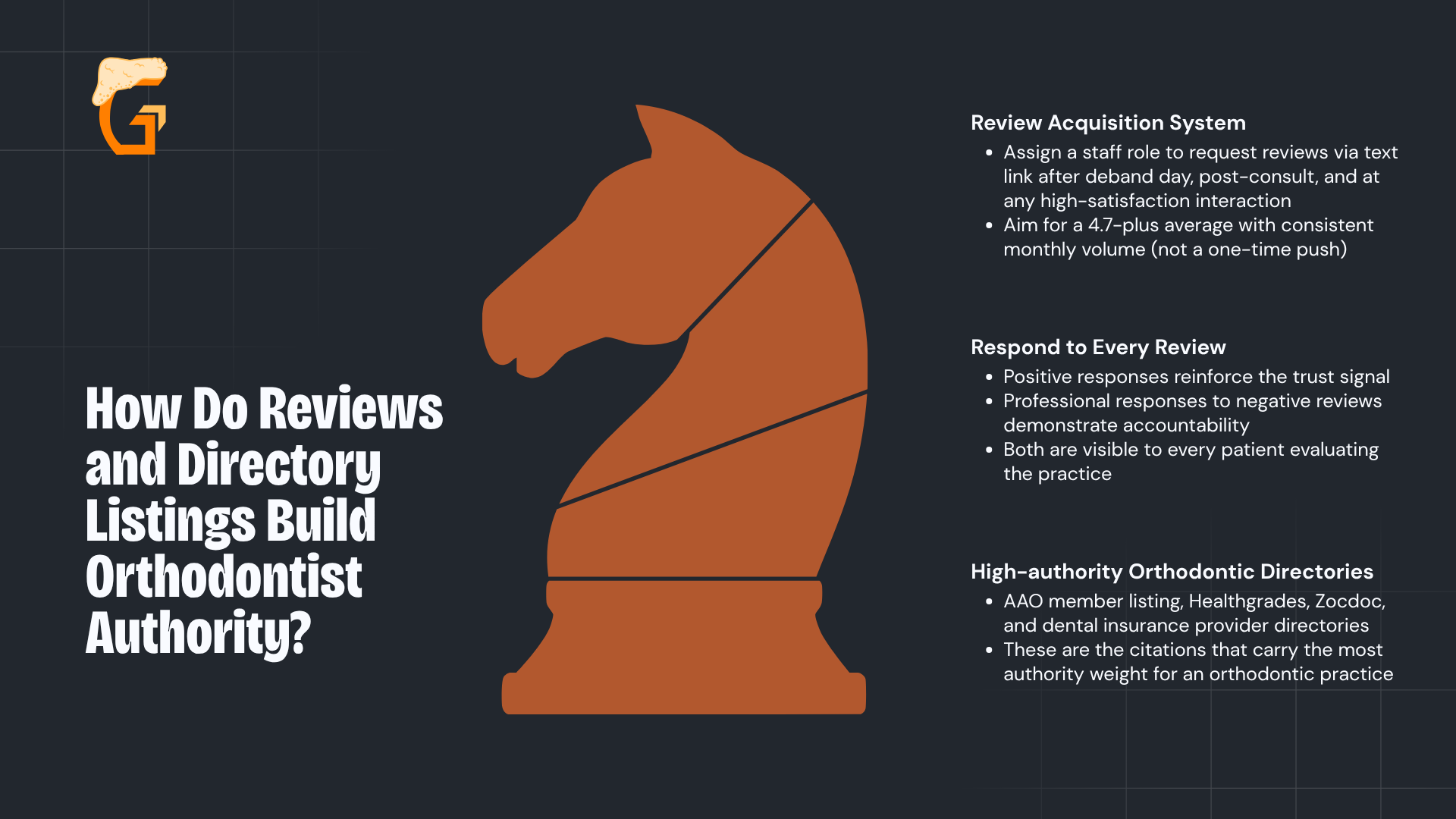
How Do Reviews and Directory Listings Build Orthodontist Authority?

Unlike backlinks (which can take months to build and index) a review request system can show results from your SEO efforts in 60–90 days:
- Review acquisition system:
- Assign a staff role to request reviews via text link after deband day, post-consult, and at any high-satisfaction interaction.
- Aim for a 4.7-plus average with consistent monthly volume, not a one-time push.
- Respond to every review:
- Positive responses reinforce the trust signal.
- Professional responses to negative reviews demonstrate accountability (both are visible to every patient evaluating the practice).
- High-authority orthodontic directories:
- AAO member listing, Healthgrades, Zocdoc, and dental insurance provider directories
- These are the citations that carry the most authority weight for an orthodontic practice.
Reviews compound over time, steadily lifting SEO rankings.
A competitor adding 10 reviews per month while a practice adds none is building an advantage that takes months to close.
How Do Local Backlinks and NAP Consistency Strengthen Citations?
Local backlinks build relevance in the specific market a practice serves, much like they do for other local businesses:
- Sponsor local school sports teams or events for a website link from the school or organization’s site
- Contribute to local news health stories about orthodontic treatment or children’s health (a mention and link from a local news source carries local authority)
- Partner with pediatric dentists for referral and cross-link arrangements; these marketing efforts build both patient volume and domain authority
NAP consistency (practice name, address, and phone number character-for-character identical across the GBP, website, and all directories) is the prerequisite for citations to add up as authority and for improving search rankings.
Discrepancies create conflicting entity signals that prevent citations from compounding.
Growth Saloon helps orthodontic practices build the kind of digital presence that consistently generates qualified new patient inquiries – not just clicks.
Contact our team today to find out how our dental marketing services can lower your cost per new patient and grow your practice.
How Can Growth Saloon Help Your Dental Practice Grow?
Growth Saloon is a Chicago-based digital marketing agency built to help dental practices attract more patients and grow their practice through performance-driven digital marketing.
Mike Lowe and the Growth Saloon team specialize in orthodontist marketing, SEO, web design, conversion rate optimization, and marketing attribution – working alongside your practice to build a measurable digital presence that generates qualified patient inquiries, not just website traffic.
From ranking for high-intent local search terms to converting site visitors into booked appointments, a strong SEO strategy focuses on results at every stage of the patient acquisition funnel.
Practice owners and marketing managers get clear visibility through Google Analytics into exactly which channels are driving new patient growth.
We know that every open appointment slot has a real cost.
Every decision we make is built around one outcome – helping your practice fill more of them.
Meet the Founder of Growth Saloon
Meet the founder and lead strategist at Growth Saloon – Mike Lowe:
- As founder and CEO of Growth Saloon, Mike brings years of hands-on experience in SEO strategy, SEO trends, CRO, web design, and marketing attribution for service-based businesses competing in local and regional markets.
- Based in Chicago and working with practices across the country, Mike has built and managed digital growth campaigns for businesses competing in some of the most contested search markets in the country.
- Growth Saloon’s data-driven approach to effective orthodontic SEO and patient acquisition helps dental practices turn their websites into their highest-performing new patient channel.
What Does Working With Growth Saloon Look Like?
Growth Saloon operates as a dedicated extension of your marketing team, building effective SEO strategies rather than disappearing after onboarding.
Every engagement includes direct access to Mike and the team, transparent reporting tied to actual patient acquisition outcomes, and orthodontist SEO services tailored to your specific services and local market.
Whether you’re looking to rank for high-value procedures, improve your site’s appointment conversion rate, or finally get clarity on where your new patients are actually coming from, Growth Saloon ranks among the top orthodontist SEO agencies that build the strategy and do the work.
Growth Saloon helps dental practices build the kind of digital presence that consistently generates qualified new patient inquiries – not just clicks.
Contact our team today to find out how our dental marketing services can lower your cost per new patient and grow your practice.
How's your SEO going?
Get your free comprehensive SEO audit.
Enter your website URL below to get a free comprehensive SEO audit.
- Scan entire website for technical issues
- Get a list of your top opportunities
- See your highest priority fixes to make
-
Expect early ranking movement at three to six months and meaningful new patient flow from organic search at six to twelve months.
The first ninety days are foundation work (technical site fixes, Google Business Profile optimization, optional paid advertising, and building baseline rankings for your primary location terms).
Practices in lower-competition markets may see search engine results faster; practices in dense metro areas with multiple established competitors should plan for a longer runway, or supplement with Google Ads, before organic search becomes a primary acquisition channel.
-
Yes, Invisalign deserves its own dedicated landing page and keyword strategy rather than being lumped into a general services page.
Patients actively searching “Invisalign near me” or “Invisalign [city]” have high purchase intent and are often comparing providers.
A dedicated Invisalign page targeting those terms with candidacy criteria, before/after results, cost ranges, and a clear call to action outperforms a practice that lists Invisalign as one bullet point on a services overview.
-
Compete on depth and credentials.
A general dentist offering Invisalign typically has a thin Invisalign page targeting a broad keyword.
An orthodontist can publish a comprehensive page covering complex cases, adult versus teen Invisalign, refinements, retainers, and the specialist advantage (all backed by a board-certified orthodontist’s credentials and before/after case library).
Google’s quality evaluation favors demonstrated expertise on healthcare topics, and an orthodontist’s specialist training is a content and trust advantage a general dentist cannot replicate.
-
The primary category.
Setting the primary category to “Orthodontist” rather than “Dentist” or “Dental clinic” is the single highest-impact GBP change for an orthodontic practice.
Google uses the primary category to determine which local searches your listing is eligible to appear in.
An orthodontist listed as a generic dentist will miss the map pack and lose organic traffic for “orthodontist near me” searches (the highest-value query for a specialty practice).
-
They help, both SEO and conversions.
Patients searching “braces cost [city]” or “Invisalign cost with insurance” are close to booking and doing final comparison research.
A practice that answers the cost question directly (with typical price ranges, financing options, and insurance guidance) builds trust and captures patients who would otherwise leave to find the answer elsewhere.
Practices that hide pricing do not rank well for cost-intent searches and miss high-intent traffic.
-
Review count alone does not determine map pack placement (proximity, GBP completeness, and website relevance all factor in).
That said, in most markets the top three orthodontist map pack results have 50 or more reviews with a 4.6-plus average.
Volume, recency, and specificity matter:
- Patient reviews mentioning specific treatments (eg. “my daughter’s braces were done by Dr. [Name]”) carry more authenticity signal than a string of undetailed five-star ratings.
Most agencies sell traffic. We sell actual growth. That’s the Growth Saloon difference.
Are you looking to grow?
Recent blogs
Enter your website URL below to get free comprehensive SEO audit.
- Scan entire website for technical issues
- Get a list of your top opportunities
- See your highest priority fixes to make